
Building Thermal Insulation Market- Industry Structure Evaluation, Demand Drivers Analysis, Regional Growth Analysis and Identification, Competitive Positioning Review & Global Market Size Forecast to 2032
Overview
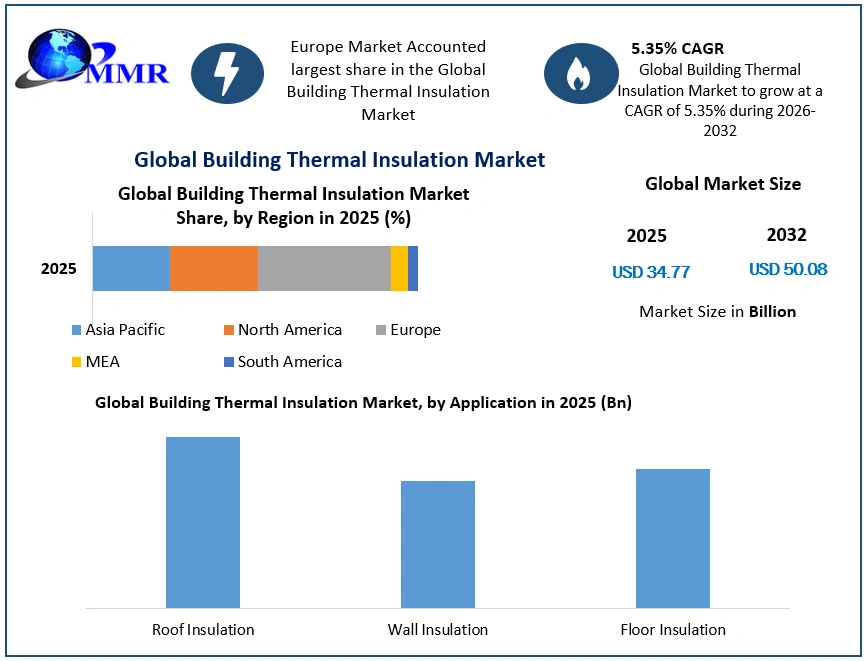
The Building Thermal Insulation Market size was valued at USD 34.77 Billion in 2025 and the total Building Thermal Insulation revenue is expected to grow at a CAGR of 5.35% from 2026 to 2032, reaching nearly USD 50.08 Billion by 2032.
Building Thermal Insulation Market Overview:
Building Thermal Insulation Market is expected to reach US$ 42.84 Bn. Thermal insulation often refers to the use of suitable insulation materials and design modifications for buildings to prevent heat gain and loss by slowing the transmission of heat through the enclosure. The temperature difference between indoors and outdoors is what causes heat to transfer. This report focuses on the different segments of the Building Thermal Insulation market (Product, Application, Building Type, and Region). In this report, the top industry participants and regions are in-depthly investigated (North America, Asia Pacific, Europe, Middle East & Africa, and South America). It is an in-depth analysis of the several sectors' fast advancements in the modern era. The primary data analysis from 2020 to 2025 is highlighted through numbers, visualisations, and presentations. The market drivers, restraints, opportunities, and challenges for Building Thermal Insulation are examined in this report. The MMR report's investment suggestions are based on a thorough examination of the current competitive environment in the Building Thermal Insulation market.
To know about the Research Methodology :- Request Free Sample Report
Building Thermal Insulation Market Dynamics:
The Building Thermal Insulation Market growth is expected to be driven by growing household and commercial application of the product to lower total energy costs and rising awareness of energy saving.
Favorable laws because they place a strong emphasis on reducing overall energy use are probably a key factor driving the market. Thermal insulation contributes to a decrease in the need for heating, ventilation, and air conditioning (HVAC), which in turn lowers overall energy consumption and is anticipated to help the economy thrive.
North America largest share is expected to come from the United States. The Weatherization Assistance Program (WAP), which focuses on widespread product adoption in low-income homes, is only one of the programmes that are expected to play a significant role in driving growth.
The adoption of energy certification organisations like the U.S. Green Building Council (USGBC) and Leadership in Energy and Environmental Design (LEED) in addition to favourable building codes in the U.S. and Canada are expected to have a positive effect on the demand for building thermal insulation. But because foamed plastics have a limited biodegradability and are carcinogenic, the United States Environmental Protection Agency (EPA) has set strict rules on their use that is expected to hinder market growth.
During the forecast period, the market focus is expected to turn to the creation of environmentally friendly goods due to the influence insulation materials have on the environment. In addition, it is expected that rising plastic foam prices hinder the market growth, driving the creation of substitute goods.
The strict restrictions governing traditional goods like plastic foams are making recyclable insulation more and more attractive. Due to rising environmental consciousness, consumers, businesses, and architects are likely to show an increased preference for green, biodegradable, and recyclable products over the forecast period.
Building Thermal Insulation Market Segment Analysis:
The Building Thermal Insulation Market is segmented by Product, Application, and Building Type.
Based on the Product, the market is segmented into Glass Wool, Mineral Wool, EPS, XPS, and Others. EPS (Expanded Polystyrene) segment is expected to hold the largest market share of xx% by 2032. This is due to its long lifespan and outstanding thermal insulation capabilities. Additionally, rising consumer demand for the product as a result of its non-toxic, rot-proof, and recyclable qualities is expected to boost growth. Because of its resistance to water, ability to offer energy savings, and capacity to lessen damages caused by moisture. Additionally, it is expected that growth will be aided by its capacity to prevent microbial or fungal growth in the insulated region.
Mineral Wool segment is expected to grow rapidly at a CAGR of xx% during the forecast period 2026-2032. This is due to the product's exceptional qualities, which include dimensional stability, fire safety, an effective heat barrier, and compatibility with the environment. During the forecast period, rising demand for mineral wool in thermal barrier applications is expected to boost its growth.
Based on the Application, the market is segmented into Roof Insulation, Wall Insulation, and Floor Insulation. Roof Insulation segment is expected to grow rapidly at a CAGR of xx% during the forecast period 2026-2032. Because there is a growing need to prevent heat from the sun's rays from entering through the roof. Additionally, during the forecast period, an increase in single-family homes is expected to drive market growth.
Wall Insulation segment is expected to grow rapidly at a CAGR of xx% during the forecast period 2026-2032. This is because more people are using the product on both interior and exterior walls. Additionally, it is expected that increased product penetration for cavity wall insulation will support market growth.
Building Thermal Insulation Market Regional Insights:
Europe region is expected to dominate the Building Thermal Insulation Market during the forecast period 2026-2032. Europe region is expected to hold the largest market share of xx% by 2032. The European Commission and the Registration, Evaluation, Authorisation, and Restriction of Chemicals (REACH) initiative to encourage thermal insulation as an energy-saving measure is expected to boost regional market growth.
North America region is expected to grow rapidly at a CAGR of xx% during the forecast period 2026-2032. The North American market growth is expected to be driven by the booming residential and commercial construction industries in North America as well as the strong green building regulations that have been implemented to lower the energy consumption per structure. Additionally, favourable government rules for the use of the product in both residential and commercial structures are expected to drive growth during the forecast period.
Asia Pacific region is expected to grow rapidly at a CAGR of xx% during the forecast period 2026-2032. This is due to the increased building work being done in the region to meet the needs of an increasing population. Due to numerous government measures to develop its public infrastructure, China is expected to account for the largest share in the Asia Pacific region.
The objective of the report is to present a comprehensive analysis of the Global Building Thermal Insulation Market to the stakeholders in the industry. The past and current status of the industry with the forecasted market size and trends are presented in the report with the analysis of complicated data in simple language. The report covers all the aspects of the industry with a dedicated study of key players that include market leaders, followers, and new entrants.
PORTER, PESTEL analysis with the potential impact of micro-economic factors of the market has been presented in the report. External as well as internal factors that are supposed to affect the business positively or negatively have been analyzed, which will give a clear futuristic view of the industry to the decision-makers.
The reports also help in understanding the Global Market dynamic and structure by analyzing the market segments and projecting the Global Market size. Clear representation of competitive analysis of key players by Distribution Channel, price, financial position, product portfolio, growth strategies, and regional presence in the Building Thermal Insulation Market make the report investor’s guide.
Building Thermal Insulation Market Scope: Inquire before buying
| Global Building Thermal Insulation Market | |||
|---|---|---|---|
| Report Coverage | Details | ||
| Base Year: | 2025 | Forecast Period: | 2025-2032 |
| Historical Data: | 2020 to 2025 | Market Size in 2025: | USD 34.77 Billion. |
| Forecast Period 2026 to 2032 CAGR: | 5.35% | Market Size in 2032: | USD 50.08 Billion. |
| Segments Covered: | by Material | Glass Wool Mineral Wool EPS XPS Cellulose PIR PUR Others |
|
| by Application | Roof Insulation Wall Insulation Floor Insulation |
||
| by End-Use | Residential Commercial |
||
Building Thermal Insulation Market, by Region
North America (United States, Canada and Mexico)
Europe (UK, France, Germany, Italy, Spain, Sweden, Austria and the Rest of Europe)
Asia Pacific (China, South Korea, Japan, India, Australia, Indonesia, Malaysia, Vietnam, Taiwan, Bangladesh, Pakistan and the Rest of APAC)
South America (Brazil, Argentina Rest of South America)
Middle East & Africa (South Africa, GCC, Egypt, Nigeria and the Rest of ME&A)
Building Thermal Insulation Market, Key Players are
1. Johns Manville Corporation (US)
2. Saint-Gobain S.A. (France)
3. BASF SE (Germany)
4. Kingspan Group plc (Ireland)
5. Knauf Insulation, Inc. (US)
6. Owens Corning (US)
7. Huntsman Corporation (US)
8. Rockwool International A/S (Denmark)
9. Firestone Building Products Company (US)
10. Cabot Corporation (US)
11. Dow Corning Corporation (US)
12. Covestro AG (Germany)
13. URSA Insulation, S.A. (Spain)
14. Paroc Group Oy (Finland)
15. Atlas Roofing Corporation (US))
Frequently Asked Questions:
1] Which region is expected to hold the highest share in the Building Thermal Insulation Market?
Ans. Europe region is expected to hold the highest share in the Building Thermal Insulation Market.
2] Who are the top key players in the Building Thermal Insulation Market?
Ans. Johns Manville Corporation (US), Saint-Gobain S.A. (France), BASF SE (Germany), Kingspan Group plc (Ireland), Knauf Insulation, Inc. (US), Owens Corning (US), and Huntsman Corporation (US) are the top key players in the Building Thermal Insulation Market.
3] Which segment is expected to hold the largest market share in the Building Thermal Insulation Market by 2032?
Ans. EPS (Expanded Polystyrene) segment is expected to hold the largest market share in the Building Thermal Insulation Market by 2032.
4] What is the market size of the Building Thermal Insulation Market by 2032?
Ans. The market size of the Building Thermal Insulation Market is expected to reach USD 50.08 Bn. by 2032.
5] What was the Building Thermal Insulation Market size in 2025?
Ans: The Building Thermal Insulation Market size was USD 34.77 Billion in 2025.