
Blockchain Insurance Market Size – Industry Structure Evaluation, Demand Drivers Analysis, Regional Growth Analysis and Identification, Competitive Positioning Review & Global Market Size Forecast to 2032
Overview
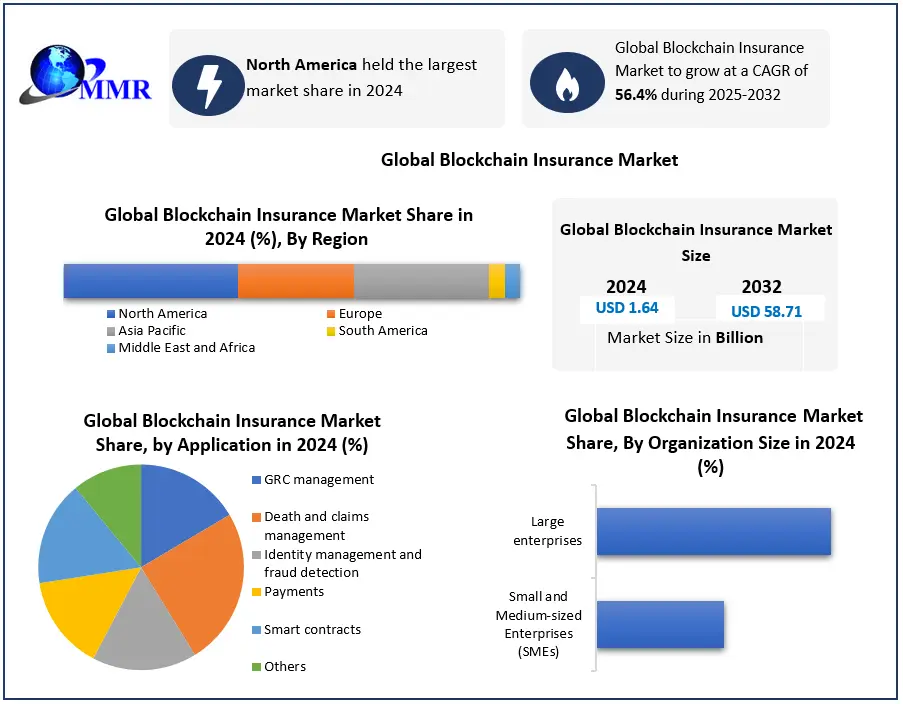
Blockchain Insurance Market size was valued at USD 1.64 Bn. in 2024, and the total Global Blockchain Insurance Market revenue is expected to grow by 56.4% from 2025 to 2032, reaching nearly USD 58.71 Bn.
Blockchain insurance is a shared record-keeping technology in which the data is in cryptographically secured form. Blockchain technology enables data to be transferred in real-time between multiple parties in a trusted and verifiable manner while also bringing about considerable efficiency gains, cost savings, transparency, quicker pay-outs, and fraud reduction. Blockchain insurance market helps new insurance methods create better markets and products.
 To know about the Research Methodology:-Request Free Sample Report
Insurance transactions via blockchain accounts are made possible by Ethereum's smart contracts and used for, adding further automation and tamper-proof audit trails. The low cost of smart contracts and related transactions enables the entry of underinsured markets in developing countries by making numerous items more competitive, which is driving blockchain insurance market growth across the world. India’s Insurance industry stands at nearly USD 966.41 Bn. in 2023. Over the past two decades, the Indian insurance business has grown at a CAGR of 72.36 %, and it is expected that this significant growth continues during the forecast period. Future economic opening up will mostly benefit general insurance companies, especially as trade activity improves and demand for health and auto insurance rises. Over the next ten years, the vehicle insurance market is expected to grow significantly. In the meantime, a steep yield curve with low short-term rates and higher long-term rates will be advantageous for the life insurance industry. The growth of online channels and digital issuance is expected to continue. Web aggregators already account for 30–40% of the issuance of digital insurance, and their market share within it has been steadily growing. As a result, these factors are expected to drive the blockchain insurance market growth through the forecast period.
Blockchain Insurance Market Dynamics:
Drivers:
Customers and insurers may adopt blockchain-enabled smart contracts to manage claims in a transparent, quick, and irrefutable way, streamlining the claims processing process and enhancing customer satisfaction. For instance, smart contracts can be configured to receive information from telematics devices, raise insurance claims, and initiate pay-outs in the event of an accident.
Blockchain application in insurance is one of the cutting-edge approaches to decrease fraud, mitigate risk, and increase client happiness. The quantity of fraudulent actions in the insurance sector is increasing. It presents a strong argument in favor of integrating blockchain technology into its procedures. To stop fraudulent claims, insurance companies must replace the outdated legacy systems that are already a part of their insurance systems. A decentralized public ledger is provided by blockchain and can be shared by many unreliable parties. It might therefore be used to spot fraud and get rid of mistakes. Additionally, blockchain technology is based on the idea of validation and can be used to confirm the legitimacy of insurance customers' policies by offering a thorough historical record of a policyholder's prior transactions. As a result, blockchain technology enhances the effectiveness of fraud detection and prevention. As a result, the blockchain insurance market is expected to rise during the forecast period.
Opportunities:
Blockchain is growing rapidly in the insurance industry. The market's BSFI segment, in particular, is in high demand. The industry will have lots of potential for growth due to technological advancement. The development of technology will enable insurance companies to offer specific services. The enormous rise of BaaS is beneficial to the growth of the market. Large tech companies are embracing the BaaS. Their cloud computing modules include the BaaS. All of these elements support the growth of the blockchain insurance market. Growth prospects in the insurance industry will result from the growing R&D in blockchain technology. Innovation and market growth will result from research and development. During the forecast period, a Blockchain requirements application could be released. Consumers will be attracted in by these market trends. Ultimately increasing the blockchain insurance market's growth potential and income.
Blockchain Insurance Market Trends:
• In particular circumstances, blockchain implementation should be taken into consideration. If several parties are involved in the transaction and they need both the guarantee of an intermediary and an accurate, immutable record of the date and time, blockchain provides a disintermediation solution. Blockchain can be helpful in cases where there is no central trusted authority accessible or desired, numerous uses of the same item are highly likely, and the parties participating in transactions may have competing interests. Conversely, insurance players can continue using their current transaction models if transactions only involve a small number of participants, do not require an intermediary, or if an established, reliable intermediary already exists.
The initial impact of blockchain in insurance will come from highly focused activities across the value chain and businesses. It might identify the greatest use cases to develop a design that will look, cut expenses, and boost the effectiveness of the major financial institutions. Eliminating substantial information discontinuities between numerous parties in current business processes will be beneficial rather than gaining value from a new exchange.
The growing popularity of platforms based on the sharing economy makes it authoritative to offer real-time insurance coverage to the renters who book on this platform. Dynamic insurance, when existing through Blockchain technology, can help real-time usage-based insurance while continuing the entire history of transactions.
Limitations of Using Blockchain for Insurance in Blockchain Insurance Market:
Understanding the blockchain is complicated because of its complexity, which also makes it difficult for people to appreciate its advantages. Before going into this ground-breaking technology, it is important to comprehend the fundamentals of distributed ledger and encryption. Because Blockchain is still in its infancy, addressing challenges like data caps, transaction speeds, and verification procedures will be crucial to its widespread adoption.
Insurance regulations must constantly be amended because they are uncertain and dynamic. Due to the unstable environment, blockchain faces significant challenges.
Blockchain Insurance Market Segment Analysis:
Based on Provider, the Application & Solution Providers segment dominated in 2024 and is expected to maintain its lead during the forecast period. This dominance is due to the rising demand for blockchain-powered applications that streamline core insurance processes such as claims management, policy administration, fraud detection, and smart contracts. Insurers increasingly rely on customized blockchain solutions to enhance transparency, reduce operational inefficiencies, and build trust with policyholders. Compared to middleware and infrastructure providers, application & solution providers deliver direct, ready-to-deploy value to insurance companies, making this segment the most widely adopted across the industry.
Based on Application, the Death and Claims Management segment dominated in 2024 and is projected to maintain its lead during the forecast period. This dominance is driven by the fact that claims processing is one of the most critical and time-consuming functions in the insurance industry, often plagued by delays, paperwork, and fraud risks. Blockchain enables faster, more transparent, and tamper proof claim settlements, improving trust between insurers and policyholders. As insurers increasingly adopt blockchain to automate verification and streamline payouts through smart contracts, the demand for blockchain in claims management continues to outpace other applications such as GRC, identity management, and payments.
Blockchain Insurance Market Regional Insights:
North America dominated the global blockchain insurance market in 2023, with a revenue share of more than 43% in 2023. Rising initiatives by insurance agencies to inform insurers about the benefits of using blockchain technology, high adoption in the finance sector, rising skilled expertise for cryptocurrencies, and rising adoption in Canada and the US are all contributing to the global blockchain insurance market growth in the region.
During the forecast period, the blockchain insurance market in the APAC region is expected to rise strongly. The introduction of blockchain-enabled medical insurance services in China, the development of cutting-edge technologies in India, the expansion of initiatives by the Indian insurer consortium, and improvements to claims management systems and insurance services are all contributing to the blockchain's role in the region's growing insurance blockchain insurance market.
Blockchain in Indian Insurance industry:
Specific areas of innovation, like blockchain, may help to reduce insurance costs as emerging technologies advance inside India's financial services industry. Although there are many developing technologies available, such as Cloud, AI, RPA, Big Data, etc., blockchain stands out when it comes to pricing.
Prescriptive requirements: The Indian Insurance Regulatory and Development Authority is pointing out deficiencies in the insurance industry more and more. Policy uniformity was one of the regulators' key priorities in the year 2020. The regulator once more raised concerns about price increases in the insurance and reinsurance sectors in 2023.
Blockchain Insurance Market Competitive Landscapes:
The competitive landscape section in the blockchain insurance market offers a deep dive into the profiles of the leading companies operating in the global market landscape. It offers captivating insights on the key developments, differential strategies, and other crucial aspects about the key players having a stronghold in the blockchain insurance market.
The largest Ethereum mining pool in the world, Sparkpool, and Applied Blockchain, Inc. announced in May 2022 that they had completed a Purchase Agreement for the purchase of NVIDIA GPUs as part of the company's strategy to develop a significant Ethereum / Altcoin mining operation. A specialised insurer named Beazley has announced the introduction of a new Directors' & Officers' liability (D&O) insurance plan for bitcoin enterprises in 2022. According to Zetrix, Covinsure will start offering insurance in 2022 with blockchain technology and cryptocurrency as a payout. Only a passport and a Zetrix wallet are needed to obtain insurance thanks to Zetrix.
Blockchain Insurance Market Scope: Inquire before buying
| Global Blockchain Insurance Market | |||
|---|---|---|---|
| Report Coverage | Details | ||
| Base Year: | 2024 | Forecast Period: | 2025-2032 |
| Historical Data: | 2019 to 2024 | Market Size in 2024: | USD 1.64 Bn. |
| Forecast Period 2025 to 2032 CAGR: | 56.4% | Market Size in 2032: | USD 58.71 Bn. |
| Segments Covered: | by Provider | Application and solution provider Middleware provider Infrastructure and protocols provider |
|
| by Component | Platforms Service |
||
| by Organization Size | Small and Medium-sized Enterprises (SMEs) Large enterprises |
||
| by Application | GRC management Death and claims management Identity management and fraud detection Payments Smart contracts Others |
||
| by End User | Health Insurance Life Insurance Title Insurance Travel Insurance Automobile Insurance Others |
||
Blockchain Insurance Market, by Region
North America (United States, Canada, and Mexico)
Europe (UK, France, Germany, Italy, Spain, Sweden, Austria, and the Rest of Europe)
Asia Pacific (China, South Korea, Japan, India, Australia, Indonesia, Malaysia, Vietnam, Taiwan, Bangladesh, Pakistan, and the Rest of APAC)
Middle East and Africa (South Africa, GCC, Egypt, Nigeria, and the Rest of ME&A)
South America (Brazil, Argentina Rest of South America)
Blockchain Insurance Market, Key Players
North America:
1. Lemonade
2. MetLife
3. AXA XL
4. State Farm
5. Liberty Mutual
Europe:
1. B3i (Blockchain Insurance Industry Initiative)
2. Allianz
3. Generali
4. Mapfre
5. Swiss Re
Asia-Pacific:
1. Ping An Insurance
2. Bajaj Allianz General Insurance
3. Sompo Japan Nipponkoa Insurance
4. Tokio Marine & Nichido Fire Insurance
5. QBE Insurance
FAQs:
1] What segments are covered in the Blockchain Insurance Market report?
Ans. The segments covered in the Blockchain Insurance Market report are based on Provider, Application, Organization Size and Component, End user and Region.
2] Which region is expected to hold the highest share of the Blockchain Insurance Market?
Ans. The North American region is expected to hold the highest share of the Blockchain Insurance Market.
3] What is the market size of the Blockchain Insurance Market by 2032?
Ans. The market size of the Blockchain Insurance Market by 2032 is expected to reach USD 58.71 Bn.
4] What is the forecast period for the Blockchain Insurance Market?
Ans. The forecast period for the Blockchain Insurance Market is 2025-2032.
5] What was the market size of the Blockchain Insurance Market in 2024?
Ans. The market size of the Blockchain Insurance Market in 2024 was valued at USD 1.64 Bn.