Biomass Gasification Market Size by Technology, Feedstock Type, Application, End-Use Industry and Region – Segment-Level Market Assessment, Growth Opportunity Analysis, Competitive Mapping & Forecast to 2032

7.9%
CAGR (2025-2032)
154.64 USD Bn.
Market Size
306
Report Pages
161
Market Tables

Overview

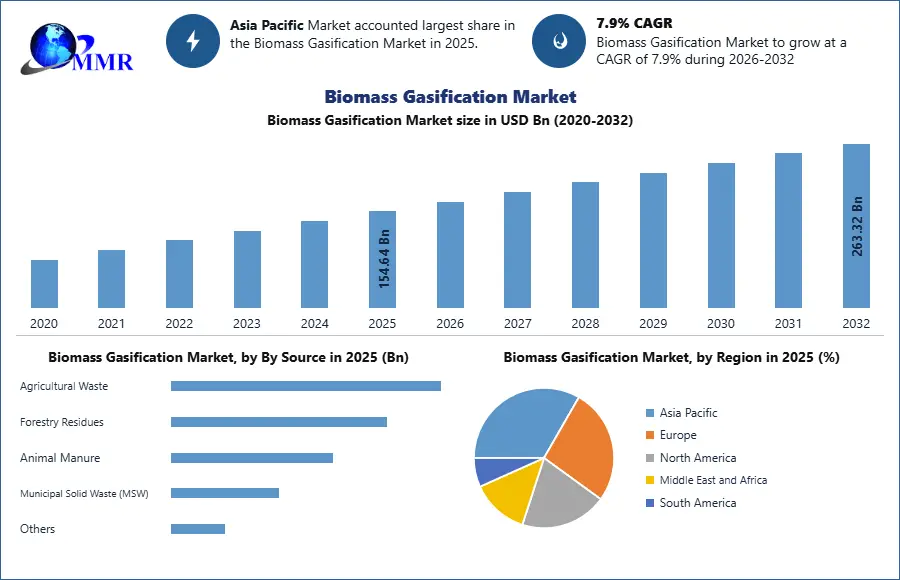
Biomass Gasification Market was valued at USD 154.64 Bn. in 2025 and the total Global Electric Biomass Gasification Market revenue is Expected to grow at a CAGR of 7.90% from 2025 to 2032 reaching nearly USD 263.32 Bn. by 2032.

Biomass gasification is a procedure that requires a thermochemical transformation of biomass into a flammable gas mixture along a limited combustion way with airstream confined to less than that speculative required for full flaming. It also prepares a means of acquiring other various kinds of energy from the thermochemical transformation of biomass than traditional combustion.

The report has analyzed the drivers, restraints, and challenges facing the Biomass Gasification Market.
Biomass Gasification MarketTo know about the Research Methodology :- Request Free Sample Report

Biomass Gasification Market Dynamics

Government support through different rules and regulations along with plentiful attainability of biomass, increasing environmental worry, and rising greenhouse release because of which the companies are now moving toward eco- friendly energy plans. These are various factors which will operate the development of the biomass gasification market. Furthermore, governments of different nations are motivating versatile biomass gasifier-based power plants for processing electricity utilizing locally accessible biomass resources like woods chips, rice husk, and cotton stalks. In India, about 150 MW biomass gasifier structures have been arranged for the grid and off-grid projects. Also, other than 300 rice mills and different industries are using gasifiers systems for assembling their confined power and thermal implementations. In addition, nearly 70 biomass gasifier systems are giving electricity to most of the villages in India. These factors are possible to operate the biomass gasification market.

Biomass Gasification Market Segment Analysis

In 2025, the Source segment is dominated by Agricultural Waste and Forestry Residues, driven by their wide availability and cost-effectiveness in biomass-rich regions. Agricultural residues such as crop stalks and husks are extensively utilized due to their consistent supply in countries with strong agricultural output. Forestry residues also hold a significant share, supported by sustainable forest management practices. Municipal Solid Waste (MSW) is gaining traction as governments focus on waste-to-energy initiatives, while Animal Manure and other sources contribute moderately, primarily in rural and decentralized energy systems.

Based on Application, Power Generation remains the largest segment in 2025, as biomass gasification is widely used to produce electricity in both grid-connected and off-grid systems. Heat Generation also holds a substantial share, especially in industrial and residential heating applications. Chemicals & Fertilizers and Hydrogen Production are emerging as high-growth segments due to increasing interest in green chemicals and clean hydrogen production. Meanwhile, Transportation Fuel applications are expanding steadily with the rising demand for biofuels, although they remain at a developing stage compared to power-focused uses.


Biomass Gasification Market Regional Analysis

Based on Region, Asia Pacific leads the Biomass Gasification Market in 2025, supported by abundant biomass resources, rapid industrialization, and strong government initiatives promoting renewable energy, particularly in countries like China and India. Europe follows closely, driven by stringent environmental regulations and a strong focus on decarbonization and circular economy practices. North America shows steady growth due to technological advancements and increasing investments in clean energy infrastructure. Other regions such as Latin America and the Middle East & Africa (MEA) are witnessing moderate growth, supported by rising awareness and gradual adoption of biomass-based energy solutions.

Biomass Gasification Market Key Developments

Air Liquide and General Electric are innovating advanced technologies to develop the Biomass gasification market.
The objective of the report is to present a comprehensive analysis of the Biomass Gasification Market including all the stakeholders of the industry. The past and current status of the industry with forecasted market size and trends are presented in the report with the analysis of complicated data in simple language. The report covers all the aspects of the industry with a dedicated study of key players that includes market leaders, followers, and new entrants. PORTER, SVOR, PESTEL analysis with the potential impact of micro-economic factors of the market has been presented in the report. External as well as internal factors that are supposed to affect the business positively or negatively have been analyzed, which will give a clear futuristic view of the industry to the decision-makers.

The report also helps in understanding Biomass Gasification Market dynamics, structure by analyzing the market segments and projects the Biomass Gasification Market size. Clear representation of competitive analysis of key players By Voltage, price, financial position, Product portfolio, growth strategies, and regional presence in the Biomass Gasification Market make the report investor’s guide.

Global Biomass Gasification Market Scope: Inquiry Before Buying

Biomass Gasification Market
Report Coverage Details
Base Year: 2025 Forecast Period: 2026-2032
Historical Data: 2020 to 2025 Market Size in 2025: 154.64 USD Bn
Forecast Period 2026-2032 CAGR: 7.9% Market Size in 2032: 263.32 USD Bn
Segments Covered: By Technology Fixed Bed Gasifier
Fluidized Bed Gasifier
Entrained Flow Gasifier
Others
By Source Agricultural Waste
Forestry Residues
Animal Manure
Municipal Solid Waste (MSW)
Others
By Application Power Generation
Heat Generation
Transportation Fuel
Chemicals & Fertilizers
Hydrogen Production
Others
By End-Use Industry Electric Utilities
Chemical Industry
Agriculture
Transportation
Residential
Others

Biomass Gasification Market, by Region

North America (United States, Canada and Mexico)
Europe (UK, France, Germany, Italy, Spain, Sweden, Austria and Rest of Europe)
Asia Pacific (China, South Korea, Japan, India, Australia, Indonesia, Malaysia, Vietnam, Taiwan, Bangladesh, Pakistan and Rest of APAC)
Middle East and Africa (South Africa, GCC, Egypt, Nigeria and Rest of ME&A)
South America (Brazil, Argentina and Rest of South America)

Biomass Gasification Market Key Players


  1. Thyssenkrupp AG
  2. Air Liquide
  3. Synthesis Energy Systems, Inc. (SES)
  4. Valmet Corporation
  5. Mitsubishi Heavy Industries, Ltd.
  6. Royal Dutch Shell
  7. General Electric
  8. Eqtec PLC
  9. SPG Dry Cooling
  10. Nexterra Systems Corp.
  11. Babcock & Wilcox Enterprises, Inc.
  12. Ankur Scientific Energy Technologies Pvt. Ltd.
  13. PRME Energy Systems
  14. ALL Power Labs
  15. Shangqiu Haiqi Machinery Equipment Co., Ltd.
  16. Agro Power Gasification Plant Pvt. Ltd.
  17. Spanner Re2 GmbH
  18. Chanderpur Works Pvt. Ltd.
  19. The Energy and Resources Institute (TERI)
  20. Husk Power Systems Pvt. Ltd.
  21. Infinite Energy Private Limited
  22. GP GREEN Energy Systems Private Limited
  23. Radhe Renewable Energy Development Pvt. Ltd.
  24. Manglam Gasifier Company Pvt. Ltd.
  25. Cosmo Powertech Pvt. Ltd.
  26. Ratfisch Analysensysteme GmbH
  27. ReGaWatt GmbH
  28. SYNCRAFT Engineering GmbH

Table of Contents

1. Biomass Gasification Market: Market Introduction 1.1. Executive Summary 1.2. Market Size (2025) & Forecast (2026-2032) 1.3. Market Size (Value USD) and Market Share (%) - By Segments, Regions and Country 2. Biomass Gasification Market Competitive Landscape 2.1. MMR Competition Matrix 2.2. Competitive Positioning of Top Key Players 2.3. Key Players Benchmarking 2.3.1 Company Name 2.3.2 Headquarter 2.3.3 Business Portfolio 2.3.4 End User 2.3.5 Revenue (2025) 2.3.6 Market Share (%) 2025 2.3.7 Profit Margin (%) 2.3.8 Growth Rate (%) 2.3.9 R &D Investment 2.3.10 Energy Efficiency (%) 2.3.11 Technology Integration 2.3.12 CO2 Emissions 2.3.13 Certifications 2.3.14 ESG / sustainability policies 2.3.15 Geographical Presence 2.4. Market Structure 2.4.1 Market Leaders 2.4.2 Market Followers 2.4.3 Emerging Players 2.5. Mergers and Acquisitions Details 3. Biomass Gasification Market Dynamics 3.1. Biomass Gasification Market Trends 3.2. Biomass Gasification Market Dynamics 3.2.1 Drivers 3.2.2 Restraints 3.2.3 Opportunities 3.2.4 Challenges 3.3. PORTER’s Five Forces Analysis 3.4. PESTLE Analysis 3.5. Key Opinion Leader Analysis For the Global Industry 4. Technological Advancements & Innovations 4.1 Advanced Gasifier Designs 4.2 Syngas Cleanup & Tar Reduction 4.3 Integration with Hydrogen & Biofuels 4.4 Digitalization & Smart Operations 4.5 Carbon Capture Synergies 4.6 Decentralized & Modular Systems 5. Pricing & Cost Structure Analysis 2025 5.1 Overview of Biomass Gasification Costs 2020-2025 5.2 Capital Expenditure (CAPEX) 5.3 Plant & Equipment Costs 5.4 Civil Works & Infrastructure 5.5 Engineering, Procurement & Construction (EPC) 5.6 Installation & Commissioning 5.7 Operating Expenditure (OPEX) 5.8 Feedstock Procurement Costs 5.9 Labor Costs 5.10 Maintenance & Repair Costs 5.11 Utilities & Consumables 5.12 Waste Management 5.13 Feedstock Cost Breakdown 5.14 Agricultural Residues 5.15 Forestry Residues 5.16 Municipal Solid Waste (MSW) 5.17 Energy Crops 6. Investment & Funding Landscape By Region 6.1 Overview of investment Trends 6.2 Sources of funding (government grants, development banks, private equity/VC, energy companies) 6.3 Regional investment analysis 6.4 Public-Private Partnerships (PPPs) in project financing 6.5 ESG-driven investments (green bonds, climate funds, carbon credits) 6.6 Key deals & funding activities 6.7 Investment challenges & risks 7. Sustainability & Environmental Impact 7.1 Role of biomass gasification in decarbonization 7.2 Carbon footprint reduction through fossil fuel substitution 7.3 Life Cycle Assessment (LCA) impacts across feedstock, conversion, and end-use 7.4 Contribution to the circular economy (waste-to-energy, by-product utilization) 7.5 Social & community benefits (rural jobs, off-grid energy access) 7.6 Alignment with global climate goals (SDGs, Paris Agreement, net-zero targets) 8. Regulatory & Compliance Landscape By Region 8.1 Global Policy Framework for Biomass Gasification 8.2 Regional Regulations & Standards 8.3 Environmental Regulations & Emission Norms 8.4 Safety & Technical Compliance 8.5 Incentives & Support Mechanisms 9. Feedstock Supply Chain & Availability Analysis 2020-2025 9.1 Regional Feedstock Availability And Seasonality Assessment 9.2 Collection, Aggregation, And Logistics Cost Dynamics 9.3 Competing Demand From Bioenergy, Biofuels, And Agriculture 9.4 Feedstock Quality Variability And Impact On Gasifier Performance 9.5 Long-term Feedstock Supply Contracts And Risk Mitigation 9.6 Price Volatility And Supply Disruption Risks 10. End-use Application & Demand Assessment 10.1 Power Generation And CHP Adoption Trends 10.2 Industrial Heat And Process Energy Applications 10.3 Syngas Use For Chemicals, Fuels, And Hydrogen Production 10.4 Waste-to-energy Applications Using MSW And Residues 10.5 Off-grid And Rural Electrification Use Cases 10.6 Emerging Demand From Green Hydrogen And SAF Pathways 11. Project Economics & Commercial Viability Analysis 11.1 Levelized Cost Of Energy (LCOE) Comparison Vs Alternatives 11.2 Break-even Analysis By Plant Scale And Feedstock Type 11.3 Revenue Streams From Power, Heat, Syngas, And By-products 11.4 Sensitivity Analysis: Feedstock Cost, Carbon Pricing, Subsidies 11.5 Payback Period And IRR Benchmarks By Region 11.6 Key Economic Success Factors For Commercial-scale Projects 12. Installed Base, Pipeline & Capacity Outlook 12.1 Existing Operational Biomass Gasification Plants By Region 12.2 Announced, Planned, And Under-construction Projects 12.3 Capacity Additions Outlook (2020–2025) 12.4 Project Cancellations And Stalled Pipeline Analysis 12.5 Technology-wise Capacity Split 12.6 Regional Capacity Concentration Risks 13. Integration With Energy Transition & Hydrogen Economy 13.1 Role Of Biomass Gasification In Negative Emissions (BECCS) 13.2 Synergies With Green And Bio-hydrogen Production 13.3 Integration With Carbon Markets And Offset Mechanisms 13.4 Role In Industrial Decarbonization Roadmaps 13.5 Policy Alignment With Long-term Energy Transition Goals 13.6 Strategic Relevance In Net-zero Energy Systems 14. Stakeholder Impact & Socioeconomic Assessment 14.1 Rural Development And Farmer Income Impact 14.2 Employment Generation Across The Value Chain 14.3 Community Acceptance And Social License To Operate 14.4 Skill Development And Workforce Readiness 14.5 Equity And Inclusion Considerations 14.6 Long-term Regional Economic Benefits 15. Biomass Gasification Market: Global Biomass Gasification Market Size and Forecast by Segmentation (by Value in USD) (2025-2032) 15.1. Global Biomass Gasification Market Size and Forecast, by Technology 15.1.1 Fixed Bed Gasifier 15.1.2 Fluidized Bed Gasifier 15.1.3 Entrained Flow Gasifier 15.1.4 Others 15.2. Global Biomass Gasification Market Size and Forecast, by Source 15.2.1 Agricultural Waste 15.2.2 Forestry Residues 15.2.3 Animal Manure 15.2.4 Municipal Solid Waste (MSW) 15.2.5 Others 15.3. Global Biomass Gasification Market Size and Forecast, by Application 15.3.1 Power Generation 15.3.2 Heat Generation 15.3.3 Transportation Fuel 15.3.4 Chemicals & Fertilizers 15.3.5 Hydrogen Production 15.3.6 Others 15.4. Global Biomass Gasification Market Size and Forecast, by End-Use Industry 15.4.1 Electric Utilities 15.4.2 Chemical Industry 15.4.3 Agriculture 15.4.4 Transportation 15.4.5 Residential 15.4.6 Others 15.5. Global Biomass Gasification Market Size and Forecast, by Region 15.5.1 North America 15.5.2 Europe 15.5.3 Asia Pacific 15.5.4 Middle East and Africa 15.5.5 South America 16. North America Biomass Gasification Market Size and Forecast by Segmentation (by Value in USD) (2025-2032) 16.1. North America Market Size and Forecast, by Technology 16.2. North America Market Size and Forecast, by Source 16.3. North America Market Size and Forecast, by Application 16.4. North America Market Size and Forecast, by End-Use Industry 16.5. North America Market Size and Forecast, by Country 16.5.1 United States 16.5.2 United States Market Size and Forecast, by Technology 16.5.3 United States Market Size and Forecast, by Source 16.5.4 United States Market Size and Forecast, by Application 16.5.5 United States Market Size and Forecast, by End-Use Industry 16.5.6 Canada 16.5.7 Mexico 17. Europe Biomass Gasification Market Size and Forecast by Segmentation (by Value in USD) (2025-2032) 17.1. Europe Market Size and Forecast, by Technology 17.2. Europe Market Size and Forecast, by Source 17.3. Europe Market Size and Forecast, by Application 17.4. Europe Market Size and Forecast, by End-Use Industry 17.5. Europe Market Size and Forecast, by Country 17.5.1 United Kingdom 17.5.2 France 17.5.3 Germany 17.5.4 Italy 17.5.5 Spain 17.5.6 Sweden 17.5.7 Russia 17.5.8 Rest of Europe 18. Asia Pacific Biomass Gasification Market Size and Forecast by Segmentation (by Value in USD) (2025-2032) 18.1. Asia Pacific Market Size and Forecast, by Technology 18.2. Asia Pacific Market Size and Forecast, by Source 18.3. Asia Pacific Market Size and Forecast, by Application 18.4. Asia Pacific Market Size and Forecast, by End-Use Industry 18.5. Asia Pacific Market Size and Forecast, by Country 18.5.1 China 18.5.2 S Korea 18.5.3 Japan 18.5.4 India 18.5.5 Australia 18.5.6 Indonesia 18.5.7 Malaysia 18.5.8 Philippines 18.5.9 Thailand 18.5.10 Vietnam 18.5.11 Rest of Asia Pacific 19. Middle East and Africa Biomass Gasification Market Size and Forecast by Segmentation (by Value in USD) (2025-2032) 19.1.Middle East and Africa Market Size and Forecast, by Technology 19.2.Middle East and Africa Market Size and Forecast, by Source 19.3.Middle East and Africa Market Size and Forecast, by Application 19.4.Middle East and Africa Market Size and Forecast, by End-Use Industry 19.5. Middle East and Africa Market Size and Forecast, by Country 19.5.1 South Africa 19.5.2 GCC 19.5.3 Egypt 19.5.4 Nigeria 19.5.5 Rest of ME&A 20. South America Biomass Gasification Market Size and Forecast by Segmentation (by Value in USD) (2025-2032) 20.1. South America Market Size and Forecast, by Technology 20.2. South America Market Size and Forecast, by Source 20.3. South America Market Size and Forecast, by Application 20.4. South America Market Size and Forecast, by End-Use Industry 20.5. South America Market Size and Forecast, by Country 20.5.1 Brazil 20.5.2 Argentina 20.5.3 Colombia 20.5.4 Chile 20.5.5 Rest Of South America 21. Company Profile: Key Players 21.1. Thyssenkrupp AG. 21.1.1 Company Overview 21.1.2 Business Portfolio 21.1.3 Financial Overview 21.1.4 SWOT Analysis 21.1.5 Strategic Analysis 21.1.6 Recent Developments 21.2. Air Liquide 21.3. Synthesis Energy Systems, Inc. (SES) 21.4. Valmet Corporation 21.5. Mitsubishi Heavy Industries, Ltd. 21.6. Royal Dutch Shell 21.7. General Electric 21.8. Eqtec PLC 21.9. SPG Dry Cooling 21.10. Nexterra Systems Corp. 21.11. Babcock & Wilcox Enterprises, Inc. 21.12. Ankur Scientific Energy Technologies Pvt. Ltd. 21.13. PRME Energy Systems 21.14. ALL Power Labs 21.15. Shangqiu Haiqi Machinery Equipment Co., Ltd. 21.16. Agro Power Gasification Plant Pvt. Ltd. 21.17. Spanner Re2 GmbH 21.18. Chanderpur Works Pvt. Ltd. 21.19. The Energy and Resources Institute (TERI) 21.20. Husk Power Systems Pvt. Ltd. 21.21. Infinite Energy Private Limited 21.22. GP GREEN Energy Systems Private Limited 21.23. Radhe Renewable Energy Development Pvt. Ltd. 21.24. Manglam Gasifier Company Pvt. Ltd. 21.25. Cosmo Powertech Pvt. Ltd. 21.26. Ratfisch Analysensysteme GmbH 21.27. ReGaWatt GmbH 21.28. SYNCRAFT Engineering GmbH 21.28.1 Others 22. Key Findings 23. Analyst Recommendations 24. Research Methodology

Custom Market Research Services

We Will Customise The Research For You, In Case The Report Listed Above Does Not Meet With Your Requirements