Avalanche Radar Market Size by Type, Technology, Component, Application, End User, Region, Industry-Wide Analysis, Competitive Landscape Assessment & Long-Term Forecast to 2034

43.2%
CAGR (2026-2034)
4.69 USD Bn.
Forecast Market Size
318
Report Pages
120
Market Tables

Overview

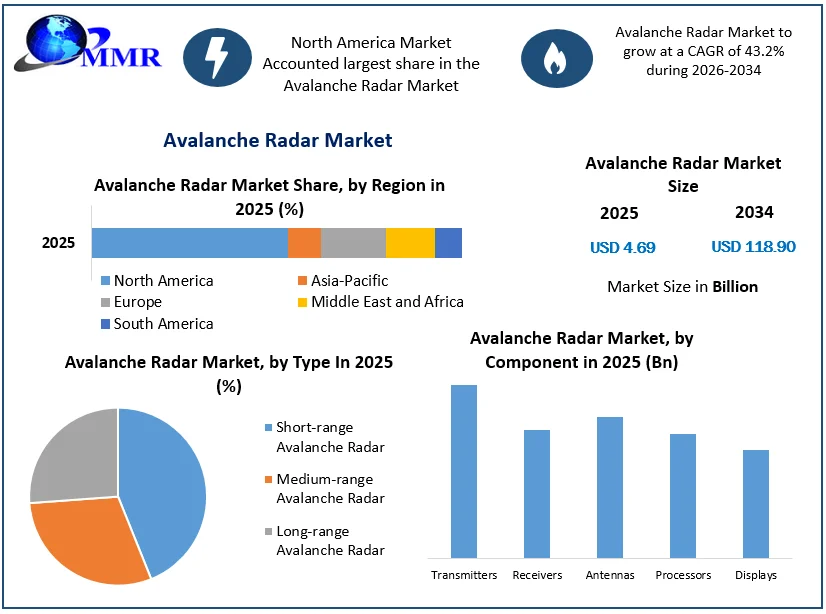
The Avalanche Radar Market size was valued at USD 4.69  Billion in 2025 and the total Avalanche Radar Market revenue is expected to grow at a CAGR of 43.2 % from 2026 to 2034, reaching nearly USD 118.90 Billion.

Avalanche Radar Market Overview

Avalanche radar is a device that uses radar waves to detect the presence of snow and ice and the movements of avalanches. This device is used to avoid avalanches or to rescue people who have been caught in an avalanche. The avalanche radar is designed to provide an early warning of avalanches and to trigger an alarm. In the event of an avalanche, roads, and railway the avalanche radar is an effective technology for automatic avalanche detection. It offers crucial advantages over conventional, local sensors that are installed in known flow paths. The avalanche radar can work in any weather and at any time of day, it has a range of up to 5 km, and avalanche radars cover large slopes with a single device. The avalanche radar is designed.

Avalanche Radar Market Growth and Share Analysis
Avalanche Radar Market size

To know about the Research Methodology :- Request Free Sample Report

Avalanche Radar Market Dynamics

Growing Applications of Avalanche Radars in the Military and Defense Sector Drive Market Growth

The growing applications of avalanche radars in the military and defense sectors are expected to drive the growth of the avalanche radar market. These radars are increasingly being utilized in military operations in mountainous terrain, where avalanches pose a significant threat. They enable armed troops to plan and carry out operations more safely by spotting and monitoring avalanche-prone areas, which provides important situational awareness. Avalanche radars are also used for border monitoring and security, assisting border security troops in keeping situational awareness and quickly retaliating to possible threats. By finding and determining the effects of avalanches on people or equipment, they are also used to preserve key infrastructure in avalanche-prone locations and are crucial to search and rescue efforts. Avalanche radars are also used in military training and simulation exercises, allowing for realistic scenarios and boosting the training of people in avalanche reaction, survival, and rescue operations. Overall, the Avalanche Radar market expansion is fuelled by the growing use of avalanche radars in the military and defense industry, which takes advantage of their capabilities for improved safety, security, and operational effectiveness.

Enhancing Safety in Avalanche-Prone Areas through Avalanche Radar Systems

The use of avalanche radar systems is driving Avalanche Radar industry growth by enhancing safety in areas prone to avalanches. These radar systems play a crucial role in detecting and locating buried victims, ultimately increasing the chances of successful rescue operations. By providing valuable information to search and rescue teams, they enable more effective and efficient response measures, helping to mitigate the risks associated with avalanches. Avalanche radar systems utilize radar technology, which involves the emission and reception of radar waves. These wavelengths can pass through the snowpack, enabling the radar system to find things or people that are buried below the surface. This skill is crucial in avalanche scenarios since it are difficult to find victims using traditional search techniques because they may be buried at different depths. Rescue efforts after an avalanche must be completed quickly. Avalanche radar technologies dramatically minimize search time by rapidly detecting the existence of buried victims. The rescuers can receive real-time information about the victim's position from the radar waves because they can pass through the snow. The efficiency of the rescue operation is increased by the search and rescue teams' ability to concentrate their efforts on particular locations thanks to this precise and timely information.

Restraints Impacting the Avalanche Radar Market Due to the high cost of acquisition and maintenance
The avalanche radar market is the high cost associated with installing and maintaining these radar systems. Avalanche radar systems require advanced technology and specialized equipment to detect and monitor avalanches accurately. Procuring and deploying such equipment is expensive, especially considering the need for rugged and durable components that can withstand harsh environmental conditions. The high cost of acquisition and maintenance becomes a barrier for many organizations and authorities responsible for avalanche monitoring, especially those with limited budgets or resources. Consequently, this financial constraint hinders the widespread adoption and implementation of avalanche radar systems, limiting their effectiveness in providing timely warnings and reducing the risk of avalanches. Overcoming this cost restraint through technological advancements, cost-effective solutions, and collaborative initiatives can significantly boost the market and enhance the safety of avalanche-prone regions.

Avalanche Radar Market Segment Analysis

This Report covers the analysis of Avalanche Radar Market trends in each sub-segment from 2026 to 2034, as well as historical data and estimates for global, regional, and national revenue growth. Reports and Data have segmented the Avalanche Radar Market based on grade, product, application, and region.

Based on type, the avalanche radar market is segmented based on the Types they are categorized into short-, long-range, and medium-range. The long-range sub-segment is holding the largest market share in 2025. Short-range avalanche radar systems are typically used for localized monitoring in ski resorts and small-scale areas. Medium-range avalanche radar provides coverage for larger areas such as highways and transportation routes. Long-range avalanche radar offers extensive coverage for regional or mountainous terrains. Each range has its advantages and limitations, and the selection depends on the desired coverage area and monitoring objectives.

Based on components, the avalanche radar market is segmented based on components. They are categorized into Transmitters, Receivers, Antennas, Processors, and Displays. The process segment is dominating the market in 2025. Processors play a crucial role in analysing radar data, extracting insights, and enabling real-time processing for accurate avalanche detection and monitoring. Transmitters generate radar signals, receivers capture and process the reflected signals, and antennas emit and receive signals, while displays visually present the processed data. However, processors have emerged as a dominant segment due to their vital role in enhancing the effectiveness and reliability of avalanche radar systems.

Avalanche Radar Market Regionals Insights

North America is holding the largest Avalanche Radar market share for avalanche radars, followed by Europe and Asia-Pacific. The growth of the market in North America is attributed to the increasing popularity of winter sports and the presence of a large number of government agencies and private companies that use avalanche radars for avalanche control and forecasting. The growth of the market in Europe is attributed to the increasing investment in avalanche safety and security by governments and private companies. The growth of the market in Asia-Pacific is attributed to the increasing popularity of winter sports and the growing disposable incomes of people in the region.

Avalanche Radar Market Competitive Landscape

The competitiveness of the Avalanche Radar industry is increasing due to the ultimate innovations and productions, in a fight to stay ahead in the market. Companies are focusing on improving their product offerings and increasing their distribution networks through partnerships and collaboration to get a larger portion of the market growing start-ups, mergers, and increasing trends of organic and inorganic growth is being witnessed. The key players in the Avalanche Radar market such as Geobrugg AG, Wyssen Avalanche Control AG, GEOPRAEVENT AG, and L.B. Foster Company this major key players are using strategies such as acquisition and mergers, partnerships, and investment and divestment, fueling industry growth. Furthermore, large and medium-scale companies are offering highly improved product-type portfolios and customer services. This trend is projected to positively impact the global market during the forecast period

Avalanche Radar Market Recent Development

Date Company Development Impact
11 January 2026 Gravimon The company successfully installed its proprietary Avymonster Doppler radar system at the Alaska Electric Light & Power substation on Douglas Island to continuously monitor active snowpack movements on Mount Juneau. This deployment enables municipal forecasters to obtain real-time velocity data and pinpoint the exact initiation zone of micro-avalanches, significantly enhancing community safety and infrastructure protection.
19 February 2026 GeoPraevent AG The natural hazard monitoring firm expanded its strategic collaboration with Spotter Global to integrate short-to-mid range radar units into multi-layered threat detection networks at high-risk alpine locations, including the Matterhorn and Little Cottonwood Canyon. The integrated low-frequency electromagnetic wave technologies deliver all-weather, day-and-night visibility that allows instant automated traffic closures and early hazard alerts for surrounding infrastructure.
19 April 2026 Wyssen Avalanche Control AG The company executed a major structural leadership transition, appointing Lisa Dreier as the new CEO of Wyssen Canada Inc. to direct the expansion of its localized monitoring networks across North America. This corporate restructure aligns with the massive growth of their Avalanche Detection Network (ADN) in the Columbia Mountains, which captured a record 4,695 successful automated tracking events during the season.
03 May 2026 EGU General Assembly Researchers presented a critical technical breakthrough detailing the validation of the Depth-Averaged Material-Point Method (DAMPM) for simulating real 3D terrains like the Stanley Path during controlled avalanche mitigation. This validation allows manufacturers to drastically optimize radar-guided preventive blasting operations by determining the exact structural dimensions needed to halt cross-slope crack propagation.

Avalanche Radar Market Scope: Inquire before buying

Avalanche Radar Market
Report Coverage Details
Base Year: 2025 Forecast Period: 2026-2034
Historical Data: 2020 to 2025 Market Size in 2025: USD 4.69 Bn
Forecast Period 2026 to 2034 CAGR: 43.2% Market Size in 2034: USD 118.90 Bn
Segments Covered: by Type 1.Short-range Avalanche Radar
2. Medium-range Avalanche Radar
3.Long-range Avalanche Radar
by Technology 1.Frequency Modulated Continuous Wave (FMCW) Radar
2.Pulsed Radar
by Component 1.Transmitters
2.Receivers
3.Antennas
4.Processors
5.Displays
by Application 1.Avalanche Forecasting and Warning Systems
2.Search and Rescue Operations
3.Ski Resort Safety and Management
4.Transportation Infrastructure Safety (roads, railways, etc.)
5.Mountain Monitoring and Research
by End User 1.Military and Defense
2.Weather Monitoring
3.Government and Public Sector
4.Ski Resorts and Tourism Industry
5.Transportation and Infrastructure Sector
6.Research and Academic Institutions

Avalanche Radar Market, by Region

North America (United States, Canada, and Mexico)
Europe (UK, France, Germany, Italy, Spain, Sweden, Austria, and the Rest of Europe)
Asia Pacific (China, South Korea, Japan, India, Australia, Indonesia, Malaysia, Vietnam, Taiwan, Bangladesh, Pakistan the and Rest of APAC)
South America (Brazil, Argentina Rest of South America)
Middle East & Africa (South Africa, GCC, Egypt, Nigeria, and the Rest of ME&A)

Avalanche Radar Market, Key players

The market for Avalanche Radar includes the production, sale, and maintenance of specialized radar devices, beacons, and other monitoring gear for detecting unstable snow layers, predicting avalanches, and locating people trapped beneath the snow.

Company Name Headquarters Core Competencies
Geobrugg AG Romanshorn, Switzerland Avalanche protection systems, hazard mitigation, monitoring solutions
Wyssen Avalanche Control AG Reichenbach im Kandertal, Switzerland Avalanche radar systems, remote avalanche control, mountain safety solutions
GEOPRAEVENT AG Zurich, Switzerland Avalanche monitoring, natural hazard detection, early warning systems
L.B. Foster Company Pittsburgh, Pennsylvania, USA Avalanche monitoring systems, geotechnical infrastructure, rail safety solutions
Swiss Radar Technologies AG Winterthur, Switzerland Doppler radar systems, avalanche detection, real-time monitoring
IDS GeoRadar (Hexagon AB) Pisa, Italy Ground-based radar, slope stability monitoring, geohazard detection
Hexagon AB Stockholm, Sweden Geospatial technologies, radar monitoring, geotechnical solutions
Recco AB Lidingö, Sweden Avalanche rescue detection technology, search and rescue systems
Vaisala Oyj Helsinki, Finland Weather monitoring, snow observation, environmental sensing
Trimble Inc. Westminster, Colorado, USA GNSS monitoring, geospatial positioning, terrain and infrastructure monitoring
Leica Geosystems (Hexagon AB) Heerbrugg, Switzerland Surveying, geospatial monitoring, terrain mapping and hazard assessment
TechnoAlpin S.p.A. Bolzano, Italy Avalanche safety technologies, snow management systems, mountain infrastructure
Campbell Scientific, Inc. Logan, Utah, USA Environmental monitoring systems, weather stations, snow and avalanche instrumentation
Teledyne FLIR LLC Wilsonville, Oregon, USA Thermal imaging, surveillance sensors, environmental monitoring solutions
RST Instruments Ltd. Maple Ridge, British Columbia, Canada Geotechnical monitoring instruments, slope stability and hazard monitoring

Frequently Asked Questions:

1] What is the growth rate of the Global Avalanche Radar Market?
Ans. The Global Avalanche Radar Market is growing at a significant rate of 43.2 % during the forecast period.

2] Which region is expected to dominate the Global Avalanche Radar Market?
Ans. North America is expected to dominate the Avalanche Radar Market during the forecast period.

3] What is the expected Global Avalanche Radar Market size by 2034?
Ans. The Avalanche Radar Market size is expected to reach USD 118.90 Bn by 2034.

4] Which are the top players in the Global Avalanche Radar Market?
Ans. Some of the top players operating in the Avalanche Radar Market are Geobrugg AG, Wyssen Avalanche Control AG, GEOPRAEVENT AG, and L.B. Foster Company.

5] Which sector is the key driver in the Avalanche Radar Market?
Ans. Increasing Demand for Enhancing Safety in Avalanche-Prone Areas through Avalanche Radar Systems.

Table of Contents

1. Global Market Introduction 1.1. Study Assumption and Market Definition 1.2. Scope of the Study 1.3. Executive Summary 2. Global Global Market: Competitive Landscape 2.1. MMR Competition Matrix 2.2. Competitive Landscape 2.3. Key Players Benchmarking 2.3.1. Company Name 2.3.2. Business Segment 2.3.3. End-user Segment 2.3.4. Revenue (2025) 2.3.5. Company Locations 2.4. Leading Global Market Companies, by market capitalization 2.5. Market Structure 2.5.1. Market Leaders 2.5.2. Market Followers 2.5.3. Emerging Players 2.6. Mergers and Acquisitions Details 3. Global Market: Dynamics 3.1. Global Market Trends by Region 3.1.1. North America Global Market Trends 3.1.2. Europe Global Market Trends 3.1.3. Asia Pacific Global Market Trends 3.1.4. Middle East and Africa Global Market Trends 3.1.5. South America Global Market Trends 3.2. Global Market Dynamics by Region 3.2.1. North America 3.2.1.1. North America Global Market Drivers 3.2.1.2. North America Global Market Restraints 3.2.1.3. North America Global Market Opportunities 3.2.1.4. North America Global Market Challenges 3.2.2. Europe 3.2.2.1. Europe Global Market Drivers 3.2.2.2. Europe Global Market Restraints 3.2.2.3. Europe Global Market Opportunities 3.2.2.4. Europe Global Market Challenges 3.2.3. Asia Pacific 3.2.3.1. Asia Pacific Global Market Drivers 3.2.3.2. Asia Pacific Global Market Restraints 3.2.3.3. Asia Pacific Global Market Opportunities 3.2.3.4. Asia Pacific Global Market Challenges 3.2.4. Middle East and Africa 3.2.4.1. Middle East and Africa Global Market Drivers 3.2.4.2. Middle East and Africa Global Market Restraints 3.2.4.3. Middle East and Africa Global Market Opportunities 3.2.4.4. Middle East and Africa Global Market Challenges 3.2.5. South America 3.2.5.1. South America Global Market Drivers 3.2.5.2. South America Global Market Restraints 3.2.5.3. South America Global Market Opportunities 3.2.5.4. South America Global Market Challenges 3.3. PORTER's Five Forces Analysis 3.4. PESTLE Analysis 3.5. Technology Roadmap 3.6. Regulatory Landscape by Region 3.6.1. North America 3.6.2. Europe 3.6.3. Asia Pacific 3.6.4. Middle East and Africa 3.6.5. South America 3.7. Key Opinion Leader Analysis For Global Industry 3.8. Analysis of Government Schemes and Initiatives For Global Industry 3.9. Global Market Trade Analysis 3.10. The Global Pandemic Impact on Global Market 4. Global Market: Global Market Size and Forecast by Segmentation (in USD Billion) 2025-2034 4.1. Global Market Size and Forecast, by Type (2025-2034) 4.1.1. Short-range Avalanche Radar 4.1.2. Medium-range Avalanche Radar 4.1.3. Long-range Avalanche Radar 4.2. Global Market Size and Forecast, by Technology (2025-2034) 4.2.1. Frequency Modulated Continuous Wave (FMCW) Radar 4.2.2. Pulsed Radar 4.3. Global Market Size and Forecast, by Component (2025-2034) 4.3.1. Transmitters 4.3.2. Receivers 4.3.3. Antennas 4.3.4. Processors 4.3.5. Displays 4.4. Global Market Size and Forecast, by Application (2025-2034) 4.4.1. Avalanche Forecasting and Warning Systems 4.4.2. Search and Rescue Operations 4.4.3. Ski Resort Safety and Management 4.4.4. Transportation Infrastructure Safety (roads, railways, etc.) 4.4.5. Mountain Monitoring and Research 4.5. Global Market Size and Forecast, by End User (2025-2034) 4.5.1. Military and Defense 4.5.2. Weather Monitoring 4.5.3. Government and Public Sector 4.5.4. Ski Resorts and Tourism Industry 4.5.5. Transportation and Infrastructure Sector 4.5.6. Research and Academic Institutions 4.6. Global Market Size and Forecast, by Region (2025-2034) 4.6.1. North America 4.6.2. Europe 4.6.3. Asia Pacific 4.6.4. Middle East and Africa 4.6.5. South America 5. North America Global Market Size and Forecast by Segmentation (in USD Billion) 2025-2034 5.1. North America Global Market Size and Forecast, by Type (2025-2034) 5.1.1. Short-range Avalanche Radar 5.1.2. Medium-range Avalanche Radar 5.1.3. Long-range Avalanche Radar 5.2. North America Global Market Size and Forecast, by Technology (2025-2034) 5.2.1. Frequency Modulated Continuous Wave (FMCW) Radar 5.2.2. Pulsed Radar 5.3. North America Global Market Size and Forecast, by Component (2025-2034) 5.3.1. Transmitters 5.3.2. Receivers 5.3.3. Antennas 5.3.4. Processors 5.3.5. Displays 5.4. North America Global Market Size and Forecast, by Application (2025-2034) 5.4.1. Avalanche Forecasting and Warning Systems 5.4.2. Search and Rescue Operations 5.4.3. Ski Resort Safety and Management 5.4.4. Transportation Infrastructure Safety (roads, railways, etc.) 5.4.5. Mountain Monitoring and Research 5.5. North America Global Market Size and Forecast, by End User (2025-2034) 5.5.1. Military and Defense 5.5.2. Weather Monitoring 5.5.3. Government and Public Sector 5.5.4. Ski Resorts and Tourism Industry 5.5.5. Transportation and Infrastructure Sector 5.5.6. Research and Academic Institutions 5.6. North America Global Market Size and Forecast, by Country (2025-2034) 5.6.1. United States 5.6.1.1. United States Global Market Size and Forecast, by Type (2025-2034) 5.6.1.1.1. Short-range Avalanche Radar 5.6.1.1.2. Medium-range Avalanche Radar 5.6.1.1.3. Long-range Avalanche Radar 5.6.1.2. United States Global Market Size and Forecast, by Technology (2025-2034) 5.6.1.2.1. Frequency Modulated Continuous Wave (FMCW) Radar 5.6.1.2.2. Pulsed Radar 5.6.1.3. United States Global Market Size and Forecast, by Component (2025-2034) 5.6.1.3.1. Transmitters 5.6.1.3.2. Receivers 5.6.1.3.3. Antennas 5.6.1.3.4. Processors 5.6.1.3.5. Displays 5.6.1.4. United States Global Market Size and Forecast, by Application (2025-2034) 5.6.1.4.1. Avalanche Forecasting and Warning Systems 5.6.1.4.2. Search and Rescue Operations 5.6.1.4.3. Ski Resort Safety and Management 5.6.1.4.4. Transportation Infrastructure Safety (roads, railways, etc.) 5.6.1.4.5. Mountain Monitoring and Research 5.6.1.5. United States Global Market Size and Forecast, by End User (2025-2034) 5.6.1.5.1. Military and Defense 5.6.1.5.2. Weather Monitoring 5.6.1.5.3. Government and Public Sector 5.6.1.5.4. Ski Resorts and Tourism Industry 5.6.1.5.5. Transportation and Infrastructure Sector 5.6.1.5.6. Research and Academic Institutions 5.6.2. Canada 5.6.2.1. Canada Global Market Size and Forecast, by Type (2025-2034) 5.6.2.1.1. Short-range Avalanche Radar 5.6.2.1.2. Medium-range Avalanche Radar 5.6.2.1.3. Long-range Avalanche Radar 5.6.2.2. Canada Global Market Size and Forecast, by Technology (2025-2034) 5.6.2.2.1. Frequency Modulated Continuous Wave (FMCW) Radar 5.6.2.2.2. Pulsed Radar 5.6.2.3. Canada Global Market Size and Forecast, by Component (2025-2034) 5.6.2.3.1. Transmitters 5.6.2.3.2. Receivers 5.6.2.3.3. Antennas 5.6.2.3.4. Processors 5.6.2.3.5. Displays 5.6.2.4. Canada Global Market Size and Forecast, by Application (2025-2034) 5.6.2.4.1. Avalanche Forecasting and Warning Systems 5.6.2.4.2. Search and Rescue Operations 5.6.2.4.3. Ski Resort Safety and Management 5.6.2.4.4. Transportation Infrastructure Safety (roads, railways, etc.) 5.6.2.4.5. Mountain Monitoring and Research 5.6.2.5. Canada Global Market Size and Forecast, by End User (2025-2034) 5.6.2.5.1. Military and Defense 5.6.2.5.2. Weather Monitoring 5.6.2.5.3. Government and Public Sector 5.6.2.5.4. Ski Resorts and Tourism Industry 5.6.2.5.5. Transportation and Infrastructure Sector 5.6.2.5.6. Research and Academic Institutions 5.6.3. Mexico 5.6.3.1. Mexico Global Market Size and Forecast, by Type (2025-2034) 5.6.3.1.1. Short-range Avalanche Radar 5.6.3.1.2. Medium-range Avalanche Radar 5.6.3.1.3. Long-range Avalanche Radar 5.6.3.2. Mexico Global Market Size and Forecast, by Technology (2025-2034) 5.6.3.2.1. Frequency Modulated Continuous Wave (FMCW) Radar 5.6.3.2.2. Pulsed Radar 5.6.3.3. Mexico Global Market Size and Forecast, by Component (2025-2034) 5.6.3.3.1. Transmitters 5.6.3.3.2. Receivers 5.6.3.3.3. Antennas 5.6.3.3.4. Processors 5.6.3.3.5. Displays 5.6.3.4. Mexico Global Market Size and Forecast, by Application (2025-2034) 5.6.3.4.1. Avalanche Forecasting and Warning Systems 5.6.3.4.2. Search and Rescue Operations 5.6.3.4.3. Ski Resort Safety and Management 5.6.3.4.4. Transportation Infrastructure Safety (roads, railways, etc.) 5.6.3.4.5. Mountain Monitoring and Research 5.6.3.5. Mexico Global Market Size and Forecast, by End User (2025-2034) 5.6.3.5.1. Military and Defense 5.6.3.5.2. Weather Monitoring 5.6.3.5.3. Government and Public Sector 5.6.3.5.4. Ski Resorts and Tourism Industry 5.6.3.5.5. Transportation and Infrastructure Sector 5.6.3.5.6. Research and Academic Institutions 6. Europe Global Market Size and Forecast by Segmentation (in USD Billion) 2025-2034 6.1. Europe Global Market Size and Forecast, by Type (2025-2034) 6.2. Europe Global Market Size and Forecast, by Technology (2025-2034) 6.3. Europe Global Market Size and Forecast, by Component (2025-2034) 6.4. Europe Global Market Size and Forecast, by Application (2025-2034) 6.5. Europe Global Market Size and Forecast, by End User (2025-2034) 6.6. Europe Global Market Size and Forecast, by Country (2025-2034) 6.6.1. United Kingdom 6.6.1.1. United Kingdom Global Market Size and Forecast, by Type (2025-2034) 6.6.1.2. United Kingdom Global Market Size and Forecast, by Technology (2025-2034) 6.6.1.3. United Kingdom Global Market Size and Forecast, by Component (2025-2034) 6.6.1.4. United Kingdom Global Market Size and Forecast, by Application (2025-2034) 6.6.1.5. United Kingdom Global Market Size and Forecast, by End User (2025-2034) 6.6.2. France 6.6.2.1. France Global Market Size and Forecast, by Type (2025-2034) 6.6.2.2. France Global Market Size and Forecast, by Technology (2025-2034) 6.6.2.3. France Global Market Size and Forecast, by Component (2025-2034) 6.6.2.4. France Global Market Size and Forecast, by Application (2025-2034) 6.6.2.5. France Global Market Size and Forecast, by End User (2025-2034) 6.6.3. Germany 6.6.3.1. Germany Global Market Size and Forecast, by Type (2025-2034) 6.6.3.2. Germany Global Market Size and Forecast, by Technology (2025-2034) 6.6.3.3. Germany Global Market Size and Forecast, by Component (2025-2034) 6.6.3.4. Germany Global Market Size and Forecast, by Application (2025-2034) 6.6.3.5. Germany Global Market Size and Forecast, by End User (2025-2034) 6.6.4. Italy 6.6.4.1. Italy Global Market Size and Forecast, by Type (2025-2034) 6.6.4.2. Italy Global Market Size and Forecast, by Technology (2025-2034) 6.6.4.3. Italy Global Market Size and Forecast, by Component (2025-2034) 6.6.4.4. Italy Global Market Size and Forecast, by Application (2025-2034) 6.6.4.5. Italy Global Market Size and Forecast, by End User (2025-2034) 6.6.5. Spain 6.6.5.1. Spain Global Market Size and Forecast, by Type (2025-2034) 6.6.5.2. Spain Global Market Size and Forecast, by Technology (2025-2034) 6.6.5.3. Spain Global Market Size and Forecast, by Component (2025-2034) 6.6.5.4. Spain Global Market Size and Forecast, by Application (2025-2034) 6.6.5.5. Spain Global Market Size and Forecast, by End User (2025-2034) 6.6.6. Sweden 6.6.6.1. Sweden Global Market Size and Forecast, by Type (2025-2034) 6.6.6.2. Sweden Global Market Size and Forecast, by Technology (2025-2034) 6.6.6.3. Sweden Global Market Size and Forecast, by Component (2025-2034) 6.6.6.4. Sweden Global Market Size and Forecast, by Application (2025-2034) 6.6.6.5. Sweden Global Market Size and Forecast, by End User (2025-2034) 6.6.7. Austria 6.6.7.1. Austria Global Market Size and Forecast, by Type (2025-2034) 6.6.7.2. Austria Global Market Size and Forecast, by Technology (2025-2034) 6.6.7.3. Austria Global Market Size and Forecast, by Component (2025-2034) 6.6.7.4. Austria Global Market Size and Forecast, by Application (2025-2034) 6.6.7.5. Austria Global Market Size and Forecast, by End User (2025-2034) 6.6.8. Rest of Europe 6.6.8.1. Rest of Europe Global Market Size and Forecast, by Type (2025-2034) 6.6.8.2. Rest of Europe Global Market Size and Forecast, by Technology (2025-2034) 6.6.8.3. Rest of Europe Global Market Size and Forecast, by Component (2025-2034) 6.6.8.4. Rest of Europe Global Market Size and Forecast, by Application (2025-2034) 6.6.8.5. Rest of Europe Global Market Size and Forecast, by End User (2025-2034) 7. Asia Pacific Global Market Size and Forecast by Segmentation (in USD Billion) 2025-2034 7.1. Asia Pacific Global Market Size and Forecast, by Type (2025-2034) 7.2. Asia Pacific Global Market Size and Forecast, by Technology (2025-2034) 7.3. Asia Pacific Global Market Size and Forecast, by Component (2025-2034) 7.4. Asia Pacific Global Market Size and Forecast, by Application (2025-2034) 7.5. Asia Pacific Global Market Size and Forecast, by End User (2025-2034) 7.6. Asia Pacific Global Market Size and Forecast, by Country (2025-2034) 7.6.1. China 7.6.1.1. China Global Market Size and Forecast, by Type (2025-2034) 7.6.1.2. China Global Market Size and Forecast, by Technology (2025-2034) 7.6.1.3. China Global Market Size and Forecast, by Component (2025-2034) 7.6.1.4. China Global Market Size and Forecast, by Application (2025-2034) 7.6.1.5. China Global Market Size and Forecast, by End User (2025-2034) 7.6.2. S Korea 7.6.2.1. S Korea Global Market Size and Forecast, by Type (2025-2034) 7.6.2.2. S Korea Global Market Size and Forecast, by Technology (2025-2034) 7.6.2.3. S Korea Global Market Size and Forecast, by Component (2025-2034) 7.6.2.4. S Korea Global Market Size and Forecast, by Application (2025-2034) 7.6.2.5. S Korea Global Market Size and Forecast, by End User (2025-2034) 7.6.3. Japan 7.6.3.1. Japan Global Market Size and Forecast, by Type (2025-2034) 7.6.3.2. Japan Global Market Size and Forecast, by Technology (2025-2034) 7.6.3.3. Japan Global Market Size and Forecast, by Component (2025-2034) 7.6.3.4. Japan Global Market Size and Forecast, by Application (2025-2034) 7.6.3.5. Japan Global Market Size and Forecast, by End User (2025-2034) 7.6.4. India 7.6.4.1. India Global Market Size and Forecast, by Type (2025-2034) 7.6.4.2. India Global Market Size and Forecast, by Technology (2025-2034) 7.6.4.3. India Global Market Size and Forecast, by Component (2025-2034) 7.6.4.4. India Global Market Size and Forecast, by Application (2025-2034) 7.6.4.5. India Global Market Size and Forecast, by End User (2025-2034) 7.6.5. Australia 7.6.5.1. Australia Global Market Size and Forecast, by Type (2025-2034) 7.6.5.2. Australia Global Market Size and Forecast, by Technology (2025-2034) 7.6.5.3. Australia Global Market Size and Forecast, by Component (2025-2034) 7.6.5.4. Australia Global Market Size and Forecast, by Application (2025-2034) 7.6.5.5. Australia Global Market Size and Forecast, by End User (2025-2034) 7.6.6. Indonesia 7.6.6.1. Indonesia Global Market Size and Forecast, by Type (2025-2034) 7.6.6.2. Indonesia Global Market Size and Forecast, by Technology (2025-2034) 7.6.6.3. Indonesia Global Market Size and Forecast, by Component (2025-2034) 7.6.6.4. Indonesia Global Market Size and Forecast, by Application (2025-2034) 7.6.6.5. Indonesia Global Market Size and Forecast, by End User (2025-2034) 7.6.7. Malaysia 7.6.7.1. Malaysia Global Market Size and Forecast, by Type (2025-2034) 7.6.7.2. Malaysia Global Market Size and Forecast, by Technology (2025-2034) 7.6.7.3. Malaysia Global Market Size and Forecast, by Component (2025-2034) 7.6.7.4. Malaysia Global Market Size and Forecast, by Application (2025-2034) 7.6.7.5. Malaysia Global Market Size and Forecast, by End User (2025-2034) 7.6.8. Vietnam 7.6.8.1. Vietnam Global Market Size and Forecast, by Type (2025-2034) 7.6.8.2. Vietnam Global Market Size and Forecast, by Technology (2025-2034) 7.6.8.3. Vietnam Global Market Size and Forecast, by Component (2025-2034) 7.6.8.4. Vietnam Global Market Size and Forecast, by Application (2025-2034) 7.6.8.5. Vietnam Global Market Size and Forecast, by End User (2025-2034) 7.6.9. Taiwan 7.6.9.1. Taiwan Global Market Size and Forecast, by Type (2025-2034) 7.6.9.2. Taiwan Global Market Size and Forecast, by Technology (2025-2034) 7.6.9.3. Taiwan Global Market Size and Forecast, by Component (2025-2034) 7.6.9.4. Taiwan Global Market Size and Forecast, by Application (2025-2034) 7.6.9.5. Taiwan Global Market Size and Forecast, by End User (2025-2034) 7.6.10. Rest of Asia Pacific 7.6.10.1. Rest of Asia Pacific Global Market Size and Forecast, by Type (2025-2034) 7.6.10.2. Rest of Asia Pacific Global Market Size and Forecast, by Technology (2025-2034) 7.6.10.3. Rest of Asia Pacific Global Market Size and Forecast, by Component (2025-2034) 7.6.10.4. Rest of Asia Pacific Global Market Size and Forecast, by Application (2025-2034) 7.6.10.5. Rest of Asia Pacific Global Market Size and Forecast, by End User (2025-2034) 8. Middle East and Africa Global Market Size and Forecast by Segmentation (in USD Billion) 2025-2034 8.1. Middle East and Africa Global Market Size and Forecast, by Type (2025-2034) 8.2. Middle East and Africa Global Market Size and Forecast, by Technology (2025-2034) 8.3. Middle East and Africa Global Market Size and Forecast, by Component (2025-2034) 8.4. Middle East and Africa Global Market Size and Forecast, by Application (2025-2034) 8.5. Middle East and Africa Global Market Size and Forecast, by End User (2025-2034) 8.6. Middle East and Africa Global Market Size and Forecast, by Country (2025-2034) 8.6.1. South Africa 8.6.1.1. South Africa Global Market Size and Forecast, by Type (2025-2034) 8.6.1.2. South Africa Global Market Size and Forecast, by Technology (2025-2034) 8.6.1.3. South Africa Global Market Size and Forecast, by Component (2025-2034) 8.6.1.4. South Africa Global Market Size and Forecast, by Application (2025-2034) 8.6.1.5. South Africa Global Market Size and Forecast, by End User (2025-2034) 8.6.2. GCC 8.6.2.1. GCC Global Market Size and Forecast, by Type (2025-2034) 8.6.2.2. GCC Global Market Size and Forecast, by Technology (2025-2034) 8.6.2.3. GCC Global Market Size and Forecast, by Component (2025-2034) 8.6.2.4. GCC Global Market Size and Forecast, by Application (2025-2034) 8.6.2.5. GCC Global Market Size and Forecast, by End User (2025-2034) 8.6.3. Nigeria 8.6.3.1. Nigeria Global Market Size and Forecast, by Type (2025-2034) 8.6.3.2. Nigeria Global Market Size and Forecast, by Technology (2025-2034) 8.6.3.3. Nigeria Global Market Size and Forecast, by Component (2025-2034) 8.6.3.4. Nigeria Global Market Size and Forecast, by Application (2025-2034) 8.6.3.5. Nigeria Global Market Size and Forecast, by End User (2025-2034) 8.6.4. Rest of ME&A 8.6.4.1. Rest of ME&A Global Market Size and Forecast, by Type (2025-2034) 8.6.4.2. Rest of ME&A Global Market Size and Forecast, by Technology (2025-2034) 8.6.4.3. Rest of ME&A Global Market Size and Forecast, by Component (2025-2034) 8.6.4.4. Rest of ME&A Global Market Size and Forecast, by Application (2025-2034) 8.6.4.5. Rest of ME&A Global Market Size and Forecast, by End User (2025-2034) 9. South America Global Market Size and Forecast by Segmentation (in USD Billion) 2025-2034 9.1. South America Global Market Size and Forecast, by Type (2025-2034) 9.2. South America Global Market Size and Forecast, by Technology (2025-2034) 9.3. South America Global Market Size and Forecast, by Component (2025-2034) 9.4. South America Global Market Size and Forecast, by Application (2025-2034) 9.5. South America Global Market Size and Forecast, by End User (2025-2034) 9.6. South America Global Market Size and Forecast, by Country (2025-2034) 9.6.1. Brazil 9.6.1.1. Brazil Global Market Size and Forecast, by Type (2025-2034) 9.6.1.2. Brazil Global Market Size and Forecast, by Technology (2025-2034) 9.6.1.3. Brazil Global Market Size and Forecast, by Component (2025-2034) 9.6.1.4. Brazil Global Market Size and Forecast, by Application (2025-2034) 9.6.1.5. Brazil Global Market Size and Forecast, by End User (2025-2034) 9.6.2. Argentina 9.6.2.1. Argentina Global Market Size and Forecast, by Type (2025-2034) 9.6.2.2. Argentina Global Market Size and Forecast, by Technology (2025-2034) 9.6.2.3. Argentina Global Market Size and Forecast, by Component (2025-2034) 9.6.2.4. Argentina Global Market Size and Forecast, by Application (2025-2034) 9.6.2.5. Argentina Global Market Size and Forecast, by End User (2025-2034) 9.6.3. Rest Of South America 9.6.3.1. Rest Of South America Global Market Size and Forecast, by Type (2025-2034) 9.6.3.2. Rest Of South America Global Market Size and Forecast, by Technology (2025-2034) 9.6.3.3. Rest Of South America Global Market Size and Forecast, by Component (2025-2034) 9.6.3.4. Rest Of South America Global Market Size and Forecast, by Application (2025-2034) 9.6.3.5. Rest Of South America Global Market Size and Forecast, by End User (2025-2034) 10. Company Profile: Key Players 10.1. Geobrugg AG 10.1.1. Company Overview 10.1.2. Business Portfolio 10.1.3. Financial Overview 10.1.4. SWOT Analysis 10.1.5. Strategic Analysis 10.1.6. Scale of Operation (small, medium, and large) 10.1.7. Details on Partnership 10.1.8. Regulatory Accreditations and Certifications Received by Them 10.1.9. Awards Received by the Firm 10.1.10. Recent Developments 10.2. Wyssen Avalanche Control AG 10.3. GEOPRAEVENT AG 10.4. L.B. Foster Company 10.5. Swiss Radar Technologies AG 10.6. IDS GeoRadar (Hexagon AB) 10.7. Hexagon AB 10.8. Recco AB 10.9. Vaisala Oyj 10.10. Trimble Inc. 10.11. Leica Geosystems (Hexagon AB) 10.12. TechnoAlpin S.p.A. 10.13. Campbell Scientific 10.14. Inc. 10.15. Teledyne FLIR LLC 10.16. RST Instruments Ltd. 11. Key Findings 12. Industry Recommendations 13. Global Market: Research Methodology 14. Terms and Glossary

Custom Market Research Services

We Will Customise The Research For You, In Case The Report Listed Above Does Not Meet With Your Requirements