
Autonomous Robot Toys Market Size by Type, Application, Industry Vertical, and Region - Segment-Level Market Assessment, Growth Opportunity Analysis, Competitive Mapping & Forecast to 2032
Overview
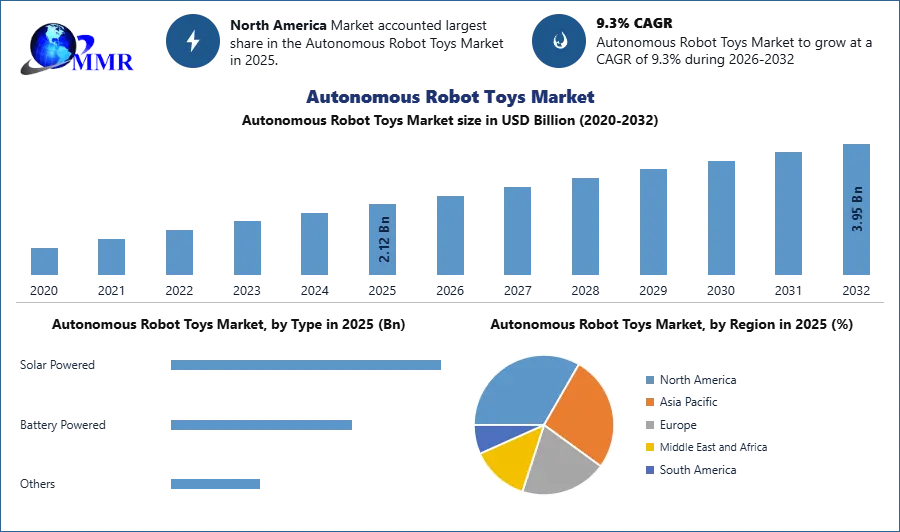
Autonomous Robot Toys Market size was valued at 2.12 Bn in 2025 and the total Global Autonomous Robot Toys Market revenue is expected to grow at a CAGR of 9.3% from 2026 to 2032, reaching nearly USD 3.95 Bn by 2032.
Autonomous Robot Toys Market Overview:
Autonomous robot toys are self-operating, AI-powered toys that interact with users or environments using sensors and programmable features, often serving educational or entertainment purposes. The market is expanding due to rising demand for interactive and STEM-focused play, driven by advancements in AI and robotics, with growth fueled by increasing disposable income and tech adoption.
Demand is rising in tech-savvy regions, while supply is keeping pace, though high-tech components. The dominant regions include North America (U.S., Canada) due to strong toy industries and tech penetration. Key autonomous robot toys manufacturers include LEGO Group (Mindstorms), ArcBiotics, Dexter Industries, UBTECH Robotics. End-user contributions come mainly from children and parents (educational/entertainment value), hobbyists/collectors (premium programmable toys), schools (STEM tools), and gift buyers (seasonal demand spikes).
Covid-19 Impact on Autonomous Robot Toys Market:
The COVID-19 pandemic, that began in China and spread throughout the world, and has had an impact on the market. This problem has impacted most autonomous robot toys makers, and it is projected to have a medium-term impact. This is mostly due to the temporary shutdown of robotics-related institutions, universities, and training institutes. As a result, market participants have seen a decrease in sales. For example, ABB (Switzer land Robotics)'s & Discrete Automation segment's revenue fell 26% in Q2 2023 compared to the same period the previous year, owing in part to the impact of COVID-19.
However, the situation improved in Q3 2023, with a decrease of only 3% compared to Q3 2023. As a result of COVID-19, the market saw significant growth among high- and middle-income consumers, prompting the creation of various stay-at-home product lines by the major businesses. Toy and game sales were predominantly driven by online retail of products during the pandemic.
 To know about the Research Methodology :- Request Free Sample Report
Autonomous Robot Toys Market Dynamics:
Government Investments and Educational Demand to Drive Growth in the Autonomous Robot Toys Market
The global autonomous robot toys market is being driven by rising government investments in upgrading educational institutions, rising popularity of autonomous robot toys as perfect teaching equipment, and developments in robot toys. For educating youngsters and developing their talents, autonomous toys have gained a lot of popularity in educational institutions and households. What sets autonomous robot toys apart from other items is their ability to gather accurate and precise information about their surroundings and act on it without the need for human intervention. During the assessment period, this will continue to function as a stimulus for the expansion of the autonomous robot toys market.
Transforming Education Through Interactive STEM Learning and Cognitive Development to Boost the Autonomous Robot Toys Market
Teachers and parents can use these self-contained robot toys for educating a group of children or a single student for a set amount of time. They alter pupils' learning styles, resulting in a more informed and well-adjusted learner. The core function of toys stays unchanged: to entertain; however, autonomous robot toys can go much beyond that. They assist children in developing problem-solving abilities as the interaction stimulates cognitive processes, thinking creatively and imaginatively as the toy encourages exploration, and learning vital skills for today's digital environment. Some autonomous robot toys teach youngsters about STEM (Science, Technology, Engineering, and Math) and programming, as well as basic AI ideas, which is especially important for children with learning disabilities.
High Production Costs and Retail Prices to Restrain Mass-Autonomous Robot Toys Market Accessibility
The high production costs of autonomous robot toys, driven by expensive components like AI processors, advanced sensors, and durable materials, significantly inflate retail prices, limiting mass-market accessibility. According to industry analyses, basic programmable robots for education start at $100, while premium AI-powered models can exceed $500 placing them out of reach for budget-conscious consumers, particularly in emerging markets. A 2024 survey by the International Robotics Association revealed that over 60% of parents in developing economies consider these toys unaffordable, despite recognizing their educational value. Additionally, manufacturing complexities, such as integrating machine learning capabilities and ensuring child-safe designs, further elevate costs.
Autonomous Robot Toys Market Segment Analysis:
Based on Type, the Autonomous Robot Toys market is classified into Solar Powered, Battery Powered and Others. The Battery Powered autonomous robot toys segment is expected to hold a larger share over the coming years with a steady increase in the adoption of solar powered autonomous robot toys. Battery powered toys last a good amount and has no hassle of charging it under the sun. Batteries can also include electric charging like any Bluetooth speaker which also makes it not only convenient but also a safe option to use.
Based on Application, the Autonomous Robot Toys market is classified into Educational and Entertainment. The Entertainment Autonomous Robot Toys have had a higher market share throughout the years and is expected to continue with a high growth rate of Educational Autonomous Robot Toys in competition. This is due to recent advancements in technology and AI collaborated with education and distance learning especially booming after the Covid pandemic. Although, toys are originally meant to be entertainment and that is what attracts most children, teenagers or even young adults to buy them for leisure.
Autonomous Robot Toys Market Regional Overview:
North America Accounted Highest Share in the Autonomous Robot Toys Market
North America is projected to hold the largest share of the global market, according to the report, and is projected to grow at an impressive CAGR over the forecast period, owing to ongoing technological advancements, the heavy presence of leading market players, and the growing adoption rate of autonomous robot toys throughout educational institutes. Leading institutes in industrialized countries such as the United States use autonomous robot toys to help students acquire skills and make the learning process more engaging and enjoyable.
Sales of autonomous robot toys in Asia Pacific are expected to expand at a rapid CAGR during the forecast period, thanks to rising acceptance of classroom automation and increased government spending in modernizing the educational sector. Countries like China and Japan are popular for robotics and engineering, they have the resources and even a fan base or customers for robot toys be it their cultural reference for their inclination towards anime or entertainment. Due to the growing popularity of such teaching Equipments, availability of many items at reduced rates, and rapid expansion of the educational industry, countries like China & South Korea are experiencing huge market for autonomous robot toys.
Autonomous Robot Toys Market Competitive Landscape:
Sony continues to dominate the premium segment of autonomous robot toys, with its AIBO robotic dog achieving 92% customer satisfaction (2024 Sony Consumer Report) and maintaining a 15% market share in the high-end ($1,000+) category. The company’s focus on advanced AI and emotional connectivity has resulted in 40% repeat purchase rates among luxury buyers, outperforming competitors in brand loyalty. Sony’s 18% YoY increase in robotics-related patents according to 2024 WIPO data underscores its innovation leadership, particularly in lifelike interaction and machine learning. AIBO’s integration with Sony’s ecosystem (e.g., smart home compatibility with 85% of IoT devices) enhances its value proposition. In Japan, AIBO holds 30% of the companion robot market, with growing demand in affluent U.S. and European households.
Autonomous Robot Toys Market Key Trends:
• AI- Powered Personalization: Autonomous robot toys are increasingly using adaptive AI to tailor interactions, with 65% of new models featuring voice/behaviour recognition (TechKids Report 2024).
• STEM-Focused Educational Demand: Schools drive 40% of sales for programmable robots, as governments invest USD 2.8B globally in robotics curricula (Gartner 2025).
• Eco-Conscious Designs: 30% of 2025 launches use recycled materials, responding to Gen Alpha’s parents’ sustainability demands (GreenToy Alliance).
Recent Industry Developments
| Exact Date | Company | Development | Impact |
|---|---|---|---|
| 12 January 2026 | Lego Group | The company launched an AI-integrated Mindstorms successor featuring native edge-computing for real-time obstacle avoidance without cloud latency. | This development strengthens market leadership by providing more complex autonomous behaviors for advanced educational users. |
| 22 November 2025 | Sony Group Corporation | Sony announced a major software update for its AIBO companion robot, enabling multi-robot coordination and localized spatial mapping. | The update enhances the entertainment segment's value proposition by allowing collaborative play in smart home environments. |
| 15 September 2025 | UBTECH Robotics | The firm entered a strategic partnership with regional school boards to deploy 50,000 humanoid robot toys for primary AI education. | This mass commercialization deal significantly scales the educational support tools segment across Asian markets. |
| 04 June 2025 | Modular Robotics | The company unveiled Cubelets 2.0, incorporating low-energy Bluetooth Mesh for faster inter-module communication in autonomous builds. | The upgrade improves user engagement by reducing response lag in modular, self-navigating toy configurations. |
| 18 March 2025 | ArcBotics | The company released the Sparki Pro, an affordable autonomous robotics kit featuring integrated LiDAR for advanced SLAM learning. | Lowering the price point for LiDAR-capable toys increases accessibility for high-school level STEM programs globally. |
Autonomous Robot Toys Market Scope: Inquire before buying
| Autonomous Robot Toys Market | |||
|---|---|---|---|
| Report Coverage | Details | ||
| Base Year: | 2025 | Forecast Period: | 2026-2032 |
| Historical Data: | 2020 to 2025 | Market Size in 2025: | 2.12 USD Billion |
| Forecast Period 2026-2032 CAGR: | 9.3% | Market Size in 2032: | 3.95 USD Billion |
| Segments Covered: | by Type | Solar Powered Battery Powered Others |
|
| by Application | Educational Entertainment Others |
||
North America (United States, Canada and Mexico)
Europe (United Kingdom, France, Germany, Italy, Spain, Sweden, Russia, Rest of Europe)
Asia Pacific (China, Japan, South Korea, India, Australia, Malaysia, Thailand, Vietnam, Indonesia, Philippines, Rest of APAC)
Middle East and Africa (South Africa, GCC, Nigeria, Egypt, Turkey, Rest of MEA)
South America (Brazil, Argentina, Colombia, Chile, Peru, Rest of South America)
Key Players / Competitors Profiles Covered in Brief in Global Autonomous Robot Toys Market Report in Strategic Perspective:
- Parallax Inc.
- ArcBiotics
- Dexter Industries
- Wonder Workshop
- Anki
- Petronics
- RoboThink
- Lego Group
- Modular Robotics
- Fischertechnik GmbH
- Blue Frog Robotics
- Hanson Robotics
- MRT International
- RAWrobotics
- Robotical Ltd.
- Byrobot
- Robo Wunderkind
- Sphero
- WowWee Group
- UBTECH Robotics
- Makeblock
- Digital Dream Labs
- Sony Group Corporation
- Matatalab
- Birdbrain Technologies