
Automotive Noise, Vibration, and Harshness (NVH) Materials Market by Application (Absorption, Damping, Insulation), Material (Rubber, Thermoplastic Polymers, Engineering Resins, Other), End-Use Industry (Automotive, Aerospace, Consumer Goods, Power Tools, Other), and Region - Global Market Size Estimation, Industry-Wide Analysis, Competitive Landscape Assessment & Long-Term Forecast to 2030
Overview
Automotive Noise, Vibration, and Harshness (NVH) Materials Market size was valued at USD 12.97 Bn. in 2023 and the total market revenue is expected to grow by 5.5 % from 2024 to 2030, reaching nearly USD 18.87 Bn.
Automotive Noise, Vibration, and Harshness (NVH) Materials Market Overview:
NVH material refers to the production of noise-reducing components, also known as NVH materials in the automotive industry. NVH parts are designed to reduce unwanted sources of noise and vibration in vehicles. components and techniques are frequently used outside of the automotive industry to reduce the effects of noise and vibration in other electronic products and machinery. Market reduction efforts are primarily focused on absorption and insulation. The steady revenue growth of the automotive Noise, Vibration, and Harshness (NVH) materials market can be attributed to the growing demand for cars in an emerging market. Sales of electric vehicles increased by around 60% in 2023.
Furthermore, regulatory authorities are increasing the number of warranty claims implemented in the interest of customers against noise, vibration, and harnesses. This has prompted automotive manufacturers to aggressively invest in research and development to create and incorporate NVH materials in terms of speed, horsepower, fuel economy, comfort, and NVH characteristics that influence their buying decision. Foam laminates are extensively used as insulation materials for floor insulation, door insulation, floor lining, and vehicle cushioning because of their lightweight and flexibility.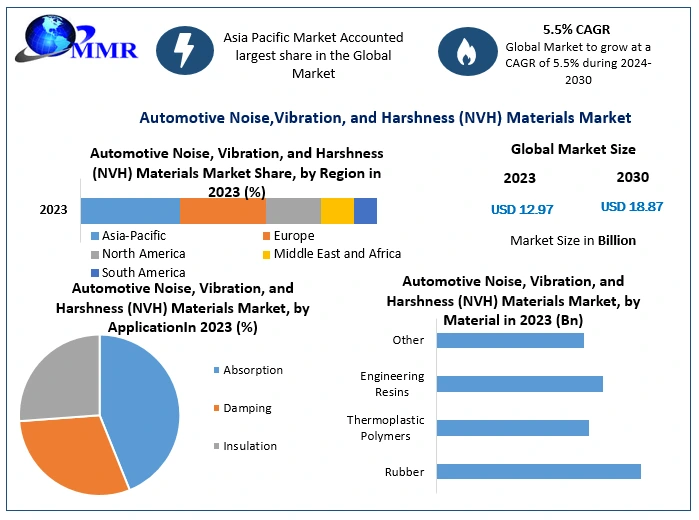 To know about the Research Methodology :- Request Free Sample Report
Automotive Noise, Vibration, and Harshness (NVH) Materials Market Market Dynamics:
Growing demand for lightweight automotive vehicles
Automotive fuel efficiency and NVH (noise, vibration, and harshness) performance are key considerations in a customer's car purchasing decision. Lightweight vehicle designs are required to help with fuel economy improvements. The weight-saving potential and NVH performance of several lightweight glazing materials increase demand for Automotive Noise, Vibration, and Harshness (NVH) Materials Market for lightweight design.
The lightweight glazing materials with "Material A," "Material B," "Material C" with conventional lamination, and "Material C" with acoustic lamination. According to the findings of this study, lightweight glazing materials can save 30% to 40% of their weight without sacrificing NVH, which creates an opportunity for Automotive Noise, Vibration, and Harshness (NVH) Materials Market players.
These materials have substantially higher damping qualities than standard tempered glass, allowing them to compensate for the mass reduction influence on vehicle NVH. Statistical Energy Analysis (SEA) studies also show that it is possible to prevent NVH degradation by employing glazing materials with good damping qualities or laminated panels with damping loss values ranging from 6% to 20%. The report addresses the weight reduction and NVH performance of lightweight glazing materials with driving factors of NVH materials.
NVH Solutions for Future Mobility Concepts
Mobility trends such as e-mobility, autonomous driving, and energy efficiency create huge difficulties for the whole automotive industry. Apart from technical implementation, modifications frequently have an impact on the comfort and convenience of all passengers. To ensure comfortable, calm, and safe travel in a fuel-efficient, electrified, or even autonomous future, new Noise, Vibration, and Harshness (NVH) solutions are required.
From self-driving cars to shared mobility solutions, automakers must discover new ways to move people and products in a reliable, safe, and cost-effective manner. This demands lighter, more environmentally friendly automobiles that run on less gasoline. Vibracoustic creates novel NVH solutions for established and developing automotive manufacturers' future mobility concepts, which are expected to drive the Automotive Noise, Vibration, and Harshness (NVH) Materials Market.
rowing demand for battery electric vehicles creates a noiseless and vibration-free ride for passengers. Passengers in autonomous vehicles will even have a higher impression of NVH challenges when steering, accelerating, and braking control are transferred to the vehicle in partially or fully autonomous vehicles. As a result, standard NVH products are no longer suitable for future mobility concepts.
However, it is not only technological needs that are increasing; drivers and passengers are increasingly demanding greater comfort and convenience in their vehicles. When it comes to buying a new automobile, two-thirds of drivers in China, Germany, and the United States believe comfort and convenience are the most significant factors. In addition, 75% believe that noises and vibrations have an adverse effect on their health, such as a low mood or lack of attention. Thanks to the high demand for Automotive Noise, Vibration, and Harshness (NVH) Materials Market globally.
Increased overall vehicle weight owing to the usage of NVH materials
The NVH control materials have been noted to increase the overall weight of the vehicle. The increasing cost of automotive fuels, combined with increased awareness of greenhouse gas-emitting vehicle emissions, has encouraged manufacturers to create more fuel-efficient vehicles. A few years ago, 2000 cc engines were available in automobiles offered by top Japanese, European, and American manufacturers.
The same automobiles now employ 1000 to 1500 cc engines, which are as powerful and about 1.5 times more fuel-efficient than the outgoing 2000 cc engines. The next generation of engines emits less pollution. The CO2 emissions from the new engine per kilometre of travel are about one-fifth that of the older 2000 cc engines.
Manufacturers use different strategies, such as more efficient fuel injection systems and turbochargers, to make the smaller power trains produce power similar to the older normally aspirated engines. The new engines can run more parts and create noise. Additional NVH control materials are used to observe NVH requirements. The increased vehicle weight caused by the use of NVH materials may hamper the growth of the Automotive Noise, Vibration, and Harshness (NVH) Materials Market during the forecast period.
EVs Drive NVH Material Innovations
The trend toward electric vehicles presents both challenges and opportunities for automotive
manufacturers. The growing demand for Automotive Noise, Vibration, and Harshness (NVH) Materials Market in electric vehicles, thanks to the driving range of electric vehicles is one of the most important. The EV development groups work hard to lower vehicle weight in order to boost driving range. However, there is no opportunity for reducing the weight of the vehicle chassis and body. Finding the ideal balance between vehicle weight and performance elements such as durability, noise, vibration, ride, and handling is more important than ever.
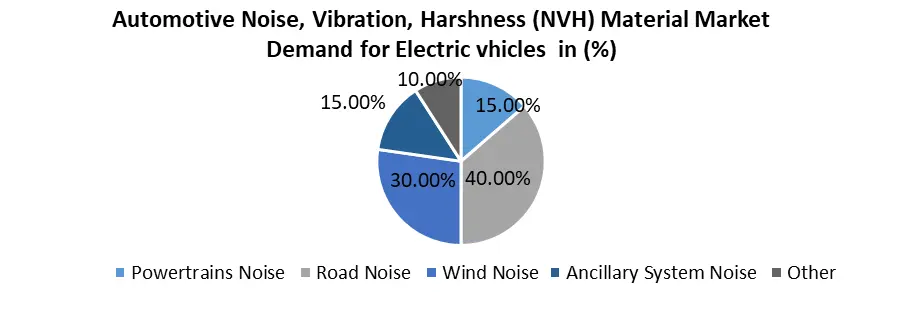 Road noise must be reduced by using effective and dependable processes such as transfer path analysis. (TPA). This technique enables the identification of noise-critical routes on the chassis and automobile body that contribute to interior noise. More advanced approaches, such as strain-based TPA, become critical building blocks to tackle the complexity and closely spaced loads of suspension systems, which drive the Market
For other auxiliaries, the key information can be provided by a wide toolset of NVH tests and analysis techniques. And again, for many of these subsystems, the traditional transfer path analysis (TPA) can help to identify the component or structure causing the noise issue. To keep up with the market, automotive OEMs develop advanced vehicle models rapidly. This creates the need to take control of the vehicle NVH performance as quickly as possible, earlier in the development cycle ever, which creates an oppurchunit for new market players in Automotive, Noise, Vibration, and Harshness (NVH) Material Market globally.
Automotive Noise, Vibration, and Harshness (NVH) Materials Market Segment Analysis:
Based on Material, the Automotive Noise, Vibration and Harness (NVH) material market is segmented into Rubber, Thermoplastic Polymers, Engineering Resins, and Other. Rubber is expected to dominate the Market during the forecast period. Rubber, being the wonderfully flexible material that it is, an excellent NVH material. Rubber's physical features of high density and consistency make it ideal for these applications.
Rubber's significant density absorbs sound and vibrations, while its consistency allows sound and vibration to be spread equally across the material, which is expected to drive the Market Furthermore, rubber compounds of varied thicknesses can be employed to manage the amount of sound and vibration dampening. By altering the thickness of the material used, dampening can be reduced or increased as required.
The high density of rubber absorbs the vehicle's sound and vibrations, while the consistency allows the sound and vibration to be distributed evenly throughout the material. Rubber compounds of varying densities can be used to limit the amount of sound and vibration dampening. By varying the density of the substance utilized, less or more dampening can be obtained as desired. Rubber compounds minimize vibration transfer from one component of the vehicle to another.
NVH is controlled in vehicle design by limiting the transmission of undesired noises and vibrations into the passenger compartment. The NVH components that absorb and dampen noise and vibrations are utilized to eliminate undesirable concerns and improve comfort, efficiency, and safety of the vehicle.
Based on the Application, the Automotive Noise, Vibration, and Harshness (NVH) Materials Market is segmented into Absorption, Damping, and Insulation. Absorption is the held largest market share in 2023. The most common way for NVH control is for physical structures to absorb sound energy. Mechanical properties, density, fundamental structure, component shape, connections, and stress are all complex linkages between physical and design elements that influence how well different materials absorb energy. When a light material is directly substituted in a current design, but a greater mass is required to meet NVH criteria, automakers may face a zero-sum game. Consideration of NVH early in the design of new material can have a positive impact on weight, cost, and energy. Because of increased demand, the insulation segment is likely to grow at a stable rate during the forecast period.
Automotive Noise, Vibration, and Harshness (NVH) Materials Market Regional Insights:
Asia Pacific Market is expected to dominate the market during the forecast period. Increasing activities by key market players in the region as car manufacturers put more emphasis on sound management and noise reduction in passenger and commercial vehicles using NVH materials to increase durability, decrease cabin noise, improve fuel efficiency, and offer extra protection. For example, on August 30, 2022, BASF introduced Thermoplastic Polyurethane Paint Protection Film from RODIM for improved automobile paint protection. RODIM, a BASF paint-related product, launched its new invisible Thermoplastic Polyurethane (TPU) Paint Protection Film in Asia Pacific. (PPF).
It provides complete and long-lasting protection for automotive coatings. The RODIM TPU PPF will give car owners additional protection. During a 3,000-hour accelerated UV test, the product displayed excellent durability under natural elements such as high temperatures and extensive sun exposure. RODIM TPU PPF successfully protects autos from a number of chemicals that might cause surface stains, such as tree sap, bugs, bird droppings, acid rain, and others.
Automotive Noise, Vibration, and Harshness (NVH) Materials Market Scope: Inquiry Before Buying
| Automotive Noise, Vibration, and Harshness (NVH) Materials Market | |||
|---|---|---|---|
| Report Coverage | Details | ||
| Base Year: | 2023 | Forecast Period: | 2024-2030 |
| Historical Data: | 2018 to 2023 | Market Size in 2023: | USD 12.97 Bn |
| Forecast Period 2024 to 2030 CAGR: | 5.5% | Market Size in 2030: | USD 18.87 Bn |
| Segments Covered: | by Application | Absorption Damping Insulation |
|
| by Material | Rubber Thermoplastic Polymers Engineering Resins Other |
||
| by End-Use Industry | Automotive Aerospace Consumer Goods Power Tools Other |
||
Automotive Noise, Vibration, and Harshness (NVH) Materials Market, by Region
North America (United States, Canada and Mexico)
Europe (UK, France, Germany, Italy, Spain, Sweden, Austria and Rest of Europe)
Asia Pacific (China, South Korea, Japan, India, Australia, Indonesia, Malaysia, Vietnam, Taiwan, Bangladesh, Pakistan and Rest of APAC)
Middle East and Africa (South Africa, GCC, Egypt, Nigeria and Rest of ME&A)
South America (Brazil, Argentina Rest of South America)
Automotive Noise, Vibration, and Harshness (NVH) Materials Market Key Players
1. AltruWood, Inc.
2. Atlantic Reclaimed Lumber, LLC
3. Beam & Board, LLC
4. Carpentier Hardwood Solutions NV
5. Elemental Republic
6. Jarmak Corporation
7. Longleaf Lumber Inc.
8. Royal TenCate
9. NAUE Group
10. GSE Holdings, Inc.
11. Officine Maccaferri S.p.A.
12. Olde Wood, Ltd.
13. Vintage Timberworks Inc.
14. Imondi Flooring
15. Elmwood Reclaimed Timber
16. Trestlewood
Frequently Asked Questions:
1] What segments are covered in the Global Automotive Noise, Vibration, and Harshness (NVH) Materials Market report?
Ans. The segments covered in the Automotive Noise, Vibration, and Harshness (NVH) Materials Market report are based on Type, Application, End-user, and Region.
2] Which region is expected to hold the highest share in the Global Automotive Noise, Vibration, and Harshness (NVH) Materials Market?
Ans. The North America region is expected to hold the highest share of the Market.
3] What is the market size of the Global Automotive Noise, Vibration, and Harshness (NVH) Materials Market by 2030?
Ans. The market size of the Market by 2030 is expected to reach US$ 18.87 Bn.
4] What is the forecast period for the Global Automotive Noise, Vibration, and Harshness (NVH) Materials Market?
Ans. The forecast period for the Automotive Noise, Vibration, and Harshness (NVH) Materials Market is 2024-2030.
5] What was the market size of the Global Market in 2023?
Ans. The market size of the Market in 2023 was valued at US$ 12.97 Bn.