
Astronaut Space Suits Market Size by Suit Type, Material Technology, Weight, Life Support Architecture, Application, End User, Region, Industry-Wide Analysis, Competitive Landscape Assessment & Long-Term Forecast to 2032
Overview
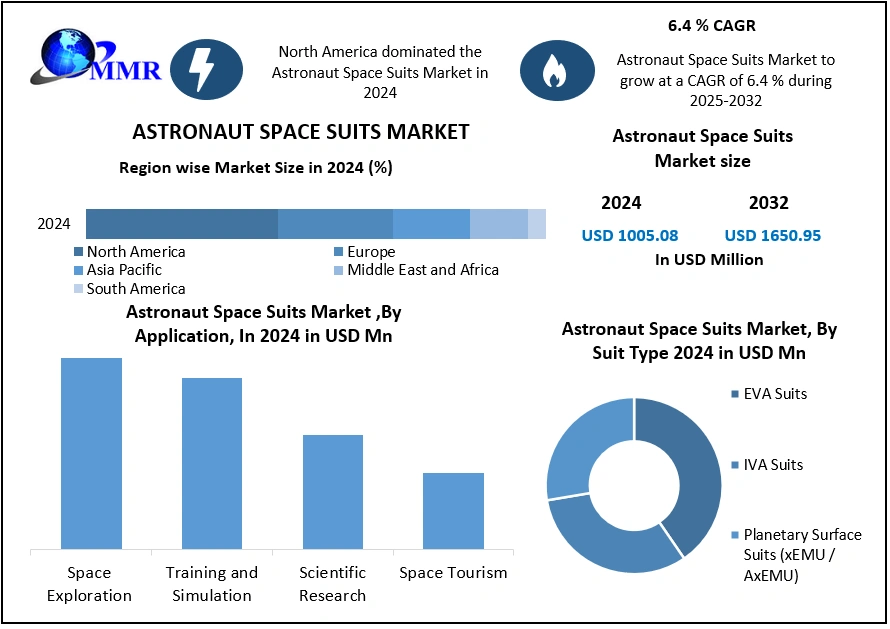
The Astronaut Space Suits Market size was valued at USD 1005.08 Million in 2024, and the total revenue is expected to grow at CAGR of 6.4 % from 2025 to 2032, reaching nearly USD 1650.95 Million.
The Astronaut Space Suit Market Report provides an extensive and structured analysis covering all critical dimensions of the industry, including market evolution, engineering materials, suit specifications for ISS, lunar, Mars, and commercial missions, and detailed comparisons between IVA and EVA suits. It further examines space tourism suit requirements, pricing and procurement models, life-support technologies, next-generation engineering innovations, and global testing and certification standards. The report also assesses manufacturing ecosystems, supply chain risks, end-user procurement behaviors, maintenance and lifecycle management, sustainability metrics, and region-specific regulatory frameworks. these sections deliver a complete and data-driven understanding of current trends, technological advancements, and future developments across the astronaut space suit ecosystem.
A spacesuit is a protective garment worn by astronauts in space to shield them from the harsh environment. Space radiation is hazardous to the human body and can cause hypothermia and heat strokes. It shields astronauts from the sun's UV radiation while also maintaining the ideal air pressure and atmosphere for breathing. During the forecast period, the astronaut spacesuit market is expected to grow rapidly due to an increase in space exploration missions and increased awareness of space programmes.
 To know about the Research Methodology :- Request Free Sample Report
Increasing investments in deep space human exploration initiatives by countries such as US, China, India, and Russia are expected to boost demand for space suits through the forecast period. The market is expected to grow rapidly in the next years as new and upgraded spacesuits with advanced materials for low weight and increased mobility are developed.
The Global Astronaut Space Suits Market is segmented by type, design and application. Based on type, the market is segmented into IVA Suits and EVA Suits. Based on design, the market is segmented into Soft-suit, Hard-shell suit, Skin-tight suit and Hybrid suit. Based on application, the market is segmented into Intravehicular Activity (IVA) and Extravehicular Activity (EVA). Based on region, the market is segmented into North America, Asia Pacific, Europe, Middle East & Africa, and South America.
In the report, 2021 is considered as a base year to forecast the market from 2022 to 2027. 2021’s market size is estimated on real numbers and outputs of the key players and major players across the globe. Past five years' trends are considered while forecasting the market through 2027.
Astronaut Space Suits Market Dynamics
The need for a spacesuit is driven by the growing trend of commercial space flight, the development of multifunctional spacesuits, and wearable technologies. Furthermore, as the pace of space exploration missions picks up, so does the manufacture and demand for spacesuits for extravehicular activities, requiring more regional and international enterprises to participate. Several governments are increasing their investments in human space exploration initiatives in deep space. Additionally, the incorporation of technology for the construction of new-generation spacesuits with advanced materials for reduced weight and better mobility is propelling the global astronaut spacesuit market, which is expected to produce substantial demand over the forecast period.
Rapid Increase in Extravehicular Activities
Extravehicular activities on the space station are often activities for planetary exploration, such as spacewalks, satellite repair, and other exterior operations. Environmental protection, movement, communications, and life support are all provided by the extravehicular mobility unit (EMU) suits. Many countries are expanding their space programmes around the world. Furthermore, space research organisations like NASA have begun to launch several missions to the moon, Mars, and other planets. EVA suits are necessary for various extravehicular activities. Moreover, continual developments in astronaut spacesuits are expected to drive the global astronaut spacesuit market growth through the forecast period.
Growing Importance of New Products, Applications and Services
Companies are readily entering the market and providing a variety of on-demand services. As a result, the opportunities for new applications, products, and services are expanding. Many private actors, for example, are presently offering internet-based space exploration to the general public. The decreasing cost of building and launching satellites has led in an increase in forthcoming launches for earth observation, surveillance, and communication purposes by both military and corporate enterprises around the world. Moreover, compared to the relatively restricted sources in the 1990s, financing for private spaceflight has risen in recent years from a bigger pool of sources. With a 100-fold increase since 1980, some investors believe the traditional spaceflight sector is poised for competition. A total of USD 1.8 billion was invested in private spaceflight businesses by venture capital firms, which was more than they had invested in the preceding 15 years. Lux Capital, Bessemer Venture Partners, Khosla, Founders Fund, RRE Ventures, and Draper Fisher Jurvetson were the largest and most active investors in space. These factors are driving the astronaut space suit market.
Substantial Growth in Investment for Space Exploration Missions
Countries all across the world are investing more on space exploration projects. Because of a rise in space exploration missions and projects, the Asia-Pacific and European regions are expected to drive global market growth. Moreover, the next generation space suits are lighter and more mobile, providing astronauts with greater comfort and safety. Also, space projects indicate a country's strength in the aeronautics sector, resulting in an increase in investment and chances for leading market participants to increase output. Wearables, a urine collection transfer assembly, a pharmaceutical support assembly, and an air pressure control helmet make up these spacesuits. The spacesuits also protect astronauts from the harsh conditions of space, such as micrometeorites and rapid temperature changes.
Astronaut Space Suits Market Segment Analysis
Based on the Suit Type, In 2024, EVA suits is expected to dominate the global Astronaut Space Suits Market due to the rising number of spacewalks, ISS maintenance operations, and growing commercial missions. IVA suits rank as the second-dominant segment, supported by continuous demand for crew transport, pre-launch operations, and commercial capsules from NASA, SpaceX, and emerging private operators. Planetary surface suits (xEMU/AxEMU) remain the fastest-growing category, propelled by Artemis lunar missions and future Mars exploration requiring advanced mobility, dust mitigation, and next-gen life-support systems. Overall, increasing mission complexity, private astronaut programs, and renewed lunar ambitions are reshaping suit engineering and boosting adoption across all suit types.
Based on the End User, In 2024, government space agencies are expected to dominate the global Astronaut Space Suits Market, driven by large-scale programs such as NASA’s Artemis, ESA’s exploration missions, CNSA and Roscosmos operations, and ISS-based EVA activities that require continuous suit upgrades, testing, and certification. Commercial launch and space-tourism operators form the second-largest segment, expanding rapidly as SpaceX, Blue Origin, and Axiom Space increase crewed flights and private astronaut missions, boosting demand for customized IVA and training suits. Defense and Research Institutions hold a steady but smaller share, supported by R&D in extreme-environment technologies, life-support systems, material science, and analog mission simulations. Together, these end users drive innovation in mobility, safety, modularity, and planetary surface readiness, shaping next-generation suit development.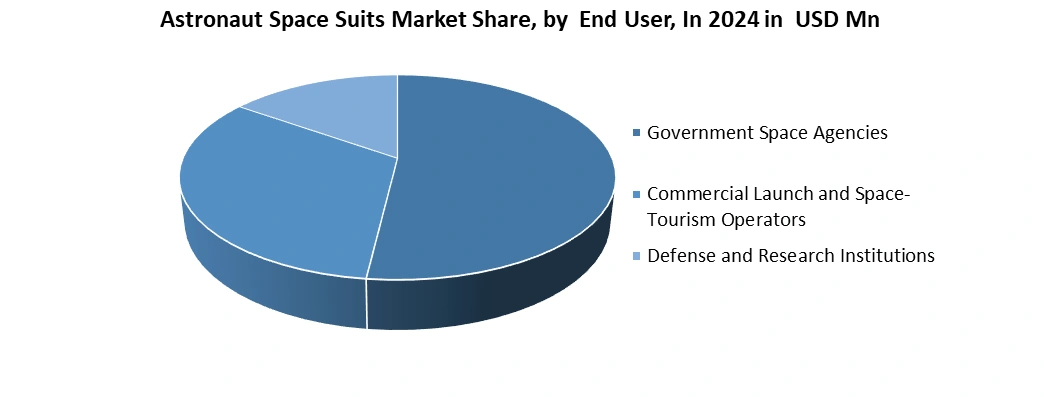
Astronaut Space Suits Market Regional Insights
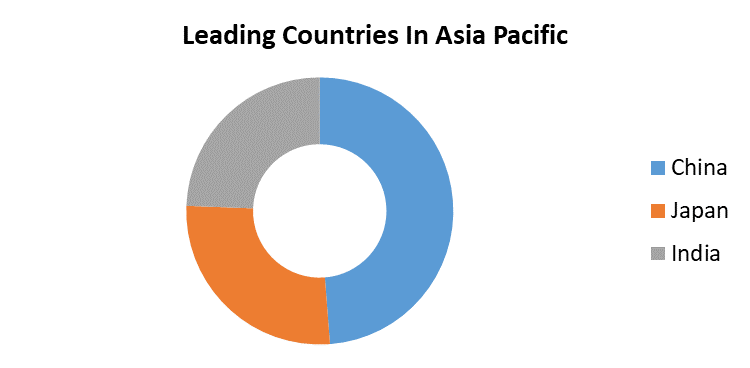
Asia Pacific region is estimated to dominate the Astronaut Space Suits market through the forecast period. The Astronaut Space Suits market in Asia-Pacific region is expected to grow at the highest rate during the forecast period. Human space exploration plans are moving forward in Asia-Pacific countries including China, Japan, and India, among others, with plans to send humans to Mars for planetary explortion in the coming years.
China intends to build and operate a space station in low earth orbit (LEO) as part of its human space exploration programme. The nation intends to complete building the space station by 2024. The China National Space Administration has announced that human exploration of the moon will begin in the 2030s.
The Indian Space Research Organisation (ISRO) has announced that four astronauts would be sent to the International Space Station (ISS) in 2022. ISRO created a new spacesuit for the astronauts (prototype presented in September 2018) with one oxygen cylinder carrying capacity for this mission. In the coming years, such space exploration missions are expected to increase demand for IVA and EVA suits.
In February 1970, Japan launched its first satellite, Osumi, into orbit, becoming the fourth country after the Soviet Union, the United States, and France to do so. It now has a satellite fleet that includes communications, meteorological, earth observation, and astronomical observation satellites.
 Increased space investment in North America is expected to boost the demand for astronaut space suits. The United States is expected to be North America's most crucial and major contributing market. The expansion of the Astronaut Space Suits market in the United States is largely due to NASA. One of the primary factors driving the astronaut space suit market is the increase in the number of satellite launches and launch vehicles. Another key element driving the market in the North American area is increased expenditure on space exploration initiatives.
European area is expected to contribute significantly to the growth of the Astronaut Space Suits market. In comparison to other European countries, Russia Federation dominates the Europe area, launching the majority of space satellites and spaceships. The origins of the Russian space programme can be traced back to 1957, when the Soviet Union launched Sputnik 1, the world's first artificial satellite. The country today has the world's third-largest spacecraft fleet, which includes communications, meteorological, and reconnaissance satellites. The United Kingdom, France, Germany, and Luxembourg are among the few European countries that have contributed significantly to the growth of the global Astronaut Space Suits market. Middle East & Africa and South America is estimated to grow at a steady rate and hold a significant share of the Astronaut Space Suits market during the forecast period.
The global astronaut space suit market is consolidated, with only a few vendors and consumers, with the National Aeronautics and Space Administration (NASA) serving as the dominant end user. Thus, established suppliers prevent new entrants from entering the niche market. New spacesuits for astronauts are being developed by space organisations and industrial businesses, with superior materials, improved communications systems, and more mobility. In future, the corporations are expected to expand their global footprint as the demand for human space exploration missions increases.
The objective of the report is to present a comprehensive analysis of the global Astronaut Space Suits Market to the stakeholders in the industry. The past and current status of the industry with the forecasted market size and trends are presented in the report with the analysis of complicated data in simple language. The report covers all the aspects of the industry with a dedicated study of key players that include market leaders, followers, and new entrants.
PORTER, PESTEL analysis with the potential impact of micro-economic factors of the market have been presented in the report. External as well as internal factors that are supposed to affect the business positively or negatively have been analyzed, which will give a clear futuristic view of the industry to the decision-makers.
The reports also help in understanding the Astronaut Space Suits Market dynamic, structure by analyzing the market segments and projecting the Astronaut Space Suits Market size. Clear representation of competitive analysis of key players by Vehicle type, price, financial position, product portfolio, growth strategies, and regional presence in the Astronaut Space Suits Market make the report investor’s guide.
Astronaut Space Suits Market Scope: Inquiry Before Buying
| Global Astronaut Space Suits Market | |||
|---|---|---|---|
| Report Coverage | Details | ||
| Base Year: | 2024 | Forecast Period: | 2025-2032 |
| Historical Data: | 2019 to 2024 | Market Size in 2024: | USD 1005.08 Mn. |
| Forecast Period 2025 to 2032 CAGR: | 6.4% | Market Size in 2032: | USD 1650.95 Mn. |
| Segments Covered: | by Suit Type | IVA Suits EVA Suits Planetary Surface Suits (xEMU / AxEMU) |
|
| by Material Technology | Soft Suit Hard Shell Hybrid/Mechanical Counter-Pressure (MCP) |
||
| by Weight | Up to 50 kg 50 to 100 kg Above 100 kg |
||
| by Life Support Architecture | Backpack PLSS Distributed-system PLSS Suitport-Integrated Systems |
||
| by Application | Space Exploration Space Tourism Scientific Research Training and Simulation |
||
| by End User | Government Space Agencies Commercial Launch and Space-Tourism Operators Defense and Research Institutions |
||
Astronaut Space Suits Market, by Region
North America (United States, Canada, and Mexico)
Europe (UK, France, Germany, Italy, Spain, Sweden, Austria, and the Rest of Europe)
Asia Pacific (China, South Korea, Japan, India, Australia, ASEAN, Indonesia, Philippines, Malaysia, Vietnam, Thailand, ASEAN, Rest of Asia Pacific)
Middle East & Africa (South Africa, GCC, Nigeria, Rest of ME&A)
South America (Brazil, Argentina, Rest of South America)
Key Players of Astronaut Space Suits Market
1. SpaceX
2. NASA
3. Axiom Space, Inc.
4. ILC Dover LP
5. Collins Aerospace
6. David Clark Company
7. Oceaneering International, Inc.
8. Paragon Space Development Corporation
9. Final Frontier Design
10. NPP Zvezda (Russia)
11. Pacific Spaceflight
12. Sure Safety (India) Ltd.
13. The Boeing Company
14. Blue Origin Enterprises, L.P.
15. Vinyl Technology Inc.
16. Austrian Space Forum (OeWF)
17. Sierra Nevada Corporation
18. JAXA
19. Roscosmos / RSC Energia (Russia)
20. China National Space Administration (CNSA)
21. European Space Agency (ESA)
22. Others
Frequently Asked Questions:
1] What segments are covered in the Astronaut Space Suits Market report?
Ans. The segments covered in the Astronaut Space Suits Market report are based on Suit Type, Material Technology, Weight, Life Support Architecture, Application, End User and region
2] Which region is expected to hold the highest share of the Astronaut Space Suits Market?
Ans. The North America region is expected to hold the highest share of the Astronaut Space Suits Market.
3] What is the market size of the Astronaut Space Suits Market by 2032?
Ans. The market size of the Astronaut Space Suits Market by 2032 is USD 1650.95 Mn.
4] What is the growth rate of the Astronaut Space Suits Market?
Ans. The Global Astronaut Space Suits Market is growing at a CAGR of 6.4 % during the forecasting period 2025-2032.
5] What was the market size of the Astronaut Space Suits Market in 2024?
Ans. The market size of the Astronaut Space Suits Market in 2024 was USD 1005.08 Mn.