
Anti-Ageing Cosmetics Market by Product, Nature, Distribution Channel, End User and Region – Global Market Size Estimation, Industry-Wide Analysis, Competitive Landscape Assessment & Long-Term Forecast to 2032
Overview
Anti-Ageing Cosmetics Market was valued at USD 51.40 Bn in 2024, and total global Anti-Ageing Cosmetics Market revenue is expected to grow at a CAGR of 5.9% from 2025 to 2032, reaching nearly USD 81.31 Bn, by aging population, influencer marketing & natural skincare
Anti-Ageing Cosmetics Market Overview
Anti-ageing cosmetics market includes topical skincare products like serum, cream and lotions designed to reduce visible sign of ageing like wrinkles, fine lines and age spots. Market products developed using dermatological science, natural botanicals and clean label formulations. Driven by the rising global ageing population and growing consumer focus on appearance and wellness, demand is fueled by social media influence, technological advancements and rising disposable incomes. Supply remains robust through innovation in biotech and clean formulations. North America led the anti-ageing market in 2024, driven by premium brand penetration and tech savvy consumers, while Asia Pacific follows by booming demand, influencer led growth, and cultural emphasis on skincare. Market leaders like L’Oréal, Estée Lauder and Shiseido set the pace with R\&D backed luxury offerings and regional strength. End user ranging from individual to aesthetic clinics drive sales via online and retail channels. Regulatory flexibility and increased awareness of ingredient transparency further boost product acceptance and market growth globally.
Report covers the Anti-Ageing Cosmetics Market dynamic, structure by analysing the market segments and projecting Anti-Ageing Cosmetics Market size. Clear representation of competitive analysis of key players by type, price, financial position, product portfolio, growth strategies and regional presence in Anti-Ageing Cosmetics Market.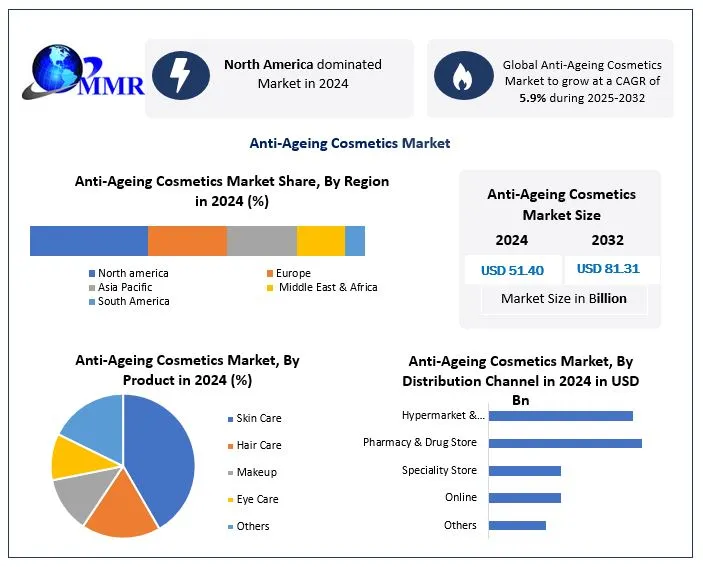 To know about the Research Methodology :- Request Free Sample Report
Anti-Ageing Cosmetics Market Dynamics
Ageing Population, Tech Innovation & Influencer Impact to Drive the Anti-Ageing Cosmetics Market
The growing older population throughout the world is a primary driver of the anti-aging cosmetics business, which is driving the Anti-Ageing Cosmetics market immensely. Consumer awareness of skincare, beauty, and wellbeing has increased demand for anti-aging cosmetics. Consumers are actively looking for items that might address particular ageing problems and help them seem younger. This has led to the success of brands like Drunk Elephant and The Ordinary, which focus on transparent ingredient lists and targeted anti-ageing solutions.
Companies like SkinCeuticals and Neutrogena have leveraged advancements in technology to develop innovative anti-ageing products. The growing influence of social media platforms and beauty influencers has significantly impacted consumer purchasing decisions. Influencers' recommendations and demonstrations of anti-ageing products create awareness and drive consumer interest in trying new products. Brands like Glossier and Fenty Beauty have successfully utilized influencer marketing to promote their anti-ageing offerings.
Scientific Demands and Sensitivity Concerns to Restrain the Anti-Ageing Market Growth
The demand for scientific evidence to support product claims is increasing. Consumers are seeking anti-ageing products backed by clinical studies or proven effectiveness. To produce scientific proof, businesses must spend in research and development. Skinceuticals and La Roche-Posay, for example, emphasise the scientific research behind their anti-aging treatments. Certain components often found in anti-aging cosmetics may cause allergies or skin sensitivity in some customers. To address this, companies such as Clinique and Paula's Choice provide fragrance-free and hypoallergenic solutions for people with sensitive skin.
Wellness Trends and Emerging Markets to drive Future Opportunities in Anti-Ageing Cosmetics Market
The expanding beauty and wellness industry presents significant opportunities for the anti-ageing cosmetics market. Brands like Tata Harper and Dr Barbara Sturm have successfully tapped into the wellness trend by offering holistic and natural anti-ageing products. Emerging markets, especially in Asia Pacific and Latin America, offer untapped potential for the anti-ageing cosmetics market. The rising disposable incomes, changing lifestyles, and increasing beauty consciousness in these regions create new opportunities. For example, K-beauty brands like Laneige and Innisfree have gained popularity in Asia with their innovative anti-ageing offerings.
Anti-Ageing Cosmetics Market Segmentation
Based on Nature, the Anti-Ageing Cosmetics Market is segmented into Natural and Convectional. The conventional segment dominated the anti-ageing cosmetics market in 2024 and Natural segment is expected to grow rapidly during the forecast period. Concerns about synthetic components and a desire for clean, sustainable beauty are driving customer demand for natural and organic skincare products. Tata Harper, Dr. Hauschka, Herbivore Botanicals, RMS Beauty, and Juice Beauty dominate this market. Organic anti-ageing cosmetics are gaining Anti-Ageing Cosmetics market share. Clean and sustainable beauty products propel their growth. Natural and organic anti-ageing brands, botanical extracts, essential oils, and herbal formulations, eco-friendly packaging, and sustainable sourcing are market trends.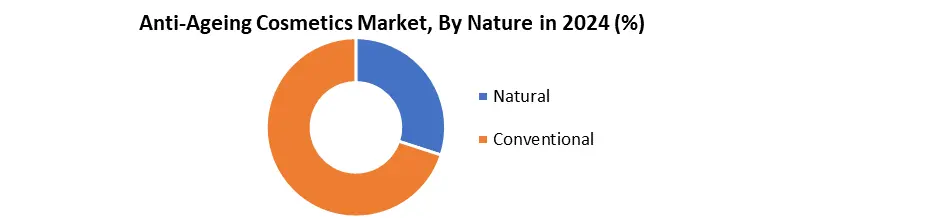
Based on distribution channel, the anti-ageing cosmetics market is dominated by online retail and hypermarkets & supermarkets in 2024. Online platforms are gaining rapid traction due to convenience, greater product variety and personalized marketing. Hypermarkets and supermarkets remain strong, especially for established brands, as they offer immediate availability and trust. Pharmacy and drug stores account for about 15%, valued for offering dermatologist recommended and medically backed products. Specialty stores, cater to premium and brand loyal consumers seeking expert advice. The Others category, including department stores and direct sellers.
Anti-Ageing Cosmetics Market Regional Analysis
North America's Led in the Global Anti-Ageing Cosmetics Market
North America led global anti-ageing cosmetics market in 2024 and is expected to continue its dominance during the forecast period, by large, aging population and strong cultural focus on youth and appearance. High disposable incomes enable consumers to invest in premium skincare products and frequent anti-ageing treatments. The region is also a hub for advanced skincare and medical aesthetic technologies, like Botox and laser procedures. Established brands and robust R&D infrastructure fosters continuous innovation. High consumer awareness, boosted by social media and influencer marketing, keeps anti-ageing products in high demand. Relatively flexible regulatory environment further supports rapid product launches and effective product claims. Factors like demographic, wealth, innovation, branding and a youth centric culture solidify North Americas dominance in the global anti-ageing cosmetics market.
Anti-Ageing Cosmetics Market Competitive Landscape
In the innovation-driven arena of anti-ageing cosmetics, three powerhouses L’Oréal (France), Estée Lauder Companies (USA) and Shiseido Co., Ltd. (Japan) stand out as categorydefining leaders. Each company bring a unique geographic strength, heritage and R&D philosophy, collectively shaping consumer expectations and product evolution across mature and emerging markets.
L’Oréal, often dubbed the "Apple of Beauty," is the market’s most diversified and research intensive player. Backed by decades of dermatological partnership and cutting edge biotech investment (e.g., LabSkin, green sciences), it leads with brands like Lancôme, Vichy and SkinCeuticals positioning itself at intersection of science and luxury.
Estee Lauder, the American prestige beauty conglomerate, dominates premium skincare with icon like Estee Lauder Advanced Night Repair, La Mer and Clinique. Strength lies in digital transformation, influencer led marketing and swift global rollout of innovation, mainly in Asia and the Middle East.
Shiseido, Japan's oldest cosmetic group, fuses traditional Asian beauty principles with deep scientific study. Brands like Vital Perfection and Ultimune cater to sophisticated consumers who value holistic ageing solutions. Shiseido’s agility in hybrid formats cosmeceuticals with wellness cues gives it a sharp edge in the fast growing Asia Pacific region.
Anti-Ageing Cosmetics Market Trends
| Trends | Details | Impact |
| Rise of Non-Invasive Treatments | Growing demand for procedures like Botox, fillers, and laser treatments that offer visible results without surgery. | Expands consumer base and boosts aesthetic dermatology sector. |
| Clean and Natural Skincare Movement | Increasing consumer preference for anti-ageing products with organic, vegan, and chemical-free ingredients. | Drives innovation in product formulations and clean-label branding. |
| Personalized Skincare Solutions | Use of AI, skin diagnostics, and DNA testing to offer customized anti-ageing regimens tailored to individual skin types and concerns. | Enhances customer loyalty and enables premium pricing. |
Anti-Ageing Cosmetics Market Key Developments
• 23rd August 2023, P&G’s (U.S) powerhouse Olay Super Serum launched in the U.S., combining niacinamide, vitamin C, collagen peptides, vitamin E, and AHAs. It quickly became the top selling serum, with a bottle sold “every minute” in the U.S. market.
• 🇺🇸 North America – Estée Lauder Companies (USA)
• 15th January 2024, P&G (U.S) Released Re Nutriv Ultimate Diamond Transformative Brilliance Soft Crème featuring the SIRTIVITY LP™ peptide system. Promised visible age reversal in just 14 days, highlighting advanced skin longevity science.
• 6th January, 2025, L’Oreal (France), unveiled Cell BioPrint at CES 2025, a “lab on a chip” device that determines skin biological age and predicts ingredient responsiveness in about 5 minutes.
• 3rd June 2025, Shiseido (Japan) introduced fourth gen Ultimune with fermented camellia seed extract, supported by Harvard linked research showing Memory T cell activation to eliminate senescent skin cells.
• 8th May 2025, Natura &Co’s (Brazil) revenue surged: +8.2% in Brazil and +38.4% in Hispanic countries. Digital sales climbed +34.7%, with expansions to 149 company stores and 869 franchises.
Anti-Ageing Cosmetics Market Scope :Inquire Before Buying
| Anti-Ageing Cosmetics Market | |||
|---|---|---|---|
| Report Coverage | Details | ||
| Base Year: | 2024 | Forecast Period: | 2025-2032 |
| Historical Data: | 2019 to 2024 | Market Size in 2024: | USD 51.40 Bn. |
| Forecast Period 2025 to 2032 CAGR: | 5.9% | Market Size in 2032: | USD 81.31 Bn. |
| Segments Covered: | by Product | Skin Care Hair Care Makeup Eye Care Others |
|
| by Nature | Natural Conventional |
||
| by Distribution Channel | Hypermarket & Supermarket Pharmacy & Drug Stores Speciality Store Online Others |
||
| by End User | Women Men |
||
Anti-Ageing Cosmetics Market, by Region
North America (United States, Canada and Mexico)
Europe (UK, France, Germany, Italy, Spain, Sweden, Austria and Rest of Europe)
Asia Pacific (China, South Korea, Japan, India, Australia, Indonesia, Malaysia, Vietnam, Thailand, Bangladesh, Phillipines and Rest of APAC)
Middle East and Africa (South Africa, GCC, Egypt, Nigeria and Rest of ME&A)
South America (Brazil, Argentina Rest of South America)
Anti-Ageing Cosmetics Market Key Players
North America
1. Procter & Gamble (U.S)
2. Estée Lauder Companies (U.S)
3. Johnson & Johnson (U.S)
4. Coty Inc. (U.S)
5. Nu Skin Enterprises (U.S)
6. Rodan + Fields (U.S)
7. Mary Kay Inc. (U.S)
8. Avon Products Inc. (U.S)
9. Revlon Inc. (U.S)
10. CP Skin Health Group (U.S)
11. Algenist (U.S)
12. Revision Skincare (U.S)
Europe
13. L’Oréal S.A. (France)
14. Beiersdorf AG (Germany)
15. Clarins Group (France)
16. Caudalie (France)
17. Sisley (France)
18. Weleda AG (Switzerland)
19. Oriflame Holding AG (Sweden)
20. Chanel S.A. (France)
21. LVMH (France)
22. Elizabeth Arden (UK)
23. Medik8 (UK)
Asia Pacific
24. Shiseido Co., Ltd. (Japan)
25. Amorepacific Corp. (South Korea)
26. Kao Corporation (Japan)
South America
27. Natura &Co (Brazil)
Anti-Ageing Cosmetics Market FAQs
1. Which region has the largest share in Global Anti-Ageing Cosmetics Market?
Ans: North America region held the highest share in 2024.
2. What is the growth rate of Global Anti-Ageing Cosmetics Market?
Ans: The Global Anti-Ageing Cosmetics Market is growing at a CAGR of 5.9% during forecasting period 2025-2032.
3. What is scope of the Global Anti-Ageing Cosmetics Market report?
Ans: Global Anti-Ageing Cosmetics Market report helps with the PESTEL, PORTER, COVID-19 Impact analysis, Recommendations for Investors & Leaders, and market estimation of the forecast period.
4. Who are the key players in Global Anti-Ageing Cosmetics Market?
Ans: The important key players in the global market are Procter & Gamble (U.S), Estée Lauder Companies (U.S), Johnson & Johnson (U.S), Coty Inc. (U.S), Nu Skin Enterprises (U.S), Rodan + Fields (U.S).
5. What is the study period of this market?
Ans: The Global Anti-Ageing Cosmetics Market is studied from 2024 to 2032.