
Ammonium Thiosulfate Market Size by Type, Application, Region, Industry-Wide Analysis, Competitive Landscape Assessment & Long-Term Forecast to 2034
Overview
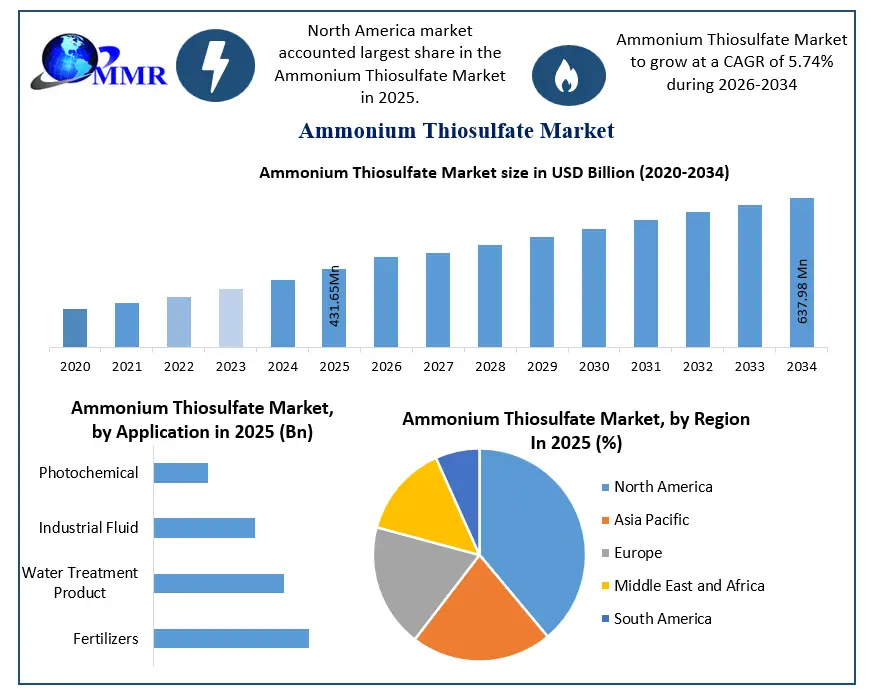
Ammonium Thiosulfate Market was valued at USD 431.65 Mn in 2025, and Global Ammonium Thiosulfate Market is expected to reach USD 637.98 Mn by 2034, growing at a CAGR of 5.74 % during the forecast period.
Ammonium Thiosulfate Market Overview:
Ammonium Thiosulfate is used in the leaching of gold and silver, and in photographic fixing salt. Inorganic ammonium salt composed of ammonium and thiosulfate ions in a 2:1 ratio. It has a role as a fertilizer, an herbicide safener, a bleaching agent, and a reducing agent. It encompasses all aspects of the supply chain, from the manufacturing of ATS from raw materials (like ammonia, water, and sulfur dioxide) to its various applications in end-use industries.
The commercial market for Ammonium Thiosulfate (ATS) has been experiencing a high growth rate, as it helps improve the soil platform and has various applications in industry. The market is categorized as Solid (more than 68 percent share) and Liquid category and on the application sector Fertilizers dominates the sector with 37 percent revenue share. The highest consumer (53.72 percent share in 2025) is North America. Major industry players such as Tessenderlo Kerley, Koch Fertilizer (one of which is a large acquisition in 2025), and Nutrien are setting up new capacities and concentrating on sustainable and high-efficiency production to fulfill the rising demand worldwide. It is growing because it is very important in improving the fertility of the soil (increase crop yields by 9-11%)
Ammonium thiosulfate market is dominated by the Solid ATS segment with a share of more than 68 per cent whereas the application segment with fertilizers has the leading share of 37 per cent revenue share. The largest consumer at the current moment is North America, which has the majority share of 53.72 in the world market.
Ammonium Thiosulfate Market Market Growth Outlook

To know about the Research Methodology :- Request Free Sample Report
Ammonium Thiosulfate Market Dynamics:
Enhanced Soil Fertility and Applications to Drive Ammonium Thiosulfate Market Growth- The increasing use of Ammonium Thiosulfate Fertilizer in Agricultural applications, Industrial applications, and other industries is driving the growth of the Ammonium Thiosulfate market across the world. Ammonium Thiosulfate exerts inhibitory activity at a large agronomic rate of 2500-5000 mg/kg soil, which enhances the fertile rate of the soil. It also slows nitrification, the conversion of ammonium to nitrate, which can reduce the loss of nitrate to the air and water.
Regulatory Pressures and Environmental Considerations to Restrain Ammonium Thiosulfate Market- Ammonium thiosulfate is an eco-friendly and natural product without adverse impacts on the environment, which positively contributes to the Ammonium Thiosulfate Market, whereas the exacting guidelines such as product safety and chemical storage maintenance restrains the growth of the ammonium thiosulfate market. Ammonium thiosulfate is subjected to stringent regulations governing its manufacture, distribution, and usage, especially in the agricultural and industrial domains.
Ammonium Thiosulfate Market Segment Analysis:
Based on the Type the market is segmented into Solid and Liquid types. With the several applications of the solid types of Ammonium Thiosulfate, it captured the largest product segment, accounting for more than 68% of the market in 2022. The solid segment is expected to grow with the highest CAGR of 6.3% during the forecast period. The solid type segment is expected to remain the key segment type of Ammonium thiosulfate thanks to substantial demand for the inorganic compound for various other industries including mining and treatment of industrial wastewater.
Based on Application, the market is segmented into Fertilizers, Water Treatment Products, Industrial Fluid, Photochemicals, and others. The fertilizers segment has acquired the highest market share of 37% by revenue over the forecast period, owing to increasing demand for Ammonium Thiosulfate in Grain Fertilizer, Cash Crop Fertilizer Agricultural Applications. As growing demand for this segment, manufacturers are focusing on the introduction of advanced technology for the product, which fuels a high growth rate for this segment.
Ammonium Thiosulfate Market Regional Insights:
North America region is the largest Ammonium Thiosulfate market consumer in the world during 2025 and it has accounted for more than half of the global consumption of Market share around, 5.74% in terms of revenue. Growth in the region is supported by the presence of major producers and agriculture sector in the region. Europe Occupied significant Ammonium Thiosulfate Market share accounted for more than 5.74% in 2025. The Asia Pacific region is expected to grow significantly in the global Ammonium Thiosulfate market due to lower current market product penetration rates and rising awareness of sustainable agricultural essentials. The Middle East and African market is expected to grow at a slow pace due to poor demand.
The objective of the report is to present a comprehensive analysis of the Ammonium Thiosulfate Market to the stakeholders in the industry. The past and current status of the industry with the forecasted market size and trends are presented in the report with the analysis of complicated data in simple language. The report covers all the aspects of the industry with a dedicated study of key players that include market leaders, followers, and new entrants.
PORTER, PESTEL analysis with the potential impact of micro-economic factors of the market have been presented in the report. External as well as internal factors that are supposed to affect the business positively or negatively have been analyzed, which will give a clear futuristic view of the industry to the decision-makers.
The reports also helps in understanding the Ammonium Thiosulfate Market dynamic, structure by analyzing the market segments and project the Ammonium Thiosulfate Market size. Clear representation of competitive analysis of key players by product, price, financial position, product portfolio, growth strategies, and regional presence in the Ammonium Thiosulfate Market make the report investor’s guide.
Ammonium Thiosulfate Market Competitor Analysis:
Top key Players in Ammonium Thiosulfate Market are Tessenderlo Kerley, Inc., Koch Fertilizer, LLC, Nutrien Ltd., TIB Chemicals AG. Tessenderlo Kerley, Inc. focusing on manufacturing liquid fertilizers based on sulfur such as ATS, and its parent Tessenderlo Group mark good financial performance in 2024. Koch Fertilizer, LLC already made a major acquisition when, in September 2024, it bought the plant of OCI Global in Wever, Iowa, having an estimated capacity of 1.2M tons of nitrogen fertilizer, with a total price tag of nearly 3.6 billion, which also has a direct effect on the provision of ATS. Nutrien Ltd., among the world leaders in crop inputs, showed that its financial position was strong to support strategic investments in its expanded fertilizer portfolio at $5.4 billion adjusted EBITDA in 2024.
TIB Chemicals AG increased its North American operations when it acquired REAXIS Inc. in January 2025, a firm that deals with specialty additives, although it enhances its general chemical position. Kugler Company is a well-known regional player in the U.S, whose innovation is on customized liquid fertilizer solutions. Although Martin Midstream Partners L.P. recorded a net loss of 1.0 million in Q1 2025, adjusted EBITDA of its sulfur services business went up as volumes rose and its new joint venture came online, underscoring the fact that sulfur-based products remain a key source of revenue to Martin Midstream. Such activities and especially key purchases are a sign of a process of market consolidation and building of vertical integration to satisfy an increasing global interest in the efficient fertilizers.
Ammonium Thiosulfate Market Key Trends:
• Growing Demand for High-Efficiency Fertilizers
Global population growth, there's an urgent need to increase crop yields and optimize soil fertility. ATS, as a dual source of nitrogen and sulfur, significantly boosts crop productivity (9-11% yield increase) and improves soil efficiency, making it a preferred choice for modern agricultural practices.
• Rise of Precision Agriculture and Sustainable Farming
The increasing adoption of precision farming techniques, which involve targeted nutrient application and data analytics, is driving demand for liquid fertilizers like ATS. Its ability to be precisely applied, enhance nutrient uptake, and potentially reduce environmental impact aligns with sustainable agriculture goals
• Preference for Liquid Fertilizers
Liquid ATS offers ease of application and superior solubility, making it highly compatible with modern fertigation systems and foliar sprays. This preference for liquid forms over solid forms is a notable trend, despite solid ATS still holding a larger market share.
• Infrastructure Expansion in Emerging Economies
Rapid investments in fertilizer blending and distribution hubs in regions like Latin America, Southeast Asia, and Sub-Saharan Africa are paving the way for wider ATS penetration, supported by government priorities on food security.
Ammonium Thiosulfate Market Recent Development
| Date | Company | Development | Impact |
|---|---|---|---|
| 21 August 2025 | Tessenderlo Kerley, Inc. | The company celebrated the grand opening of its brand-new liquid fertilizer production facility in Defiance, Ohio. | This expansion significantly boosts the domestic supply and distribution infrastructure for high-concentration liquid sulfur fertilizers across North America. |
| 02 September 2025 | Agricen | The company officially launched EXTRACT XC, a specialized agricultural solution that combines microbial-derived biochemistry directly with ammonium thiosulfate. | The new technology improves nutrient release and uptake efficiency from applied liquid fertilizer blends, boosting overall crop performance. |
| 15 January 2026 | Tessenderlo Kerley | The enterprise hosted a milestone event in Rouen, France, celebrating the 1-year anniversary of its French homologation for Thio-Sul® as a dual nitrogen loss inhibitor. | This development solidifies the company's regional leadership and emphasizes sustainable agriculture by reducing volatilization and environmental nitrogen runoff. |
| 15 May 2026 | Westling & Co. | The business detailed progress on constructing a multi-product chemical plant in Gothenburg, Nebraska, engineered to yield 140,000 tons of ammonium thiosulfate annually. | This substantial regional capital allocation will target growing precision farming demand for liquid sulfur amendments in the U.S. Midwest corn belt. |
Ammonium Thiosulfate Market Scope: Inquire before buying
| Ammonium Thiosulfate Market | |||
|---|---|---|---|
| Report Coverage | Details | ||
| Base Year: | 2025 | Forecast Period: | 2026-2034 |
| Historical Data: | 2020 to 2025 | Market Size in 2025: | USD 431.65 Mn. |
| Forecast Period 2026 to 2034 CAGR: | 5.74% | Market Size in 2034: | USD 637.98 Mn. |
| Segments Covered: | by Type | Solid Liquid |
|
| by Application | Fertilizers Water Treatment Product Industrial Fluid Photochemical |
||
Ammonium Thiosulfate Market, by Region
North America (United States, Canada and Mexico)
Europe (UK, France, Germany, Italy, Spain, Sweden, Austria and Rest of Europe)
Asia Pacific (China, South Korea, Japan, India, Australia, Indonesia, Malaysia, Vietnam, Taiwan, Bangladesh, Pakistan and Rest of APAC)
Middle East and Africa (South Africa, GCC, Egypt, Nigeria and Rest of ME&A)
South America (Brazil, Argentina Rest of South America)
Ammonium Thiosulfate Market Key Players:
North America
1. Tessenderlo Kerley, Inc. (United States)
2. Koch Fertilizer, LLC (United States)
3. Nutrien Ltd. (Canada/United States)
4. Kugler Company (United States)
5. Martin Midstream Partners L.P. (United States)
6. Bunge Limited (United States)
Europe
1. Tessenderlo Group NV (Belgium)
2. TIB Chemicals AG (Germany)
3. SKW Stickstoffwerke Piesteritz GmbH (Germany)
4. Yara International ASA (Norway)
5. Esseco Srl (Italy)
Asia Pacific
1. Sumitomo Chemical Co., Ltd. (Japan)
2. Showa Denko K.K. (Japan)
3. Wuzhou Sun Shine Forestry and Chemicals Co., Ltd. (China)
4. Haimen Wuyang Chemical Co., Ltd. (China)
5. Hubei Yihua Chemical Industry Co., Ltd. (China)
6. Shakti Chemicals (India)
Middle East & Africa
1. SABIC (Saudi Basic Industries Corporation) (Saudi Arabia)
2. Sasol Ltd. (South Africa)
3. OCI N.V. (Netherlands)
4. African Resins & Chemicals (Pty) Ltd. (South Africa)
South America
1. Juan Messina S.A. (Argentina)
2. Grupo Resinas Brasil (GRB) (Brazil)
Frequently Asked Questions:
1. Which region has the largest share in Global Ammonium Thiosulfate Market?
Ans: North America region held the highest share in 2025.
2. What is the Growth rate of Global Ammonium Thiosulfate Market?
Ans: The Global Ammonium Thiosulfate Market is growing at a CAGR of 5.74 % during forecasting period 2026-2034.
3. What is scope of the Global Ammonium Thiosulfate Market report?
Ans: Global Ammonium Thiosulfate Market report helps with the PESTEL, PORTER, COVID-19 Impact analysis, Recommendations for Investors & Leaders, and market estimation of the forecast period.
4. Who are the key players in the Global Ammonium Thiosulfate Market?
Ans: The important key players in the Global Ammonium Thiosulfate Market are – Tessenderlo Kerley, Inc., Koch Fertilizer, LLC, Nutrien Ltd., TIB Chemicals AG
5. What is the study period of this Market?
Ans: The Global Ammonium Thiosulfate Market is studied from 2020 to 2034.