
Air Traffic Control Market Size by Airspace, Application, Offerings, Investment Type, Airport Size, Sector, Region, Industry-Wide Analysis, Competitive Landscape Assessment & Long-Term Forecast to 2034
Overview
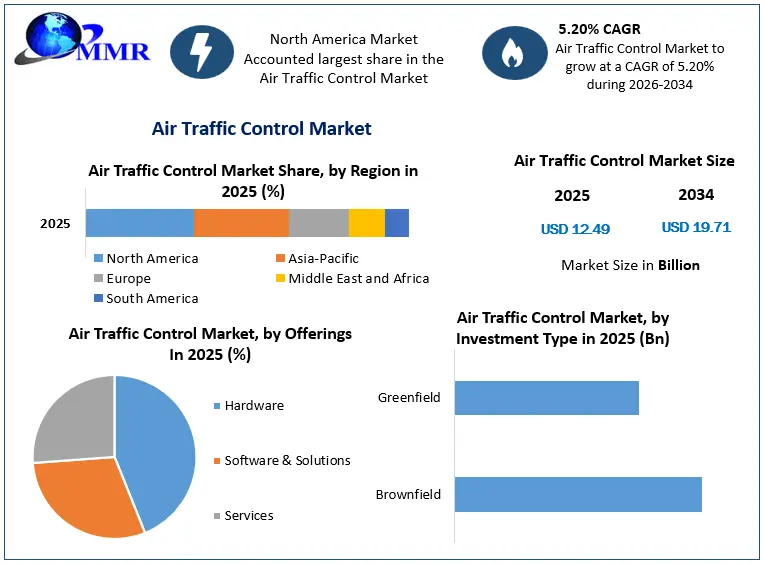
The Air Traffic Control Market size was valued at USD 12.49 Billion in 2025 and the total Air Traffic Control revenue is expected to grow at a CAGR of 5.20% from 2026 to 2034, reaching nearly USD 19.71 Billion.
Air Traffic Control Market Overview:
Ground-based air traffic controllers provide air traffic control (ATC), which is a sort of service that provides crucial data to aircraft. The primary goal of air traffic control systems is to minimise and prevent crashes while also maintaining and organising traffic flow by supplying pilots with meaningful and helpful data.
Air Traffic Control Market Growth Outlook
To know about the Research Methodology:- Request Free Sample Report
Recent Trends of Air Traffic Control Market:
• The Northrop Grumman is a U.S multinational aerospace and defense technology company. In 2020, the U.S multinational aerospace and defense Technology Company generated some USD $ 36.8 billion in revenue. Throughout a seven-year deal worth roughly $350 million, Northrop Grumman Corporation (NYSE:NOC) will continue to support the Federal Aviation Administration (FAA) in modernizing the nation's air traffic control system.
• In March 2021, The Thales Group has unveiled the RSM NG surveillance radar, which will be utilized in air traffic control (ATM). The radar can track around 2,000 airplanes and send 64 real - time data streams to multiple air traffic control centers (ATCC), indicating a high growth potential.
Air Traffic Control Market Dynamics:
Tourism is growing at a rapid rate, which is driving up air traffic all around the world. Passengers prefer to go by plane since it saves time, so the market is looking up. As per the International Civil Aviation Organization, approximately 400 commercial airplane depart per hour around the world. With the increased popularity of air travel, this number is expected to rise in the future. Air traffic control systems are in high demand as a means of reducing plane crashes and tragedies, which is propelling the market forward.
Many emerging nations are planning to build additional airports to improve air travel within and across their borders. For example, as part of Prime Minister Narendra Modi's aim to make India a $5 trillion economy by the end of 2025, India plans to open 100 new airports by the end of 2024. This will consequently result in increased demand for air traffic control systems, increasing the market's growth.
Some constraints, such as cyber security concerns, high starting costs, a scarcity of experienced staff, and a poor infrastructure in various places, are impeding industry progress. Cyber threats to air traffic control have developed as technologies and digitalization have progressed, impeding the industry's growth. By offering communication and information services to pilots and controllers, the Air Navigation Service Providers (ANSP) play a critical role in air traffic control. These companies communicate information about aircraft crossings, flight paths, and weather conditions, as well as providing take-off and landing instructions.
The growing demand for interconnected airports, airlines, and other associated air traffic control and data exchange systems makes them more vulnerable to cyberattacks, which is a primary issue limiting market value. Industries, on the other hand, are creating new and improved technologies to minimize cyberattacks to a minimum range in order to face the obstacles.
Air Traffic Control Market Segment Analysis:
The Air traffic control Market is segmented by Airspace, Application, Offerings, Investment Type, Airport Size and Sector.
Based on the airspace, the Air traffic control Market is segmented into AIR TRAFFIC CONTROL TOWER (ATCT), TERMINAL RADAR APPROACH CONTROL (TRACON), AIR ROUTE TRAFFIC CONTROL CENTERS (ARTCC), and REMOTE TOWER (RT). The air traffic control tower (ATCT) segment held the largest market share of xx% in the global Air traffic control in 2025. Compared with other airspace segments, the ATCT segment has a larger proportion because all countries have a large number of ATCT towers. ATCT also owns key equipment, giving it a larger market share. For example, North America and Europe are investing heavily in equipment modernization to improve air traffic efficiency, thereby expanding the market through brownfield investment.
Based on the Application, the Air traffic control Market is segmented into Communication, Navigation, Surveillance, and Automation. The automation segment is expected to grow at a higher CAGR of 6.8% in the Air traffic control Market during the forecast period. It is growing rapidly as airports and air traffic controllers engage in simulations, and the business is being fueled by the increased use of remote towers. So, this major factor will drive the growth of automation segment in the global Air traffic control during the forecast period.
Based on the Airport Size, the Air traffic control Market is segmented into Large, Small, and Medium. The medium segment is expected to hold the largest market share of xx% by 2034. Passenger traffic at airports is increasing year after year. As a result, the money generated by airports is proportionate to the number of passengers handled. Over 70% of the globe's aviation passenger traffic passes through large and medium-sized airports. As a result of the increased air traffic, airports must modernise their air traffic control systems to ensure efficient airspace operations. Because there are so many medium-sized airports around the globe, medium-sized airports are dominating the industry. These airports have an imminent need to adequately manage their airspace. Seasonal flight traffic is a problem for small airports. As a result, they require a flexible air traffic management alternative, and the remote tower can significantly help these airports.
Air Traffic Control Market Regional Insights:
North America dominate the Air traffic control Market during the forecast period. North America held the largest market share with such a value of USD $ 2.5 billion in the Air traffic control Market in 2025. Increasing investment and implementation of advanced technologies including communications, surveillance and navigation systems provide the industry with strong growth prospects. The increase in air traffic at airports in the region has also contributed to the industry’s revenue. And Europe has the second largest market share of xx% in 2025.
Also, Asia Pacific is expected to grow at a faster CAGR in global air traffic control during the forecast period. The market in Asia Pacific is quickly expanding, result of an increase in air passenger traffic. In addition, considerable investments in airport improvements and the development of new regional airports have helped this region increase exponentially.
The objective of the report is to present a comprehensive analysis of the Air traffic control Market to the stakeholders in the industry. The past and current status of the industry with the forecasted market size and trends are presented in the report with the analysis of complicated data in simple language. The report covers all the aspects of the industry with a dedicated study of key players that include market leaders, followers, and new entrants.
PORTER, PESTEL analysis with the potential impact of micro-economic factors of the market have been presented in the report. External as well as internal factors that are supposed to affect the business positively or negatively have been analyzed, which will give a clear futuristic view of the industry to the decision-makers.
The reports also helps in understanding the Air traffic control Market dynamic, structure by analyzing the market segments and project the Air traffic control Market size. Clear representation of competitive analysis of key players by product, price, financial position, product portfolio, growth strategies, and regional presence in the market make the report investor’s guide.
Air Traffic Control Market Recent Industry Developments:
| Date | Company | Development | Impact |
|---|---|---|---|
| 22 June 2026 | ASI | Secured a 12-year, $875 million software and AI contract from the Federal Aviation Administration (FAA) to deploy its core FMDS and SMART systems. | The platform introduces AI-powered predictive modeling to actively balance airspace capacity, optimize routes, and reduce nationwide congestion before delays manifest. |
| 16 June 2026 | Indra Group USA | Announced the successful operational commissioning of the FAA's first newly upgraded secondary surveillance radar system in Putnam, Oklahoma. | This marks the opening milestone of a large-scale 185-radar deployment under the Radar System Replacement program to phase out aging 1980s infrastructure and minimize latency. |
| 27 May 2026 | Thales | Formed a strategic research and validation partnership with the French Civil Aviation University (ENAC) to co-develop next-generation AI-based air traffic management (ATM) solutions. | The collaboration optimizes flight trajectories to help airlines curb fuel consumption, establishing an environmental target of cutting aviation CO₂ emissions by roughly 10%. |
| 07 January 2026 | Indra Group | Awarded a $342 million contract by the FAA to manufacture next-generation air traffic surveillance radars at its domestic Kansas City facility. | The program establishes a cyber-secure, modernized framework backing the FAA's broader Brand-New Air Traffic Control System (BNATCS) initiative. |
| 06 January 2026 | Collins Aerospace | Secured a major $438 million contract from the FAA to supply advanced cooperative and non-cooperative radar tracking platforms. | By incorporating the Condor Mk3 and ASR-XM systems, the initiative integrates legacy trackers into a unified architecture that drastically improves aircraft tracking precision at low altitudes. |
Air Traffic Control Market Scope: Inquire before buying
| Global Air Traffic Control Market | |||
|---|---|---|---|
| Report Coverage | Details | ||
| Base Year: | 2025 | Forecast Period: | 2026-2034 |
| Historical Data: | 2020 to 2025 | Market Size in 2025: | USD 12.49 Bn. |
| Forecast Period 2026 to 2034 CAGR: | 5.20% | Market Size in 2034: | USD 19.71 Bn. |
| Segments Covered: | by Airspace | AIR ROUTE TRAFFIC CONTROL CENTERS (ARTCC) TERMINAL RADAR APPROACH CONTROL (TRACON) AIR TRAFFIC CONTROL TOWER (ATCT) REMOTE TOWER (RT) |
|
| by Application | Communication Navigation Surveillance Automation |
||
| by Offerings | Hardware Software & Solutions Services |
||
| by Investment Type | Brownfield Greenfield |
||
| by Airport Size | Large Medium Small |
||
| by Sector | Commercial Defense |
||
Air Traffic Control Market, by Region
North America (United States, Canada and Mexico)
Europe (UK, France, Germany, Italy, Spain, Sweden, Austria and Rest of Europe)
Asia Pacific (China, South Korea, Japan, India, Australia, Indonesia, Malaysia, Vietnam, Taiwan, Bangladesh, Pakistan and Rest of APAC)
Middle East and Africa (South Africa, GCC, Egypt, Nigeria and Rest of ME&A)
South America (Brazil, Argentina Rest of South America)
Air Traffic Control Market, Key Players:
1. Air Traffic Management (ATM) & ATC System Providers
These companies develop integrated air traffic control systems, automation platforms, communication networks, surveillance solutions, and command-and-control technologies.
Europe
1. Thales Group – France
2. Indra Sistemas S.A. – Spain
3. Frequentis AG – Austria
4. BAE Systems plc – United Kingdom
North America
5. L3Harris Technologies, Inc. – United States
6. Lockheed Martin Corporation – United States
7. Raytheon Technologies Corporation (RTX) – United States
8. Northrop Grumman Corporation – United States
9. Honeywell International Inc. – United States
2. Radar, Surveillance & Aviation Electronics Manufacturers
These companies manufacture primary and secondary surveillance radars, avionics, communication equipment, and aircraft monitoring technologies.
North America
1. Telephonics Corporation – United States
2. Becker Avionics, Inc. – United States operations
3. Sierra Nevada Corporation – United States
4. Intelcan Technosystems Inc. – Canada
Europe
5. Cobham Limited – United Kingdom
6. Kongsberg Geospatial – Norway
3. Airport Digital Tower, Navigation & Airspace Management Providers
These companies specialize in remote tower systems, airspace visualization, navigation technologies, and airport operational solutions.
North America
1. Searidge Technologies Inc. – Canada
2. Advanced Navigation & Positioning Corporation (ANPC) – Canada
Europe
1. The Aeronav Group – United Kingdom
2. Frequentis AG – Austria
4. Aviation Communication & Connectivity Solution Providers
These companies provide communication, satellite connectivity, and data services supporting aviation operations.
North America
1. Global Eagle Entertainment Inc. (now part of Anuvu) – United States
Frequently Asked Questions:
1. Which region has the largest share in Global Air Traffic Control Market?
Ans: North America region holds the highest share in 2025.
2. What was the Global Air Traffic Control Market size in 2025?
Ans: The Global Air Traffic Control Market size was USD 12.49 Billion in 2025.
3. What is scope of the Global Air Traffic Control market report?
Ans: Global market report helps with the PESTEL, PORTER, COVID-19 Impact analysis, Recommendations for Investors & Leaders, and market estimation of the forecast period.
4. Who are the key players in Global Air Traffic Control market?
Ans: The important key players in the Global market are – The Aeronav Group, BAE Systems plc., Becker Avionics Inc., Cobham Plc., Frequentis AG, Global Eagle Entertainment Inc., Indra Sistemas S. A., Intelcan Technosystems, Inc., Kongsberg Geospatial, L3Harris Technologies, and Inc.
5. What is the study period of this market?
Ans: The Global market is studied from 2020 to 2034.