
Global Air Defence Missile System Market Size, Share, Growth & Forecast (2025–2034)
Overview
Competitor report tells you the air defence market is worth USD 31.23 billion in 2025. This report tells you which six sub-segments have no dominant player, which contracts already prove the budget exists, and which capability gap Golden Dome and NATO’s 5% pledge are both racing to close. That is the difference between a market report and an intelligence report.”
The Global Air Defence Missile System Market Inflection Point
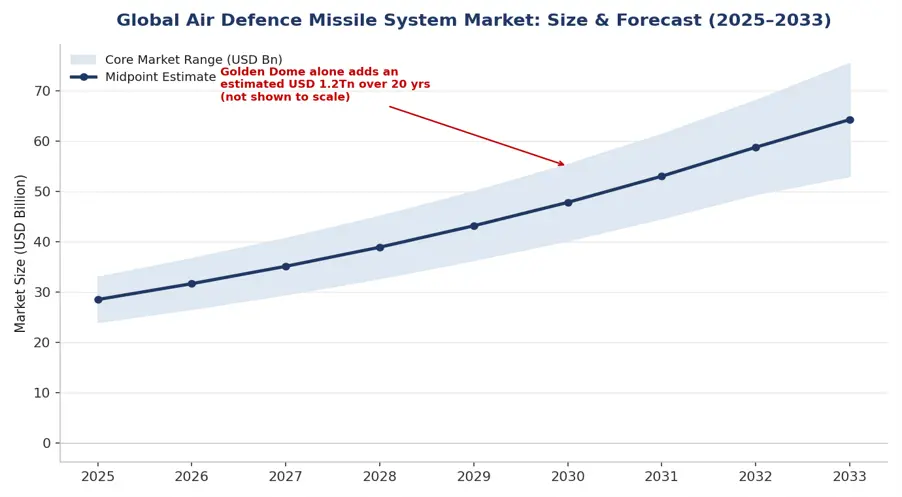
In September 2019, a coordinated drone-and-missile strike on Saudi Arabia’s Abqaiq oil processing complex knocked out nearly five percent of global oil supply within hours. The attackers’ hardware cost a few hundred thousand dollars combined; the economic shock ran into billions. That asymmetry between attack cost and economic consequence is the entire logic of the Global Air Defence Missile System Market. According to Maximize Market Research (MMR) analysis, the market is valued at approximately USD 31.23 billion in 2025 and is projected to reach USD 53–68 billion by 2033, growing at a CAGR of roughly 6–9% — a figure that expands past USD 100 billion once Counter-UAS, directed energy, and the U.S. Golden Dome programme are counted.
This is not a weapons-procurement category — it is the risk-underwriting infrastructure of the modern economy. Every power grid, port, and data centre kept running through a regional conflict has a radar, an interceptor, and a command network behind it. Growth here is not demand-led in the conventional sense; it is driven by a structural realignment of who owns the sensor-to-shooter data layer, who absorbs the cost of an asymmetric attack, and where margin is migrating from kinetic hardware toward software and space-based sensing.
| THREE FORCES PERMANENTLY REDRAWING THE AIR DEFENCE LANDSCAPE |
| 1. Drone and loitering-munition warfare has made the cost of attack structurally cheaper than the cost of defence — forcing a redesign of every layered architecture built before 2020. 2. Space-based sensing and AI battle-management are crossing from experimental to mandatory — Golden Dome and IBCS are making proliferated satellites and sensor fusion contract requirements, not differentiators. 3. Alliance-level policy has hardened demand into law — NATO’s 5%-of-GDP pledge and India’s USD 25 billion single-sitting procurement round show budgets no longer wait for a crisis to move. |
This report is designed for: defense-sector investors and PE firms evaluating air-defence and counter-drone platforms; OEM strategy and business-development teams benchmarking where to deploy R&D capital; government procurement officials assessing capability gaps; institutional investors tracking the Golden Dome and NATO Sky Shield supply chains; and counter-UAS and directed-energy technology companies identifying first-mover entry windows.
To know about the Research Methodology :- Request Free Sample Report
The USD 100,000 Drone vs. USD 4 Million Missile Problem
This is the industry’s defining economic contradiction. A Patriot PAC-3 or comparable interceptor typically costs in the low millions of dollars per round. The drones increasingly used to provoke a launch can cost a fraction of that. Used unselectively, layered air defence becomes a war of attrition that favours the attacker on cost alone — and every defence budget in this report is, in some way, a response to that asymmetry.
| Threat Type | Typical Attack Cost | Typical Defense Cost | Cost Ratio | Industry Response |
| Small Loitering Drone | < USD X00K | USD X–XM (kinetic) | ~X:20–X0 | Counter-UAS / RF & kinetic mitigation |
| Cruise Missile | USD X.5–2M | USD X–4M (SAM) | ~X:2–X | AI-prioritized selective engagement |
| Ballistic Missile (SRBM/MRBM) | USD X–XM | USD X–X0M+ (THAAD-class) | ~X:2–X | Layered, multi-tier interception |
| Drone Swarm (10–50 units) | < USD XM total | USD 10–40M (unselective) | ~X:20+ | Directed energy / HPM (cost-per-shot → electricity) |
| Hypersonic Glide Vehicle | USD X0–30M+ | Interceptor in development | Currently unfavorable to defender | Glide-Phase Interceptor (GPI) programmes |
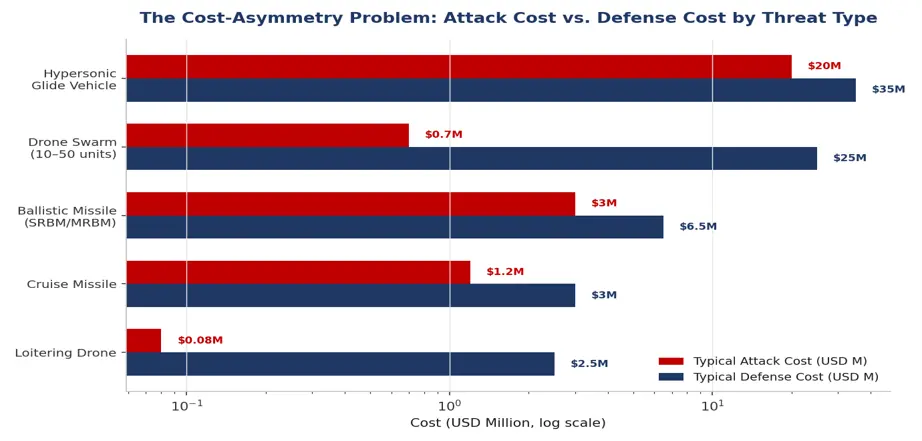
Two responses are now visible in hard numbers. The first is software: Israel’s Iron Dome uses automated threat assessment to skip interceptors against rockets headed for open ground, reportedly cutting ammunition use by 40–60% versus unselective engagement. The second is scale at the cheap end of the threat spectrum: in March 2026 the U.S. Army awarded Anduril Industries a ten-year, USD 20 billion firm-fixed-price contract for its AI-enabled Lattice counter-drone suite — a single company contract larger than most full-market forecasts for the entire global missile defence industry. The U.S. Navy’s CHAMP high-power-microwave system reportedly disabled small drone groups at an 85% success rate in January 2026 shipboard trials, pointing toward a future where the marginal cost of a “shot” approaches the cost of electricity.
The MMR Capability-Economics Matrix
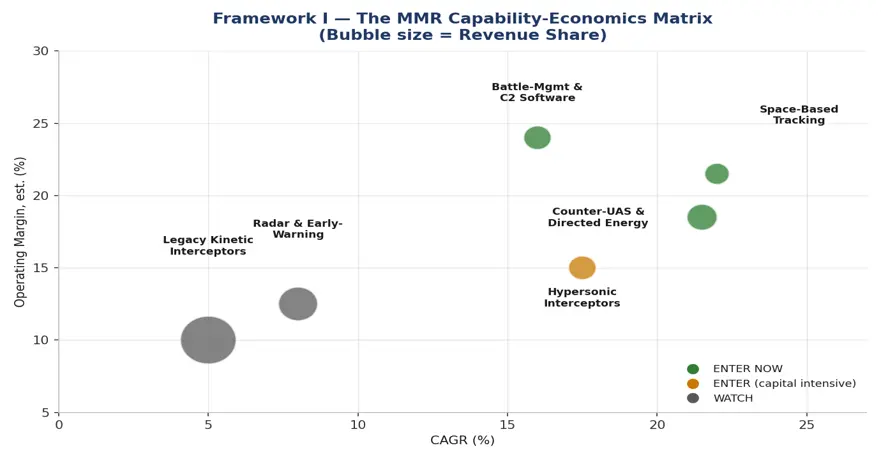
The Capability-Economics Matrix synthesizes five dimensions for each segment of the Global Air Defence Missile System Market: revenue share, operating margin, growth trajectory, competitive density, and the resulting capital-allocation verdict.
| Segment | Revenue Share | Op. Margin (est.) | CAGR | MMR Verdict |
| Legacy Kinetic Interceptors | ~X0% | X–X2% | X–6% | WATCH — volume locked in, margin capped by fixed-price programmes |
| Radar & Early-Warning Systems | ~X0% | X0–X5% | X% | WATCH — steady AESA upgrade cycle, no first-mover window |
| Battle-Management & C2 Software | ~X0% | 2X–2X% | X% | ENTER NOW — highest margin, IBCS / Golden Dome tailwind |
| Counter-UAS & Directed Energy | ~X2% | 1X–2X% | X% | ENTER NOW — fastest volume growth, Anduril-scale contracts proven |
| Space-Based Tracking & Sensors | ~X% | 1X–2X% | X0%+ | ENTER NOW — Golden Dome is the catalyst; contractor pool still forming |
| Hypersonic-Capable Interceptors | ~X0% | 1X–1X% | X–X0% | ENTER — capital-intensive, very few qualified primes |
 The Margin Migration Map
Value in the Global Air Defence Missile System Market is not static — it migrates. The 2025–2033 window is the most consequential migration since the Cold War, as programmes shift from buying missiles to buying ecosystems.
| FROM (2015–2022) | SHIFT | TO (2024–2033) | Margin Impact |
| Missile inventory size / count | ➡ | Sensor-to-shooter engagement speed | 8–12% → 18–28% |
| Platform ownership (radar, launcher capex) | ➡ | Data / software ownership (IBCS, AI fusion) | Capex → recurring margin |
| Single-nation standalone procurement | ➡ | Multi-nation interoperable architectures | Renewal risk reduced |
| Unselective interception | ➡ | AI-prioritized selective engagement | Ammunition cost –40% to –60% |
| Ground-radar-only detection | ➡ | Proliferated-satellite, space-enabled tracking | New pricing models unlock |
| Commodity kinetic-hardware margins | ➡ | Platform & software margins | 2–3× margin expansion possible |
| MMR INTELLIGENCE ANALYSIS
Lockheed Martin does not compete with Anduril Industries on missile range. Anduril competes on cost-per-engagement and software refresh cycles — and the U.S. Army just backed that thesis with a USD 20 billion, ten-year contract. The prime that owns the sensor-fusion and command layer captures disproportionate value going forward, regardless of which interceptor ultimately fires. |
Strategic Market Forces
| Dimension | Key Forces | Impact |
| Drivers | Missile & drone proliferation; hypersonic weapons race; NATO 5%-of-GDP pledge; Golden Dome catalytic effect; rising drone attacks on critical infrastructure | Very High |
| Restraints | Programme cost overruns (Golden Dome USD 175Bn → USD 1.2Tn); fixed-price contract margin pressure; export-control friction on hypersonic / space-tracking tech | High |
| Opportunities | Counter-UAS at USD 100Bn+ addressable scale by early 2030s; mid-tier nation missile shields; AI battle-management software; naval/maritime C-UAS | Very High |
| Challenges | Few qualified primes for hypersonic interceptors; legacy single-domain SAM systems facing obsolescence; talent shortage in space-systems engineering | Medium-High |
| Trends | AI-prioritized selective engagement; directed-energy weapons moving lab-to-fleet; proliferated low-earth-orbit tracking constellations; software-native entrants (Anduril) winning prime-scale contracts | Transformative |
The Geopolitical Trigger Map
Six geopolitical events are simultaneously reshaping procurement across every region this report covers — each has already created a specific, identifiable contracting opportunity.
| Trigger | Market Impact | Programme / Corridor Created | First-Mover Advantage |
| NATO Hague Summit (2025) | 5%-of-GDP pledge by 2035; European allies + Canada raised spend ~20% in 2025 alone | European Sky Shield Initiative (21 members) | Vendors inside Sky Shield lock multi-year framework agreements ahead of national tenders |
| U.S. Golden Dome Executive Order (2025) | Cost estimate already risen from USD 175Bn to USD 1.2Tn (CBO, May 2026) | Space-based interceptor & tracking layer; SDA satellite constellation | Early SDA / Starshield awardees (SpaceX, Anduril, Lockheed, Northrop, True Anomaly) hold first-mover position |
| Israel–Iran War (2025–ongoing) | Real combat data: ~92% IDF interception rate feeding Western design choices | Accelerated U.S.–Israel co-production of Arrow 3 / Iron Dome-class systems | Israeli primes (IAI, Rafael) gain export credibility — e.g., USD 6.5Bn Germany deal |
| Houthi Red Sea Attacks (2024–ongoing) | Forced naval doctrine rewrite; sustained SM-2/SM-6 expenditure at scale | Renewed urgency for low-cost ship-based interceptors & sea-based directed energy | Navy directed-energy programmes (CHAMP) gain budget priority |
| China Hypersonic Programme / Taiwan Strait Tension | Reframes Golden Dome from rogue-state shield to peer-adversary shield | Glide-Phase Interceptor (GPI) development track | Early GPI contractors secure a multi-decade pipeline |
| India–Pakistan / China Border Tension | ~USD 25Bn DAC approval in a single March 2026 sitting, incl. 5 additional S-400 regiments | Indigenous Akashteer / Akash ecosystem + Russian S-400 expansion | Indian DPSUs (Bharat Dynamics) and Russian primes capture sustained multi-year orders |
Regional Power Dynamics — Six Theatres, One Intelligence Framework
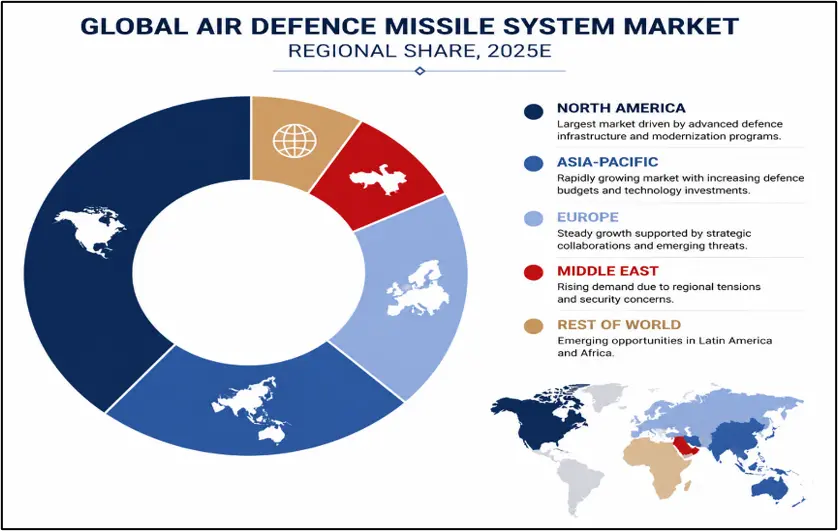
| Region | 2025E Share | CAGR | Strategic Role | The One Insight |
| North America | ~X% | ~X% | Anchor & Architecture Designer | Golden Dome’s USD 1.2Tn price tag will redefine what a ‘national missile shield’ is assumed to cost everywhere else. |
| Europe | ~18–20% | ~X% | Urgency-Driven Re-Armament | NATO’s 5% pledge plus Sky Shield turns 21 separate national procurement decisions into one coordinated buying bloc. |
| Asia-Pacific | ~X–25% | ~X% | Volume & Indigenization Engine | India alone approved USD 25 billion in a single DAC sitting in March 2026 — more than most countries commit in a decade. |
| India (standalone thesis) | Fastest single-country growth | ~XX–1X% | Highest-Beta Single-Country Play | S-400 expansion + indigenous Akashteer/Akash ecosystem = import-substitution and export-platform thesis at once. |
| Middle East | ~X–1X% | ~9–1X% | Highest-Intensity Proving Ground | Operational data from the Israel–Iran war is now the de facto design spec for both Golden Dome and NATO programmes. |
| Rest of World / Africa | Small base, high beta | Double-digit off small base | First-Mover Frontier | Counter-UAS demand is showing up in homeland-security budgets years before any missile-shield budget exists. |
The White Space Map: Six Underpenetrated Segments
Six segments combine the same four signals: demand growing faster than 15% annually, no dominant player above meaningful share, technology infrastructure running ahead of fielded supply, and procurement budgets that already exist but are not yet fully allocated.
| Segment | CAGR | Margin | Opportunity | Why Act Now |
| Counter-UAS & Anti-Drone Platforms | 18–25% | 15–22% | USD 24–55Bn by 2030–34 | Anduril’s USD 20Bn Army contract proved the budget exists; most mid-tier nations have none of this capability yet |
| Directed Energy / HPM Weapons | ~10–11% | High (early) | Nascent, scaling fast | US Navy CHAMP just hit 85% success in trials — cost-per-shot collapses from millions to dollars |
| Space-Based Missile Tracking | 20%+ | 18–25% | Golden Dome-driven | SDA named 1,000+ qualifying offerors in Dec 2025 — the contractor pool is still being built |
| Naval / Maritime Counter-UAS | ~24% | Medium-High | Fastest-growing platform segment | Red Sea attacks proved ship-based point-defense is structurally under-provisioned |
| Mid-Tier National Missile Shields | High, off small base | Medium | Multi-USD Bn per programme | Golden Dome’s price tag makes a USD 2–5Bn national shield look like a bargain by comparison |
| AI Battle-Management & Sensor-Fusion Software | 14–18% | 20–28% | Highest-margin layer market-wide | Not capital-intensive to scale — the only segment where a software-only entrant can compete with primes |
Industrial-Base & Contract Intelligence: Deals That Reshape the Market
| Deal / Contract | Date | Value | Strategic Signal |
| DoD direct equity investment in L3Harris Missile Solutions (pre-IPO) | Jan–Apr 2026 | USD 1Bn convertible preferred | Government becomes a direct capital stakeholder in a solid-rocket-motor supplier — an unprecedented industrial-policy signal |
| Lockheed Martin THAAD interceptor production scale-up | Feb 2026 | 4× output over 7 years | Confirms multi-year demand visibility most market models still understate |
| US Army – Anduril Industries (Lattice C-UAS) | Mar 2026 | USD 20Bn, 10-year | Software-native entrant now holds a contract larger than most full missile-defense market forecasts |
| India Defence Acquisition Council approval | Mar 2026 | ~USD 25Bn incl. 5 additional S-400 regiments | Single sitting approval bigger than most countries’ entire annual defense budget |
| Israel Aerospace Industries – Germany (Arrow 3 expansion) | Jan 2026 | USD 3.1Bn within a USD 6.5Bn deal | Largest non-U.S. missile-defense export in years |
| RTX – Lower Tier Air & Missile Defense Sensor (LTAMDS) | 2024–2025 | USD 2.08Bn | Confirms next-gen radar replacing Patriot-era sensors at scale |
| Lockheed Martin – Precision Strike Missile (PrSM) | Ongoing | USD 1.7Bn | Positions Lockheed to retire legacy ATACMS by 2029 |
| MBDA–SAAB JV (TAURUS Systems GmbH) – German serial production line | Dec 2025 | Undisclosed | Confirms Europe re-shoring missile production rather than relying solely on imports |
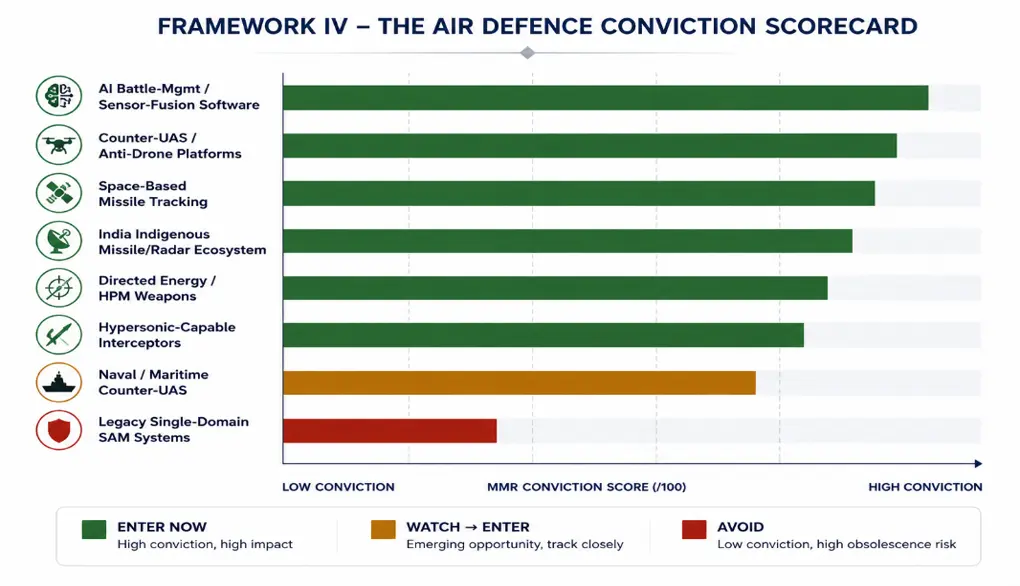
The Air Defence Conviction Scorecard
Every segment and geography in this report receives a Conviction Score — synthesizing margin opportunity, first-mover window, competitive density, technology readiness, and geopolitical stability — mapped to Enter Now, Watch, or Avoid.
| Opportunity | Score /100 | Margin | Window | Verdict |
| AI Battle-Management / Sensor-Fusion Software | 93 | 20–28% | Closes ~2029 | ENTER NOW |
| Counter-UAS / Anti-Drone Platforms | 91 | 15–22% | Closes ~2028 | ENTER NOW |
| Space-Based Missile Tracking (Golden Dome chain) | 89 | 18–25% | Closes ~2028 | ENTER NOW — capital intensive |
| India Indigenous Missile/Radar Ecosystem | 84 | 12–18% | Closes ~2030 | ENTER NOW |
| Directed Energy / HPM Weapons | 83 | High (early) | Closes ~2030 | ENTER — early stage |
| Hypersonic-Capable Interceptors | 80 | 12–18% | Closes ~2032 | ENTER — long-cycle, few primes |
| Naval / Maritime Counter-UAS | 79 | 15–20% | Closes ~2029 | WATCH → ENTER |
| Legacy Single-Domain SAM Systems (non-networked) | 38 | 4–6% | Saturated | AVOID — designed out of new architectures |
Competitive Landscape: The Tiered Player Map
The Global Air Defence Missile System Market spans four distinct competitive tiers. SIPRI data place the combined revenue of the world’s top 100 arms-producing companies at approximately USD 679 billion in 2024, with U.S. firms alone capturing close to 49% of that total — a concentration unmatched in any other global industrial sector.
| Company | HQ | Core Strength | 2026 Strategic Bet |
| Lockheed Martin | USA | World’s largest defense contractor (USD 68.4Bn revenue, 2024); THAAD, PAC-3, PrSM | Quadrupling THAAD output; positioning PrSM to retire ATACMS by 2029 |
| RTX (Raytheon) | USA | Patriot, SM-3/SM-6, LTAMDS radar | USD 2.08Bn LTAMDS contract to replace Patriot-era sensors fleet-wide |
| Northrop Grumman | USA | IBCS command architecture, space sensors | Anchoring Golden Dome’s sensor-fusion and space-tracking layer |
| BAE Systems | UK | Combat systems, radar, naval air defense | Expanding transatlantic co-production amid NATO re-armament |
| L3Harris Technologies | USA | Solid rocket motors (Aerojet Rocketdyne), missile solutions | DoD took a USD 1Bn equity stake ahead of a 2026 Missile Solutions IPO — unprecedented industrial-policy signal |
Specialist & Allied Champions
| Company | HQ | Core Strength | 2026 Strategic Bet | |
| Thales | France | Ground-based air defense, radar, C2 systems | Deepening European Sky Shield integration | |
| MBDA | France/UK/Italy/Germany | Pan-European missile champion (incl. TAURUS NEO JV) | New German serial-production line for TAURUS NEO (Dec 2025) | |
| Israel Aerospace Industries (IAI) | Israel | Arrow 3, Iron Dome-class systems | USD 6.5Bn Germany deal — largest non-U.S. export win in years | |
| RAFAEL Advanced Defense Systems | Israel | Iron Dome, David’s Sling, AI-assisted selective engagement | Exporting selective-engagement software logic globally | |
| Rheinmetall | Germany | Air defense systems, AESA radar integration (with Indra) | Capturing the bulk of Germany’s re-armament spend | |
| Saab | Sweden | Giraffe radar family, mobile air defense | New Giraffe 1X order from Danish MoD (2026) | |
| Leonardo | Italy | Radar, electronic warfare, naval air defense | Expanding NATO interoperability programmes |
Software-Native & Counter-UAS Disruptors
| Company | HQ | Core Strength | 2026 Strategic Bet |
| Anduril Industries | USA | AI-enabled Lattice C-UAS platform | USD 20Bn, 10-year U.S. Army contract — largest counter-drone deal on record |
| DroneShield | Australia | Detection & RF-mitigation counter-UAS hardware | Scaling into airport and critical-infrastructure civil-security contracts |
| Fortem Technologies | USA | SkyDome radar + DroneHunter interceptor drones | Doubled European/Middle East deliveries in Q3 2025 vs. prior year |
| Dedrone (Axon) | USA/Germany | Airspace security software & sensor fusion | Expanding from military into homeland-security civil deployments |
Regional & Emerging-Market Champions
| Company | HQ | Core Strength | 2026 Strategic Bet |
| Bharat Dynamics | India | Akash missile system, indigenous SAM production | Beneficiary of India’s USD 25Bn March 2026 DAC procurement round |
| ASELSAN | Türkiye | HISAR air defense family, radar systems | Expanding export footprint across the Middle East and Central Asia |
| Hanwha Aerospace | South Korea | Cheongung (KM-SAM) interceptor systems | Growing exports on the back of Korea’s defense-industrial push |
| Diehl Defence | Germany | IRIS-T SLM — reported ~99% interception rate in Ukraine | Capturing fresh European orders on combat-proven performance |
| Kongsberg Defence & Aerospace | Norway | NASAMS air defense system | Riding NATO demand for proven, exportable medium-range systems |
Recent Developments (2025–2026)
• Dec 2025: MBDA–SAAB joint venture TAURUS Systems GmbH secures a German serial-production line for the TAURUS NEO missile.
• Jan 2026: Israel Aerospace Industries secures a USD 3.1Bn contract within a broader USD 6.5Bn deal to expand Germany’s Arrow 3 procurement.
• Jan 2026: L3Harris and the U.S. Department of War agree to a USD 1Bn convertible-preferred investment in L3Harris’ Missile Solutions business ahead of a planned 2026 IPO.
• Jan 2026: US Navy’s CHAMP high-power-microwave trial disables small drone groups at an 85% success rate.
• Feb 2026: Lockheed Martin agrees with the DoD to quadruple THAAD interceptor production over the next seven years.
• Mar 2026: India’s Defence Acquisition Council approves ~USD 25Bn in procurement, including five additional S-400 regiments.
• Mar 2026: US Army awards Anduril Industries a USD 20Bn, 10-year contract for AI-enabled counter-UAS systems.
• Mar 2026: Israel’s integrated, U.S.-backed air defence network reports a 92% interception success rate against missile and drone threats amid the ongoing Israel–Iran conflict.
• Apr 2026: Pentagon’s FY2027 budget submission requests USD 17.9Bn specifically for the Golden Dome programme.
• Apr 2026: DoD completes its USD 1Bn investment in L3Harris’ Missile Solutions unit ahead of a planned IPO later in 2026.
• May 2026: Congressional Budget Office estimates Golden Dome’s true 20-year cost at approximately USD 1.2Tn — nearly seven times the original public figure.
Strategic Takeaway & The Central Thesis
• Volume is structurally guaranteed: missile and radar demand does not collapse with budget cycles — it recalibrates around new threats.
• Margin migrates toward software: battle-management and sensor-fusion software now out-earns kinetic hardware by roughly 2–3× on operating margin.
• The cost-asymmetry crisis is the industry’s biggest unsolved problem: and the company that solves cost-per-engagement, not range, wins the next decade of contracts.
• Golden Dome is a price-discovery event for the entire market: its move from USD 175Bn to USD 1.2Tn resets what every nation now assumes a credible shield costs.
• Asia-Pacific adds the most absolute opportunity through 2033: India’s single-sitting USD 25Bn approval is the clearest signal of where volume is heading next.
| THE CENTRAL THESIS
The Global Air Defence Missile System Market is no longer about who can build the fastest interceptor. It is about who can detect, prioritize, and neutralize a threat before its cost asymmetry ever gets to play out. Golden Dome, the NATO 5% pledge, and the rapid scaling of AI-enabled counter-drone contracts are not isolated headlines — they are the early architecture of that shift, and in committed dollars they are already worth more than much of the missile-specific market they grew out of. |
Air Defence Missile System Market Scope: Inquire before buying
| Report Coverage | Details |
| Base Year | 2025 |
| Forecast Period | 2026–2032 |
| Historical Data | 2020 to 2024 |
| Market Size in 2025 | USD 24–33 Bn (core scope) |
| Forecast Period CAGR | ~6–9% |
| Market Size in 2033 | USD 53–68 Bn (core scope) |
| Segments | Sub-Segments |
| By Range | Short-Range (SHORAD) │ Medium-Range (MRAD) │ Long-Range (LRAD) |
| By Platform | Ground-Based │ Naval │ Airborne / Space-Based Tracking |
| By Technology | Kinetic-Kill Interceptors │ Directed Energy (Laser/HPM) │ AI Battle-Management Software |
| By Threat Type | Ballistic Missile │ Cruise Missile │ Hypersonic │ Counter-UAS / Anti-Drone |
| By End-User | Military & Defense │ Homeland Security │ Critical Infrastructure Protection |
| By Region | North America │ Europe │ Asia-Pacific │ Middle East │ Rest of World |
Frequently Asked Questions
Q1. What is the size of the Global Air Defence Missile System Market?
The Global Air Defence Missile System Market is valued at approximately USD 24–33 billion in 2025 and is projected to reach USD 53–68 billion by 2033. Including the wider Counter-UAS and space-based tracking ecosystem, addressable spending exceeds USD 100 billion.
Q2. What is the CAGR of the Air Defence Missile System Market?
Most current estimates place the core market CAGR between 6% and 9% through 2033, while Counter-UAS and Anti-Drone Systems are growing significantly faster, at 18–25% CAGR.
Q3. Which region dominates the Global Air Defence Missile System Market?
North America holds the largest share, anchored by the U.S. Golden Dome programme and an established Patriot, THAAD, and Aegis base. Asia-Pacific — led by India’s USD 25 billion March 2026 procurement round — and the Middle East are the fastest-growing regions.
Q4. Which segment is growing fastest, and which should investors watch?
Counter-UAS, directed energy, and space-based tracking are the fastest-growing and highest-conviction segments per the MMR Conviction Scorecard, driven by the economic mismatch between low-cost drone threats and high-cost interceptor missiles.
Q5. Who are the key players in the Global Air Defence Missile System Market?
Tier 1 primes include Lockheed Martin, RTX, Northrop Grumman, BAE Systems, and L3Harris. Tier 2 specialists include Thales, MBDA, Israel Aerospace Industries, Rheinmetall, and Saab. Software-native disruptor Anduril Industries now holds the single largest counter-drone contract on record.
Q6. How is the U.S. Golden Dome programme affecting the broader market?
Golden Dome’s cost estimate has risen from USD 175 billion to as much as USD 1.2 trillion (CBO, May 2026), making it a price-discovery event for the entire industry and accelerating contracts across space-based tracking, AI battle-management, and next-generation interceptors well beyond the U.S. market alone.
Lead Analyst Profile
| LEAD ANALYST — GLOBAL DEFENSE & AEROSPACE INTELLIGENCE PRACTICE |
| This research is authored by Rucha Deshpande, MMR Lead Analyst, with deep expertise in defense-industrial economics, missile and radar competitive dynamics, counter-UAS platform strategy, government procurement architecture, and geopolitical risk modeling — advising defense ministries, Tier-1 OEM strategy teams, institutional and private-equity investors, and allied-nation procurement bodies across North America, Europe, the Middle East, and Asia-Pacific. Core competencies: defense-spend econometrics │ capability-gap and conviction scoring │ industrial-base & M&A intelligence │ geopolitical trigger mapping │ regional demand modeling. |