
Global AI Trust, Risk and Security Management (AI TRiSM) Market Size, Share, Trends, Growth and Forecast (2026-2034)
Overview
The Global AI Trust, Risk, and Security Management (AI TRiSM) market was valued at USD 2.328 billion in 2025 and is estimated to reach USD 10.669 billion by 2034, growing at a CAGR of 18.43% during 2025–2034.
AI Trust, Risk, and Security Management Market Key Market Highlights
| Market Growth: AI TRiSM market was valued at USD 2.328 billion in 2025 and is estimated to hit USD 10.669 billion by 2034, at 18.43% CAGR. |
| Dominant Capability: AI Governance & Compliance leads with 19% share, driven by rising AI regulations and enterprise governance needs. |
| Leading Region: North America dominates with 41.5% share, supported by strong AI adoption, cybersecurity investment, and technology leadership |
| Leading Deployment: Cloud leads with 55% share, benefiting from scalable AI infrastructure and cloud-native governance platforms. |
| Key Industry: IT & Telecommunications remains a major adopter, driven by extensive AI deployment and growing AI security requirements |
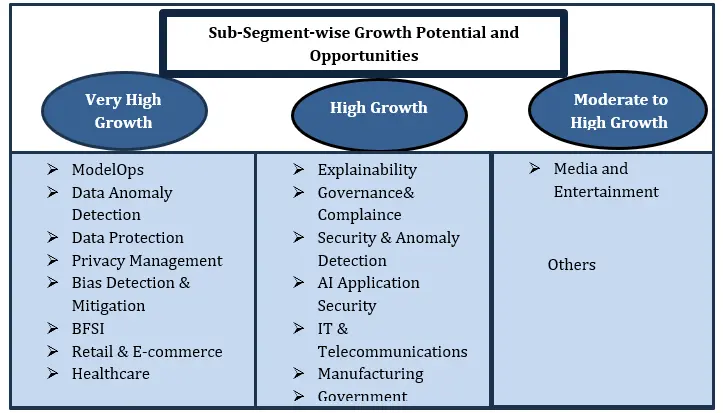
| Growth Opportunity: Generative AI governance, ModelOps, AI application security, and real-time monitoring emerge as high-potential areas |
AI Trust, Risk and Security Management Market Overview
The AI Trust, Risk and Security Management (AI TRiSM) market refers to the technologies, platforms, and services that help organizations to govern, secure, monitor, evaluate, and manage risks associated with artificial intelligence systems throughout their lifecycle. The market encompasses AI governance, model risk management, AI security, privacy and data protection, explainability, model monitoring, bias detection and mitigation, compliance management, and AI lifecycle governance. The use of AI have came up with the falsifying risk associated with it.
AI TRiSM addresses risks arising from the behavior and use of AI models, including inaccurate outputs, algorithmic bias, data leakage, privacy violations, model manipulation, adversarial attacks, lack of transparency, and inadequate human oversight. It is different from traditional cybersecurity risk management, which previously protected only the IT infrastructure. NIST's AI Risk Management Framework provides a major foundation for this ecosystem by organizing AI risk management around Govern, Map, Measure, and Manage functions. NIST also identifies trustworthy AI characteristics such as validity and reliability, safety, security and resilience, accountability and transparency, explainability and interpretability, privacy enhancement, and fairness.
The growth of enterprise AI and generative AI increases the need for continuous trust, risk, and security management. Organizations integrate AI into customer interactions, financial decision-making, healthcare, manufacturing, software development, cybersecurity, and business operations, creating a broader risk surface that requires monitoring beyond traditional IT controls. Generative AI introduces additional concerns involving inaccurate or fabricated outputs, sensitive-data exposure, intellectual-property risks, prompt injection, model misuse, and insufficient transparency. OECD reports that 20.2% of firms across OECD countries used AI in 2025, up from 14.2% in 2024 and 8.7% in 2023. AI adoption therefore more than doubled in two years. Adoption is particularly high among large firms, with 52.0% using AI compared with 17.4% of small firms. This widespread adoption of AI creates emergency requirement for an AI Trust, risk, and security management market.
NIST's Generative AI Profile, released in 2024 as a companion to the AI RMF, guides identifying and managing risks that arise specifically from generative AI across its lifecycle. The OECD similarly identifies AI risks related to privacy, security, safety, discrimination and bias, and information integrity, reinforcing the need for structured risk-management practices across the AI value chain. These developments support demand for AI governance platforms, model monitoring, explainability tools, privacy management, bias mitigation, AI security testing, and automated compliance capabilities.
Regulatory requirements strengthen the AI TRiSM ecosystem as governments and international institutions establish frameworks for responsible and secure AI deployment. The EU AI Act introduces a risk-based regulatory framework and establishes requirements covering areas such as risk management, data governance, technical documentation, record-keeping, human oversight, accuracy, robustness, and cybersecurity for applicable high-risk AI systems. Such requirements underscore the importance of platforms that can document AI models, monitor performance, identify risks, maintain audit trails, and demonstrate compliance. At the same time, organizations increasingly seek integrated solutions that connect AI governance, cybersecurity, privacy, compliance, model operations, and responsible AI rather than managing these functions independently. IBM describes AI TRiSM as an approach that addresses trustworthiness, fairness, reliability, robustness, efficacy, data protection, explainability, ModelOps, and resistance to adversarial attacks, highlighting the market's movement toward comprehensive AI risk-management architectures.
The market is growing at a CAGR of 18.43% through 2034, reaching USD 10.669 billion by 2034. The growth reflects increasing enterprise AI adoption, expanding generative AI use, regulatory requirements, rising AI-related security and privacy risks, and greater demand for continuous AI governance and monitoring.
Analyst Insights
The Global AI Trust, Risk and Security Management (AI TRiSM) Market is transitioning from a governance-focused requirement into a broader enterprise technology layer that combines AI governance, model risk management, security, privacy, explainability, and continuous monitoring. As AI becomes embedded across business applications and workflows, organizations increasingly need technical controls rather than standalone policies. Gartner notes that AI governance is moving toward continuous and enforceable controls as AI systems become more complex and autonomous.
The market is also being strengthened by the rapid expansion of generative and agentic AI. NIST's Generative AI Profile highlights governance, pre-deployment testing, content provenance, and incident disclosure as important considerations for managing generative AI risks. In 2026, NIST also identified novel security concerns around AI agents, reinforcing the need for specialized AI security and risk-management capabilities.
Why This Report
This report provides a comprehensive assessment of the AI TRiSM market size, growth, competitive landscape, regional opportunities, technology capabilities, deployment models, and emerging trends. It is particularly relevant for technology providers, investors, enterprises, and decision-makers seeking to understand how AI governance and security requirements are evolving alongside enterprise AI adoption.
The report also evaluates key capabilities including AI Governance and Compliance, AI Model Risk Management, Explainability and Interpretability, ModelOps and Model Monitoring, Data Protection and Privacy, Bias Detection and Mitigation, and AI Application Security. This provides stakeholders with a clearer view of where demand is concentrated and which AI risk-management capabilities offer future growth opportunities.
Future Outlook
The future of the AI TRiSM market is expected to be shaped by the shift from periodic AI assessments toward continuous, automated, and real-time risk management. As organizations deploy AI across increasingly complex environments, demand is expected to increase for automated governance, model monitoring, explainability, privacy protection, AI application security, and runtime controls. NIST's AI RMF is also evolving, with the framework currently undergoing revision and a 2026 concept note addressing trustworthy AI in critical infrastructure.
With the global market projected to grow at a CAGR of 18.43%, AI TRiSM is expected to become an important component of enterprise AI infrastructure. The strongest long-term opportunities are likely to emerge around generative AI governance, agentic AI security, automated compliance, model risk management, real-time monitoring, and AI application security.
Global AI Trust, Risk and Security Management Market Growth Outlook
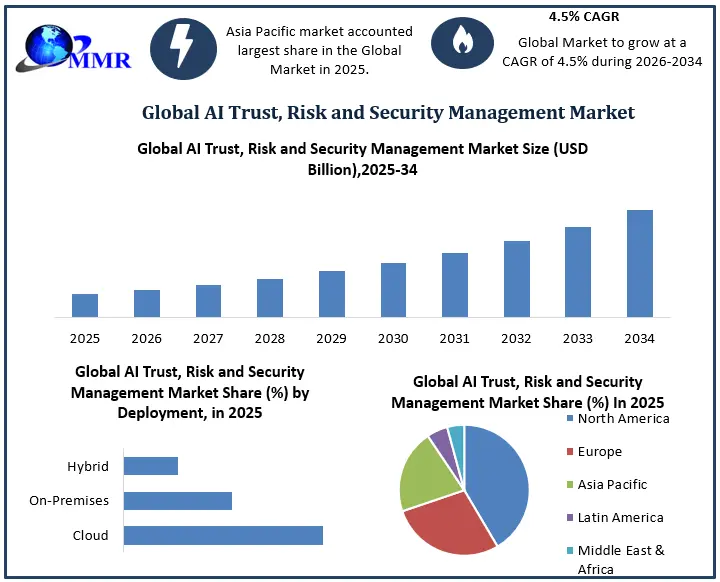
To know about the Research Methodology :- Request Free Sample Report
AI Trust, Risk and Security Management Market Dynamics
Rising Enterprise AI Adoption Drives Demand for AI Risk Management
The rapid expansion of enterprise AI adoption increases the need for AI governance, AI risk management, model monitoring, and AI security solutions. According to the OECD, 20.2% of firms across OECD countries used AI in 2025, compared with 14.2% in 2024 and 8.7% in 2023, meaning the share of AI-using firms more than doubled over two years. Adoption is particularly strong among large enterprises, with 52.0% of large firms using AI compared with 17.4% of small firms. AI adoption also reaches 57.3% among ICT firms and 36.8% among professional and scientific services firms. As AI moves from experimentation into operational business processes, organizations face greater requirements for model validation, continuous monitoring, data protection, explainability, access controls, and risk assessment. NIST's AI Risk Management Framework supports this shift by recommending continuous risk management across the AI lifecycle through its Govern, Map, Measure, and Manage functions.
Complexity of AI Risk Management Increases Implementation Costs
The complexity of managing AI risks across different models, datasets, applications, and deployment environments restrains adoption, particularly among organizations with limited technical and governance resources. AI TRiSM requires coordination between data governance, cybersecurity, privacy, compliance, model development, IT operations, and business teams, creating integration and implementation challenges. NIST emphasizes that trustworthy AI involves multiple characteristics—including validity and reliability, safety, security and resilience, accountability and transparency, explainability and interpretability, privacy enhancement, and fairness with harmful bias managed—which must be considered throughout the AI lifecycle rather than treated as isolated controls. Consequently, enterprises may face higher costs for AI governance platforms, model evaluation, specialized personnel, security testing, compliance documentation, and continuous monitoring. Fragmented AI environments can further increase complexity when organizations use multiple foundation models, third-party AI applications, and internally developed models.
Generative AI Expansion Creates Opportunities for Continuous AI Governance
The growing deployment of generative AI, large language models, retrieval-augmented generation, and AI agents creates significant opportunities for AI TRiSM providers. Generative AI introduces risks that require specialized controls around model behavior, sensitive information, prompt inputs, generated outputs, security, reliability, and misuse. NIST released its Generative AI Profile in July 2024 to help organizations identify and manage risks specific to generative AI, demonstrating the increasing need for structured risk-management approaches as these technologies enter enterprise environments. AI TRiSM providers can capitalize on this opportunity by developing solutions for AI cataloging, data mapping, continuous evaluation, runtime inspection, policy enforcement, model security, explainability, bias detection, and automated compliance. IBM also identifies AI catalogs, AI data mapping, continuous assurance and evaluation, and runtime inspection and enforcement as important capabilities for modern AI TRiSM solutions.
Fragmented AI Governance and Evolving Regulatory Requirements Complicate Standardization
The lack of universally consistent AI governance practices creates a challenge for organizations operating across multiple jurisdictions. Different governments and institutions are developing their own approaches to AI safety, privacy, cybersecurity, transparency, accountability, and risk classification, requiring multinational enterprises to align AI systems with multiple regulatory and governance frameworks. NIST's AI RMF is voluntary and designed to be flexible across sectors and use cases, while other jurisdictions impose legally binding requirements. This creates demand for adaptable AI TRiSM platforms but also complicates product development because vendors must continuously update governance controls, compliance mappings, documentation, and monitoring capabilities. The challenge becomes greater as AI models and applications evolve rapidly, requiring organizations to maintain risk assessments and controls throughout the AI lifecycle rather than relying on one-time compliance reviews.
AI Trust, Risk and Security Management Market Trends
Generative AI Governance Drives AI TRiSM Adoption - The rapid expansion of generative AI increases demand for AI governance, model monitoring, explainability, privacy protection, and AI security controls. The increasing use of generative AI across enterprise workflows creates a larger requirement for organizations to evaluate model behavior, monitor outputs, protect sensitive information, and establish accountability mechanisms. AI TRiSM solutions increasingly address these requirements through continuous model evaluation, AI application security, data protection, policy enforcement, and risk monitoring.
Continuous AI Monitoring Strengthens AI Risk Management - AI governance increasingly shifts from periodic assessment toward continuous monitoring and lifecycle-based risk management. Organizations deploy AI models across multiple applications and environments, making one-time validation insufficient for detecting changes in model performance, data quality, security exposure, or compliance status. NIST's AI Risk Management Framework emphasizes managing AI risks through the Govern, Map, Measure, and Manage functions across the AI lifecycle. This approach supports growing demand for automated AI monitoring, model evaluation, risk scoring, anomaly detection, explainability, and performance tracking. AI TRiSM platforms therefore increasingly integrate with existing data, cybersecurity, ModelOps, and enterprise governance environments to provide continuous visibility into AI systems.
AI Regulation Accelerates AI Governance Solutions - The implementation of AI regulation increasingly turns governance capabilities into an operational requirement for organizations. The EU AI Act reached a major implementation milestone on 2 August 2026, when most of its rules began applying, and enforcement started for applicable provisions. The regulation introduces requirements related to transparency, general-purpose AI, and governance, while high-risk AI requirements apply from 2 December 2027 for certain systems and 2 August 2028 for high-risk AI embedded in regulated products. These requirements cover areas such as risk assessment, data quality, logging, documentation, human oversight, cybersecurity, robustness, and accuracy. This regulatory development strengthens demand for automated AI compliance, documentation, audit trails, risk assessment, and governance platforms.
AI Security Integrates with AI Governance - AI security increasingly converges with governance and risk management as organizations recognize that AI-specific threats cannot be addressed solely through conventional cybersecurity controls. AI TRiSM platforms increasingly combine model security, data protection, privacy, adversarial testing, access controls, threat detection, and governance policies within integrated environments. This convergence becomes particularly important as AI systems gain access to enterprise data and business processes. The trend also supports stronger collaboration between cybersecurity, compliance, data governance, and AI development teams, creating demand for unified AI security and governance architectures.
AI Governance Expands into AI Agents and Autonomous Systems - AI governance increasingly extends beyond conventional predictive and generative models toward AI agents and autonomous AI systems that can make decisions, access enterprise data, call external tools, and execute actions with limited human intervention. These systems increase the importance of identity management, authorization, activity logging, human oversight, runtime monitoring, and policy enforcement. The European Commission's evolving AI governance framework also emphasizes traceability, human oversight, robustness, and cybersecurity for applicable high-risk systems. As autonomous AI becomes more integrated into enterprise workflows, AI TRiSM providers increasingly focus on controlling not only what an AI model generates but also what an AI system can access and execute.
AI Trust, Risk and Security Management Market Segment Analysis
AI Trust, Risk and Security Management Market by AI TRiSM Capability

The AI TRiSM capability segment includes governance and compliance, explainability and interpretability, model risk management, ModelOps and monitoring, data protection and privacy, bias detection and mitigation, AI application security, and security and anomaly detection. Explainability and interpretability dominate the AI TRiSM capability segment by xx% in 2025, as organizations increasingly require visibility into how AI systems generate predictions, recommendations, and decisions.
Explainability is particularly important in regulated and high-impact applications where organizations need to establish accountability and demonstrate that AI outputs can be understood and evaluated. NIST recognizes explainability and interpretability as core characteristics of trustworthy AI alongside validity, reliability, security, resilience, privacy, transparency, and fairness. The growing deployment of complex machine learning and generative AI models further strengthens demand for tools that provide model transparency, performance evaluation, risk identification, and continuous monitoring.
AI TRiSM Technology Capability Growth Matrix
| Technology capability | Current position | Future growth outlook |
| Explainability | Dominant | High |
| ModelOps | Emerging | Very High |
| Data Anomaly Detection | Established | Very High |
| Data Protection | Major | Very High |
| AI Application Security | Established | High |
AI Trust, Risk and Security Management Market by End Use
The end-use segment includes IT and telecommunications, BFSI, healthcare and life sciences, manufacturing, retail and e-commerce, government and defense, energy and utilities, and other industries. IT and telecommunications dominate the AI TRiSM end-use segment, supported by extensive deployment of AI across cloud infrastructure, software development, cybersecurity, customer engagement, automation, and enterprise analytics. The sector also manages large volumes of sensitive data and operates complex technology environments, increasing the need for AI security, model governance, privacy protection, anomaly detection, and continuous AI monitoring. As AI becomes embedded into operational technology and business-critical applications, technology providers increasingly require controls that extend across the AI lifecycle. NIST emphasizes that AI risk management should remain continuous and lifecycle-based, with governance integrated across the functions of governing, mapping, measuring, and managing AI risks. This is because of its high concentration of AI developers, cloud providers, cybersecurity companies, financial institutions, and large enterprises deploying AI at scale. The U.S. also maintains a strong institutional foundation for AI governance through NIST's AI Risk.
AI Trust, Risk and Security Management Market Growth Potential
Management Framework, which provides a structured approach to governing, mapping, measuring, and managing AI risks. U.S. federal AI policy increasingly emphasizes AI evaluations, interpretability, robustness, secure-by-design AI, AI incident response, and protection of government and commercial AI systems. The region's demand is particularly strong for AI model security, governance and compliance, explainability, privacy management, and continuous AI monitoring. Large enterprises and technology-intensive industries create substantial demand because AI is increasingly embedded into business-critical applications. The U.S. represents the principal country-level opportunity in the region, supported by its mature AI ecosystem and extensive enterprise deployment. North America therefore maintains high growth potential, particularly in enterprise AI governance, generative AI security, and AI compliance.
AI Trust, Risk and Security Management Market Regional Insights
Europe Accelerates AI TRiSM Demand Through Regulatory Requirements
Europe represents one of the strongest regulation-driven AI TRiSM markets, with the EU AI Act creating a formal framework for risk-based AI governance. The regulatory framework establishes requirements covering risk management, data governance, technical documentation, record keeping, human oversight, accuracy, robustness, and cybersecurity for applicable high-risk AI systems. Therefore, the implementation of the EU AI Act directly supports demand for AI governance platforms, compliance management, risk assessment, auditability, transparency, explainability, and monitoring solutions. The region also benefits from relatively strong AI adoption in several economies. OECD data shows that AI use among firms exceeds 35% in several Nordic countries, including Denmark, Finland, and Sweden. Europe consequently offers particularly strong growth potential for vendors providing regulatory mapping, automated compliance, model documentation, and trustworthy-AI assessment. Germany, France, the Netherlands, and the Nordic countries represent important country-level opportunities because of their industrial AI deployment, digitalization, and regulatory focus.
Asia Pacific Expands AI TRiSM Adoption Through AI Deployment and Governance
Asia Pacific presents very high future growth potential as enterprises, governments, and technology companies rapidly expand AI deployment while strengthening governance frameworks. The region combines large-scale AI adoption, expanding cloud infrastructure, growing generative AI use, and increasing government attention to AI safety and responsible deployment. China remains a major AI development center, while Japan, South Korea, Singapore, and India increasingly strengthen institutional frameworks around trustworthy and responsible AI.
For example, Japan’s Ministry of Economy, Trade and Industry and Ministry of Internal Affairs and Communications maintain AI Guidelines for Business, with the latest Version 1.2 compiled in March 2026, providing guidance for businesses as AI technologies evolve. Japan therefore offers an important market for AI governance, risk assessment, security, and compliance solutions. India is also a high-potential market, supported by expanding enterprise AI adoption, government-backed AI initiatives, and growing demand for responsible AI. The broader region benefits from strong AI research and deployment momentum; OECD data shows that China accounts for 22% of global AI publications, compared with 14% for the EU and 11% for the U.S.
South America Increases AI TRiSM Demand as Enterprise AI Adoption Expands
South America represents an emerging AI TRiSM market, with demand increasing as financial services, telecommunications, retail, manufacturing, and public-sector organizations adopt AI for automation, customer analytics, fraud detection, and decision support. The region's principal opportunity comes from organizations moving from experimental AI projects toward operational deployment, which increases requirements for data privacy, model monitoring, cybersecurity, explainability, and governance. Brazil stands out as the region's most important country-level opportunity because of its comparatively advanced digital economy and significant enterprise base. The OECD's enterprise research also includes 167 Brazilian enterprises in its study of AI adoption, highlighting Brazil's importance in the emerging AI ecosystem. However, skills shortages, infrastructure differences, cost constraints, and regulatory fragmentation can moderate adoption. The OECD identifies skills shortages, legal and data-protection concerns, costs, and technology lock-in as factors that can slow AI diffusion.
Middle East and Africa Strengthen AI Governance and Security Adoption
The Middle East & Africa market represents an emerging but increasingly attractive growth opportunity, supported by national digital-transformation programs, cloud infrastructure investment, smart-city initiatives, financial technology adoption, and government use of AI. Countries such as the United Arab Emirates and Saudi Arabia are particularly important because they pursue national AI strategies and deploy AI across government, financial services, healthcare, energy, and smart infrastructure.
These applications increase requirements for AI security, privacy management, governance, explainability, and risk monitoring, especially when AI systems operate in critical or public-facing environments. Africa offers longer-term potential as digital infrastructure and AI adoption expand, with South Africa and other digitally advanced markets providing initial opportunities. However, the region continues to face differences in digital infrastructure, AI skills, investment availability, and regulatory maturity, which can result in uneven adoption. The region therefore provides high long-term growth potential, with demand initially concentrated in financially strong economies and technology-intensive sectors.
AI Trust, Risk and Security Management Market Recent Developments
| Date | Company / Institution | Development | Strategic Impact |
| Aug. 2026 | Fortinet | Acquires Virtue AI to strengthen AI-agent runtime security and automated validation. | Accelerates AI-agent security and continuous AI assurance. |
| Apr.–May 2026 | ServiceNow | Completes Armis acquisition and expands autonomous security and risk capabilities. | Converges AI governance, cybersecurity, identity, and risk management. |
| Jun. 2026 | IBM | Study finds 77% of surveyed organizations report AI adoption is outpacing governance capabilities. | Increases demand for automated AI governance and continuous monitoring. |
| Jun. 2026 | IBM | Study finds 91% of surveyed executives lack full visibility into AI vendor, model, and infrastructure dependencies. | Strengthens demand for AI inventory, dependency mapping, and AI sovereignty controls. |
| 2026 | EU / Global regulators | AI governance shifts toward implementation of risk, transparency, documentation, and oversight requirements. | Drives demand for AI compliance, risk assessment, audit trails, and continuous monitoring. |
AI Trust, Risk and Security Management Market Competitive Landscape
AI TRiSM Competitive Positioning Matrix
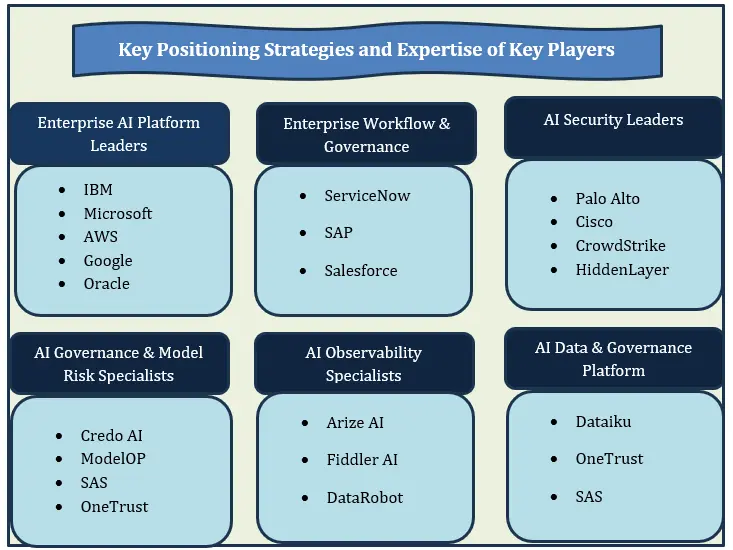
The AI TRiSM market shows a moderately fragmented and rapidly evolving competitive structure rather than a market controlled by a single vendor. Competition spans large enterprise technology companies, cloud hyperscalers, cybersecurity providers, governance specialists, analytics companies, and global IT-service providers. The competitive boundary is also expanding because AI TRiSM increasingly combines AI governance, model risk management, explainability, privacy, data protection, AI application security, runtime monitoring, and compliance. Current AI governance evaluations include both established enterprise vendors and specialist providers, reflecting the breadth of the competitive field.
India is becoming particularly relevant as an AI-services and implementation hub. TCS, Infosys, Wipro, and HCLTech are increasingly positioning their AI capabilities around enterprise transformation, governance, and responsible deployment. The competitive environment is also changing as AI reduces traditional IT-services pricing power and pushes Indian providers toward outcome-based AI services and specialized offerings. Infosys, for example, states that its Responsible AI Office supports AI risk and maturity assessments, governance controls, and audits, while its AI Management System aligns with ISO/IEC 42001.
Platform Integration Increases Competitive Differentiation
Large technology vendors increasingly compete by embedding AI TRiSM capabilities into platforms customers already use, rather than selling governance as an isolated product. Cloud providers integrate model monitoring, security, evaluation, and governance into AI development environments, while enterprise software vendors connect AI governance with data management, GRC, workflow automation, and business applications. This strategy reduces implementation friction and strengthens customer retention because organizations can manage AI risks within existing technology ecosystems. Specialist vendors counter this advantage by offering vendor-neutral, multi-model, multi-cloud, and cross-platform governance, which appeals to enterprises operating heterogeneous AI environments. Gartner's 2026 AI Governance Platforms research reflects this broadening competitive field, covering both large enterprise technology companies and specialist AI governance providers.
Global AI Trust, Risk and Security Management Key Players Positioning and Strategies
| Company | Strategic Positioning | Core AI TRiSM Strength | Commercial / Pricing Strategy |
| IBM | Enterprise-wide AI governance and risk management | AI governance, model risk, compliance, explainability and continuous monitoring | Tiered enterprise licensing + consumption options; IBM publicly lists Model Management and Risk & Compliance plans, including monthly and usage-based options. |
| Microsoft | Integrated AI governance within cloud, data security and compliance ecosystem | AI governance, data governance, security, compliance and policy controls | Consumption-based cloud pricing + subscription ecosystem; Microsoft Purview uses consumption-based pricing for several governance capabilities. |
| AWS | Cloud-native AI risk, governance and security infrastructure | AI/ML governance, access controls, model documentation, monitoring and data/AI governance | Pay-as-you-go + usage-linked pricing, with savings/commitment options across AWS services. |
| AI model evaluation, responsible AI and cloud-native governance | Model evaluation, responsible AI, security and AI lifecycle controls | Consumption-oriented cloud model, linking governance capabilities with broader Google Cloud workloads | |
| SAS | Risk-intensive and regulated-industry AI governance | Model risk management, validation, monitoring, explainability and regulatory compliance | Enterprise software licensing + solution-based contracts, emphasizing high-value regulated use cases |
| ServiceNow | AI governance embedded into enterprise workflows and GRC | AI governance, risk workflows, policy management and automated compliance processes | Subscription / enterprise platform model, with AI TRiSM capabilities positioned as part of broader workflow and GRC adoption |
Regulatory Compliance Strengthens Vendor Positioning
Regulatory readiness is becoming a major competitive differentiator as enterprises need to demonstrate AI risk assessment, transparency, documentation, human oversight, security, and accountability. Vendors increasingly position their platforms around regulatory frameworks such as the EU AI Act, NIST AI RMF, ISO/IEC 42001, GDPR, and sector-specific model-risk requirements. This particularly benefits vendors that can automatically map AI inventories, policies, controls, risk assessments, and audit evidence to multiple regulatory frameworks. The competitive advantage therefore shifts from basic model monitoring toward automated, continuous, multi-jurisdiction AI governance.
Specialist Vendors Challenge Large Platform Providers
Specialist AI TRiSM vendors compete by addressing specific problems that broader enterprise platforms may not solve with the same depth. Companies such as Credo AI, ModelOp, Holistic AI, Saidot, Fiddler AI, and OneTrust emphasize areas such as AI governance, model risk, explainability, privacy, regulatory intelligence, and AI inventory management. This creates a two-speed competitive market: large vendors compete through ecosystem scale and integrated platforms, while specialists compete through deeper functionality, faster innovation, vendor neutrality, and specialized regulatory expertise. Current industry coverage identifies both categories as important participants in the evolving AI governance ecosystem.
Customer Requirements Shape Competitive Strategies
The customer base increasingly divides into large enterprises, regulated industries, technology companies, government organizations, and SMEs. Large enterprises generally favor integrated platforms that connect AI governance with existing cybersecurity, data governance, GRC, cloud, and enterprise software environments. BFSI and healthcare customers place greater emphasis on model risk, privacy, explainability, auditability, and regulatory compliance, while technology companies prioritize AI security, runtime monitoring, model evaluation, and developer integration. Government customers emphasize security, transparency, accountability, procurement compliance, and data sovereignty. This segmentation encourages vendors to develop vertical-specific offerings rather than relying on a single universal AI TRiSM product.
competitive assessment: The market remains highly innovation-driven and moderately fragmented, with no single vendor controlling the complete AI TRiSM stack. Large cloud and enterprise technology companies have an advantage in platform integration, installed customer bases, and global distribution, while specialist vendors compete through AI governance depth, model-risk expertise, regulatory intelligence, and vendor-neutral capabilities. Meanwhile, global IT-service providers strengthen the services layer through implementation, consulting, and managed AI governance. The competitive frontier increasingly centers on agentic AI governance, runtime inspection and enforcement, automated regulatory compliance, multi-cloud governance, and continuous AI risk monitoring. Gartner's 2025 market guide identifies AI TRiSM as a distinct technical capability layer combining AI governance with runtime inspection and enforcement, reinforcing this shift toward continuous operational control.
AI Trust, Risk and Security Management Market Scope: Inquire before buying
| AI Trust, Risk and Security Management Market | |||
|---|---|---|---|
| Report Coverage | Details | ||
| Base Year: | 2025 | Forecast Period: | 2026-2032 |
| Historical Data: | 2020 to 2025 | Market Size in 2025: | USD 2.32 Bn. |
| Forecast Period 2026 to 2032 CAGR: | 18.43% | Market Size in 2032: | USD 10.69 Bn. |
| Segments Covered: | by Component | Solutions Services Professional Services Managed Services |
|
| by AI TRiSM Capability | AI Governance and Compliance AI Model Risk Management Explainability and Interpretability ModelOps and Model Monitoring Data Protection and Privacy Bias Detection and Mitigation AI Application Security Data Anomaly Detection Security and Anomaly Detection |
||
| by Deployment | Cloud On-Premises Hybrid |
||
| by Organization Size | Large Enterprises Small and Medium Enterprises (SMEs) |
||
| by Application | Risk and Compliance Management Continuous AI Monitoring and Analytics Threat Detection and Response Identity and Access Management Fraud Detection and Prevention AI Security Management Privacy Management Incident Response and Forensics |
||
| by End-Use | IT and Telecommunications BFSI Healthcare and Life Sciences Government and Defense Manufacturing Retail and E-Commerce Energy and Utilities Media and Entertainment Others |
||
Global AI Trust, Risk and Security Management Market, by Region
North America (United States, Canada, and Mexico)
Europe (UK, France, Germany, Italy, Spain, Sweden, Austria, and the Rest of Europe)
Asia Pacific (China, South Korea, Japan, India, Australia, Indonesia, Malaysia, Vietnam, Taiwan, Bangladesh, Pakistan, and the Rest of APAC)
Middle East and Africa (South Africa, GCC, Egypt, Nigeria, and the Rest of ME&A)
South America (Brazil, Argentina, Rest of South America)
Global AI Trust, Risk and Security Management Market, Key Players
1. IBM
2. Microsoft
3. Amazon Web Services (AWS)
4. Google
5. Oracle
6. SAP
7. SAS Institute
8. ServiceNow
9. Salesforce
10. Palo Alto Networks
11. Fortinet
12. CrowdStrike
13. Cisco Systems
14. Cloudflare
15. OneTrust
16. Securiti
17. BigID
18. Proofpoint
19. Rapid7
20. Darktrace
21. Zscaler
22. Check Point Software Technologies
23. CyberArk
24. Sophos
25. DataRobot
26. Palantir Technologies
27. Databricks
28. Informatica
29. Collibra
30. MetricStream
Specialist AI Governance / AI TRiSM Players
31. Credo AI
32. ModelOp
33. Holistic AI
34. ValidMind
35. Monitaur
36. Saidot
37. Truyo
38. Cranium AI
39. Relyance AI
40. Fiddler AI
41. LatticeFlow AI
42. Modulos
43. Airia
44. Trustible
45. Arize AI
46. Arthur AI
47. HiddenLayer
48. Noma Security
49. Mindgard
50. WitnessAI
Global IT & Consulting Players
51. Accenture
52. Tata Consultancy Services (TCS)
53. Infosys
54. Wipro
55. HCLTech
56. Tech Mahindra
57. Fujitsu
58. NTT DATA
59. PwC
60. EY
Frequently Asked Questions About the AI Trust, Risk and Security Management Market
1. What is the AI Trust, Risk and Security Management (AI TRiSM) Market?
The AI TRiSM market includes solutions and services that help organizations manage AI governance, security, risk, privacy, explainability, compliance, and trust throughout the AI lifecycle.
2. What is the global AI TRiSM market size?
The global AI Trust, Risk and Security Management market was valued at USD 2.328 billion in 2025 and is expected to grow significantly during the forecast period.
3. What is the CAGR of the AI Trust, Risk and Security Management Market?
The global AI TRiSM market is estimated to grow at a CAGR of 18.43% during the forecast period, supported by rising enterprise AI adoption and growing demand for AI governance and security.
4. What are the key factors driving AI TRiSM market growth?
Key factors include the rapid adoption of generative AI, increasing AI cybersecurity threats, evolving AI regulations, demand for explainable AI, data privacy concerns, model risks, and the need for continuous AI monitoring and governance.
5. What are the major segments of the AI TRiSM market?
The market is broadly segmented into solutions and services. Major solution areas include AI governance, AI security, model risk management, explainability, data protection, privacy management, anomaly detection, and AI application security.
6. Which region dominates the global AI TRiSM market?
North America is a leading region in the global AI TRiSM market, supported by high enterprise AI adoption, advanced cybersecurity infrastructure, major technology companies, and increasing investment in AI governance and regulatory compliance.
7. Which industries use AI Trust, Risk and Security Management solutions?
Major industries adopting AI TRiSM solutions include BFSI, healthcare, IT and telecommunications, retail and e-commerce, manufacturing, government, automotive, and energy and utilities.
8. How does generative AI drive the AI TRiSM market?
The rapid adoption of generative AI increases the need to manage AI hallucinations, data leakage, prompt injection, bias, model security, privacy, intellectual property risks, and regulatory compliance, creating strong demand for AI TRiSM solutions.
9. Who are the key players in the AI TRiSM market?
Key players include IBM, Microsoft, Google, AWS, NVIDIA, Oracle, SAS, Salesforce, Informatica, ServiceNow, Palo Alto Networks, F5, Credo AI, Holistic AI, and ModelOp, along with other specialized AI governance and security providers.
10. What is the future outlook for the global AI TRiSM market?
The global AI TRiSM market is expected to experience strong growth as enterprises move AI and generative AI applications into production. Increasing demand for AI governance, automated compliance, model monitoring, explainability, AI security, privacy management, and real-time risk management is expected to support market expansion.