
AI in Oncology Market Size by Component, Cancer Type, Deployment Mode, Application, End User, Region, Industry-Wide Analysis, Competitive Landscape Assessment & Long-Term Forecast to 2032
Overview
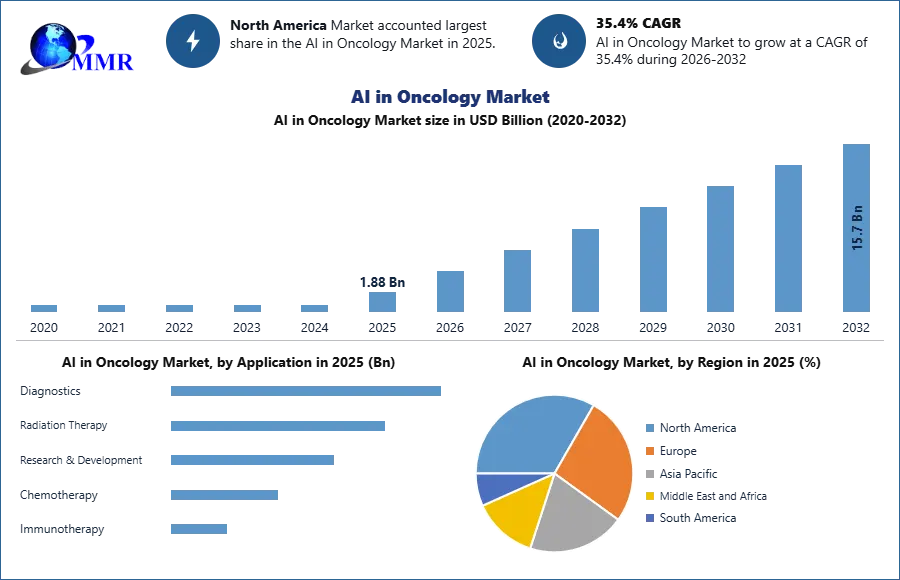
The AI in Oncology Market was valued at USD 1.88 billion in 2025, and total Revenue is expected to grow at a CAGR of 35.4 % from 2026 to 2032, reaching nearly USD 15.7 billion.
AI in Oncology Market Overview:
The MMR report provides a comprehensive analysis of the AI in Oncology Market, systematically evaluating its economic feasibility, technological progress, and real-world clinical adoption. The study assesses pricing models, cost–benefit considerations, and return on investment for healthcare providers, while examining innovation pipelines, patent activity, and R&D intensity shaping the AI in Oncology Market. It further analyzes regional adoption trends, integration across clinical workflows, data interoperability readiness, and hospital infrastructure maturity. Patient outcomes, accessibility, investment patterns, sustainability considerations, and regulatory and ethical frameworks are also evaluated to present a structured view of market dynamics and long-term growth potential.
The AI in Oncology Market has demonstrated substantial expansion, driven by the increasing integration of artificial intelligence across cancer care pathways. Initially applied in cancer cell detection within histopathological samples, AI technologies now support screening, early diagnosis, molecular testing, treatment planning, and patient monitoring. Advancements in deep learning, natural language processing, AI-powered algorithms, and robotics have significantly enhanced clinical precision and operational efficiency within the AI in Oncology Market. North America accounts for approximately 55% of the global market share, supported by advanced healthcare infrastructure and strong investment activity.
 To know about the Research Methodology :- Request Free Sample Report
AI in Oncology Market Dynamics
Growth Drivers of AI in Oncology Market
The key drivers for growth are advances in technology which has directly simplified and streamlined many complex processes in the Oncology market. With the advent of digital information, AI has showed promise across all cancer research areas. With the increasing expansion of data sets, molecular-level tumour information from cancer patients can be easily obtained. AI also has made analysing medical images, such as X-rays, CT scans, and MRIs simpler and more accurate. Risk mitigation, Drug testing, Analysis of current and future status of a patient, all has been possible as AI in oncology market has fared well. Also, treatments regarding each patient can be well directed and specialized increasing the chances of cure through such modified treatments. Another driving factor in AI in Oncology market is the use of Machine Learning. These technologies have enhanced robotics in oncology market. Robots can identify data from enormous dataset and recognize specific patterns. This has allowed the creation of advanced robots that can do complicated jobs, which mitigates the risk quotient to a significant limit. Robots can also learn, forecast, and optimise using the data allowing predictive maintenance and quality control. Example – Illumina released Connected Insights to enable tertiary analysis for oncology and uncommon disorders.
Challenges of AI in Oncology market
The major challenge in front of the AI in oncology market is regarding the use of such technologies. The intention behind the use can make the technology regressive or progressive. One such example is of IBM's Watson Oncology, where the AI module was showing non-specific results. Also, cases of failure in deep learning algorithms which misjudged the cancer cells and showed less accurate results has occurred in the past. The data required for these models to function is huge, especially if we talk about more common types of cancers, the dataset becomes huge to analyse. Also, the cost to collect, manage, analyse and derive the data is huge. Another challenge arises when the cancer is of rare type, where on the basis of insufficient data, the model fails to develop a proper treatment. The use of robotics is also questionable especially during direct interference between treatments. The issue of safety, accountability and approval are major challenges of AI in oncology market. Hacking AI systems could provide unauthorised access to patient data or diagnostic outcomes. Thus, tampering with such technologies can be easily possible which can endanger the patient’s life
Trends in AI in Oncology market
The field itself is relatively new and has huge scope in future. AI in oncology market can help with early detection by analysing a patient's medical history and test results to identify patterns that may indicate the presence of cancer. As new drugs are being discovered to cure cancer patients, AI can have a huge role in it. Right from formulation to testing, AI, Robotics, algorithms can play a crucial role in future. Also, AI in oncology market has offered specialists, a more detailed overview, which would eventually make the process even simpler in future. Also, with the advent of AI in oncology market, the implementation of radiation therapy on cancerous cells have changed. Use of AI in radiation therapy has been a huge future implementation of the technology. It can also enhance the quality of radiation therapy by identifying and correcting errors in treatment plans, streamlining the process and making it more efficient
AI in Oncology Market Segment Analysis
Based on the Application, the Diagnostics segment is dominated the AI in Oncology Market in 2025, driven by the widespread adoption of AI-powered imaging, pathology, and early cancer detection tools that improve diagnostic accuracy and reduce turnaround time. Radiation Therapy follows, supported by the use of AI for treatment planning, dose optimization, and precision targeting to enhance clinical outcomes. The Research & Development segment continues to grow steadily as AI accelerates drug discovery, biomarker identification, and clinical trial optimization. Chemotherapy applications are gaining traction through AI-driven treatment planning and response prediction, while Immunotherapy adoption is emerging, driven by AI-based patient stratification and therapy personalization.
Based on the End-user, the Hospitals segment is dominated the AI in Oncology Market in 2025, driven by high patient volumes, advanced diagnostic infrastructure, and increasing adoption of AI-enabled imaging, pathology, and clinical decision support systems. Surgical Centers & Medical Institutes follow, supported by growing use of AI for precision surgery planning, treatment optimization, and specialized cancer care. The Others segment, including diagnostic laboratories, research organizations, and specialty clinics, plays a complementary role, primarily focused on niche applications, clinical research, and pilot AI deployments.
AI in Oncology Market Regional Insights
North America dominated the AI in Oncology Market in 2025 with an estimated share of around 41%. The region’s leadership is driven by strong healthcare infrastructure, early adoption of AI technologies, and substantial investments in oncology research and precision medicine. The United States, accounting for the majority of regional demand, has widespread integration of AI-enabled diagnostic imaging, treatment planning algorithms, and clinical decision support tools across cancer centers and academic hospitals. A well-established ecosystem of AI startups, venture capital funding, and collaborations between tech companies and healthcare providers accelerates commercialization. Supportive regulatory frameworks and reimbursement pathways for AI-assisted diagnostics further encourage adoption.
Europe holds the second-largest regional share in 2025, representing an estimated 28% of the global AI in Oncology Market. The region’s growth is underpinned by increasing government initiatives toward digital health transformation and widespread adoption of AI in radiology and pathology workflows. Countries such as the United Kingdom, Germany, and France are investing in large-scale health data infrastructure and real-world evidence generation, enabling AI applications in early cancer detection and predictive modeling.
AI in Oncology Market Competitive Landscape
The AI in Oncology market has attracted significant attention from many companies that are willing to invest in these technologies and benefit from their applications. The market has relatively low entry barriers; however, substantial financial backing is required to scale products effectively. Several major companies, such as IBM, Siemens, and GE HealthCare, have invested heavily to cater to this dynamic market.
The AI in Oncology market is largely dominated by the United States, with nearly 55% of the market share held by North American companies. Apart from the U.S., Europe represents the second-largest market. Within Europe, Germany is the leading country in the AI in Oncology market, while United Kingdom and France have also demonstrated significant market growth.
Acquisitions are common in this industry as companies aim to strengthen their technological capabilities. For example, Merck acquired Pandion Data to utilize AI-based solutions and improve the accuracy and efficiency of cancer diagnosis and treatment. Meanwhile, the Asia Pacific region is expected to witness the highest growth during the forecast period due to increasing healthcare investments and the rapid adoption of advanced digital technologies.
AI in Oncology Market Scope: Inquire before buying
| AI in Oncology Market | |||
|---|---|---|---|
| Report Coverage | Details | ||
| Base Year: | 2025 | Forecast Period: | 2026-2032 |
| Historical Data: | 2020 to 2025 | Market Size in 2025: | 1.88 USD Billion |
| Forecast Period 2026-2032 CAGR: | 35.4% | Market Size in 2032: | 15.7 USD Billion |
| Segments Covered: | by Component | Software Solutions Hardware Services |
|
| by Cancer Type | Breast Cancer Lung Cancer Prostate Cancer Colorectal Cancer Brain Tumor Others |
||
| by Deployment Mode | Cloud-Based On-Premises |
||
| by Application | Diagnostics Radiation Therapy Research & Development Chemotherapy Immunotherapy |
||
| by End User | Hospitals Surgical Centers & Medical Institutes Others |
||
AI in Oncology Market, by Region
North America (United States, Canada and Mexico)
Europe (UK, France, Germany, Italy, Spain, Sweden, Austria and Rest of Europe)
Asia Pacific (China, South Korea, Japan, India, Australia, Indonesia, Malaysia, Vietnam, Taiwan, Bangladesh, Pakistan and Rest of APAC)
Middle East and Africa (South Africa, GCC, Egypt, Nigeria and Rest of ME&A)
South America (Brazil, Argentina Rest of South America)
Key Players/Competitors Profiles Covered in Brief AI in Oncology Market Report in Strategic Perspective
- GE HealthCare
- Siemens Healthineers AG
- SOPHiA GENETICS
- IBM Watson Health (Merative)
- NVIDIA Corporation
- Intel Corporation
- Oracle (Cerner)
- Philips Healthcare
- Medtronic plc
- F. Hoffmann-La Roche Ltd.
- Varian Medical Systems (Siemens Healthineers)
- Elekta AB
- Tempus Labs Inc.
- Flatiron Health (Roche)
- PathAI Inc.
- Paige AI
- ConcertAI
- Azra AI
- Digital Diagnostics Inc.
- Median Technologies
- Microsoft Corporation
- Canon Medical Systems
- Oncora Medical
- Aidoc
- iCAD Inc.