
AI in Drug Discovery Market- Industry Structure Evaluation, Demand Drivers Analysis, Regional Growth Analysis and Identification, Competitive Positioning Review & Global Market Size Forecast to 2032
Overview
AI in Drug Discovery Market size was valued at USD 3.5 Billion in 2025 and the total AI in Drug Discovery revenue is expected to grow at a CAGR of 28% from 2026 to 2032, reaching nearly USD 14.8 Billion.
AI in Drug Discovery Market Overview:
The use of the Artificial Intelligence has been increasing in various sectors of Pharmaceutical Industry. AI models are used to determine relationship between the structural properties of chemical compounds and biological toxicity. AI is impacting drug discovery in new and previously unimaginable ways.Investors have largerly gravitated toward the hype throwing an un-precedented amount of funding toward Artificial Intelligence in Drug Discovery.
Artificail Intelligence in Drug Discovery not only flash gene-sequencing work,but also trained to predict drug efficacy and side effects. By implementing AI solutions, the length of the clinical trial cycle is shortened, and the procedure is more efficient and accurate. As a result, stakeholders in the life science industry are becoming more and more interested in implementing these cutting-edge AI solutions in drug discovery procedures. The strategic alliances and collaborations between the largest AI-based drug discovery businesses and pharmaceutical corporations expanded from 4 partnerships in 2015 to 27 partnerships in 2020, according to Clinical Trials Arena data forecasts for 2022.
The AI among top biopharmaceutical companies is a result of expanding interest in AI in the pharmaceutical industry and rising expenses on medication development. Modern algorithms are created by combining AI with cutting-edge biology and chemistry techniques, and this technology has the ability to move drug screening from the bench to the virtual lab without the need for a lot of experimental input or human labour.To increase the research power of immuno-oncology medications, metabolic disease therapies, cancer treatments, and many other therapeutic targets, the majority of sizable biopharmaceutical companies have started internal programmes or are partnering to develop AI platforms for drug discovery.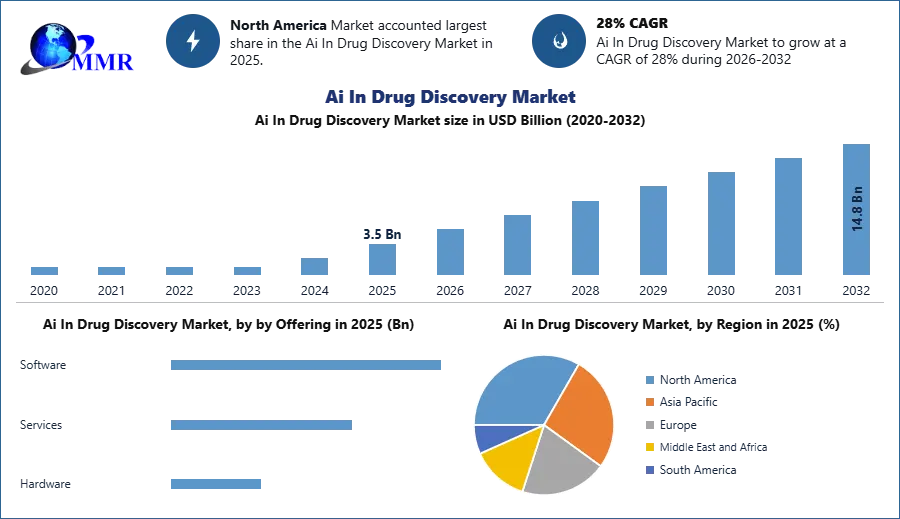 To know about the Research Methodology :- Request Free Sample Report
Scope of the Report:
The report provides a comprehensive analysis of the global AI in Drug Discovery Market. This report estimates the market in terms of USD value from 2026 to 2032. The research contains In-depth analysis about the major factors that are driving and hampering the growth of the AI in Drug Discovery market across the world. The report includes a thorough segmental analysis based on offerings, Therapeutic insights and application. In-depth understanding of the potential of the AI in Drug Discovey market has gained from regional examination of the innovation, merger and acquisition, corporate operations, and market value. In addition, there is a separate section on the market structure.
The section offers a thorough analysis of the major industry participants and their plans for growth in the world AI in Drug Discovery market. The Research aims to provide market participants with an overview of the AI in Drug Discovery Market. The study looks at the markets recent, ongoing, and predicted future changes. It also provides a simple analysis of complex data. New entrants, industry titans, and followers are some of the primary forces that actively and carefully perform research.
The study displays the results of the PORTER and PESTEL analyses as well as probable outcomes of the microeconomic market elements. After accounting for internal and external variables that can have a favorable or unfavorable impact on the firm, decision-makers will have a clear futuristic perspective of the market. The market segmentation analysis and market size forecast in the research help investors better understand the dynamics and structure of the AI in Drug Discovery market. The report acts as a buyer's guide by clearly outlining the comparative analysis of the top AI in Drug Discovery businesses by price, financial position, product, product portfolio, growth strategies, and regional presence.
AI in Drug Discovery Market Dynamics:
Big Tech and Pharmaceutical companies investing together
In order to use Microsoft's AI algorithms on the massive datasets used in pharma, Novartis and the computer company established a multi-year strategic agreement in 2019. The businesses said that in order to produce personalised medicine and improve cell and gene therapy, they intended to apply picture analysis and generative methods. In April, Nvidia, a company that makes graphics processing units and has been stepping up its AI efforts, teamed up with Schrödinger in an effort to speed up and improve the software's ability to forecast molecules. These aforementioned factors are greatly driving the AI in Drug Discovery Market.
Exscientia is one of many businesses formed in the last ten years around AI-based approaches to drug discovery and development, many of which have lately generated significant finance. Some of them are creating instruments to speed up the discovery of potential small-molecule medication candidates. For Instance, Recursion Pharmaceuticals, raised 436 million in its IPO, producing enormous volumes of customised data on cellular behaviour in the expectation that these may be mined using AI to provide biological insights that could guide the creation of novel medications. Additionaly IT firms like IBM, Microsoft, and Google are also participating in investing and having finanvial collaboration with the pharmaceutical companies for building up AI in Drug Discovery Market.
Technical Challenges
In many ways, artificial intelligence and machine learning are already developed. The quality of data sets, however presents a substantial obstacle when using Artificial intelligence methods for drug development. Numerous data sets are further challenging factors,while it is generally acknowledged that cooperation is crucial to advancing the use of AI in drug discovery, challenging problems relating to data ownership and sharing confidentially need to be handled. The field currently lacks strong instances of promising leads from the start, and many current technologies have been verified retroactively.
The search for quality over quantity in drug discovery
Artificial Intelligence offer potential approaches in examininig the large number of aspects of the drug discovery at an early stage before the compounds need to be taken in laboratory.For Instance AstraZeneca has implemented “5R framework”to improve R&D PRODUCTIVITY.By implementing 5R framework,AstraZeneca reports has improve the use of Ariticial Intelligence in drug discovery by 19%.Partnering between Pharma Companies and Artificial Intelligence companies are definitely booming across the industry.For Instance, Weatherall points to a collaboration launched in 2019 between AstraZenca and Benevolent Artificial Intelligence , To discover new drugs for chronic kidney diseases and idiopathic pulmonary fibrosis.
Artificial Intelligence with its ability to look at vast quantatites of existing data and learn patterns which are too complex for human to recognize can recognize and predict small molecules with the desirable properties, taking the computation skills to the next levels.For Instance,the Iktos,announced in March 2022 that it was applying its technology to a number of small molecule discovery programmes at Pfizer. It has also made collaboration with Merck ,KGaA,Almirall, which is a Barcelona based company working on treatments of skin diseases. There has been surge of interest in approaches based around generating data specifically with the Artificial Intelligence application in mind, for Instance, Insitro which was founded in 2018 are rapidly generating high quality biological data sets suitable for machine learning in drug Discovery creating a growth opportunities in AI in Drug Discovery Market.
Recent Industry Developments
| Exact Date | Company | Development | Impact |
|---|---|---|---|
| 13 January 2025 | NVIDIA Corporation | Announced strategic collaborations with IQVIA, Illumina, Mayo Clinic, and Arc Institute to deploy AI-powered accelerated computing platforms for genomics research and drug discovery. | The initiative strengthens AI infrastructure for biomedical research, enabling faster target identification, improved clinical trial efficiency, and accelerated drug discovery workflows. |
| 13 June 2025 | AstraZeneca PLC | Entered a $5.3 billion AI-driven drug discovery collaboration with CSPC Pharmaceuticals Group to identify and develop novel small-molecule oral therapies for chronic diseases. | The partnership expands the use of AI-based target identification and molecule design, accelerating pre-clinical drug candidate discovery and strengthening AstraZeneca’s AI drug pipeline. |
| 11 July 2025 | Elix, Inc. & Life Intelligence Consortium (LINC) | Commercialized Elix Discovery™, the first AI drug discovery platform using federated learning models trained on datasets from 16 pharmaceutical companies. | The platform enables secure multi-company data collaboration, significantly improving AI model accuracy and accelerating early-stage drug discovery research. |
| 14 October 2025 | Nabla Bio & Takeda Pharmaceutical Company | Expanded a multi-year AI-driven research collaboration using Nabla’s Joint Atomic Model (JAM) platform to design protein therapeutics for Takeda’s pipeline. | The partnership accelerates AI-based protein engineering and antibody design, potentially reducing drug development timelines to only a few weeks for early-stage discovery cycles. |
| 12 January 2026 | NVIDIA Corporation & Eli Lilly and Company | Announced a $1 billion AI co-innovation lab to build next-generation drug discovery systems powered by the NVIDIA BioNeMo platform and advanced AI infrastructure. | The initiative aims to create continuous AI-assisted experimentation and large-scale biological modeling, significantly improving the speed and efficiency of pharmaceutical R&D. |
AI in Drug Discovery Market Segment Analysis:
By Offering, the AI in Drug Discovery Market is segmented into Software, Hardware Services. Software is expected to dominate the market during the forecast period. AI software platforms enable pharmaceutical companies to analyze vast datasets, simulate molecular interactions, and predict drug efficacy more efficiently than traditional methods. These software solutions integrate advanced technologies like deep learning, natural language processing, and predictive analytics, which are essential for tasks such as virtual screening, biomarker discovery, and drug repurposing. Although hardware and services also contribute to the AI ecosystem, software remains central as it powers the core functions of AI in drug discovery.
The growing demand for more sophisticated computational tools in the pharmaceutical industry underscores the importance of software, particularly in reducing the time and cost associated with drug development. Additionally, software offerings are often paired with cloud-based platforms, allowing seamless integration with existing research pipelines and enhancing scalability. As AI continues to evolve, software will maintain its dominance due to the need for increasingly powerful algorithms and analytical tools to support the discovery of new, effective treatments.
By Therapeutic Area, the market is segmented into the Oncology, Neurology, Cardiovascular Diseases, Metabolic Diseases, Immunology and others. Oncology is held the largest AI in Drug Discovery Market share in 2025. Oncology stands out as the most useful therapeutic area for AI in drug discovery due to the immense potential it holds in transforming cancer treatment. Cancer is one of the most complex and heterogeneous diseases, with each type exhibiting unique genetic and molecular profiles, making traditional drug discovery methods slow and costly.
AI's ability to analyze massive datasets, such as genomic sequences and clinical trial data, is revolutionizing how researchers identify potential drug targets and develop personalized therapies. In oncology, AI is instrumental in speeding up the drug discovery process by predicting which compounds are likely to be effective against specific cancer subtypes. Additionally, AI-driven models can identify biomarkers that help stratify patients based on their likelihood of responding to certain treatments, paving the way for more personalized, targeted therapies.
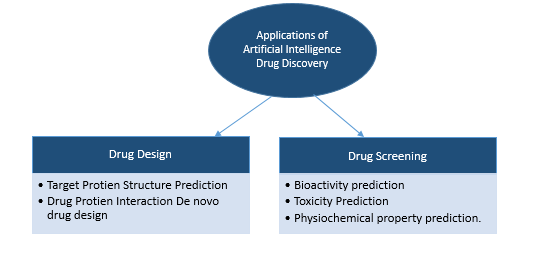
By Application, the AI in Drug Discovery Market is by application is segment into AI used in pharmacology, drug design, drug screening, drug repurposing, In which Ai used in drug design and drug screening segment dominate the market. According to MMR finding the AI used in Drug scrrening showed that 70% of anti microbial activity could accurately predict the toxic properties of the drug with only 4% of error rate.AI are widely used to find inhibitor molecule for specific protiens.
Further the AI in drug Discovery are widely used in Clinical trials application and this segment is forecasted to dominate the market.The recent development of AI tools for the clinical trials during drug discoery have been ideal for recognizing diseases of patients, identifying gene targets and off targets.AI in drug discovery are used to identify and predict human relevant biomarkers of diseases to select and recruit specific patient population which has further increased the success rate of Clinical trials.
AI in Drug Discovery Market Regional Insights:
In 2025, North America's revenue share was above 56%, which was the highest. The United States has been at the forefront of AI technology since its inception. Due to IBM's usage of their supercomputer "Watson" to win the game "Jeopardy," the business has since improved on the concept of AI. The tech sectors have made AI a significant component, and it is commonly used in a variety of fields, including the pharmaceutical industry. To accelerate medication research, design, and repurposing, major tech corporations in the United States have all partnered with esteemed institutions. Additionally, they are utilising AI to investigate disorders and draw pertinent conclusions that can enhance disease management.
Thanks to the growing acceptance of smart cities in developing nations like India and China, the Asia Pacific AI in Drug Discovery market is expected to account for a sizeable portion of the global market. The market for AI In Drug Discovery is also expected to be driven by an increase in population in APAC nations.
AI in Drug Discovery Market Ecosystem
AI in Drug Discovery Market Scope: Inquiry Before Buying
| Ai In Drug Discovery Market | |||
|---|---|---|---|
| Report Coverage | Details | ||
| Base Year: | 2025 | Forecast Period: | 2026-2032 |
| Historical Data: | 2020 to 2025 | Market Size in 2025: | 3.5 USD Billion |
| Forecast Period 2026-2032 CAGR: | 28% | Market Size in 2032: | 14.8 USD Billion |
| Segments Covered: | by Offering | Software Services Hardware |
|
| by Technology | Machine Learning Natural Language Processing Others |
||
| by Appliaction | Target Selection and Validation Drug Screening and Lead Optimization Clinical Studies Preclinical studies Others |
||
AI in Drug Discovery Market, by Region
North America (United States, Canada and Mexico)
Europe (UK, France, Germany, Italy, Spain, Sweden, Austria and Rest of Europe)
Asia Pacific (China, South Korea, Japan, India, Australia, Indonesia, Malaysia, Vietnam, Taiwan, Bangladesh, Pakistan and Rest of APAC)
Middle East and Africa (South Africa, GCC, Egypt, Nigeria and Rest of ME&A)
South America (Brazil, Argentina Rest of South America)
Key players / Competitors profiles covered in the Ai In Drug Discovery Market report in strategic perspective
1. GNS Healthcare (US)
2. BioSymetrics (US)
3. BPGbio, Inc (US)
4. Atomwise Inc (US)
5. Insitro (US)
6. NVIDIA Corporation (US)
7. IBM Corporation (US)
8. Microsoft Corporation (US)
9. Aria Pharmaceuticals, Inc. (US)
10. Insilico Medicine (US)
11. NuMedii, Inc. (US)
12. Owkin Inc. (US)
13. Schrödinger, Inc. (US)
14. DEEP GENOMICS (Canada)
15. Cyclica (Canada)
16. BenevolentAI (UK)
17. Exscientia (UK)
18. Iktos (France)
19. Euretos (Netherlands)
20. Evaxion Biotech A/S (Denmark)
21. XtalPi Inc (China)
22.AstraZeneca PLC
23.Elix, Inc. & Life Intelligence Consortium (LINC)
24.Nabla Bio & Takeda Pharmaceutical Company
25.NVIDIA Corporation & Eli Lilly and Company