
AI in Chemical Market Size by Technology, Application, Deployment Mode and End User
Overview
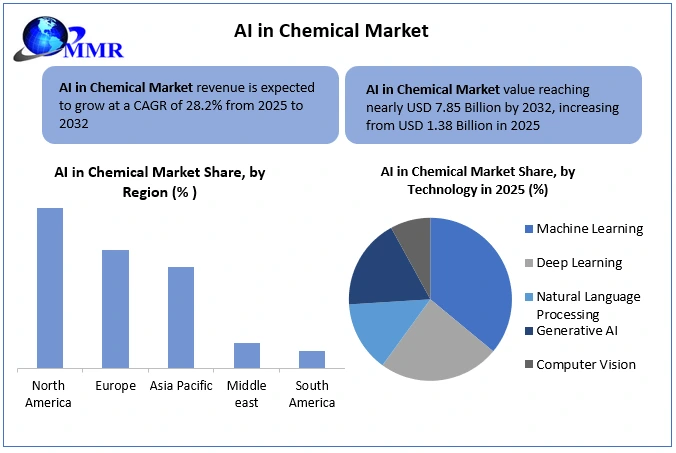
The Global AI in Chemical Market was valued at USD 1.38 billion in 2025 and is projected to reach USD 7.85 billion by 2032, expanding at a robust CAGR of 28.2% during the forecast period (2026–2032). The study covers the historic period from 2020–2025, with 2025 as the base year and forecasts extending from 2026–2032. Market growth is driven by increasing adoption of AI for process optimization, predictive maintenance, research & development, quality control, and supply chain management across the chemical industry. Regionally, North America dominates the market with a 38% share, followed by Europe (28%), Asia Pacific (24%), Middle East & Africa (6%), and South America (4%). North America's leadership is attributed to advanced digital infrastructure, significant AI investments, and the strong presence of leading chemical manufacturers.
Furthermore, Machine Learning-based solutions hold the highest market share in the AI in Chemical Market due to their strong capability in predictive analytics, process optimization, and chemical reaction modeling.
• The report provides a detailed analysis of competitors' strategies, AI platform developments, digital transformation initiatives, and strategic collaborations, helping stakeholders understand the competitive landscape and develop effective market positioning strategies.
• In 2025, the global AI in Chemical Market is primarily driven by technology adoption hubs across North America, Europe, China, Japan, and India, supported by growing demand for AI-driven molecular discovery, smart chemical manufacturing, and automated R&D systems.
• The United States ranks as the leading adopter and innovator in AI-enabled chemical solutions globally, supported by its strong ecosystem of AI companies, chemical giants, and advanced R&D infrastructure. Germany and the United Kingdom maintain significant positions through industrial automation and green chemistry initiatives, while China and India are rapidly expanding adoption through large-scale chemical production and digital transformation investments.
To know about the Research Methodology :- Request Free Sample Report
AI in Chemical Market Dynamics:
Increasing Adoption of AI-Driven R&D Automation Boosts the AI in Chemical Market
The Growth of the Global AI in Chemical market is primarily fueled by the increasing adoption of artificial intelligence across research, manufacturing, and operational processes. AI enables faster product innovation, improves production efficiency, minimizes equipment downtime, and optimizes resource utilization, resulting in significant cost savings and higher productivity.
Key growth drivers include R&D automation efficiency gains, contributing an estimated USD 3.2 billion in market impact by accelerating research workflows and reducing development time. AI-driven material discovery adds approximately USD 2.6 billion by enabling the rapid identification of advanced chemical compounds and formulations. Predictive maintenance in chemical plants contributes around USD 1.9 billion through reduced equipment failures and maintenance costs, while process optimization and yield improvement generate an estimated USD 2.1 billion by enhancing production quality, reducing waste, and improving operational efficiency across manufacturing facilities.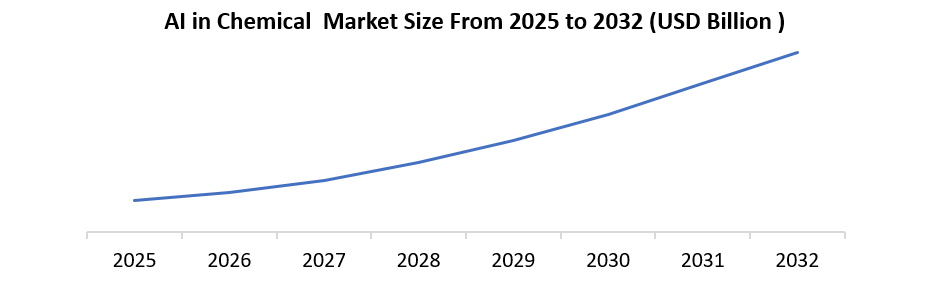
High-speed Adoption of AI in Chemical R&D and Process Optimization Drives Market Growth
There is significant market growth in the AI in Chemicals Market owing to the growing implementation of AI across the processes involved in chemical research, process optimization, and material discovery. Due to increasing pressure to enhance efficiency, lower costs, and increase innovation speed, many chemical organizations are using AI-based solutions to revolutionize their R&D processes. The growing demand for rapid discovery of molecules and advanced material design plays a critical role in promoting the adoption of AI tools such as machine learning, deep learning, and generative AI. Such AI solutions provide predictive modeling of chemical reactions, production processes, and molecular structures.
Restraining Factors – High Implementation Costs and Integration Difficulties Limiting Market Growth
Although the market offers significant growth opportunities, the AI in Chemical Market is likely to face various restraining factors that will hinder its growth. One of the main restraining factors is high implementation costs which include expenditures on computing infrastructure, cloud computing solutions, data storage solutions, and special AI software used for chemical simulations. Such high costs are likely to be difficult for small and medium-sized chemical enterprises working in competitive markets.
Moreover, another major restraining factor is integration difficulty of the AI solutions into chemical manufacturing and R&D processes. Due to the presence of legacy systems among many chemical companies, their digitalization and adoption of AI technologies can be complicated, costly, and time-consuming .Furthermore, there are certain constraints associated with a scarcity of professionals in artificial intelligence and chemical engineering industries. Moreover, concerns about data security and intellectual property protection can become other restraining factors in the adoption of AI solutions in chemistry.
AI in Chemical Market Regional Insight:
North America has the maximum market share owing to the advanced integration of AI in chemical research and development, molecular modeling, and process optimization. The availability of advanced technology providers, chemical companies, and investments in cloud-based AI software and digital twins in the region, especially in the United States, increases its dominance.
The European market constitutes a considerable portion of the market, backed by stringent environmental regulations and an emphasis on sustainable and green chemistry. Germany, the UK, and France are extensively using AI to optimize processes and reduce emissions in the chemical industry.
Asia Pacific has the highest rate of growth among all regions because of the large-scale chemical production in China, India, Japan, and South Korea. Industrialization and government policies for digital transformation have been playing their roles in the growth of this region.
The Middle East and Africa region is growing slowly due to petrochemical applications in GCC countries. Similarly, South America is also an upcoming region due to the use of AI in agrochemicals and specialty chemicals of Brazil and Argentina.
AI in Chemical Market Competitive Landscape:
Competitive and innovative AI in the Chemical Market is comprised of leading technology providers, chemical manufacturers, and AI solutions providers that continuously strive to secure better positions in the market through innovation and expansion. Artificial intelligence, machine learning, cloud computing, and analytics are used by companies in order to enhance research, manufacturing, and logistics processes in the chemical industry. Strategic cooperation between AI technology providers and chemical companies has become one of the growth strategies in the industry and allows developing intelligent solutions for material discovery, maintenance, quality control, and process optimization.
Moreover, companies in the market pay much attention to expanding their AI platforms by means of implementing digital twins, generative AI, computer vision, and IIoT technologies that will allow achieving digital transformation in chemicals. Mergers, acquisitions, joint ventures, and partnerships help companies to expand their product portfolios, enter regional markets, and develop technologically. Also, substantial investments in R&D facilitate the implementation of AI innovations in chemicals while increasing the sustainability and efficiency of processes in the industry.
AI in Chemical Market Scope: Inquire before buying
| AI in Chemical Market | |
| Market Name | AI in Chemical Market |
| Market Size in 2025 | USD 1.38 Bn. |
| Market Size in 2032 | USD 7.85 Bn. |
| CAGR (2025-2032) | 28.2% |
| Historic Data | 2020-2024 |
| Base Year | 2025 |
| Forecast Period | 2026-2032 |
| Segments Covered | |
| By Technology | Machine Learning Deep Learning Natural Language Processing (NLP) Computer Vision Generative AI |
| By Application | Drug Discovery Material Science Chemical Process Optimization Predictive Maintenance Formulation Design |
| By Deployment Mode | Cloud-Based On-Premise Hybrid |
| By End User | Chemical Manufacturers Pharmaceutical Companies Oil & Gas Industry Agrochemical Companies Research Institutes |
| Region Covered | North America: United States, Canada, Mexico Europe: Germany, United Kingdom, France, Italy, Netherlands, Switzerland, Rest of Europe Asia Pacific: China, India, Japan, South Korea, Australia, Singapore, Rest of Asia Pacific Middle East & Africa : GCC Countries, South Africa, UAE, Saudi Arabia, Rest of Middle East & Africa South America: Brazil, Argentina, Chile, Rest of South America |
| Report Coverage | Market Size & Forecast, Market Dynamics, Competitive Landscape, Company Benchmarking, AI Technology Analysis, Industry Use Case Analysis, Value Chain Analysis, Regional Insights, Investment Analysis, Strategic Recommendations, Future Growth Opportunities |
AI in Chemical Market Key Players:
| Company Name | Region | Core Competencies |
| IBM | North America | AI platforms, Watson AI for chemical modeling |
| Microsoft | North America | Azure AI, cloud-based chemical simulation |
| Google DeepMind | North America | AI-driven molecular discovery |
| NVIDIA | North America | AI computing, chemical simulation acceleration |
| AWS | North America | Cloud AI infrastructure |
| Accenture | Europe | AI consulting for chemical industry |
| Siemens | Europe | Industrial AI & digital twin systems |
| BASF | Europe | AI-driven chemical R&D & formulation |
| Dow Inc. | North America | Smart manufacturing & AI process optimization |
| SABIC | Middle East | AI-based petrochemical innovation |
| Shell | Europe | AI for energy & chemical process optimization |
| Chevron | North America | Predictive analytics in chemical processes |
| Honeywell | North America | Industrial AI automation |
| AspenTech | North America | Process optimization software |
| Schrödinger | North America | Computational chemistry AI |
| Chemours | North America | AI material innovation |
| Evonik | Europe | AI-based specialty chemicals |
| Bayer | Europe | AI-enabled chemical & life science R&D |
| Syngenta | Europe | AI in agrochemical discovery |
| Linde | Europe | Industrial gas & AI optimization |
| Reliance Industries | Asia Pacific | AI in petrochemical operations |
| Tata Chemicals | Asia Pacific | AI-based chemical manufacturing |
| LG Chem | Asia Pacific | AI-driven battery & chemical innovation |
| Samsung SDS | Asia Pacific | AI digital transformation |
| Infosys | Asia Pacific | AI & data analytics solutions |
| Wipro | Asia Pacific | AI consulting for chemical sector |
| Fujitsu | Asia Pacific | Industrial AI solutions |
| Huawei Cloud | Asia Pacific | AI computing infrastructure |
| C3.ai | North America | Enterprise AI for chemical industry |
| DataRobot | North America | AutoML for chemical analytics |
Frequently Asked Questions:
Q1. What is the market size of AI in Chemical Market in 2025?
The Global AI in Chemical Market was valued at USD 1.38 Billion in 2025.
Q2. What is the expected market size by 2032?
The Global AI in Chemical Market is estimated to reach USD 7.85 Billion by 2032.
Q3. Which region dominates the market?
North America leads with 38% share.
Q4. What is the key growth driver?
AI-driven molecular discovery and chemical R&D automation.
Q5. Which application segment is growing fastest?
Drug discovery and material science optimization.