
Adaptive Water Management Solution Market – Industry Structure Evaluation, Demand Drivers Analysis, Regional Growth Analysis and Identification, Competitive Positioning Review & Global Market Size Forecast to 2034
Overview
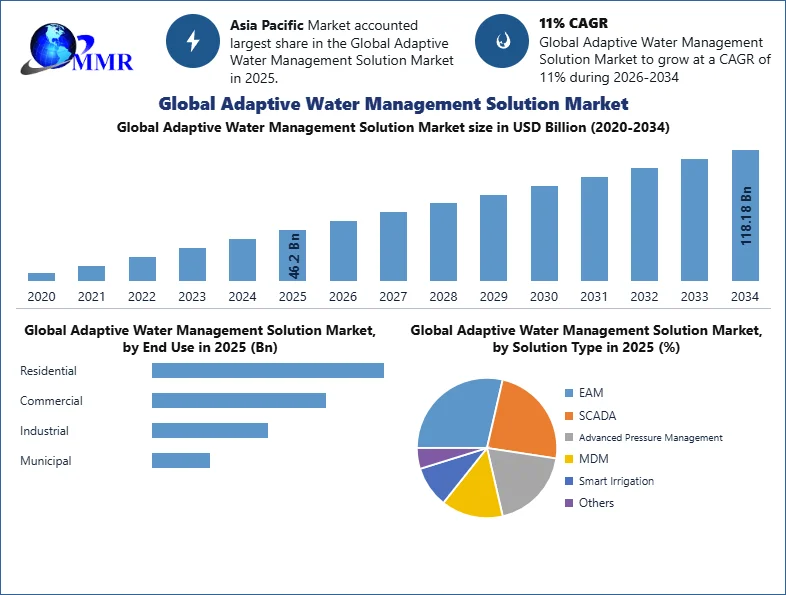
Adaptive Water Management Solution Market is estimated to grow from USD 46.2 Bn in 2025 to USD 118.18 Bn by 2034, at a CAGR of 11%. The report has analyzed the drivers, restraints, and challenges facing the Adaptive Water Management Solution Market.
Adaptive Water Management Solution Market Overview
Water Management is affected by various factors. Present water management plans of action are frequently not planned to appropriately help and adapt to changing boundary circumstances, like weather change, economic and political conditions.
 To know about the Research Methodology :- Request Free Sample Report
Adaptive Water Management Solution Market Dynamics
The global demand for water from the developing population, rising urbanization, and the price involvements of continuing old infrastructure framework are the important factors operating the development of the Adaptive Water Management solution market. In addition, with the growth of the Internet of things, intelligent cities around different zones are also estimated to encourage the development of the market. Technological developments in smart meters and their incorporation with transmission solutions (SCADA, GIS, etc.) have changed water management in directing the challenges accepted by water utilities, industries, and citizens, in connection with water management. The populations of emerging countries, basically in the south, are extremely unsafe to the influence of climate change on water accessibility due to increased rankings of vulnerability to water-related possibility, restricted surviving, frequently come to light from non-climatic elements. The effects of climate change are aggravated by quick population development in emerging countries.
Adaptive Water Management Solution Market Segment Analysis
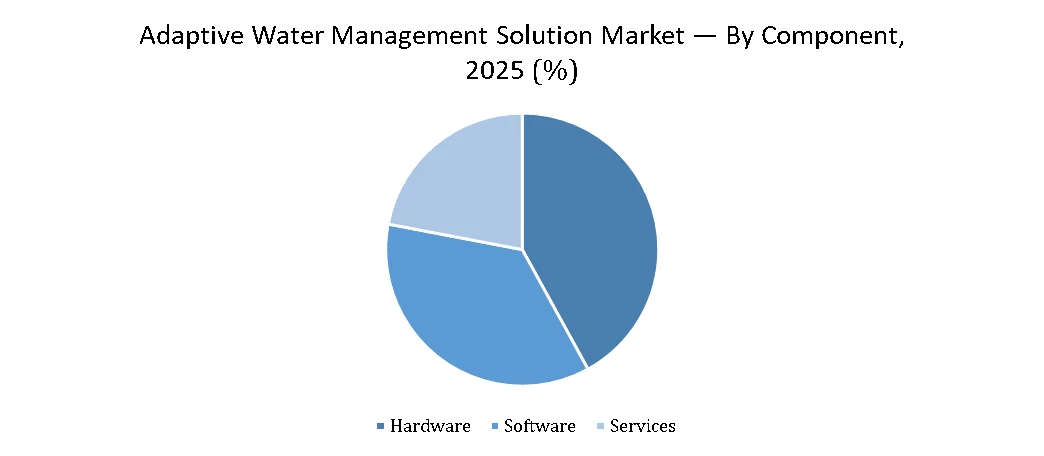
By component, the hardware segment dominated the Smart Water Management Market in 2025, accounting for the largest market share. The dominance is mainly driven by the rising deployment of smart meters, sensors, pressure monitoring devices, flow meters, communication modules, and control equipment across municipal and industrial water networks. Hardware forms the foundation of smart water infrastructure as it enables real-time data collection, leakage detection, pressure control, and water consumption monitoring. The software segment is expected to grow strongly during the forecast period due to increasing use of analytics platforms, meter data management, SCADA integration, and AI-based water network optimization. Services are also witnessing steady growth owing to demand for installation, integration, maintenance, consulting, and managed services.
By deployment model, the cloud-based segment dominated the Smart Water Management Market in 2025 and is expected to maintain its leading position during the forecast period. Cloud-based deployment is gaining strong adoption due to its scalability, lower upfront infrastructure cost, remote accessibility, faster data processing, and easy integration with IoT-enabled water monitoring systems. Municipalities and utilities are increasingly adopting cloud platforms to monitor consumption, detect leaks, optimize pressure, and manage customer billing data in real time. The on-premises segment continues to hold a significant share, especially among large utilities and industrial users that require greater control over data security, system customization, and legacy infrastructure integration.
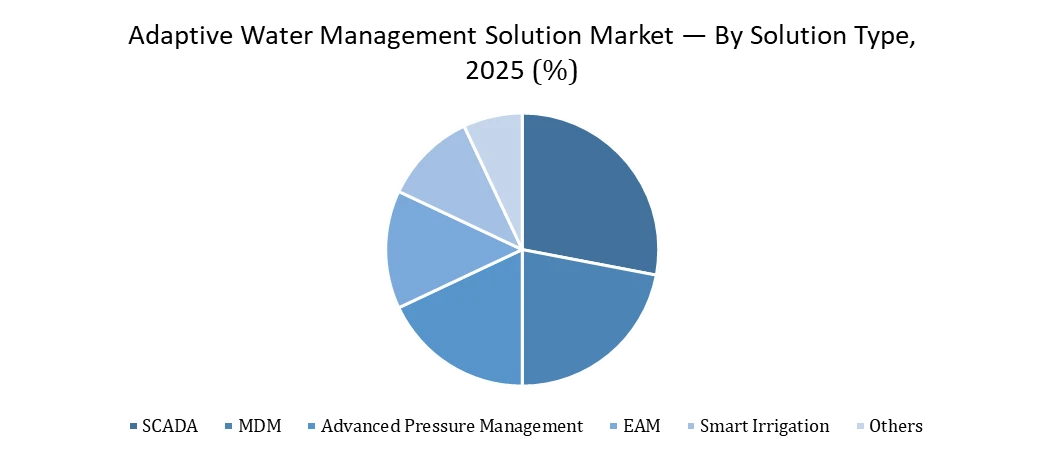
By solution type, the SCADA segment dominated the Smart Water Management Market in 2025 due to its critical role in monitoring and controlling water distribution networks, pumping stations, reservoirs, treatment plants, and pressure zones. SCADA systems help utilities improve operational visibility, reduce manual intervention, and respond quickly to leakages, equipment failures, and abnormal pressure conditions. The MDM segment also held a significant share due to the rapid adoption of smart meters and the growing need to manage large volumes of water consumption data. Advanced pressure management and smart irrigation solutions are expected to grow steadily as utilities, municipalities, agriculture users, and commercial facilities focus on reducing water losses and improving water-use efficiency.
By end user, the municipal segment dominated the Smart Water Management Market in 2025, accounting for the largest share. Municipal water utilities are the major adopters of smart water management solutions due to increasing pressure to reduce non-revenue water, improve water distribution efficiency, monitor leakage, upgrade aging infrastructure, and ensure reliable water supply. The industrial segment also holds a strong market share, supported by demand from manufacturing, power, oil & gas, food & beverage, and chemical industries where water monitoring and reuse are important for cost control and regulatory compliance. Commercial and residential segments are growing due to rising adoption of smart meters, automated billing, water conservation systems, and consumption monitoring solutions.
A rise in the call for standard water assistance with constant water-based charge is estimated to operate the market. Residential utilization of water reports for an enormous portion of water utilization, as water is examined to be preserved effectively. Hence, technology also plays an important part in making people responsible for the wastage of water. Customers are enhancing their accommodation by acquiring intelligent water administration software and hardware. This acquiring rates us quickly multiplying, as hardware and software are becoming inexpensive.
Adaptive Water Management Solution Market Regional Analysis
On the basis of region, the Adaptive Water Management Solutions Market is divided into North America, Europe, Asia Pacific, Middle East and Africa, and Latin America. Asia Pacific is estimated to be the dominant region in the Adaptive Water Management Market. Due to Quick development in the market, as it carries more than 50% of the world’s people, and hence any important technological transfers, like acquiring of Internet of things and various other high technology is likely to form the future of the zone.
Numerous Asian nations, like India, China, and Japan, purchase details concentrated technologies, to serve to the developing water utility section demand and therefore, Asia Pacific is estimated to manifest a favorable chance to increase Adaptive Water Management solutions. Digitization together with the acquiring of attached technologies is influencing all requests of Adaptive Water Management solutions, by transforming the way water management systems interchange with the environments in the accommodation sector.
Adaptive Water Management Solution Market Innovative approaches
Water Supply or excess demand management under climate emergency requires supervising under top levels of unpredictability regarding estimated impacts. To keep away from the risk involved decisions building that might demonstrate ineffective and expensive, like extensive infrastructural expenditures, Vicuna, Melo, Donoso, and Melino present and estimate water option contracts as a workable modification measure. Option agreements are risk-based devices that permit less unprotected water customers to deal with their water rights with more unprotected customers during a maximum function. They can help keep away ex-post decisions on costly infrastructure.
Key Developments:
Veolia Environment — May 2025: Veolia signed an agreement to acquire CDPQ’s 30% stake in Water Technologies and Solutions (WTS), giving Veolia full ownership of the business. The transaction value was stated at USD 1.75 billion, with expected additional cost synergies of around EUR 90 million by 2027. Impact: This strengthens Veolia’s position in advanced water technologies, especially for water scarcity, climate adaptation, semiconductor, pharmaceutical, and data center water-treatment demand.
SUEZ — January 2026: SUEZ renewed its contract with the Hérault Méditerranée Urban Community to deliver drinking water, sewerage, and sanitation services for 15 years, supported by nearly EUR 55 million of investments. The project includes smart meters, SUEZ’s Aquadvanced real-time monitoring platform, pressure optimization, 550 fixed acoustic sensors, annual leak detection, and targeted inspections. Impact: This is a strong adaptive water management development because it focuses on leakage reduction, real-time network monitoring, treated wastewater reuse, and water-loss optimization.
SUEZ — June 2026: SUEZ secured a EUR 2 billion, 15-year performance-based water and wastewater services contract with NAMA Water Services in Oman, covering services for around 2.3 million inhabitants. SUEZ also states that the project targets water-loss reduction from 34% to 11%. Impact: This is directly relevant to adaptive water management because it combines utility-scale O&M, leakage reduction, performance-based water services, and long-term water resilience.
Badger Meter — January 2025: Badger Meter acquired SmartCover Systems from XPV Water Partners for USD 185 million. SmartCover provides real-time monitoring of sewer lines, lift stations, stormwater assets, and wastewater collection systems using sensors, software, and analytics. Impact: This acquisition expands Badger Meter’s BlueEdge water management suite and strengthens its position in intelligent wastewater and stormwater monitoring.
Badger Meter — April 2026: Badger Meter signed a definitive agreement to acquire UDlive Limited, a UK-based provider of hardware-enabled software for sewer line monitoring, for USD 100 million plus contingent consideration. UDlive provides low-power water-level sensors and analytics software for real-time sewer network visibility. Impact: This strengthens Badger Meter’s global sewer monitoring portfolio and supports utilities in reducing overflows, improving wastewater resilience, and managing aging infrastructure.
Itron — November 2025: Itron announced that Northumbrian Water would deploy 330,000 Itron Aquadis+ water meters with Cyble 5 communication modules by 2029. The rollout is designed to improve data collection, billing accuracy, leakage reporting, and water conservation. Impact: This supports the smart metering and water-loss-reduction side of the Adaptive Water Management Solution Market.
Itron — June 2026: Itron collaborated with Watercare Services in New Zealand for the deployment of 100,000 Intelis wSource digital water meters as part of a broader smart metering program in Auckland. The meters use NB-IoT connectivity and are designed to eliminate manual reads, improve infrastructure insights, and support real water-loss reduction. Impact: This development strengthens demand for connected water meters and utility data platforms in adaptive water networks.
Sensus / Xylem — October 2025: Xylem announced the sale of its metering assets outside North America, while stating that its smart metering portfolio would continue under the Sensus name in North America. Impact: This is important for the smart water meter competitive landscape because it reshapes Xylem/Sensus’ regional focus and may create new competitive opportunities in international smart metering markets.
Oracle Utilities — March 2025: Oracle launched Oracle Energy and Water Data Exchange, a cloud-based solution designed to streamline data integration, sharing, and preparation for AI use cases across utilities. Impact: This is relevant to adaptive water management because AI-ready utility data platforms are becoming important for predictive analytics, meter data management, asset intelligence, and operational decision-making.
Ecolab — December 2025: Ecolab closed its acquisition of Ovivo’s Electronics ultrapure water business, strengthening its water circularity offering for semiconductor and high-tech manufacturing. The company stated that the acquisition supports reduced water use in the water-intensive semiconductor industry. Impact: This strengthens Ecolab’s position in industrial adaptive water management, especially ultrapure water, reuse, and circular water solutions for microelectronics.
Ecolab — March/July 2026: Ecolab announced and then closed the acquisition of CoolIT Systems for approximately USD 4.75 billion. CoolIT provides liquid cooling systems for AI data centers, and Ecolab stated that combining CoolIT with its water, chemistry, fluid management, digital monitoring, and service capabilities would help reduce water and energy use in data center operations. Impact: This expands Ecolab’s role in adaptive water and thermal management for high-growth AI and data center infrastructure.
Grundfos — June/August 2025: Grundfos entered into an agreement to acquire Newterra, a Pittsburgh-based water and wastewater treatment company, and its 2025 annual report states that Grundfos acquired Newterra’s water and wastewater treatment business on 15 August 2025. Impact: This expands Grundfos’ water treatment and reuse platform in North America and strengthens its position in modular and decentralized water treatment systems.
Aquatech International — 2025–2026: Aquatech announced a growth investment from Cerberus Capital Management in April 2025, acquired Century Water in June 2025 to strengthen ultrapure process water and wastewater recycling services, and acquired FTS H2O in May 2026 to advance energy-efficient brine concentration, zero liquid discharge, and resource recovery. Impact: These developments position Aquatech strongly in industrial water reuse, desalination, ultrapure water, brine management, and high-recovery water treatment.
IDE Technologies — 2025–2026: IDE’s official newsroom lists major water infrastructure developments including the SIPCOT seawater desalination plant in Tamil Nadu, the Mumbai / MCGM desalination project, the Prospect Lake Clean Water Center, and the Harbor Island 100 MGD desalination facility. Impact: These projects strengthen IDE’s role in desalination, municipal water security, and climate-resilient water supply infrastructure.
Kurita Water Industries — October 2025 / March 2026: Kurita announced orders for e-WT, an off-the-line ultrapure water supply system for the electronics industry, as part of the joint Meta-aqua Project with Fracta Leap. In March 2026, Kurita also announced the start of operations for Kurita Water Industries Mexico, focused on water treatment chemical sales. Impact: These developments support Kurita’s expansion in industrial water optimization, ultrapure water, electronics water systems, and regional water treatment services.
Saur Group — October 2025 / February 2026: Saur renewed its SMAP contract in France in October 2025 to produce drinking water for 220,000 residents, and in February 2026 Saur signed a major contract for Ras Al Khaimah’s first large-scale wastewater PPP project in the UAE. Impact: These developments support Saur’s expansion in drinking water production, wastewater PPPs, and smart water service delivery models.
Jacobs Engineering — January 2026: Jacobs was selected as the progressive design-build contractor for upgrades to the San José–Santa Clara Regional Wastewater Facility, a USD 200 million modernization project. Jacobs also announced a contract to advance water reuse and resilience in California, with a focus on direct potable reuse. Impact: This supports adaptive water management through wastewater modernization, water reuse, resilience planning, and advanced treatment infrastructure.
Schneider Electric — April 2026: Schneider Electric introduced the Modicon M590 dPAC with EcoStruxure Automation Expert, describing it as software-defined automation built for sectors including water and wastewater. Impact: This is relevant to the adaptive water management market because automation, edge control, and software-defined operations are key enablers for smarter water and wastewater infrastructure.
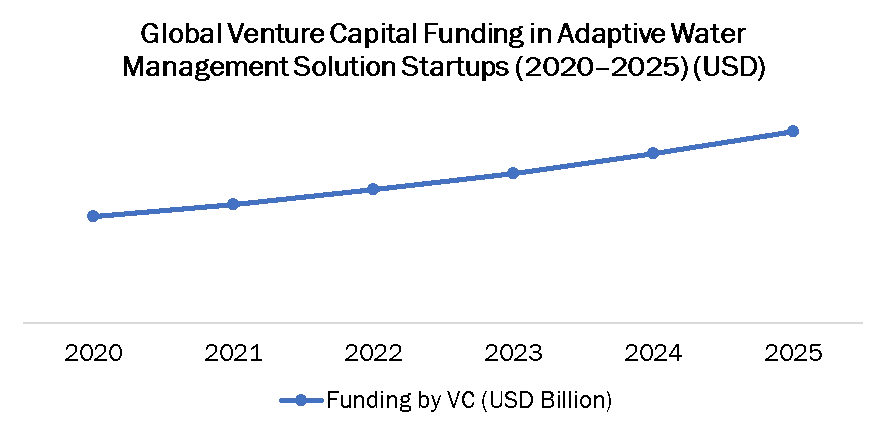
The report also helps in understanding market dynamics, structure by analyzing the market segments and projects the Adaptive Water Management Solution Market size. Clear representation of competitive analysis of key players By Type, price, financial position, Product portfolio, growth strategies, and regional presence in the market make the report investor’s guide.
Adaptive Water Management Solution Market Scope: Inquire before buying
| Adaptive Water Management Solution Market | |||
|---|---|---|---|
| Report Coverage | Details | ||
| Base Year: | 2025 | Forecast Period: | 2026-2034 |
| Historical Data: | 2020 to 2025 | Market Size in 2025: | 46.2 USD Bn |
| Forecast Period 2026-2034 CAGR: | 11% | Market Size in 2034: | 118.18 USD Bn |
| Segments Covered: | By Component | Hardware Software Services |
|
| By Type (Solution / Technology) | EAM SCADA Advanced Pressure Management MDM Smart Irrigation Others |
||
| By Deployment Model | Cloud-based On-premises |
||
| By End-Use | Residential Commercial Industrial Municipal |
||
Region Covered
North America (United States, Canada, and Mexico)
Europe (UK, France, Germany, Italy, Spain, Sweden, Austria, and the Rest of Europe)
Asia Pacific (China, South Korea, Japan, India, Australia, Indonesia, Malaysia, Vietnam, Taiwan, Bangladesh, Pakistan, and the Rest of APAC)
Middle East and Africa (South Africa, GCC, Egypt, Nigeria, and the Rest of MEA)
South America (Brazil, Argentina, Rest of South America)
Key Player / Competitors Profile Covered in (Global Market) Report in Strategic Perspective:
- Xylem
- Veolia Environnement
- SUEZ
- Badger Meter
- Itron
- Blackbuck Resources
- PowerTech Water
- MWTP Solutions
- 4Earth
- KarIoT
- Ekatvam Innovations
- WEGoT Utility Solutions
- Bariflo Labs
- Schneider Electric
- Sensus
- Oracle Utilities
- Aquatech International
- Kurita Water Industries
- IDE Technologies
- Ecolab
- Jacobs Engineering
- Grundfos
- Aquarion Group
- Bentley Systems
- Saur Group
- Ayyeka
Others