
Adaptive Optics Market– Industry Structure Evaluation, Demand Drivers Analysis, Regional Growth Analysis and Identification, Competitive Positioning Review & Global Market Size Forecast to 2034
Overview
The Adaptive Optics Market was valued at USD 3.63 Bn in 2025, and total global Adaptive Optics Market revenue is expected to grow at a CAGR of 35.2% and reach nearly USD 54.89 Bn from 2026-2034, driven by advanced ophthalmic imaging, laser beam control, and semiconductor inspection.
Adaptive Optics Market Overview
The Adaptive Optics market is expected to grow, due to the imperative need for advanced optical systems such as the Overwhelmingly Large Telescope (OWL). OWL's spectroscopy and imaging capabilities rely heavily on Adaptive Optics to concentrate light and achieve diffraction-limited performance. The Adaptive Optics market trajectory is guided by a three-generation implementation plan. The 1st generation AO emphasizes Natural Guide Stars (NGSs) and ground layer correction. The 2nd generation introduces Multi-Conjugate Adaptive Optics, employing additional deformable mirrors for enhanced correction. The 3rd generation focuses on Laser Guide Stars (LGSs), particularly Sodium LGSs, offering broader sky coverage and superior correction.
Adaptive Optics Market Growth Outlook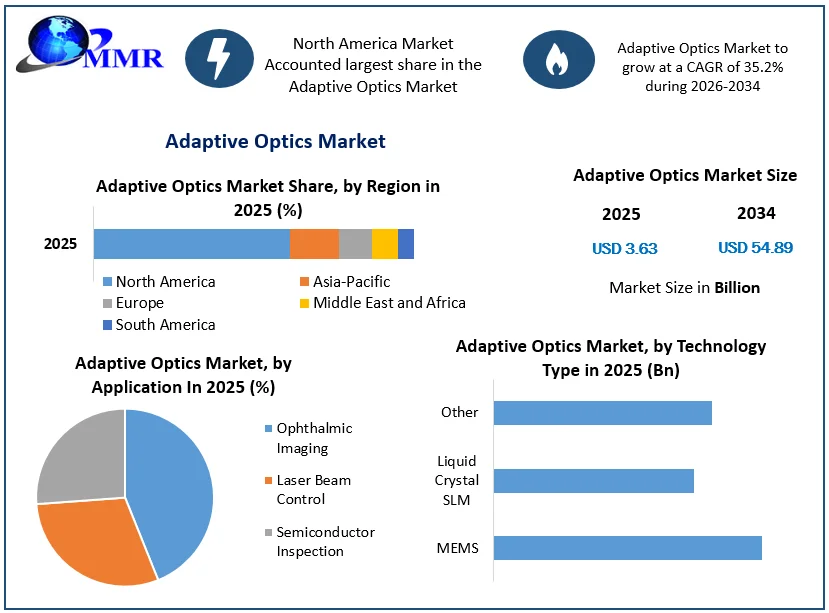
To know about the Research Methodology:-Request Free Sample Report
Performance projections are optimistic, leveraging expected technological advancements, particularly in deformable mirror sizes and actuator densities. While current technology does not fully meet all requirements, confidence is high in future advancements reshaping the market landscape. The Adaptive Optics Market is poised for growth, driven by the increasing demand for high-performance optical systems such as those required for OWL. With advancements in AO technology, the market is expected to boost further, offering enhanced capabilities and broader applications.
Adaptive Optics Market Dynamics
Driver
Rising Demand in Astronomy Boosts Adaptive Optics Market Growth
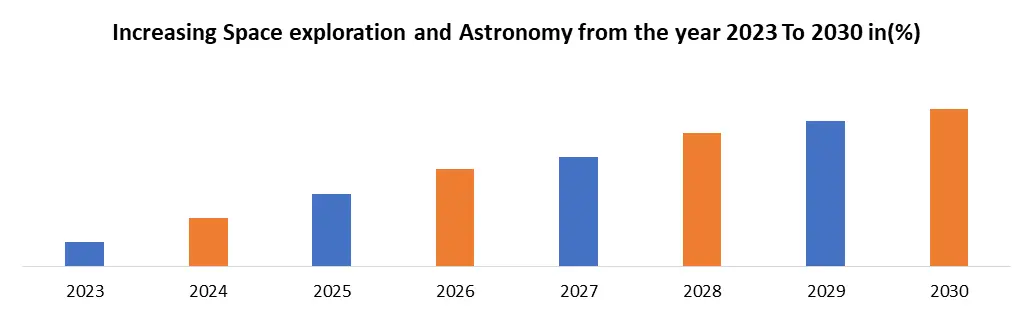
The rising demand in astronomy for high-resolution imaging and spectroscopy significantly boosts the Adaptive Optics Market. AO systems are crucial for correcting atmospheric distortions in real time, enabling telescopes to produce sharper and clearer images of celestial objects. This capability is essential for studying phenomena such as exoplanets, galaxies, and black holes in unprecedented detail, advancing scientific research and discovery. Observatories and research institutions prioritize the adoption of AO technology to maintain competitiveness in astronomical observations, attracting funding and support from various sources.
The technological advancements spurred by AO development in astronomy often lead to applications in other industries such as medicine, defense, and telecommunications, fostering innovation and boosting the market further. As astronomers continually push the boundaries of observational capabilities, the demand for AO-equipped telescopes and systems is expected to rise, driving further investment, innovation, and growth in the Adaptive Optics market. This symbiotic relationship between astronomy's quest for a deeper understanding of the cosmos and AO technology's capability to meet these demands underscores the significant role AO plays in advancing both scientific knowledge and technological progress, ensuring its continued relevance and growth.
Restrain
High Cost of the AO System limits the Market growth
The high cost of Adaptive Optics (AO) systems significantly constrains the growth of the Adaptive Optics market due to several reasons. The complex technology and specialized components required for AO systems lead to substantial manufacturing costs. These expenses are then passed on to consumers, making AO systems prohibitively expensive for many potential buyers, including researchers, observatories, and industrial users.
The maintenance and operational costs of AO systems also be substantial. These systems often require skilled personnel for installation, calibration, and ongoing support, adding to the overall expense. The need for regular upgrades and software updates further contributes to the total cost of ownership. The high initial investment required for AO systems acts as a barrier to entry for smaller research institutions, universities, and businesses, limiting the potential market size. This, in turn, hampers the economies of scale that drive down costs through mass production and widespread adoption. To address these challenges and stimulate Adaptive Optics market growth, efforts to reduce production costs, enhance efficiency, and develop more affordable alternatives to traditional AO systems are crucial. Collaboration between industry, academia, and government entities also plays a significant role in driving innovation and expanding access to AO technology.
Opportunity
Technological advancement creates lucrative growth opportunities for Market Growth
Technological advancements catalyze lucrative growth opportunities within the Adaptive Optics market by revolutionizing system capabilities, broadening applicability, and fostering innovation. Breakthroughs in wavefront sensing, modulation, and control algorithms enable AO systems to achieve unprecedented levels of precision in correcting optical aberrations. This enhanced performance is particularly appealing for industries requiring superior imaging quality, such as astronomy, microscopy, and medical imaging.
Also, advancements in component design and manufacturing processes lead to cost reductions, making AO technology more accessible to a wider range of customers. This affordability drives adoption across various sectors, including research, defense, and healthcare, boosting Adaptive Optics market growth. Technological innovation fuels the development of novel AO solutions and applications, providing companies with opportunities to differentiate themselves and capture niche markets. By investing in research and development, companies stay ahead of the curve and offer cutting-edge products that meet evolving customer needs. AO technology has become more versatile and adaptable, it penetrates emerging markets and industries. Rapid industrialization, infrastructure development, and increasing healthcare expenditures in regions such as Asia-Pacific and Latin America create new demand for AO solutions, further driving market growth.
Adaptive Optics Market Segment Analysis
Based on the Component, the Control system segment dominated the Component segment of the Adaptive Optics Market in the year 2025. The dominance of the Control System segment in the Adaptive Optics industry is due to its central role in optimizing AO system performance. Control systems are integral for processing data from wavefront sensors and driving wavefront modulators to correct optical aberrations in real time.
Their effectiveness directly impacts image quality, resolution, and sensitivity across diverse applications, from astronomy to medical imaging. As the backbone of AO functionality, advancements in control algorithms, hardware, and software integration are essential for achieving precise corrections and adapting to changing environmental conditions. Continuous innovation in control system technologies drives market growth by enabling AO systems to meet evolving demands and expand into new applications. The critical role, broad applicability, and ongoing research and development efforts in control systems position this segment as a dominant force shaping the future of the Adaptive Optics market.
Based on application, the adaptive optics market is segmented into ophthalmic imaging, laser beam control, and semiconductor inspection. Ophthalmic imaging dominated due to increasing use in advanced eye care diagnostics and retinal imaging. Laser beam control is growing significantly, driven by defense, laser communication, and biomedical applications requiring precision. Semiconductor inspection is also a key segment, as adaptive optics improve imaging accuracy during wafer and chip manufacturing processes, especially with the rise of miniaturized electronics.
Adaptive Optics Market Regional Analysis
North America dominated the Adaptive Optics Market in the year 2025. North America's dominance in the Adaptive Optics industry stems from several factors that collectively contribute to its leading position. The region boasts a strong and dynamic scientific and technological ecosystem, with renowned research institutions, universities, and high-tech industries driving innovation in optical sciences and engineering. North America is home to some of the world's largest astronomical observatories and space agencies, which heavily rely on AO systems for their research and exploration missions. These institutions foster a culture of collaboration and investment in innovative technologies, further solidifying the region's leadership in AO development and deployment.
Also, North America benefits from a strong market infrastructure and a favorable regulatory environment that supports the growth and commercialization of AO technologies. The presence of major players in the aerospace, defense, and healthcare sectors further bolsters the market, driving demand for AO-enabled products and solutions across various industries. The strategic partnerships between government agencies, private companies, and academic institutions facilitate technology transfer and knowledge exchange, fueling innovation and driving market growth. North America's dominance in the Adaptive Optics market is a testament to its technological prowess, collaborative ecosystem, and strategic investments in research and development.
Adaptive Optics Market Recent Development
| Date | Company | Development | Impact |
|---|---|---|---|
| 17 January 2025 | Edmund Optics | Edmund Optics officially acquired son-x to expand its design and manufacturing capabilities for ultra-precision optical components. | This acquisition strengthens the company's global position in providing high-end wavefront correction and adaptive optics solutions for advanced industrial applications. |
| 08 December 2025 | Imagine Optic | Imagine Optic completed the strategic acquisition of Karthala System, a specialist in ultra-fast multiphoton microscopy. | The alliance combines advanced wavefront analysis and adaptive optics to accelerate the development of high-performance deep-tissue bioimaging technologies. |
| 16 December 2025 | Keysight Technologies | Keysight Technologies joined the Edmund Optics Trusted Optical Partnerships Program to enhance high-precision optical alignment systems. | The collaboration delivers robust calibration capabilities required for testing and integrating complex adaptive optical configurations. |
| 30 January 2026 | Edmund Optics | Edmund Optics launched the TECHSPEC Gemma Variable Beam Expanders designed to support industrial laser applications. | The new systems provide simplified beam expansion that significantly improves wavefront quality and laser beam coherence. |
| 27 May 2026 | Hamamatsu Photonics | Hamamatsu Photonics established its new subsidiary, Hamamatsu Photonics Asia Pacific Pte. Ltd., in Singapore to expand regional operations. | The expansion aims to accelerate the commercialization and distribution of high-performance optical sensors and wavefront modulation systems across Southeast Asia. |
| 25 June 2026 | Hamamatsu Photonics | Hamamatsu Photonics officially rebranded its subsidiary NKT Photonics to Hamamatsu Photonics A/S, establishing the Lasers & Fibers Business Unit. | This corporate alignment enhances the development of specialized lasers and optics critical for quantum computing, semiconductor fabrication, and medical imaging. |
Adaptive Optics Market Scope: Inquire before buying
| Adaptive Optics Market | |||
|---|---|---|---|
| Report Coverage | Details | ||
| Base Year: | 2025 | Forecast Period: | 2026-2034 |
| Historical Data: | 2020 to 2025 | Market Size in 2025: | USD 3.63 Bn. |
| Forecast Period 2026 to 2034 CAGR: | 35.2% | Market Size in 2034: | USD 54.89 Bn. |
| Segments Covered: | by Component | Wavefront Modulator Wavefront Sensor Control System Others |
|
| by Technology Type | MEMS Liquid Crystal SLM Other |
||
| by Application | Ophthalmic Imaging Laser Beam Control Semiconductor Inspection |
||
| by End-User Industry | Consumer Electronics Astronomy & Space Observation Biomedical Military & Defense Industrial & Manufacturing Communications Others |
||
Adaptive Optics Market, by Region:
North America (United States, Canada, and Mexico)
Europe (UK, France, Germany, Italy, Spain, Sweden, Austria, and the Rest of Europe)
Asia Pacific (China, South Korea, Japan, India, Australia, ASEAN, Indonesia, Philippines, Malaysia, Vietnam, Thailand, ASEAN, Rest of Asia Pacific)
Middle East & Africa (South Africa, GCC, Nigeria, Rest of ME&A)
South America (Brazil, Argentina, Rest of South America)
Adaptive Optics Market, Key players
North America
1. Thorlabs, Inc. - Newton, New Jersey, USA
2. Northrop Grumman Corporation - Falls Church, Virginia, USA
3. Boston Micromachines Corporation - Cambridge, Massachusetts, USA
4. Iris AO, Inc. - Berkeley, California, USA
5. Imagine Optic SA - Orsay, France (not in the USA)
6. Baker Adaptive Optics - Boulder, Colorado, USA
7. Synopsys, Inc. - Mountain View, California, USA
8. Celestron LLC - Torrance, California, USA
9. Benchmark Electronics, Inc. - Tempe, Arizona, USA
10. 4D Technology Corporation - Tucson, Arizona, USA
11. Zygo Corporation (a part of Ametek) - Middlefield, Connecticut, USA
Europe
1. ALPAO SAS - Montbonnot-Saint-Martin, France
2. Sacher Lasertechnik GmbH - Marburg, Germany
3. Phasics Corporation - Saint-Aubin, France
4. Schott AG - Mainz, Germany
Asia Pacific
1. Hamamatsu Photonics K.K. -Japan
2. Canon Inc. - Tokyo, Japan
Frequently Asked Questions
1] What segments are covered in the Global Adaptive Optics Market report?
Ans. The segments covered in the Adaptive Optics Market report are based on, Component, Technology type, Application, End user and Regions.
2] Which region is expected to hold the highest share of the Global Adaptive Optics Market?
Ans. The North America region is expected to hold the highest share of the Adaptive Optics Market.
3] What is the market size of the Global Adaptive Optics Market by 2034?
Ans. The market size of the Adaptive Optics Market by 2034 is expected to reach US$ 54.89 Bn.
4] What was the market size of the Global Adaptive Optics Market in 2025?
Ans. The market size of the Adaptive Optics Market in 2025 was valued at US$ 3.63 Bn.
5] Key players in the Adaptive Optics Market.
Ans. Thorlabs, Inc. - Newton, New Jersey, USA, Northrop Grumman Corporation - Falls Church, Virginia, USA, Boston Micromachines Corporation - Cambridge, Massachusetts, USA, Iris AO, Inc. - Berkeley, California, USA, and Imagine Optic SA - Orsay, France (not in the USA)