
Human Portable Air Defense Systems Market Size by Component, Guidance Technology or Missile Type, Range and End-User
Overview
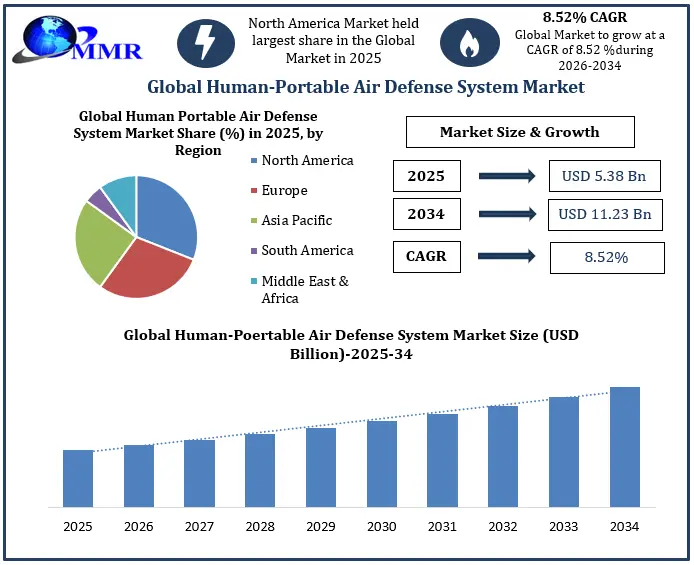
The Human Portable Air Defense Systems Market was valued at USD 5.38 billion in 2025 and is estimated to reach USD 11.23 billion by 2034. The Market grows at a CAGR of 8.52% during 2026–2034.
Key Market Highlights
|
This report provides an analyst-led assessment of the Human Portable Air Defense Systems Market, combining market dynamics, technology and range segmentation, regional demand patterns, regulatory influences, competitive positioning, pricing strategies, investment activity, and recent industry developments. It evaluates how evolving low-altitude threats, counter-UAS requirements, defense modernization, indigenous VSHORADS programs, and networked air-defense architectures shape market opportunities through 2034. The report translates these industry developments into actionable insights on market direction, regional opportunities, technology shifts, competitive strategies, and future growth areas, enabling clients to make informed investment, procurement, and market-entry decisions.
Global Human Portable Air Defense Systems Market Overview
The Human Portable Air Defense Systems market comprises lightweight, portable surface-to-air missile systems designed to provide mobile, short-range protection against low-altitude aerial threats. The systems carried and operated by an individual or a small crew, giving military forces a deployable air-defense capability that complements vehicle-mounted and fixed air-defense platforms.
The market remains important because MANPADS provide a distributed and mobile layer within integrated air and missile defense architectures. NATO's 2025 Integrated Air and Missile Defense Policy identifies a threat spectrum extending from small, low- and slow-flying UAS to cruise, ballistic, and hypersonic missiles and states that surface-based air defense requires a mix of short-, medium-, and long-range systems to create layered defense. This environment supports continued demand for highly mobile very-short-range air-defense capabilities. The adoption of air defense systems is also shaped by inventory modernization and stockpile management.
Technology penetration increasingly focuses on advanced seekers, improved countermeasure resistance, target discrimination, night-operating capability, and integration with networked sensors and command-and-control systems. NATO's recognition of Class I UAS aircraft weighing less than 150 kg as a new challenge further expands the requirement for layered short-range air defense.
Looking ahead, the market is positioned for sustained expansion as armed forces replenish legacy inventories, strengthen SHORAD capabilities, and integrate portable systems into broader multi-layer air-defense networks. The strongest growth opportunities emerge where modernization programs combine mobile deployment, improved engagement performance, counter-UAS requirements, and network-enabled air-defense operations.
Human Portable Air Defense Systems Market Growth Forecast
To know about the Research Methodology :- Request Free Sample Report
Global Human-Portable Air Defense System Market Dynamics
Rising Low-Altitude Threats are to Drive Demand for Mobile Air Defense
The growing diversity of low-altitude aerial threats strengthens demand for highly mobile very-short-range air-defense systems, driving Human-Portable Air Defense System Market growth. NATO's air and missile defense policy identifies small, low- and slow-flying unmanned aircraft systems (UAS) alongside cruise and ballistic missiles as part of the evolving threat spectrum, reinforcing the need for layered defenses across different ranges and altitudes. This environment supports MANPADS adoption as a deployable layer for forward units and dispersed forces, particularly where fixed or vehicle-mounted systems provide limited coverage.
Export Controls and Stockpile Management Restrain Market Accessibility
Strict controls on the transfer, storage, and end use of MANPADS constrain the addressable market, particularly for international procurement. These measures improve security but also limit uncontrolled cross-border transfers and extend procurement approval cycles.
Next-Generation Seekers and Network Integration Create New Opportunities
Modernization creates opportunities for manufacturers to differentiate through improved seekers, target discrimination, countermeasure resistance, and integration with wider air-defense networks. The U.S. State Department notes that newer MANPADS can incorporate capabilities that improve target recognition and rejection of basic countermeasures, while NATO increasingly emphasizes interconnected sensors, command-and-control systems, and weapons within integrated air and missile defense. This creates a shift from standalone missile procurement toward integrated short-range air-defense capability, drive Human-Portable Air Defense System Market growth.
Proliferation Risks and Countermeasure Evolution Challenge Human-Portable Air Defense System Market Growth
The same portability that makes MANPADS valuable to military forces creates significant proliferation and security challenges. The U.S. government estimates that more than 1 million MANPADS missiles have been manufactured globally, while acknowledging that the number remaining in operational inventories is difficult to determine because stockpile destruction, age, storage conditions, and maintenance vary. GAO also highlights the historical difficulty of maintaining reliable records and end-use monitoring for exported systems. Consequently, manufacturers and governments face increasing requirements for secure storage, inventory accountability, export compliance, and technologies that remain effective against evolving aircraft countermeasures.
Trends Human-Portable Air Defense System Market Trends
• Counter-UAS Requirements Push MANPADS Toward Low-Altitude Threat Defense - The rapid proliferation of small unmanned aircraft is expanding the operational relevance of portable air-defense systems. NATO identifies Class I UAS weighing less than 150 kg as a distinct emerging challenge within integrated air and missile defense, while the U.S. Army identifies UAV proliferation as a key reason SHORAD is becoming a faster-growing area of air and missile defense.
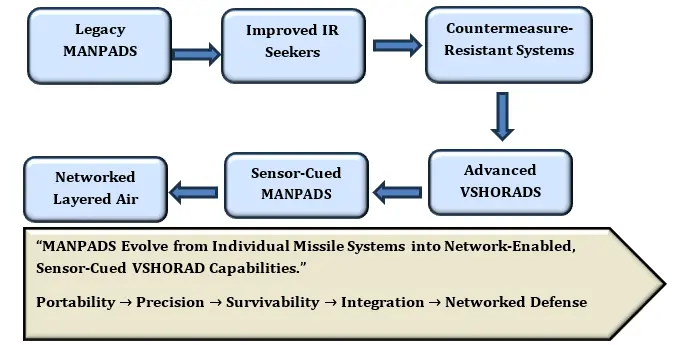
• Networked Integration Transforms Standalone MANPADS into Layered Air Defense - MANPADS increasingly operate as components of interconnected air-defence architectures rather than as isolated weapons. NATO's IAMD framework connects sensors, command-and-control assets, and weapons systems, with interoperability identified as a critical requirement. This trend encourages MANPADS development toward better connectivity, target cueing, and integration with wider SHORAD networks.
• Next-Generation Systems Improve Seeker Performance and Countermeasure Resistance - Modernization increasingly focuses on improving engagement effectiveness against evolving aerial threats. MANPADS development emphasizes enhanced seekers, target discrimination, night capability, and resistance to countermeasures, while broader SHORAD modernization also incorporates complementary technologies such as electronic warfare and directed-energy systems. The U.S. CRS notes that the Stinger has undergone a Service-Life Extension Program specifically to improve its ability to intercept drones, illustrating the shift toward adapting established MANPADS for contemporary threats.
• Indigenous V-SHORADS Programs Strengthen Domestic Air-Defense Capability - Countries increasingly pursue indigenous development and localized procurement of very-short-range air-defense systems to reduce dependence on foreign suppliers and strengthen defense-industrial capacity. India provides a current example: in July 2026, its Defence Acquisition Council approved procurement proposals worth nearly USD 5,480 Mn, including V-SHORADS alongside anti-UAV electronic warfare and MRSAM capabilities. This reflects a broader trend toward combining portable air defense with domestic defense modernization and layered air-defense programs.
MANPADS Evolution: From Standalone Weapon to Networked Air Defense
Global Human-Portable Air Defense System Market Segment Analysis
By Guidance Technology,
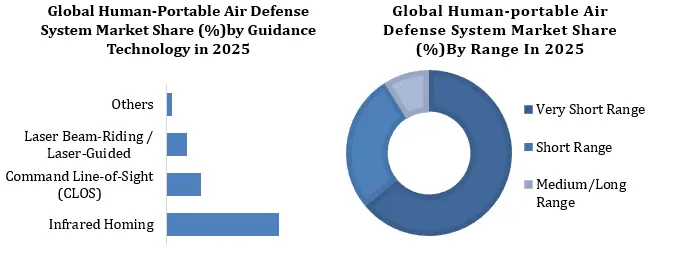
Infrared homing dominated the Human-Portable Air Defense System Market in 2025, primarily because passive infrared guidance provides a mature and operationally proven approach for portable air-defense applications. The technology allows the missile to detect and track the thermal signature of an aerial target without requiring continuous operator guidance after launch. This fire-and-forget architecture supports rapid engagement and allows the operator to relocate after launch, which is particularly valuable for dispersed and mobile ground forces.
The technology also continues to evolve toward imaging infrared (IIR) seekers, improved target discrimination, and greater resistance to countermeasures. India's DRDO provides a relevant example: its indigenous VSHORADS incorporates an Imaging Infrared (IIR) seeker and a hit-to-kill warhead, demonstrating the direction of next-generation portable air-defense development.
During 2026–2034, infrared homing is expected to retain its leadership, but growth increasingly comes from technological upgrades rather than basic seeker adoption. CLOS and laser-guided/laser-beam-riding systems remain important alternatives where operators require different guidance characteristics or greater resilience against specific countermeasures. The opportunity therefore shifts toward advanced seeker architectures, multi-spectral sensing, improved discrimination, and integration with external target-cueing systems.
By Range,
Very-short-range systems dominated the range segment for Human-Portable Air Defense System Market in 2025, consistent with the fundamental role of MANPADS as close-in, highly mobile air-defense systems. Their value comes from providing infantry and forward-deployed units with an organic capability against low-altitude aerial threats without requiring large vehicle-mounted systems.
The continued importance of this range category is reinforced by NATO's integrated air-defense architecture, which explicitly addresses threats across very short, short, and medium ranges and emphasizes combining different capabilities within a common defensive framework. NATO's Modular Ground-Based Air Defence initiative is specifically designed to counter air threats across these range layers.
The very-short-range systems supported by demand for lightweight, rapidly deployable protection. However, development increasingly focuses on extending effective engagement envelopes without compromising portability. This creates opportunities for shorter-to-medium range portable systems, improved target acquisition, and better integration with external sensors and command-and-control networks.
Human-Portable Air Defense System Market Regional Analysis
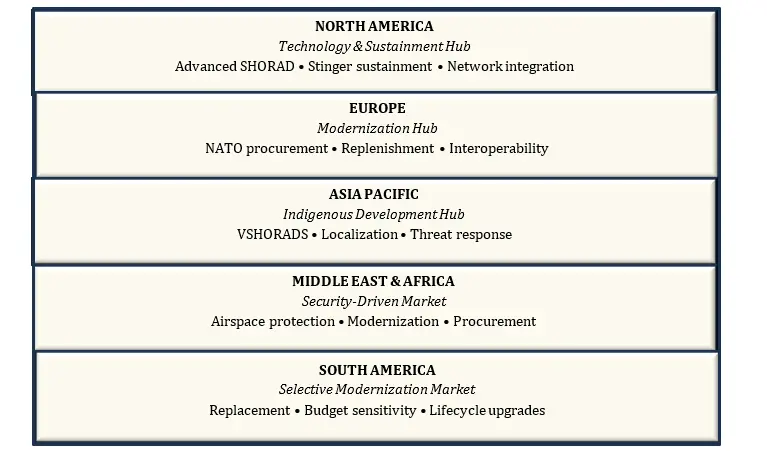
Regional Opportunity Heatmap
North America Strengthens Networked Air Defense and Sustainment
North America remains a technology-intensive Human-Portable Air Defense System Market, supported by established defense-industrial capabilities, large military procurement budgets, and continuous modernization of short-range air defense. The U.S. focuses increasingly on integrating portable systems into broader SHORAD and counter-UAS architectures rather than treating MANPADS as standalone weapons. The region also benefits from a mature sustainment ecosystem. For example, in December 2025, the U.S. approved a potential USD 136.1 million sale of Stinger service-life-extension components and support to the NATO Support and Procurement Agency, covering Germany, Italy, and the Netherlands.
Regulation remains a major market characteristic because U.S. defense exports operate through stringent government authorization and end-use controls. International demand is nevertheless substantial; in April 2025, the U.S. approved a potential USD 825 million FIM-92K Stinger Block I sale to Morocco, demonstrating the export strength of U.S.-origin MANPADS technology.
Europe to boosts Air-Defense Investment and Multinational Procurement
Europe represents one of the strongest growth environments because the regional security environment drives rapid air-defense replenishment, interoperability, and industrial expansion. NATO states committed to a new defense-investment framework in 2025, targeting 5% of GDP annually by 2035, including at least 3.5% for core defense requirements. European Allies and Canada increased defense expenditure by nearly 20% in real terms in 2025, providing a strong financial foundation for air-defense modernization. MANPADS benefit from this shift because NATO explicitly requires a layered architecture combining short-, medium-, and long-range systems. In 2025, 15 NATO Allies launched a multinational initiative for lower-level air threats, while the Modular Ground-Based Air Defence initiative expanded participation and targets very-short-, short-, and medium-range threats.
The EU updated its Common Position on arms exports in April 2025, requiring member states to assess military-equipment exports against common criteria and strengthen information sharing and end-use oversight.
Asia Pacific Expands Indigenous VSHORADS and Defense Localization
Asia Pacific shows strong adoption potential through military modernization, indigenous missile development, and growing requirements for mobile air defense. India provides a particularly relevant example. DRDO's VSHORADS uses an uncooled Imaging Infrared seeker, has a stated 0.5–6 km engagement range, and uses a man-portable tripod launcher. The system is designed for low-altitude aerial threats and incorporates IR-flare discrimination and resistance to jamming.
India's development illustrates an important regional trend: governments increasingly seek to combine portable air defense with domestic design, production, and technology sovereignty. The VSHORADS program involves DRDO, the Indian Army, Navy, Air Force, and domestic development-production partners, creating an indigenous ecosystem rather than relying entirely on imported systems.
Across the wider region, demand is supported by territorial-security requirements, modernization of legacy air-defense inventories, and the growing operational relevance of drones. Consequently, Asia Pacific increasingly favors locally produced, interoperable, and technologically upgraded VSHORADS/MANPADS capabilities.
South America Maintains Selective Demand Through Modernization and Sovereignty
South America represents a more selective but strategically relevant market, with procurement concentrated among countries maintaining established armed forces and requiring protection of air bases, critical infrastructure, borders, and deployed units. Compared with North America, Europe, and Asia Pacific, adoption is more constrained by defense-budget availability and longer procurement cycles.
Regulatory considerations remain important because portable air-defense missiles are subject to stringent international transfer, end-use, and nonproliferation controls. The U.S. State Department has historically emphasized strengthened MANPADS export controls and stockpile security, while the broader international framework places significant emphasis on preventing diversion and unauthorized transfers.
The regional opportunity therefore centers more strongly on inventory modernization, selective replacement of legacy systems, training, sustainment, and integration with existing ground-based air defense than on large-scale procurement programs. Brazil, Chile, Colombia, and other countries with established defense-industrial or military aviation capabilities provide potential demand centers, particularly where modernization programs emphasize national operational autonomy.
Demand Through Airspace Protection and Security Requirements Human-Portable Air Defense System Market Growth
Middle East & Africa present diverse demand conditions, with the Middle East supported by high defense expenditure, strategic airspace protection requirements, and procurement of sophisticated air-defense systems, while African demand is more closely associated with territorial security, protection of military installations, and management of legacy inventories. The U.S. approval of the potential USD 825 million Stinger Block I sale to Morocco in 2025 provides a concrete example of continued demand for portable air-defense capabilities in the broader region.
Regulation and stockpile security remain particularly important in this region because MANPADS are highly portable and require strict controls against diversion. International assistance programs therefore emphasize inventory accountability, secure storage, export controls, and destruction of excess or at-risk systems. This creates a dual market requirement: new-generation procurement alongside lifecycle management and security of existing inventories.
Global Human-Portable Air Defense System Market Recent Developments
| Date | Recent Development | Market Impact |
| Feb 2026 | DRDO completes three successful VSHORADS flight trials in India, including trials in final deployment configuration with field operators. | Strengthens India's indigenous MANPADS capability and supports localization of VSHORAD procurement, potentially increasing competitive pressure on foreign suppliers. |
| Apr 2025 | U.S. approves a potential USD 825 million FIM-92K Stinger Block I sale to Morocco, including missiles, engineering, logistics, and technical support. | Reinforces international demand for combat-proven MANPADS and expands the U.S. supplier ecosystem in North Africa, while generating follow-on sustainment opportunities. |
| Jul 2025 | Saab receives a SEK 1.5 billion order from Sweden for RBS 70 NG, including missiles and associated equipment. | Supports European VSHORAD modernization and strengthens demand for networkable, scalable short-range air-defense systems rather than standalone missiles. |
| 2025 | Thales and Bharat Dynamics Limited establish a framework for local production of Starstreak-based MANPADS in India, with manufacturing localization planned at up to 60%. | Accelerates defense-industrial localization, reduces reliance on direct imports, and encourages international suppliers to adopt technology-transfer and domestic-production models. |
Global Human-Portable Air Defense System Market Competitive Landscape
The Human-Portable Air Defense System Market is moderately concentrated at the technology and program level but remains globally competitive, with established suppliers competing against increasingly capable regional manufacturers. Competition is driven less by unit price and more by seeker and guidance performance, countermeasure resistance, portability, production capacity, interoperability, local manufacturing, lifecycle support, and government-to-government procurement relationships. Major international suppliers include Lockheed Martin/Raytheon Technologies in the U.S. through Stinger, MBDA in Europe through Mistral, Saab in Sweden through RBS 70, and Thales in the UK/France through Starstreak, while regional competitors such as Poland's MESKO and India's DRDO/BDL increasingly strengthen indigenous alternatives.
The competitive environment is increasingly shifting from standalone missile supply toward complete short-range air-defense capability. Saab provides a strong example: its RBS 70 NG can operate as a MANPADS, vehicle-integrated system, or remotely controlled configuration, while its Human-Portable Air Defense System (MSHORAD) solution combines firing units, radars, and command-and-control. In July 2025, Saab received a SEK 1.5 billion Swedish order for RBS 70 NG with missiles, and in August 2026 it received a further SEK 1.2 billion Finnish order. These contracts demonstrate that customers increasingly purchase missiles together with training, support, integration, and broader air-defense architecture rather than evaluating missile price alone.
European Human-Portable Air Defense System manufacturers increasingly compete through localized production and multinational procurement, while Asian suppliers emphasize technology transfer and domestic manufacturing. Thales and Bharat Dynamics Limited provide a particularly relevant example: their 2025 agreement for India's first supply of Starstreak-based laser-beam-riding MANPADS includes manufacturing of up to 60% of the system in India, creating a localized production pathway rather than a conventional import-only model.
Poland's MESKO is another increasingly significant regional competitor. The company reported producing its 3,000th Piorun system in February 2025 and stated that it was increasing missile-production capacity in response to demand. MESKO also signed a 2025 cooperation agreement with WZE to strengthen Piorun production processes as orders increased.
India is simultaneously developing a domestic competitive base. DRDO conducted three successful VSHORADS flight trials in February 2026, with field operators conducting target acquisition and firing in final deployment configuration. In July 2026, India's Defence Acquisition Council also granted in-principle approval for procurement of V-SHORADS as part of approximately USD 5.48 billion of capital acquisition proposals.
A useful illustration of the package-based pricing model is the U.S. approval of a possible $825 million FIM-92K Stinger Block I sale to Morocco in April 2025. The proposed package covered up to 600 missiles plus engineering, logistics, technical support, and other program-support elements.
Investment and Competitive Strategy
Investment is increasingly concentrated on production capacity, indigenous manufacturing, seeker modernization, and integrated air-defense capability. MESKO expands Piorun production capacity as orders increase, while India's defense R&D allocation rises to approximately USD 3.31 billion in FY2026–27 from USD 3.05 billion in FY2025–26, with approximately USD 1.96 billion allocated for capital expenditure. India also opens approximately 25% of the defense R&D budget to industry, startups, and academia, supporting a broader localization and innovation ecosystem.
The competition is moving from “who supplies the missile” toward “who provides the most deployable and sustainable short-range air-defense capability.” Established Western suppliers retain advantages in combat-proven systems, certification, interoperability and global support networks, while European and Asian competitors increasingly challenge them through localized production, lower supply-chain dependence, technology partnerships and rapid expansion of manufacturing capacity. Competitive intensity therefore increases particularly around counter-UAS effectiveness, advanced seekers, network integration, production scalability and sovereign manufacturing, rather than conventional price competition alone.
Human-Portable Air Defense System Market Scope: Inquire before buying
| Human-Portable Air Defense System Market | |||
|---|---|---|---|
| Report Coverage | Details | ||
| Base Year: | 2025 | Forecast Period: | 2026-2032 |
| Historical Data: | 2020 to 2025 | Market Size in 2025: | USD 5.38 Bn. |
| Forecast Period 2026 to 2032 CAGR: | 8.52% | Market Size in 2032: | USD 11.23 Bn. |
| Segments Covered: | by Component | Missile Launching Mechanism / Gripstock Battery Fire-Control and Sighting Units |
|
| by Guidance Technology/ Missile Type | Infrared Homing Command Line-of-Sight (CLOS) Laser-Guided / Laser Beam-Rider Others |
||
| by Range | Very Short Range / Short Range Medium Range Long Range Tapeworm Treatment |
||
| by End-User | Military Homeland Security |
||
Global Human-Portable Air Defense System Market, by Region
North America (United States, Canada, and Mexico)
Europe (UK, France, Germany, Italy, Spain, Sweden, Austria, and the Rest of Europe)
Asia Pacific (China, South Korea, Japan, India, Australia, Indonesia, Malaysia,Pakistan Vietnam, Taiwan, and the Rest of APAC)
Middle East and Africa (South Africa, GCC, Egypt, Nigeria, and the Rest of ME&A)
South America (Brazil, Argentina, Rest of South America)
Human-Portable Air Defense System Key Players by Region
North America
1. RTX (Raytheon) — U.S.
2. Lockheed Martin — U.S.
3. Boeing — U.S.
4. General Dynamics — U.S.
Europe
5. MBDA — France
6. Saab — Sweden
7. Thales — France/UK
8. MESKO / PGZ — Poland
9. Diehl Defence — Germany
10. Rheinmetall — Germany
11. Kongsberg Defence & Aerospace — Norway
12. BAE Systems — UK
13. Leonardo — Italy
Asia Pacific
14. Bharat Dynamics Limited (BDL) — India
15. DRDO — India
16. Roketsan — Türkiye
17. Hanwha Aerospace — South Korea
18. LIG Nex1 — South Korea
19. Norinco — China
20. China Aerospace Science and Technology Corporation (CASC) — China
21. China Aerospace Science and Industry Corporation (CASIC) — China
22. NIOA — Australia
Middle East & Africa
23. Roketsan — Türkiye
24. EDGE Group — UAE
25. Tawazun Council / UAE defense ecosystem — UAE
26. Denel Dynamics — South Africa
27. Rheinmetall Denel Munition — South Africa
South America
28. Saab — Brazil/Sweden
29. Avibras Aeroco — Brazil
30. AEL Sistemas — Brazil
31. Embraer Defense & Security — Brazil
Human Portable Air Defense Systems Market Frequently Asked Questions
1. What is the Human Portable Air Defense Systems (MANPADS) Market?
Ans. The MANPADS market covers portable surface-to-air missile systems designed to provide short-range air-defense capabilities against low-altitude aircraft, helicopters, and selected unmanned aerial threats.
2. What drives the Human Portable Air Defense Systems Market?
Ans. Rising low-altitude aerial threats, military modernization, replacement of aging missile inventories, and growing investment in layered short-range air defense drive market demand.
3. Which guidance technology dominates the MANPADS Market?
Ans. Infrared homing remains the dominant guidance technology because passive seekers support fire-and-forget operation, mobility, and rapid engagement.
4. Which region leads the Human Portable Air Defense Systems Market?
Ans. North America remains a major market due to advanced defense capabilities, established MANPADS programs, modernization spending, and a strong defense-industrial base.
5. How does drone proliferation affect the MANPADS Market?
Ans. The increasing use of unmanned aerial systems expands demand for low-altitude air-defense capabilities and encourages manufacturers to improve seeker discrimination, countermeasure resistance, and system integration.
6. What is the outlook for the Human Portable Air Defense Systems Market?
Ans. The market shows strong growth through 2034 as governments modernize short-range air defense, replenish inventories, develop indigenous VSHORADS, and integrate portable systems into layered and networked air-defense architectures.