
Video Laryngoscope Market – Global Market Size, Strategic Growth Drivers, Risk Assessment Framework, Regulatory Landscape Review, Competitive Intensity Mapping & Long-Term Industry Outlook to 2029
Overview
Video Laryngoscope Market size was valued at USD 305.85 Mn. in 2022 and the total Video Laryngoscope revenue is expected to grow by 18% from 2023 to 2029, reaching nearly USD 974.5 Mn.
Video Laryngoscope Market Overview:
Video laryngoscopes (VLs) and optical stylets (OS) are rigid instruments that allow indirect laryngoscopy, or the visualization of the vocal cords and related airway structures without a direct line of sight. Video laryngoscopes have quickly gained popularity as intubation devices in a wide range of clinical scenarios and settings, as well as in the hands of both airway experts and non-experts. Their indirect view of the upper airway improves glottic visualization, which is especially useful in suspected or witnessed difficult intubation. Endotracheal intubations using video laryngoscope were performed more successfully in less time than traditional direct laryngoscope.
This, along with the globally increasing prevalence of obesity among the population and rising inpatient admissions in hospital emergency departments, are some of the major factors expected to drive the adoption of the video laryngoscope market for endotracheal intubations during the forecast period.
Growing respiratory diseases are driving the video laryngoscope market. The video laryngoscope is becoming increasingly popular around the world. The demand for video laryngoscopes is expected to rise as robot-assisted intubation becomes more common. As a result of advancements in intubation, manufacturers have developed cutting-edge solutions that provide medical personnel with additional support and precision. Robot-assisted technologies contribute to the automation of anesthetic treatment by relieving anesthesiologists' workload and improving all aspects of patient care. Numerous manufacturers and researchers are researching robotics for use in a variety of laryngoscopy techniques.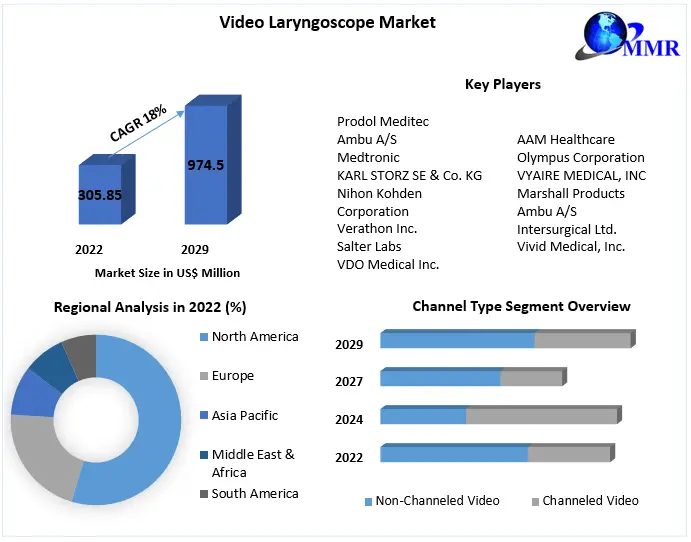 To know about the Research Methodology:- Request Free Sample Report
Video Laryngoscope Market Dynamics:
Video Laryngoscope Market Drivers
Bolstering demand for the video laryngoscope device by healthcare workers
The growing awareness of the advantages of using video laryngoscopes over traditional ones is a major factor driving the video laryngoscope market growth. These advantages include reduced applied force, improved laryngeal view, visual confirmation of tube placement, lower risk of cross-contamination, and higher rates of successful rescue after direct laryngoscopy failure, which is increasing demand. Video laryngoscopy has emerged as a viable option for intubating ventilated patients. The availability of a video laryngoscope also reduces intubation errors and improves feedback, learning, and teaching.
It also keeps healthcare technicians' faces away from the patient’s airways, lowering the risk of contamination. In order to meet rising demand, Nihon Kohden began ramping up the production of ventilators and airway management devices in 2020. Moreover, due to increased demand for airway products and ventilators, Medtronic reported positive growth in 2020. As a result, the pandemic has a positive effect on the video laryngoscope market.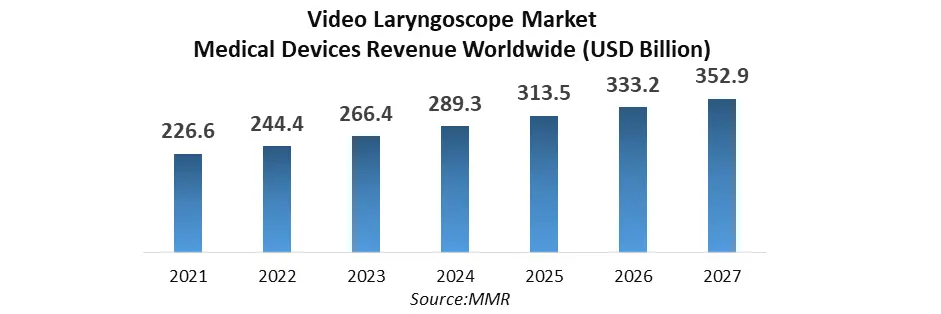 The growing prevalence of respiratory diseases is also a major driver of the video laryngoscope market. According to the WHO, approximately 65.0 million people have COPD, and 3 million people die each year from lung-related diseases as of 2019. These estimates are expected to rise over time as the target population grows, as does exposure to tobacco smoke and pollution. These factors are expected to drive the video laryngoscope market forward. Additionally, the increased use of airway management in pediatrics is increasing revenue.
Possessing more advanced technology than direct laryngoscopy devices to increase demand
Failures in intubation using a direct laryngoscope are becoming more common, resulting in severe conditions such as dental damage, laryngeal spasm, bronchospasm, dysrhythmias, cardiac arrest, brain damage, or even death. As a result, new laryngoscopes with visualization capabilities are increasingly being used in healthcare devices around the world to prevent these conditions. Because of this, doctors favor video laryngoscopes, which is fueling the demand for the video laryngoscope market.
According to a survey conducted by the American Society of Anesthesiologists, difficult and failed intubation rates by healthcare providers in both urban hospitals and smaller settings in the United States decreased significantly over a 14-year period (i.e., 2003-2016) due to the increasing use of video laryngoscope.
In addition, the increasing number of publications and studies demonstrating the safety and superiority of these devices over direct laryngoscopy procedures, as well as the introduction of innovative products by market players, have aided in the global adoption of these products. This adoption is boosted further by the availability of an integrated video display, as opposed to cart-based display models, and the introduction of fully disposable devices, such as Intersurgical Ltd's "i-view." These all aspects are expected to boost the demand for the video laryngoscope market during the forecast period,
Video Laryngoscope Market Restraints
One of the major factors limiting the growth of the video laryngoscope market is the lower adoption of anesthesia video laryngoscopes in emerging countries due to their high cost and a lack of favorable reimbursement policies to provide coverage. According to Medtronic data, the cost of reusable devices ranges from USD 1,050 to USD 8,050 Mn depending on their technical specialty, compared to the cost of a single-use traditional laryngoscope, which is USD 18.5 Mn.
As a result, the high cost of these devices, as well as their maintenance, are expected to stymie the video laryngoscope market. At the same time, the availability of cost-effective alternate devices for endotracheal intubation is a major restraining factor for the video laryngoscope market growth opportunities.
Video Laryngoscope Market Opportunity
Growing demand for advanced visualization devices
Product advancements in laryngoscopes drive the video laryngoscope market. Several market players compete on the basis of product technologies. With improved visualization capabilities, developed products have increased patient safety and outcomes. Moreover, improving access to video laryngoscopes for healthcare professionals in developing countries will drive video laryngoscope market growth in the near future.
A high-resolution micro camera mounted in video laryngoscopes improves the view of the vocal cord and increases the success rate. Additionally, increased awareness of early disease diagnosis and emergency visits to facilities benefits Device Type revenue growth.
Video Laryngoscope Market Segment Analysis:
Based on Product, In 2020, the rigid segment dominated the market for video laryngoscopes, with a revenue share of more than 63.0%. Growing product developments and investments by market participants are expected to drive segment growth. Another factor driving the market growth is the decline in the use of traditional laryngoscopes. This is due to the fact that rigid video laryngoscopes help overcome the limitations of direct or line-of-sight laryngoscopy. Rigid video laryngoscopes, for example, require less head manipulation and positioning than traditional direct laryngoscopy.
The flexible video laryngoscope segment is expected to grow the fastest during the forecast period due to its advantages over rigid ones. It allows the user to visualize biopsy tissue, and abnormalities, or aid in the removal of small growths, such as polyps, from the region, thereby propelling growth. The camera can also be precisely manipulated, providing the doctor with a clear and complete view of the motion of the vocal cords. These factors are expected to drive segment growth during the forecast period. Based on the Usage, In 2020, the reusable segment held the largest share of more than 71.0%. The device's reusability is an important factor influencing medical professionals' and hospitals' purchasing decisions. These devices are also preferred over traditional laryngoscopes due to their ease of use and increased functionality. Furthermore, the high cost of reusable laryngoscopes is a major factor driving the segment. These reusable video laryngoscopes, on the other hand, are more expensive upfront but do not need to be replaced as frequently, contributing to their growing adoption and market share.
The disposable video laryngoscopes segment is expected to grow the fastest during the forecast period due to increased usage in pre-hospital settings. Furthermore, the growing need to reduce operational costs by avoiding reprocessing costs and minimizing the risk of cross-infection is fueling growth. Nihon Kohden will introduce the NK AWS-S200 video laryngoscope in the United States in July 2020, growing its critical care portfolio. During the pandemic, there was an increase in demand for these devices because they could protect clinicians while intubating COVID-19 patients or patients with other respiratory infections. Based on the Channel Type, The non-channeled segment dominated the video laryngoscope market and held the largest revenue share of 53.0% in 2020 due to benefits such as the blades allowing more flexibility while intubating patients and being suited for experienced users. Non-channeled blades are generally easier to insert than channeled blades. These also provide more flexibility in the method of securing the airway for experienced users. As a result, experienced users may prefer non-channeled blades over channeled blades. Karl Storz's Flexible Intubation Video Endoscopes (FIVE) integrate with the company's C-MAC system to provide customers with a complete airway management system. The lack of a channel also makes cleaning the instrument quick and simple.
Channeled blades are beneficial to inexperienced users, which increases demand. Furthermore, channeled blades aid in circumventing the limitations of non-channeled blades. Channeled blades, for example, reduce the time and risk of injury associated with exploratory moves of the tracheal tube with a non-channeled blade during the first phase of insertion when the tracheal tube's tip does not yet appear on the screen. Furthermore, channeled video laryngoscopes do not require the use of a malleable stylet to insert and bend the tracheal tube according to the curvature of the blade. The aforementioned factors are driving this segment's growth over the forecast period.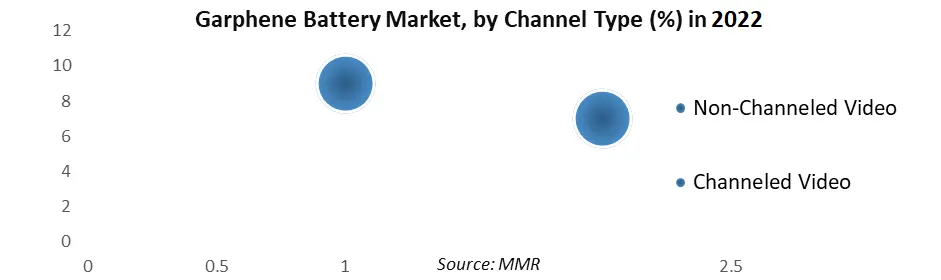 Based on the Device Type, The cart-based segment dominated the video laryngoscope market, accounting for more than 62.0% of the video laryngoscope market in 2022. This is because these laryngoscopes are commonly used in hospital settings, where the majority of intubation and other airway management procedures are performed. Cart-based video laryngoscopes provide a larger and clearer view of the airway passage, allowing for more precise tracheal tube insertion. This is the primary driver expected to contribute to segment growth. The C-MAC S by Karl Storz, for example, is a cart-based video laryngoscope that aids intubation by providing a clear and unobstructed view of the airway and vocal cords.
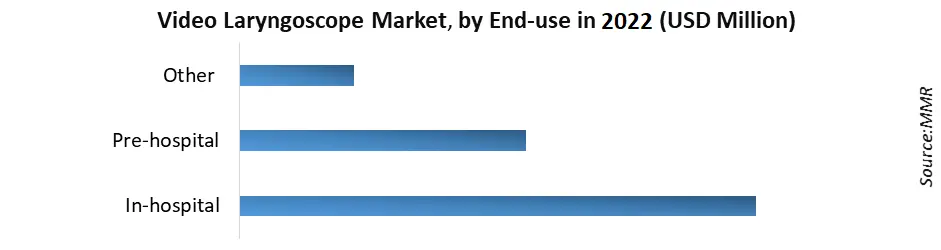
Based on the End-use, Due to the high number of airway management procedures performed in these facilities, the in-hospital segment dominated the video laryngoscope market and held the largest revenue share of more than 54.0% in 2022. When compared to traditional direct laryngoscopy, the use of video laryngoscopes has increased because the improved visualization contributes to successful intubation on the first attempt, making the process safer for patients and physicians.
Ambu strengthened its position in endoscopy in February 2021 by extending contracts with two major Group Purchasing Organizations in the United States. Approximately 90% of U.S. hospitals now have access to the company's line of single-use endoscopes, which includes rhino laryngoscopes, bronchoscopes, and cystoscopes.
The pre-hospitals segment is expected to grow the fastest during the forecast period due to increased usage in emergency facilities. On the contrary, there are several limitations to emergency endotracheal intubation in the pre-hospital setting. The emergency physician is often unaware of the patient's previous airway management history, and optimal positioning of the patient is difficult to achieve in a pre-hospital setting, limiting growth.
 Video Laryngoscope Market Regional Insights:
North America dominated the video laryngoscope market, accounting for more than 40.0% of revenue in 2020. The increase can be attributed to the high prevalence of respiratory disorders in both adults and children. Furthermore, an increase in air pollution and tobacco smoke exposure, which causes respiratory disorders, is expected to drive the market.
The presence of strict practice guidelines developed by the American Society of Anesthesiologists (ASA) and other healthcare organizations, as well as growing governmental initiatives in the region, are expected to drive the video laryngoscope market growth.
Asia Pacific is expected to grow at the fastest rate, during the forecast period. It can be attributed to the region's high disease burden, large unmet patient needs, frequent infrastructural and technological advancements in the medical device Device Type, and an increase in healthcare expenditure. According to a WHO report, the increase in morbidity and mortality rates due to COPD is most dramatic in the Asian region, where the prevalence rate of COPD is around 8.5% in 2019.
Video Laryngoscope Market Scope: Inquire before buying
| Video Laryngoscope Market | |||
|---|---|---|---|
| Report Coverage | Details | ||
| Base Year: | 2022 | Forecast Period: | 2023-2029 |
| Historical Data: | 2018 to 2022 | Market Size in 2022: | US $ 305.85 Mn. |
| Forecast Period 2023 to 2029 CAGR: | 18% | Market Size in 2029: | US $ 974.5 Mn. |
| Segments Covered: | by Product | 1. Rigid Video 2. Flexible Video |
|
| by Usage | 1. Reusable Video 2. Disposable Video |
||
| by Channel Type | 1. Non-Channeled Video 2. Channeled Video |
||
| by Device Type | 1.Cart-based Video 2. Handheld Video |
||
| by End-use | 1. In-hospital 2. Pre-hospital 3. Other |
||
Video Laryngoscope Market, by Region
North America (United States, Canada and Mexico)
Europe (UK, France, Germany, Italy, Spain, Sweden, Austria and Rest of Europe)
Asia Pacific (China, South Korea, Japan, India, Australia, Indonesia, Malaysia, Vietnam, Taiwan, Bangladesh, Pakistan and Rest of APAC)
Middle East and Africa (South Africa, GCC, Egypt, Nigeria and Rest of ME&A)
South America (Brazil, Argentina Rest of South America)
Video Laryngoscope Market, Key Players are
1. Prodol Meditec
2. Ambu A/S
3. Medtronic
4. KARL STORZ SE & Co. KG
5. Nihon Kohden Corporation
6. Verathon Inc.
7. Salter Labs
8. VDO Medical Inc.
9. AAM Healthcare
10. Hebei Vimed Medical Device Company, Ltd.
11. Olympus Corporation
12. VYAIRE MEDICAL, INC
13. Marshall Products
14. Ambu A/S
15. Intersurgical Ltd.
16. Vivid Medical, Inc.
Frequently Asked Questions:
1] What is a video laryngoscope used for?
Ans. Videolaryngoscopes have rapidly gained popularity as an intubation device in a wide range of clinical scenarios and settings, as well as in the hands of both airway experts and non-experts. Their indirect view of the upper airway improves glottic visualization, especially when difficult intubation is suspected or encountered.
2] How is video laryngoscopy done?
Ans. Fiberoptic intubation is based on video laryngoscopy. Endotracheal (ET) tubes are threaded over the shaft of a flexible fiberoptic scope during fiberoptic intubation. The scope is passed through the patient's mouth or nose, into the pharynx, and through the vocal folds into the trachea.
3] Is video laryngoscopy safer?
Ans. Doctors conclude that video laryngoscopy when compared to direct laryngoscopy, provides a lower risk profile for all adults undergoing tracheal intubation.
4] Is laryngoscopy the same as intubation?
Ans. Laryngoscopy is a term that describes the visualization or examination of the larynx through the distraction of upper airway structures, typically for the purpose of tracheal intubation and airway management in modern anesthesia and critical care practice, as well as in many trauma scenarios.
5] Is a laryngoscopy painful?
Ans. The doctor inserting the scope up your nose may feel strange. However, it should not be harmful. You will be able to breathe normally. It may taste bitter if a spray anesthetic is used.