
Telerehabilitation Market Size by Type, Application, End User, Region – Revenue Pool Analysis, Margin Structure Assessment, Capital Flow Trends, Competitive Benchmarking & Forecast to 2030
Overview
Telerehabilitation Market size was valued at USD 5.60 Bn. in 2023 and the total Telerehabilitation revenue is expected to grow by 14% from 2024 to 2030, reaching nearly USD 14 Bn.
Telerehabilitation Market Overview:
Telerehabilitation is the use of information and communication technologies (ICT) to provide rehabilitation services to people in their homes or other environments from a distance. These services include therapeutic interventions, remote progress monitoring, education, consultation, training, and a network for people with disabilities. Using technology to deliver rehabilitation services has numerous advantages for both clinicians and patients which is boosting the demand for medical devices as well as the telerehabilitation market. It gives the patient a sense of personal autonomy and empowerment, allowing them to take control of their condition's management.
In essence, they are becoming an active partner in their care rather than a passive participant. Telerehabilitation provides access to care for people living in remote areas or who have mobility issues due to physical impairment, transportation, or socioeconomic factors. Additionally, it reduces travel costs and time spent traveling for both the healthcare provider and the patient. According to MMR research, the community frequently fails to meet the rehabilitation needs of people with long-term conditions like stroke, TBI, and other neurological disorders.
The increasing adoption of digital technologies in the healthcare industry, as well as the increasing penetration of the internet and smartphones globally, are expected to drive the telerehabilitation market. As telerehabilitation involves the use of devices and software to provide services to patients, increasing internet penetration and smartphone adoption is expected to be key factors driving the market growth during the forecast period. Increased adoption of mHealth apps, which use smartphones and tablets to provide better patient outcomes, will also drive telerehabilitation market growth. Telerehabilitation services can help patients with mobility issues, as well as motor, cognitive, and sensory functions. Because these patients have difficulty traveling, there is a high demand for telerehabilitation services.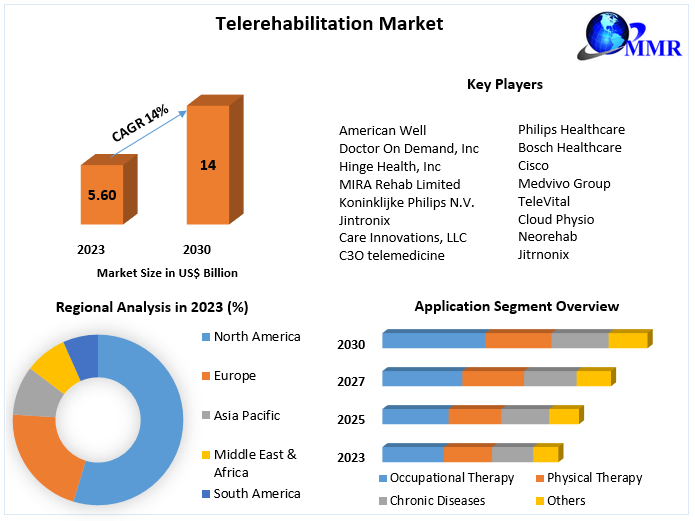 To know about the Research Methodology :- Request Free Sample Report
Telerehabilitation Market Dynamics:
Telerehabilitation Market Drivers
Bolstering demand from the healthcare workers
Telerehabilitation's limitations are similar to those of telemedicine. Video calls can only target two sensory systems, sight, and hearing. Excellent physicians, on the other hand, use multiple senses at the same time when diagnosing and treating patients. This reduction in sensory signals during a video call not only makes it more difficult to learn exercises correctly but can also interfere with purposeful communication between doctor and patient. The main benefits stem from the fact that telerehabilitation can be delivered anywhere and over great distances.
Patients do not even need to make appointments when using recorded videos. In some circumstances, telerehabilitation may be the only practical means of reaching the patient. After a patient has successfully completed an in-person rehabilitation program, telematic programs are used more frequently. Patients can continue their physical therapy at home, and if they have any additional questions, they can speak with the rehabilitation center's instructor directly. This sort of low-threshold service can also improve therapy compliance. All these aspects are boosting the demand for the telerehabilitation market and are expected to the same in the forecast period.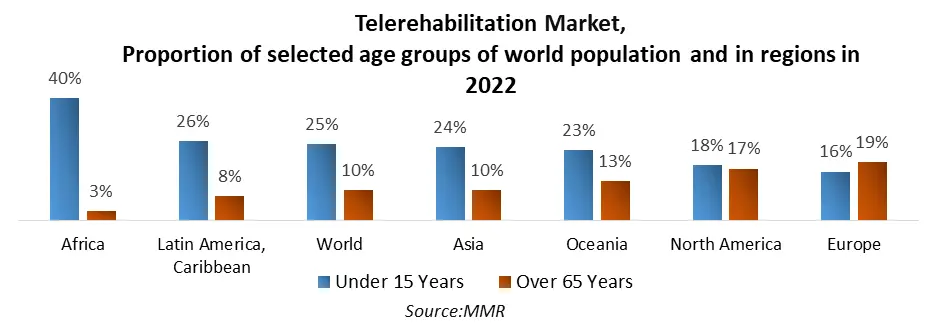 Growing geriatric population penetrates the telerehabilitation market
The growing number of elderly people has an impact on the NHS, experiencing significant health costs due to increased demand for treatments. It is hoped that by incorporating telehealth measures, these costs will be reduced. Kortke et al (2006) discovered a significant improvement in patient outcomes when using telerehabilitation, as well as a 58% cost savings when compared to in-patient rehabilitation. The growing geriatric population raises healthcare costs significantly; however, the incorporation of telehealth measures such as telerehabilitation is expected to lower healthcare costs significantly, contributing to the telerehabilitation market growth during the forecast period. Telerehabilitation services saw a significant increase during the COVID-19 pandemic due to restrictions on movement, cancellation of non-essential procedures, and conversion of wards into COVID wards in order to treat the growing number of patients.
Initiatives taken by both public and private institutions are also expected to fuel the telerehabilitation market growth during the forecast period. For instance, the American Telemedicine Association's Telemedicine Special Interest Group Special is a key resource for rehabilitation professionals who want to incorporate information and communication technologies into clinical best practices, advocacy, and the delivery of rehabilitation services. These initiatives are credited with increasing awareness of telerehabilitation services, which is expected to drive market growth.
Telerehabilitation Market Restraints
Poor Reimbursement Policies are restricting growth
The most significant barrier to widespread adoption is reimbursement for telerehabilitation. Medicare does not pay for telehealth services provided to patients living in countries designated as metropolitan areas by the federal government. Medicaid is only available in a few states, and private insurance is not always available. Because reimbursement policies are variable and dynamic, practitioners are advised to monitor such policies by contacting funders, which is a time-consuming process. As a result, poor reimbursement policies for these services are one of the major factors limiting the telerehabilitation market growth during the forecast period.
Lack of skilled professionals hampering the market
When performed by a trained professional, rehabilitation is a risk-free procedure. According to the MMR, the telerehabilitation market is being hampered by a shortage of skilled professionals in the healthcare industry in comparison to the growing number of patients. Moreover, due to age-related changes in the body, the procedure becomes technically difficult for patients over the age of 75.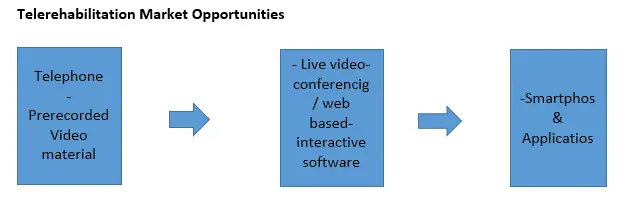 Current Market Trends Show a Gradual Shift Towards Virtual Consultation
The use of videoconferencing allows for consultations, diagnostic assessments, and treatment intervention delivery, as well as verbal and visual interaction between participants. However, the inability to measure participants' physical performance; for example, in physiotherapy, this would include measures like a range of motion and gait. Measurement tools that could accurately measure participants' physical performance soon overcame this. The advantages of these new, cutting-edge telerehabilitation market technologies have been further enhanced by developments using sensor and remote monitoring technologies for use inside the home. These advancements gave patients and rehab professionals a way to monitor their home exercise regimens, as well as a way for the professional to monitor patients' adherence to particular exercise regimens.
Another technological method introduced to healthcare is virtual environments. These enable users to interact in real-time with computer-generated environments. Virtual reality starts with real-world scenes that are then virtualized to simulate real-world environments. It allows healthcare professionals to create environments that can be used for surgery, physical rehabilitation, education, and training.
Smartphones have completely changed medical communication in recent years. The opportunity to offer medical assistance when and where people need it is made possible by modernization. Recently, it was revealed that one-fifth of smartphone users actually use health-related applications (apps), with half of the smartphone owners using their devices to get health information. Healthcare professionals, medical students, patients, and the general public can all use a variety of mobile apps. All the technological advancements and benefits provided by telerehabilitation are boosting the telerehabilitation market.
Telerehabilitation Market Segment Analysis:
Based on Type, the telerehabilitation market segments are divided into Products and services. Among them, in 2023, the services sector dominated the market. This is due to elements like the growing number of service sessions necessary for a specific disease indication, the expansion of service providers, and the rising use of telerehabilitation services. On the other hand, the market for products, which includes those that are available to support patients during these programs, is expected to grow in the forecast years. Based on Application, The telerehabilitation market is divided into categories such as chronic diseases, occupational therapy, and physical therapy. Because more patients are receiving this therapy via telerehabilitation technology, physical therapy dominated the market in 2023 with the highest market share of 45%. The primary cause of this is due to increase in illnesses, accidents, and disabilities brought on by other medical conditions. For instance, according to a 2017 article from the National Center for Biotechnology Information, 2,495 patients were admitted to clinics for occupational therapy treatment while 9,136 were treated for physical rehabilitation. The physical therapy industry probably continue to rule the market in the forecast years, based on end-user analysis.
Based on the End User, the telerehabilitation market is divided into healthcare facilities and home care based on end-users. Among them, the homecare sector held the largest share of 55% in 2023. Due to the growing geriatric population and rising demand for these services in homecare settings with real-time monitoring results, homecare is becoming incredibly popular and is expected to maintain its dominance during the forecast period. However, these technologies are also present in healthcare establishments like hospitals and clinics, which provide these services to patients in remote locations.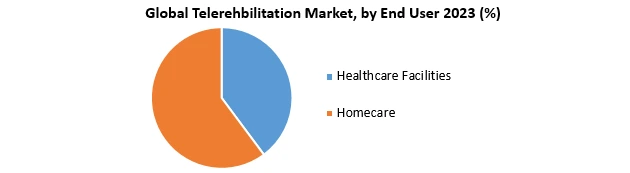
Telerehabilitation Market Regional Insights:
North America dominated the telerehabilitation market in 2023, with a revenue of USD 1.14 billion. North America's dominance is due to the gradual shift toward virtual consultation, an increase in the number of e-visits, and the presence of advanced healthcare technologies. For example, in October 2019, California's Governor signed a new law providing commercial health insurance coverage that will benefit patients by improving access to healthcare services and catalyzing the growth of telehealth technologies across the state. The growing geriatric population in Europe, as well as increased awareness and preference for telerehabilitation among the patient pool, is responsible for the region's market growth.
Asia Pacific, on the other hand, is expected to grow at the fastest rate during the forecast period. The region's high rural population, developing healthcare scenario, and growing population awareness are expected to drive the telerehabilitation market growth. Because of the large unmet patient population, Latin America, the Middle East, and Africa are expected to grow moderately in the forecast years.
Telerehabilitation Market Scope: Inquiry Before Buying
| Telerehabilitation Market | |||
|---|---|---|---|
| Report Coverage | Details | ||
| Base Year: | 2023 | Forecast Period: | 2024-2030 |
| Historical Data: | 2018 to 2023 | Market Size in 2023: | US$ 5.60 Bn. |
| Forecast Period 2024 to 2030 CAGR: | 14% | Market Size in 2030: | US$ 14 Bn. |
| Segments Covered: | by Type | Product Services |
|
| by Application | Occupational Therapy Physical Therapy Chronic Diseases Others |
||
| by End User | Healthcare Facilities Homecare |
||
Telerehabilitation Market by Region
North America (United States, Canada and Mexico)
Europe (UK, France, Germany, Italy, Spain, Sweden, Austria and Rest of Europe)
Asia Pacific (China, South Korea, Japan, India, Australia, Indonesia, Malaysia, Vietnam, Taiwan, Bangladesh, Pakistan and Rest of APAC)
Middle East and Africa (South Africa, GCC, Egypt, Nigeria and Rest of ME&A)
South America (Brazil, Argentina Rest of South America)
Telerehabilitation Market, Key Players are
1. American Well
2. Doctor On Demand, Inc
3. Hinge Health, Inc
4. MIRA Rehab Limited
5. Koninklijke Philips N.V.
6. Jintronix
7. Care Innovations, LLC
8. C3O telemedicine
9. Philips Healthcare
10. Bosch Healthcare
11. Cisco
12. Medvivo Group
13. TeleVital
14. Cloud Physio
15. Neorehab
16. Jitrnonix
Frequently Asked Questions:
1] What is Telerehabilitation occupational therapy?
Ans. Telerehabilitation (also known as e-rehabilitation) is the provision of rehabilitation services via telecommunication networks and the internet. Telerehabilitation allows patients to interact with providers remotely and can be used to both assess and treat patients.
2] What are the different types of Telerehabilitation?
Ans. Other than physical telerehabilitation, other types of telerehabilitation include speech and language therapy, audiology, and neurophysiology. Telehealth can be used to provide a wide range of assessments.
3] What is the market size of the Global Telerehabilitation Market by 2030?
Ans. The market size of the Telerehabilitation Market by 2030 is expected to reach US$ 14 Bn.
4] What is the forecast period for the Global Telerehabilitation Market?
Ans. The forecast period for the Telerehabilitation Market is 2024-2030.
5] What was the market size of the Global Telerehabilitation Market in 2023?
Ans. The market size of the Telerehabilitation Market in 2023 was valued at US$ 5.60 Bn.