Synthetic Biology Market Size by Tool, Technology, Application, Product, Region, Industry-Wide Analysis, Competitive Landscape Assessment & Long-Term Forecast to 2032

25.4%
CAGR (2026-2032)
22.99 USD Bn.
Market Size
313
Report Pages
133
Market Tables

Overview

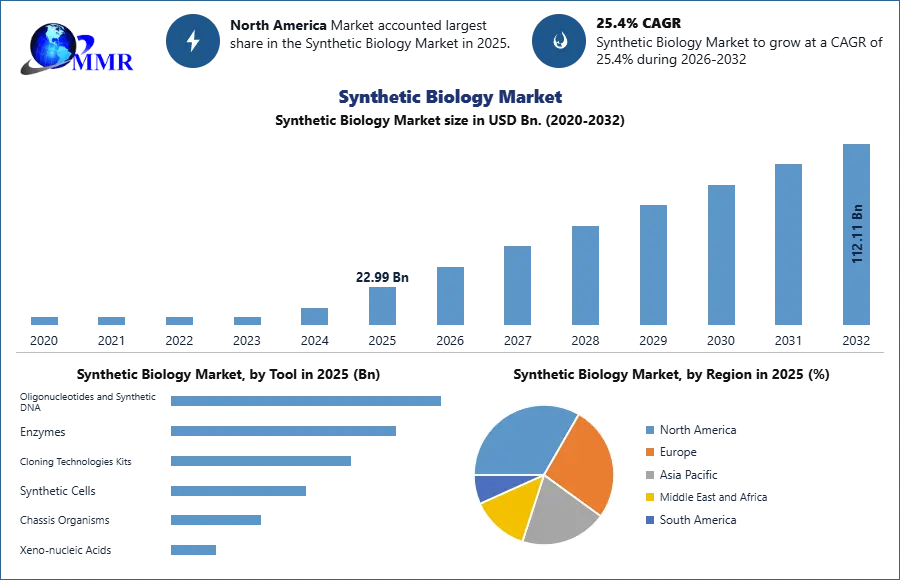
Synthetic Biology Market size was valued at USD 22.99 Bn. in 2025 and the total Synthetic Biology revenue is expected to grow by 25.4% from 2026 to 2032, reaching nearly USD 112.11 Bn.

Synthetic Biology Market Overview:

Synthetic biology (SynBio) is a multidisciplinary area of research that seeks to create new biological components, devices, and systems, as well as redesign existing natural systems. Biotechnology, genetic engineering, molecular biology engineering, systems biology, membrane science, biophysics, chemical and biological engineering, electrical and computer engineering, control engineering, and evolutionary biology are all examples of methodologies included in this branch of science.

Modern biotechnology procedures and tools, including high throughput DNA technologies and bioinformatics, are used to support synthetic biology. There is widespread agreement that synthetic biology procedures strive to exert control over the design, characterization, and fabrication of biological components, devices, and systems to build more predictable biological systems. DNA-based circuits, synthetic metabolic pathway engineering, synthetic genomics, protocell assembly, and xenobiology are examples of "synthetic biology" research.

Synthetic Biology Market Report Scope:

The Synthetic Biology market is segmented based on Tool, Technology, Application, and Region. The growth of various segments helps the report users in acquiring knowledge of the many growth factors expected to be prevalent throughout the market and develop different strategies to help identify core application areas and the gap in the target market. The report provides an in-depth analysis of the market and contains meaningful insights, facts, historical data, and statistically supported and industry-validated market statistics. It also includes estimates based on an appropriate set of assumptions and methodologies.

The bottom-up approach has been used to estimate the market size. Major Key Players in the Synthetic Biology market are identified through secondary research and their market revenues are determined through primary and secondary research. Secondary research included a review of annual and financial reports of leading manufacturers, while primary research included interviews with important opinion leaders and industry experts such as skilled front-line personnel, entrepreneurs, and marketing professionals. Some of the leading key players in the global Synthetic Biology market include Thermo Fisher Scientific, Merck KGaA, Agilent Technologies, Inc., and Novozymes A/S. They are continuously strategizing on mergers and acquisitions, strategic alliances, joint ventures, and partnerships for the growth of their market shares.
Synthetic Biology Market

To know about the Research Methodology :- Request Free Sample Report

Synthetic Biology Market Dynamics:

Increased funding for research and development in synthetic biology

Pharmaceutical firms are now receiving more funding for research and development to discover new medicines. Government initiatives to finance diverse pharma and biotech firms have promoted nutraceutical research and meditation. According to Business Wire, R&D investment in the health sciences sector increased by 22% between 2023 and 2024. This has resulted in a steady increase in R&D investment and spending over time. Pharmaceutical and biotechnology companies invest heavily in research to develop groundbreaking substances that will fulfill the growing demands of the healthcare sector and find solutions for unique ailments. Pharmaceutical R&D accounts for more than 80% of all R&D spending in the life sciences industry.

The market's growth potential may be hampered by ethical and biosafety issues

The recent breakout of COVID-19 and many theories about the virus's origin have drawn increased emphasis on biosafety in synthetic biology and pandemic prevention and control. Although the virus's origin is unknown, and there is no convincing evidence that the novel coronavirus outbreak is linked to biosafety concerns of synthetic biology, the global pandemic has already manifested and caused enormous damage globally, including human lives, national economies, and social and moral aspects.

The fundamental biosafety issue in synthetic biology is the planned or unintentional introduction of synthetic organisms into the environment for study or other purposes. When artificial microbes are introduced into the environment, they can mutate or interact with other species, potentially leading to cross-breeding and the formation of bio mistakes. As a result of these effects, the ecology of living things may be jeopardized. The emergence of antibiotic-resistant superbugs is a huge biosafety issue. The European Union (EU) recently funded several studies on the environmental impacts of releasing genetically engineered microbes for plant growth or bioremediation. These factors may hamper Synthetic Biology Market growth during the forecast period.

The demand for alternative fuels

The world's transportation sector has traditionally been driven by liquid hydrocarbon fuels such as diesel and gasoline. Efforts to produce alternative fuels have been ongoing for decades, but with shifting reasons. Current developments are justified by a reduction in the transportation sector's reliance on fossil fuels, particularly oil, to reduce greenhouse gas emissions, reduce reliance on petroleum imports, improve energy security, and, ultimately, address the depletion of crude oil resources, which are finite and nonrenewable. While there is yet to be a suitable, technically and financially viable replacement for diesel and gasoline, a few alternative fuels have made inroads into the fuel markets. Ethanol (from maize in North America or sugar cane in Brazil), biodiesel, and natural gas are examples. Other alternative fuels might be classified as experimental or niche market fuels. Future breakthroughs, such as in the field of synthetic electrofuels, can be foreseen.

Because of escalating gasoline use and growing concerns about the security of the energy supply, biofuels are becoming increasingly significant. On a large scale, almost 150 billion tonnes of biomass are generated each year. Currently, biofuels are manufactured from food items such as corn, sugarcane, and vegetable oil. As a result, the adoption of synthetic biology approaches in the development of renewable energy is becoming more feasible.

Synthetic Biology Market Segment Analysis:

By Technology, the genome engineering segment is expected to grow at a CAGR of 5.8% during the forecast period. Synthetic genomics views DNA as the cell's "causal engine." Top-down synthetic genomics begins with a complete genome, from which researchers gradually delete "non-essential" genes to reduce the genome size to the smallest feasible size at which the cell can operate normally. The fundamental objective is to create a streamlined "chassis" to which modular DNA "components" may be attached. Bottom-up synthetic genomics attempts to construct functioning genomes from synthesized DNA fragments.

Natural genomes are required as models at this point due to the large number of DNA sequences that are required yet have unclear functions. The goal of synthetic metabolic pathway engineering is to remodel or reconstruct metabolic pathways such that a specific chemical may be synthesized from the "cell factory." A synthetic route is introduced to the cell (usually based on naturally existing DNA sequences that have been computer 'optimized'), and then traditional genetic engineering technologies may be utilized to boost the desired output.

Gene shuffling is a technique in which DNA is randomly fragmented and reassembled, and the results are examined for features such as enhanced enzyme activity and improved protein functions. Also, genome shuffling may be utilized to rapidly develop microbial genomes. Harvard's Wyss Institute, for example, has created a process known as multiplex automated genome engineering (MAGE). They used MAGE to improve a pathway in E. coli by concurrently changing 24 genetic components, yielding approximately 4.3 billion combinatorial genomic variants every day, which was then evaluated for desired features. Such approaches may be used to fine-tune bacteria that have previously been transformed with or constructed from synthetic DNA, as well as for de novo protein synthesis.

Synthetic biology also uses sequence-specific nucleases, such as zinc finger nucleases (ZFN), transcription activator-like effector nucleases (TALEN), and clustered regularly interspaced short palindromic repeats (CRISPR), to attach to DNA sequences in specific ways. Bottom-up genome engineering tries to create functioning genomes from DNA fragments; it is also known as "synthetic genomics." So far, researchers have successfully replicated the viral genomes of polio and Spanish influenza.

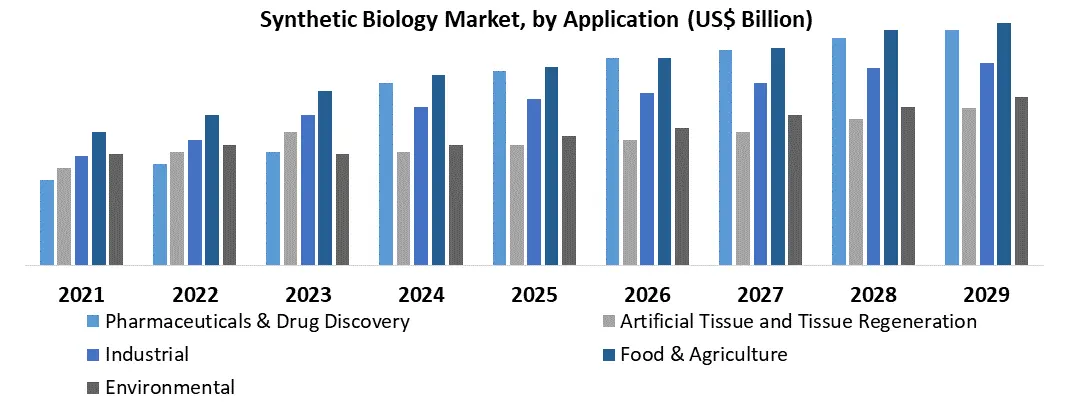
By Application, the environmental segment is expected to grow at a CAGR of 6.1% during the forecast period. Another field of synthetic biology research is environmental applications, the majority of which would involve environmental release or contained usage of organisms produced from synthetic biology processes outside of the laboratory. Scientists predict the use of engineered microbial consortia, aided in part by synthetic biology technologies, to improve mining metal recovery and acid mine drainage bioremediation. Whole-cell biosensors that detect the presence of a target, such as arsenic in drinking water, are being developed using synthetic biology methods.Synthetic Biology Market
Scientists have suggested their work resulting from an iGEM project to build an arsenic biosensor suited for field usage in underdeveloped nations, employing freeze-dried modified E. coli that changes color in the presence of arsenic. The Arsenic Biosensor Collaboration is presently focusing on arsenic biosensor research. Another example of an environmental application was the winning iGEM project at the European Regional Jamboree, which required engineering E. coli to emit auxin, a plant hormone that promotes root development. Also, the Imperial College (UK) researchers have proposed pre-coating seeds with the bacteria and planting them in desertification-prone areas.

Synthetic Biology Market Regional Insights:

In 2025, North America had the biggest share around 40%. As a consequence of increased investment in the development of synthetic biological products, favorable laws, and government backing. Companies in this sector raised more than $3 billion in investment in the first half of 2025, including Moderna Therapeutics, Sana Biotechnology, Poseida Therapeutics, Apeel Sciences, and Greenlight Biosciences. The United States places a high value on research in the disciplines of proteomics, genomic structure prediction, and medication development, which benefits the synthetic biology industry. Furthermore, some privately held corporations, such as the Gates and Melinda Foundation, and government-funded research organizations, such as the National Institutes of Health (NIH), are encouraging synthetic biology research and development, which might strengthen the country's growth prospects.

Synthetic biology has the potential to generate significant economic transformations, both good and bad. If synthetic biology research progresses as expected, or if current commercial and industrial applications of synthetic biology expand in scale, synthetic biology could cause an economic paradigm shift toward economies in which biotechnology, or industries based on the use of biological resources, contribute a much larger share. However, it is unclear how impoverished nations might perform in a global "bioeconomy." As with previous technology, synthetic biology applications may contribute to economic growth if developed nations accept them as niche technologies.

In specialized applications where the tropics and subtropics might be key sources of biomass needed as feedstock for bio-based processes, synthetic biology could aid developing nations' economies. It is also possible that a biotechnology-led bioeconomy will reinforce inequitable trends in international trade; that the scale of biomass extraction and use to support a global bioeconomy would be ecologically unsustainable; and that natural products currently grown or harvested would be displaced by industrial production from microorganisms resulting from synthetic biology techniques. Government laws and regulations would very certainly define the design of emerging bioeconomics and their social, economic, and cultural implications.

Recent Industry Developments (2025–2026)

Exact Date Company Development Impact
10 March 2026 Tsingke Biotech Formed a strategic partnership with iGeneTech Bioscience to integrate high-throughput gene synthesis with next-generation sequencing. Streamlines the design-build-test-learn cycle for precision medicine and bio-breeding applications.
06 February 2026 Ginkgo Bioworks Collaborated with OpenAI to deploy autonomous laboratory technology for advanced cell-free protein synthesis. Accelerates protein engineering by using AI to automate complex biological experiments without living cells.
03 February 2026 Phylo Successfully launched the Biomni Lab platform and secured $13.5 million in seed funding to scale synthetic biology tools. Increases market accessibility for smaller biotech firms through modular and affordable lab automation.
27 January 2026 Think Bioscience Raised $55 million in an oversubscribed Series A round to advance small-molecule drug discovery using biosynthetic pathways. Expands the use of engineered microbes to synthesize complex drug candidates that are difficult to produce chemically.
15 June 2025 UK National Strategy Launched a new Life Sciences Investment Programme worth £250 million specifically targeting synthetic biology and biomanufacturing. Provides critical patient capital to bridge the gap between scientific R&D and commercial industrial scaling.
12 January 2025 BASF Announced the expansion of its bio-based fermentation capacity to produce sustainable specialty chemicals at industrial scale. Solidifies market leadership in industrial biotechnology by replacing petroleum-based feedstocks with engineered biological alternatives.

Synthetic Biology Market Scope: Inquire before buying

Synthetic Biology Market
Report Coverage Details
Base Year: 2025 Forecast Period: 2026-2032
Historical Data: 2020 to 2025 Market Size in 2025: 22.99 USD Bn.
Forecast Period 2026-2032 CAGR: 25.4% Market Size in 2032: 112.11 USD Bn.
Segments Covered: by Tool Oligonucleotides and Synthetic DNA
Enzymes
Cloning Technologies Kits
Synthetic Cells
Chassis Organisms
Xeno-nucleic Acids
by Technology Gene Synthesis
Genome Engineering
Sequencing
Bioinformatics
Site-directed Mutagenesis
Cloning
Measurement and Modeling
Microfluidics
Nanotechnology
by Application Pharmaceuticals & Drug Discovery
Artificial Tissue and Tissue Regeneration
Industrial
Food & Agriculture
Environmental
by Product Core Products
Enabling Products
Enabled Products

Synthetic Biology Market, by Region

North America (United States, Canada and Mexico)
Europe (UK, France, Germany, Italy, Spain, Sweden, Austria and Rest of Europe)
Asia Pacific (China, South Korea, Japan, India, Australia, Indonesia, Malaysia, Vietnam, Taiwan, Bangladesh, Pakistan and Rest of APAC)
Middle East and Africa (South Africa, GCC, Egypt, Nigeria and Rest of ME&A)
South America (Brazil, Argentina Rest of South America)

Key Players / Competitors Profiles Covered in Brief in Global Synthetic Biology Market Report in Strategic Perspective:

  1.  Thermo Fisher Scientific
  2. Merck KGaA
  3. Agilent Technologies
  4. Novozymes A/S
  5. Ginkgo Bioworks
  6. Amyris
  7. Genscript Biotech Corporation
  8. Integrated DNA Technologies
  9. Twist Bioscience Corporation
  10. Illumina
  11. Eurofins Scientific
  12. Codexis
  13. Synthego
  14. New England Biolabs
  15. Precigen
  16. Arzeda
  17. Bota Biosciences
  18. Cyrus Biotechnology
  19. TeselaGen
  20. ATUM
  21. Creative Enzymes
  22. Inscripta
  23. Synbio Technologies
  24. LanzaTech
  25. Mammoth Biosciences

Table of Contents

1. Synthetic Biology Market Introduction
1.1. Study Assumption and Market Definition
1.2. Scope of the Study
1.3. Executive Summary
2. Global Synthetic Biology Market: Competitive Landscape
2.1. MMR Competition Matrix
2.2. Competitive Landscape
2.3. Key Players Benchmarking
2.3.1. Company Name
2.3.2. Business Segment
2.3.3. End-user Segment
2.3.4. Revenue (2025)
2.3.5. Company Locations
2.4. Leading Synthetic Biology Market Companies, by market capitalization
2.5. Market Structure
2.5.1. Market Leaders
2.5.2. Market Followers
2.5.3. Emerging Players
2.6. Mergers and Acquisitions Details
3. Synthetic Biology Market: Dynamics
3.1. Synthetic Biology Market Trends by Region
3.1.1. North America Synthetic Biology Market Trends
3.1.2. Europe Synthetic Biology Market Trends
3.1.3. Asia Pacific Synthetic Biology Market Trends
3.1.4. Middle East and Africa Synthetic Biology Market Trends
3.1.5. South America Synthetic Biology Market Trends
3.2. Synthetic Biology Market Dynamics by Region
3.2.1. North America
3.2.1.1. North America Synthetic Biology Market Drivers
3.2.1.2. North America Synthetic Biology Market Restraints
3.2.1.3. North America Synthetic Biology Market Opportunities
3.2.1.4. North America Synthetic Biology Market Challenges
3.2.2. Europe
3.2.2.1. Europe Synthetic Biology Market Drivers
3.2.2.2. Europe Synthetic Biology Market Restraints
3.2.2.3. Europe Synthetic Biology Market Opportunities
3.2.2.4. Europe Synthetic Biology Market Challenges
3.2.3. Asia Pacific
3.2.3.1. Asia Pacific Synthetic Biology Market Drivers
3.2.3.2. Asia Pacific Synthetic Biology Market Restraints
3.2.3.3. Asia Pacific Synthetic Biology Market Opportunities
3.2.3.4. Asia Pacific Synthetic Biology Market Challenges
3.2.4. Middle East and Africa
3.2.4.1. Middle East and Africa Synthetic Biology Market Drivers
3.2.4.2. Middle East and Africa Synthetic Biology Market Restraints
3.2.4.3. Middle East and Africa Synthetic Biology Market Opportunities
3.2.4.4. Middle East and Africa Synthetic Biology Market Challenges
3.2.5. South America
3.2.5.1. South America Synthetic Biology Market Drivers
3.2.5.2. South America Synthetic Biology Market Restraints
3.2.5.3. South America Synthetic Biology Market Opportunities
3.2.5.4. South America Synthetic Biology Market Challenges
3.3. PORTER's Five Forces Analysis
3.4. PESTLE Analysis
3.5. Technology Roadmap
3.6. Regulatory Landscape by Region
3.6.1. North America
3.6.2. Europe
3.6.3. Asia Pacific
3.6.4. Middle East and Africa
3.6.5. South America
3.7. Key Opinion Leader Analysis For Synthetic Biology Industry
3.8. Analysis of Government Schemes and Initiatives For Synthetic Biology Industry
3.9. Synthetic Biology Market Trade Analysis
3.10. The Global Pandemic Impact on Synthetic Biology Market
4. Synthetic Biology Market: Global Market Size and Forecast by Segmentation (in USD Bn.) 2025-2032
4.1. Synthetic Biology Market Size and Forecast, by Tool (2025-2032)
4.1.1. Oligonucleotides and Synthetic DNA
4.1.2. Enzymes
4.1.3. Cloning Technologies Kits
4.1.4. Synthetic Cells
4.1.5. Chassis Organisms
4.1.6. Xeno-nucleic Acids
4.2. Synthetic Biology Market Size and Forecast, by Technology (2025-2032)
4.2.1. Gene Synthesis
4.2.2. Genome Engineering
4.2.3. Sequencing
4.2.4. Bioinformatics
4.2.5. Site-directed Mutagenesis
4.2.6. Cloning
4.2.7. Measurement and Modeling
4.2.8. Microfluidics
4.2.9. Nanotechnology
4.3. Synthetic Biology Market Size and Forecast, by Application (2025-2032)
4.3.1. Pharmaceuticals & Drug Discovery
4.3.2. Artificial Tissue and Tissue Regeneration
4.3.3. Industrial
4.3.4. Food & Agriculture
4.3.5. Environmental
4.4. Synthetic Biology Market Size and Forecast, by Product (2025-2032)
4.4.1. Core Products
4.4.2. Enabling Products
4.4.3. Enabled Products
4.5. Synthetic Biology Market Size and Forecast, by Region (2025-2032)
4.5.1. North America
4.5.2. Europe
4.5.3. Asia Pacific
4.5.4. Middle East and Africa
4.5.5. South America
5. North America Synthetic Biology Market Size and Forecast by Segmentation (in USD Bn.) 2025-2032
5.1. North America Synthetic Biology Market Size and Forecast, by Tool (2025-2032)
5.1.1. Oligonucleotides and Synthetic DNA
5.1.2. Enzymes
5.1.3. Cloning Technologies Kits
5.1.4. Synthetic Cells
5.1.5. Chassis Organisms
5.1.6. Xeno-nucleic Acids
5.2. North America Synthetic Biology Market Size and Forecast, by Technology (2025-2032)
5.2.1. Gene Synthesis
5.2.2. Genome Engineering
5.2.3. Sequencing
5.2.4. Bioinformatics
5.2.5. Site-directed Mutagenesis
5.2.6. Cloning
5.2.7. Measurement and Modeling
5.2.8. Microfluidics
5.2.9. Nanotechnology
5.3. North America Synthetic Biology Market Size and Forecast, by Application (2025-2032)
5.3.1. Pharmaceuticals & Drug Discovery
5.3.2. Artificial Tissue and Tissue Regeneration
5.3.3. Industrial
5.3.4. Food & Agriculture
5.3.5. Environmental
5.4. North America Synthetic Biology Market Size and Forecast, by Product (2025-2032)
5.4.1. Core Products
5.4.2. Enabling Products
5.4.3. Enabled Products
5.5. North America Synthetic Biology Market Size and Forecast, by Country (2025-2032)
5.5.1. United States
5.5.1.1. United States Synthetic Biology Market Size and Forecast, by Tool (2025-2032)
5.5.1.1.1. Oligonucleotides and Synthetic DNA
5.5.1.1.2. Enzymes
5.5.1.1.3. Cloning Technologies Kits
5.5.1.1.4. Synthetic Cells
5.5.1.1.5. Chassis Organisms
5.5.1.1.6. Xeno-nucleic Acids
5.5.1.2. United States Synthetic Biology Market Size and Forecast, by Technology (2025-2032)
5.5.1.2.1. Gene Synthesis
5.5.1.2.2. Genome Engineering
5.5.1.2.3. Sequencing
5.5.1.2.4. Bioinformatics
5.5.1.2.5. Site-directed Mutagenesis
5.5.1.2.6. Cloning
5.5.1.2.7. Measurement and Modeling
5.5.1.2.8. Microfluidics
5.5.1.2.9. Nanotechnology
5.5.1.3. United States Synthetic Biology Market Size and Forecast, by Application (2025-2032)
5.5.1.3.1. Pharmaceuticals & Drug Discovery
5.5.1.3.2. Artificial Tissue and Tissue Regeneration
5.5.1.3.3. Industrial
5.5.1.3.4. Food & Agriculture
5.5.1.3.5. Environmental
5.5.1.4. United States Synthetic Biology Market Size and Forecast, by Product (2025-2032)
5.5.1.4.1. Core Products
5.5.1.4.2. Enabling Products
5.5.1.4.3. Enabled Products
5.5.2. Canada
5.5.2.1. Canada Synthetic Biology Market Size and Forecast, by Tool (2025-2032)
5.5.2.1.1. Oligonucleotides and Synthetic DNA
5.5.2.1.2. Enzymes
5.5.2.1.3. Cloning Technologies Kits
5.5.2.1.4. Synthetic Cells
5.5.2.1.5. Chassis Organisms
5.5.2.1.6. Xeno-nucleic Acids
5.5.2.2. Canada Synthetic Biology Market Size and Forecast, by Technology (2025-2032)
5.5.2.2.1. Gene Synthesis
5.5.2.2.2. Genome Engineering
5.5.2.2.3. Sequencing
5.5.2.2.4. Bioinformatics
5.5.2.2.5. Site-directed Mutagenesis
5.5.2.2.6. Cloning
5.5.2.2.7. Measurement and Modeling
5.5.2.2.8. Microfluidics
5.5.2.2.9. Nanotechnology
5.5.2.3. Canada Synthetic Biology Market Size and Forecast, by Application (2025-2032)
5.5.2.3.1. Pharmaceuticals & Drug Discovery
5.5.2.3.2. Artificial Tissue and Tissue Regeneration
5.5.2.3.3. Industrial
5.5.2.3.4. Food & Agriculture
5.5.2.3.5. Environmental
5.5.2.4. Canada Synthetic Biology Market Size and Forecast, by Product (2025-2032)
5.5.2.4.1. Core Products
5.5.2.4.2. Enabling Products
5.5.2.4.3. Enabled Products
5.5.3. Mexico
5.5.3.1. Mexico Synthetic Biology Market Size and Forecast, by Tool (2025-2032)
5.5.3.1.1. Oligonucleotides and Synthetic DNA
5.5.3.1.2. Enzymes
5.5.3.1.3. Cloning Technologies Kits
5.5.3.1.4. Synthetic Cells
5.5.3.1.5. Chassis Organisms
5.5.3.1.6. Xeno-nucleic Acids
5.5.3.2. Mexico Synthetic Biology Market Size and Forecast, by Technology (2025-2032)
5.5.3.2.1. Gene Synthesis
5.5.3.2.2. Genome Engineering
5.5.3.2.3. Sequencing
5.5.3.2.4. Bioinformatics
5.5.3.2.5. Site-directed Mutagenesis
5.5.3.2.6. Cloning
5.5.3.2.7. Measurement and Modeling
5.5.3.2.8. Microfluidics
5.5.3.2.9. Nanotechnology
5.5.3.3. Mexico Synthetic Biology Market Size and Forecast, by Application (2025-2032)
5.5.3.3.1. Pharmaceuticals & Drug Discovery
5.5.3.3.2. Artificial Tissue and Tissue Regeneration
5.5.3.3.3. Industrial
5.5.3.3.4. Food & Agriculture
5.5.3.3.5. Environmental
5.5.3.4. Mexico Synthetic Biology Market Size and Forecast, by Product (2025-2032)
5.5.3.4.1. Core Products
5.5.3.4.2. Enabling Products
5.5.3.4.3. Enabled Products
6. Europe Synthetic Biology Market Size and Forecast by Segmentation (in USD Bn.) 2025-2032
6.1. Europe Synthetic Biology Market Size and Forecast, by Tool (2025-2032)
6.2. Europe Synthetic Biology Market Size and Forecast, by Technology (2025-2032)
6.3. Europe Synthetic Biology Market Size and Forecast, by Application (2025-2032)
6.4. Europe Synthetic Biology Market Size and Forecast, by Product (2025-2032)
6.5. Europe Synthetic Biology Market Size and Forecast, by Country (2025-2032)
6.5.1. United Kingdom
6.5.1.1. United Kingdom Synthetic Biology Market Size and Forecast, by Tool (2025-2032)
6.5.1.2. United Kingdom Synthetic Biology Market Size and Forecast, by Technology (2025-2032)
6.5.1.3. United Kingdom Synthetic Biology Market Size and Forecast, by Application (2025-2032)
6.5.1.4. United Kingdom Synthetic Biology Market Size and Forecast, by Product (2025-2032)
6.5.2. France
6.5.2.1. France Synthetic Biology Market Size and Forecast, by Tool (2025-2032)
6.5.2.2. France Synthetic Biology Market Size and Forecast, by Technology (2025-2032)
6.5.2.3. France Synthetic Biology Market Size and Forecast, by Application (2025-2032)
6.5.2.4. France Synthetic Biology Market Size and Forecast, by Product (2025-2032)
6.5.3. Germany
6.5.3.1. Germany Synthetic Biology Market Size and Forecast, by Tool (2025-2032)
6.5.3.2. Germany Synthetic Biology Market Size and Forecast, by Technology (2025-2032)
6.5.3.3. Germany Synthetic Biology Market Size and Forecast, by Application (2025-2032)
6.5.3.4. Germany Synthetic Biology Market Size and Forecast, by Product (2025-2032)
6.5.4. Italy
6.5.4.1. Italy Synthetic Biology Market Size and Forecast, by Tool (2025-2032)
6.5.4.2. Italy Synthetic Biology Market Size and Forecast, by Technology (2025-2032)
6.5.4.3. Italy Synthetic Biology Market Size and Forecast, by Application (2025-2032)
6.5.4.4. Italy Synthetic Biology Market Size and Forecast, by Product (2025-2032)
6.5.5. Spain
6.5.5.1. Spain Synthetic Biology Market Size and Forecast, by Tool (2025-2032)
6.5.5.2. Spain Synthetic Biology Market Size and Forecast, by Technology (2025-2032)
6.5.5.3. Spain Synthetic Biology Market Size and Forecast, by Application (2025-2032)
6.5.5.4. Spain Synthetic Biology Market Size and Forecast, by Product (2025-2032)
6.5.6. Sweden
6.5.6.1. Sweden Synthetic Biology Market Size and Forecast, by Tool (2025-2032)
6.5.6.2. Sweden Synthetic Biology Market Size and Forecast, by Technology (2025-2032)
6.5.6.3. Sweden Synthetic Biology Market Size and Forecast, by Application (2025-2032)
6.5.6.4. Sweden Synthetic Biology Market Size and Forecast, by Product (2025-2032)
6.5.7. Austria
6.5.7.1. Austria Synthetic Biology Market Size and Forecast, by Tool (2025-2032)
6.5.7.2. Austria Synthetic Biology Market Size and Forecast, by Technology (2025-2032)
6.5.7.3. Austria Synthetic Biology Market Size and Forecast, by Application (2025-2032)
6.5.7.4. Austria Synthetic Biology Market Size and Forecast, by Product (2025-2032)
6.5.8. Rest of Europe
6.5.8.1. Rest of Europe Synthetic Biology Market Size and Forecast, by Tool (2025-2032)
6.5.8.2. Rest of Europe Synthetic Biology Market Size and Forecast, by Technology (2025-2032)
6.5.8.3. Rest of Europe Synthetic Biology Market Size and Forecast, by Application (2025-2032)
6.5.8.4. Rest of Europe Synthetic Biology Market Size and Forecast, by Product (2025-2032)
7. Asia Pacific Synthetic Biology Market Size and Forecast by Segmentation (in USD Bn.) 2025-2032
7.1. Asia Pacific Synthetic Biology Market Size and Forecast, by Tool (2025-2032)
7.2. Asia Pacific Synthetic Biology Market Size and Forecast, by Technology (2025-2032)
7.3. Asia Pacific Synthetic Biology Market Size and Forecast, by Application (2025-2032)
7.4. Asia Pacific Synthetic Biology Market Size and Forecast, by Product (2025-2032)
7.5. Asia Pacific Synthetic Biology Market Size and Forecast, by Country (2025-2032)
7.5.1. China
7.5.1.1. China Synthetic Biology Market Size and Forecast, by Tool (2025-2032)
7.5.1.2. China Synthetic Biology Market Size and Forecast, by Technology (2025-2032)
7.5.1.3. China Synthetic Biology Market Size and Forecast, by Application (2025-2032)
7.5.1.4. China Synthetic Biology Market Size and Forecast, by Product (2025-2032)
7.5.2. S Korea
7.5.2.1. S Korea Synthetic Biology Market Size and Forecast, by Tool (2025-2032)
7.5.2.2. S Korea Synthetic Biology Market Size and Forecast, by Technology (2025-2032)
7.5.2.3. S Korea Synthetic Biology Market Size and Forecast, by Application (2025-2032)
7.5.2.4. S Korea Synthetic Biology Market Size and Forecast, by Product (2025-2032)
7.5.3. Japan
7.5.3.1. Japan Synthetic Biology Market Size and Forecast, by Tool (2025-2032)
7.5.3.2. Japan Synthetic Biology Market Size and Forecast, by Technology (2025-2032)
7.5.3.3. Japan Synthetic Biology Market Size and Forecast, by Application (2025-2032)
7.5.3.4. Japan Synthetic Biology Market Size and Forecast, by Product (2025-2032)
7.5.4. India
7.5.4.1. India Synthetic Biology Market Size and Forecast, by Tool (2025-2032)
7.5.4.2. India Synthetic Biology Market Size and Forecast, by Technology (2025-2032)
7.5.4.3. India Synthetic Biology Market Size and Forecast, by Application (2025-2032)
7.5.4.4. India Synthetic Biology Market Size and Forecast, by Product (2025-2032)
7.5.5. Australia
7.5.5.1. Australia Synthetic Biology Market Size and Forecast, by Tool (2025-2032)
7.5.5.2. Australia Synthetic Biology Market Size and Forecast, by Technology (2025-2032)
7.5.5.3. Australia Synthetic Biology Market Size and Forecast, by Application (2025-2032)
7.5.5.4. Australia Synthetic Biology Market Size and Forecast, by Product (2025-2032)
7.5.6. Indonesia
7.5.6.1. Indonesia Synthetic Biology Market Size and Forecast, by Tool (2025-2032)
7.5.6.2. Indonesia Synthetic Biology Market Size and Forecast, by Technology (2025-2032)
7.5.6.3. Indonesia Synthetic Biology Market Size and Forecast, by Application (2025-2032)
7.5.6.4. Indonesia Synthetic Biology Market Size and Forecast, by Product (2025-2032)
7.5.7. Malaysia
7.5.7.1. Malaysia Synthetic Biology Market Size and Forecast, by Tool (2025-2032)
7.5.7.2. Malaysia Synthetic Biology Market Size and Forecast, by Technology (2025-2032)
7.5.7.3. Malaysia Synthetic Biology Market Size and Forecast, by Application (2025-2032)
7.5.7.4. Malaysia Synthetic Biology Market Size and Forecast, by Product (2025-2032)
7.5.8. Vietnam
7.5.8.1. Vietnam Synthetic Biology Market Size and Forecast, by Tool (2025-2032)
7.5.8.2. Vietnam Synthetic Biology Market Size and Forecast, by Technology (2025-2032)
7.5.8.3. Vietnam Synthetic Biology Market Size and Forecast, by Application (2025-2032)
7.5.8.4. Vietnam Synthetic Biology Market Size and Forecast, by Product (2025-2032)
7.5.9. Taiwan
7.5.9.1. Taiwan Synthetic Biology Market Size and Forecast, by Tool (2025-2032)
7.5.9.2. Taiwan Synthetic Biology Market Size and Forecast, by Technology (2025-2032)
7.5.9.3. Taiwan Synthetic Biology Market Size and Forecast, by Application (2025-2032)
7.5.9.4. Taiwan Synthetic Biology Market Size and Forecast, by Product (2025-2032)
7.5.10. Rest of Asia Pacific
7.5.10.1. Rest of Asia Pacific Synthetic Biology Market Size and Forecast, by Tool (2025-2032)
7.5.10.2. Rest of Asia Pacific Synthetic Biology Market Size and Forecast, by Technology (2025-2032)
7.5.10.3. Rest of Asia Pacific Synthetic Biology Market Size and Forecast, by Application (2025-2032)
7.5.10.4. Rest of Asia Pacific Synthetic Biology Market Size and Forecast, by Product (2025-2032)
8. Middle East and Africa Synthetic Biology Market Size and Forecast by Segmentation (in USD Bn.) 2025-2032
8.1. Middle East and Africa Synthetic Biology Market Size and Forecast, by Tool (2025-2032)
8.2. Middle East and Africa Synthetic Biology Market Size and Forecast, by Technology (2025-2032)
8.3. Middle East and Africa Synthetic Biology Market Size and Forecast, by Application (2025-2032)
8.4. Middle East and Africa Synthetic Biology Market Size and Forecast, by Product (2025-2032)
8.5. Middle East and Africa Synthetic Biology Market Size and Forecast, by Country (2025-2032)
8.5.1. South Africa
8.5.1.1. South Africa Synthetic Biology Market Size and Forecast, by Tool (2025-2032)
8.5.1.2. South Africa Synthetic Biology Market Size and Forecast, by Technology (2025-2032)
8.5.1.3. South Africa Synthetic Biology Market Size and Forecast, by Application (2025-2032)
8.5.1.4. South Africa Synthetic Biology Market Size and Forecast, by Product (2025-2032)
8.5.2. GCC
8.5.2.1. GCC Synthetic Biology Market Size and Forecast, by Tool (2025-2032)
8.5.2.2. GCC Synthetic Biology Market Size and Forecast, by Technology (2025-2032)
8.5.2.3. GCC Synthetic Biology Market Size and Forecast, by Application (2025-2032)
8.5.2.4. GCC Synthetic Biology Market Size and Forecast, by Product (2025-2032)
8.5.3. Nigeria
8.5.3.1. Nigeria Synthetic Biology Market Size and Forecast, by Tool (2025-2032)
8.5.3.2. Nigeria Synthetic Biology Market Size and Forecast, by Technology (2025-2032)
8.5.3.3. Nigeria Synthetic Biology Market Size and Forecast, by Application (2025-2032)
8.5.3.4. Nigeria Synthetic Biology Market Size and Forecast, by Product (2025-2032)
8.5.4. Rest of ME&A
8.5.4.1. Rest of ME&A Synthetic Biology Market Size and Forecast, by Tool (2025-2032)
8.5.4.2. Rest of ME&A Synthetic Biology Market Size and Forecast, by Technology (2025-2032)
8.5.4.3. Rest of ME&A Synthetic Biology Market Size and Forecast, by Application (2025-2032)
8.5.4.4. Rest of ME&A Synthetic Biology Market Size and Forecast, by Product (2025-2032)
9. South America Synthetic Biology Market Size and Forecast by Segmentation (in USD Bn.) 2025-2032
9.1. South America Synthetic Biology Market Size and Forecast, by Tool (2025-2032)
9.2. South America Synthetic Biology Market Size and Forecast, by Technology (2025-2032)
9.3. South America Synthetic Biology Market Size and Forecast, by Application (2025-2032)
9.4. South America Synthetic Biology Market Size and Forecast, by Product (2025-2032)
9.5. South America Synthetic Biology Market Size and Forecast, by Country (2025-2032)
9.5.1. Brazil
9.5.1.1. Brazil Synthetic Biology Market Size and Forecast, by Tool (2025-2032)
9.5.1.2. Brazil Synthetic Biology Market Size and Forecast, by Technology (2025-2032)
9.5.1.3. Brazil Synthetic Biology Market Size and Forecast, by Application (2025-2032)
9.5.1.4. Brazil Synthetic Biology Market Size and Forecast, by Product (2025-2032)
9.5.2. Argentina
9.5.2.1. Argentina Synthetic Biology Market Size and Forecast, by Tool (2025-2032)
9.5.2.2. Argentina Synthetic Biology Market Size and Forecast, by Technology (2025-2032)
9.5.2.3. Argentina Synthetic Biology Market Size and Forecast, by Application (2025-2032)
9.5.2.4. Argentina Synthetic Biology Market Size and Forecast, by Product (2025-2032)
9.5.3. Rest Of South America
9.5.3.1. Rest Of South America Synthetic Biology Market Size and Forecast, by Tool (2025-2032)
9.5.3.2. Rest Of South America Synthetic Biology Market Size and Forecast, by Technology (2025-2032)
9.5.3.3. Rest Of South America Synthetic Biology Market Size and Forecast, by Application (2025-2032)
9.5.3.4. Rest Of South America Synthetic Biology Market Size and Forecast, by Product (2025-2032)
10. Company Profile: Key Players
10.1. Thermo Fisher Scientific
10.1.1. Company Overview
10.1.2. Business Portfolio
10.1.3. Financial Overview
10.1.4. SWOT Analysis
10.1.5. Strategic Analysis
10.1.6. Scale of Operation (small, medium, and large)
10.1.7. Details on Partnership
10.1.8. Regulatory Accreditations and Certifications Received by Them
10.1.9. Awards Received by the Firm
10.1.10. Recent Developments
10.2. Merck KGaA
10.3. Agilent Technologies
10.4. Novozymes A/S
10.5. Ginkgo Bioworks
10.6. Amyris
10.7. Genscript Biotech Corporation
10.8. Integrated DNA Technologies
10.9. Twist Bioscience Corporation
10.10. Illumina
10.11. Eurofins Scientific
10.12. Codexis
10.13. Synthego
10.14. New England Biolabs
10.15. Precigen
10.16. Arzeda
10.17. Bota Biosciences
10.18. Cyrus Biotechnology
10.19. TeselaGen
10.20. ATUM
10.21. Creative Enzymes
10.22. Inscripta
10.23. Synbio Technologies
10.24. LanzaTech
10.25. Mammoth Biosciences
11. Key Findings
12. Industry Recommendations
13. Synthetic Biology Market: Research Methodology
14. Terms and Glossary

Custom Market Research Services

We Will Customise The Research For You, In Case The Report Listed Above Does Not Meet With Your Requirements