
Speaker Market By Product Type, Technology,Size, Price, End Use, Distribution Channel, Component Region - Global Market Size Estimation, Industry-Wide Analysis, Competitive Landscape Assessment & Long-Term Forecast to 2032
Overview
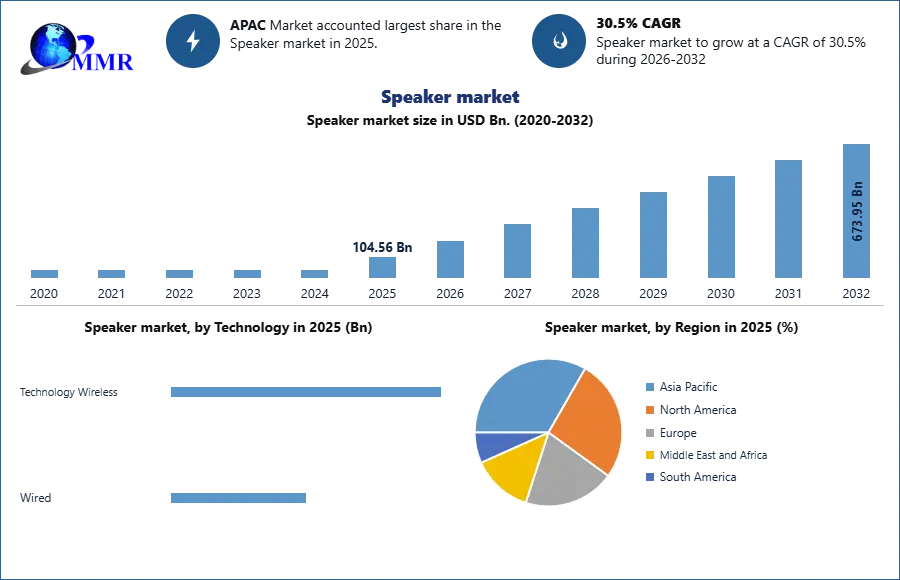
The Speaker Market size was valued at USD 104.56 Billion in 2025 and the total Speaker revenue is expected to grow at a CAGR of 30.5% from 2026 to 2032, reaching nearly USD 673.95 Billion.
Speaker Market Overview
Speakers are devices that plays audio and communicate by converting electrical signals into sound waves. Its driver or transducer vibrates to produce sound and is used in audio systems, home entertainment, public address systems, and telecommunications. Market growth is driven by smart speaker demand worldwide. Latest feature like voice assistance simplifies the speaker control and enable hands-free operations, which is the key factor in rising speaker sales. Beyond music management, these smart speakers set alarms, monitor the weather, and control smart home gadgets, improving the user-friendliness. All these improved features are getting popular day by day and boosting the market.
To know about the Research Methodology :- Request Free Sample Report
Speaker Market Research Methodology :
The report on the Speaker Industry covers an in-depth analysis of the industry. Key insights from the report include the Speaker Market size and the growth rate. A thorough regional analysis of the speaker industry is conducted at a global, regional and country level. Such analysis provides valuable information on market penetration, regional dominance and growth strategies adopted by the key players in the market. The major countries in each region are mapped according to their revenue contribution to the Global Speaker Market.
To understand the competitive landscape of the Speaker Market, key players and new entrants in the market are listed. Growth indicators such as company profiles, revenue, and share, core competitors, recent developments, new growth strategies, technological advancements and mergers and acquisitions are covered. The report provides a competitive analysis of the Speaker Market drivers, restraints, opportunities, and growth strategies.
PESTLE, SWOT and Porter’s five forces were used for industry analysis of the Speaker Market. Swot analysis is used to identify the strength and weaknesses of the market. The bottom-up approach was used for estimate the Speaker Market size. The report includes the Speaker Market’s major strategic developments, comprising R&D, new product launches, M&A, partnerships, agreements, collaborations, joint ventures, and regional growth of the key competitors. The report includes an analysis of the global, regional and country levels.
Our report examines how the Middle East conflict reshapes the revenue landscape for market leaders, followers, and disruptors. With geopolitical instability causing diverse regional impacts, segments like high-fidelity audio components and magnetics face unique pressures. We detail short-term and long-term consequences, specifically soaring raw material costs and maritime shipping delays, providing decision-makers with strategic regional frameworks to navigate this volatile and evolving environment.
Speaker Market Dynamics
These speakers can play music, retrieve information, and control smart home devices. Smart speakers are affordable, making them accessible to more consumers. Smart speaker sales are up and the market is expected to rise. Such speakers are so affordable, because manufacturing them is cheaper and their designs are appealing to more people. Economical and premium speakers have done well in the market as customers valued functionality and sound quality.
The increasing adoption of voice assistants is driving the speaker market
Voice assistants are driving speaker sales for various reasons. They are simplify controlling the speaker. Voice commands allow hands-free speaker control. This function helps people who’re busy and occupied most of the time; and like to use voice commands just as "Alexa, play music" or "Google, turn up the volume" which can start music playback on a speaker.
Voice assistants go beyond music control. They enable speakers' many functionalities. Voice assistants can play music, set alarms, check the weather, and control smart home devices. This adaptability improves the user experience hence it boosts the demand of the smart speaker in the market.
The inbuilt voice assistant gadgets also help boost the smart speaker market. Voice assistants are helping businesses improve customer service, answer questions, and sell products. Thus, voice assistant-compatible speakers are needed to help businesses use this technology. Numerous statistics corroborate these statements. Smart speaker sales rose to 157 million in from 53 million in . This shows their growing popularity. From , the worldwide voice assistant market is expected to expand by 21.8%. Voice assistants in smartphones and autos drive this trend. The report shows that 52% of consumers would buy a voice assistant-compatible speaker. Voice assistants strongly impact speaker buyers.
The increasing popularity of smart speakers would drive the Speaker Market
Smart speakers are boosting the speaker market for various reasons. Smart speakers simplify daily life. Voice commands can control smart home gadgets, get information, and play music. Smart speakers make it easy to turn on lights and set alarms by voice.
Smart speakers are multifunctional. They have many features beyond smart home gadgets and music playback. Smart speakers provide news, weather, traffic, and more. This versatility makes the gadgets ideal additions to any home, meeting a variety of requirements and preferences. Smart speakers' price has also helped them flourish. They have become increasingly affordable and popular over time. Smart speakers' affordability has driven market demand.
Numerous statistics corroborate these statements. Smart speaker sales rose to 157 million in from 53 million in . From , the smart speaker market is estimated to rise 25.6%. Smart speakers and voice assistants in smartphones and autos drive this trend. Smart speakers control lighting, thermostats, and locks in smart homes. They centralise control and simplify home automation. Smart speakers also provide weather, traffic, and news updates. Spotify, Apple Music, and Amazon Music may be streamed without headphones or cords. Smart speakers help consumers stay organised by setting alarms and timers. Finally, they act as virtual assistants, answering math, trivia, cooking, and daily life queries.
The declining prices of speakers drive the Speaker Market
Smart speakers’ prices are falling, driving market development. Smart speakers becoming more affordable is a major factor. Over the past five years, speakers have fallen 20% in price, making them more affordable and appealing to more purchasers. This affordability boosts speaker demand because more people can buy them.
Affordable smart speaker sales are growing rapidly. Affordable smart speakers are in high demand as consumers seek cheaper solutions. Speaker manufacturers can now target this market niche and offer budget-friendly speakers. Interestingly, high-quality speaker demand rises as prices fall. Consumers are increasingly willing to spend on immersive audio speakers. While price is important, customers still appreciate speaker performance and audio quality. The global speaker market was worth $47.05 billion in , demonstrating considerable growth. Due to the rising need for affordable choices and streaming service popularity, the market for affordable speakers is predicted to develop at a CAGR of 30.5% from .
Market Saturation could cause a hindrance in the Speaker Market growth
Market saturation occurs when the market is saturated with products and the supply and demand balance. When consumers have many speaker options and demand stabilizes, the speaker market is saturated. Market saturation may limit growth.
The proliferation of speaker brands and products contributes to market saturation. Many manufacturers entered the speaker market to meet consumer demand. Competition has saturated the market, giving consumers too many options.
Market saturation, especially in developed nations with high smart speaker adoption, is anticipated to hinder global smart speaker market growth, according to Market Research Future. North America and Europe have embraced smart speakers, creating a saturated industry. As the market reaches saturation in certain locations, smart speakers' growth rate slows.
Manufacturers and consumers face market saturation. They have fewer ways to distinguish their products from the competition due to limited features and functions. Manufacturers must innovate to compete in the saturated market. Market saturation gives consumers many choices but also confusion. Consumers may struggle to traverse the many brands, features, and pricing points. This complicates decision-making and may deter purchasing.
Manufacturers may enter new markets or target specialised customers to avoid market saturation. They can also differentiate their products by offering outdoor speakers, gaming speakers, or immersive audio and voice recognition to attract clients looking for unique experiences. When speaker supply exceeds demand, market saturation slows growth. Strategic differentiation, targeting new market segments, and constant innovation can help manufacturers and consumers overcome saturation and continue success in this competitive market.
The profusion of brands and products can confuse consumers and inhibit decision-making, which can hinder market growth.
Asia-Pacific has the largest speaker market due to its enormous middle class population. North America, Europe, Latin America, and the Middle East & Africa also drive market expansion with their own consumer demands. Product type, application, technology, price, distribution channel, geography, and end-user are segments discussed for the speaker market. These criteria enable manufacturers and retailers to customise marketing efforts to customer preferences. Bose, Sony, JBL, Harman Kardon, and Polk Audio compete for speaker market share. New goods like sophisticated wireless speakers and smart speakers with voice assistants show the industry's continual need for innovation.
Speaker Market Regional Insights:
The worldwide speaker market has distinct regional characteristics and contributions. Speakers' biggest market is Asia-Pacific. Speaker demand is driven by the region's massive population and rising middle class with disposable cash. China, India, and Japan are key manufacturers and consumers in this region.
The US and Canada dominate North America's second-largest speaker market. The world's largest consumer market, the US, drives speaker demand, while Canada exports speakers to many places. Technology, customer awareness, and established manufacturers drive this region's market.
Europe's speaker market is mature but growing. Leading speaker makers and importers are in the region. Germany, the UK, and France help grow the European speaker market.
Latin America is a promising speaker market. Brazil, Mexico, and Argentina increase demand. Latin America's growing population and rising living levels increase the demand for speakers and other consumer goods.
The Middle East & Africa speaker market is growing rapidly despite its tiny size. Speakers are in demand because of the region's burgeoning middle class and discretionary incomes. The regional market is predicted to grow as Middle Eastern and African economies grow and customer tastes change.
Speaker Market Segment Analysis:
Based on Size: The market is segmented into Small, Medium and Large. During the forecast period, the medium segment emerged as the leading contributor to the market and is projected to expand at a high CAGR. Portable speakers equipped with drivers sized between 20 to 50mm, compatible with Bluetooth, smart speakers, and home audio systems, are commonly found in this segment. The market witnesses significant demand for these speakers due to evolving music consumption patterns. For instance, users increasingly favor portable speakers that offer both portability and high-quality sound output, facilitating easy transportation between different locations.

Speaker Market Competitive Landscape:
Bose, Sony, JBL, Harman Kardon, and Polk Audio compete in the speaker market. These industry titans make high-quality speakers. Their brand awareness and market share increase client loyalty.
Wireless speakers have changed the speaker business. Smartphones and tablets have made wireless speakers convenient for music listening. Wireless speakers are now affordable for a wide variety of users.
Smart speaker demand is also rising. These speakers use speech assistants like Amazon Alexa or Google Assistant to control music and access services. Voice assistants and smart speakers at various price ranges are driving smart speaker growth. EU volume limiter regulations affect the speaker market. This policy protects children from hearing impairment, demonstrating how rules affect product development and market dynamics.
Recent Industry Developments (2025–2026) :
| Exact Date | Company | Development | Impact |
|---|---|---|---|
| 17 March 2026 | Samsung Electronics | The company announced the expansion of its audio lineup for 2026, including the HW-Q990H flagship soundbar and the Music Studio 7 Wi-Fi speakers. | This move aims to maintain its 21.5% global revenue leadership in the soundbar segment by integrating hardware more closely with television ecosystems. |
| 12 March 2026 | Amazon | The company rolled out a major update to its Alexa-enabled smart speakers, introducing enhanced generative AI capabilities for more natural voice interactions. | The development is expected to boost Alexa’s market share, which currently accounts for approximately 37.1% of the global smart speaker segment. |
| 15 November 2025 | Sony Group Corporation | Sony announced a strategic expansion of its manufacturing capacity in India to localize production of high-fidelity wireless speakers and headphones. | This localization strategy is designed to reduce unit costs and bypass rising import tariffs, specifically targeting the Asia-Pacific growth region. |
| 31 July 2025 | Bose Corporation | Bose launched its next-generation Ultra-Quiet noise-cancellation technology integrated into a new series of portable wireless speakers. | The technology targets the premium audio segment, where consumer demand for immersive, distortion-free sound is driving higher ASP (Average Selling Price). |
| 14 May 2025 | Sonos | Sonos completed the acquisition of a specialized Bluetooth-LE audio startup to enhance its multi-room audio synchronization and battery efficiency. | This acquisition strengthens Sonos' position in the portable speaker market, which is projected to account for 35% of the total loudspeaker industry by 2026. |
| 22 January 2025 | Google unveiled its Nest Audio 2, featuring a new internal acoustic design and improved Matter-protocol integration for smart home connectivity. | The release aims to capture a larger share of the residential smart home hub market, currently growing at a 9.4% CAGR. |
Leading brands have released new speakers. The Bose SoundLink Revolve+ 3 wireless speakers have a 360-degree sound system and better durability. The Sony SRS-XP700 wireless speaker has a long battery life and resists dust and water. JBL promoted the Flip 6 wireless speaker's portability, battery longevity, and small size. Harman Kardon introduced the Citation 300 smart speaker with Amazon Alexa and AirPlay 2. Finally, Polk Audio debuted the Signature S15 bookshelf speakers with increased sound quality and value.
Due to the rising demand for wireless and smart speakers, the speaker market is changing. Competition among big businesses, technological advancements, consumer preferences, and regulatory regulations shape the market.
Speaker Market Scope: Inquire Before Buying
| Speaker market | |||
|---|---|---|---|
| Report Coverage | Details | ||
| Base Year: | 2025 | Forecast Period: | 2026-2032 |
| Historical Data: | 2020 to 2025 | Market Size in 2025: | 104.56 USD Bn. |
| Forecast Period 2026-2032 CAGR: | 30.5% | Market Size in 2032: | 673.95 USD Bn. |
| Segments Covered: | by Product Type | Smart speakers Home audio speakers Portable Speakers True Wireless Stereo (TWS) |
|
| by Technology | Technology Wireless Wired |
||
| by Size | Small Medium Large |
||
| by Price | Less than $50 $50 to $100 $100 to $200 More than $200 |
||
| by End Use | Personal Commercial |
||
| by Distribution Channel | Offline Online |
||
Speaker Market, by Region :
North America (United States, Canada and Mexico)
Europe (UK, France, Germany, Italy, Spain, Sweden, Austria and Rest of Europe)
Asia Pacific (China, South Korea, Japan, India, Australia, Indonesia, Malaysia, Vietnam, Taiwan, Bangladesh, Pakistan and Rest of APAC)
South America (Brazil, Argentina Rest of South America)
Middle East & Africa (South Africa, GCC, Egypt, Nigeria and Rest of ME&A)
Key Players / Competitors Profiles Covered in Brief in Global Speaker Market Report in Strategic Perspective:
The report has in detail information about the Strategies adopted by the following key companies to sustain and grow in the market. These Speaker Manufacturers covered in the report are selected based on certain criteria.
- Bose
- . Sony Corporation
- JBL
- Harman Kardon
- Polk Audio
- Samsung Electronics
- Amazon
- Apple
- Sonos
- Bang & Olufsen
- Panasonic Holdings Corporation
- LG Electronics
- Xiaomi
- Altec Lansing
- Yamaha Corporation
- Logitech International
- Sennheiser Electronic
- Klipsch Audio Technologies
- Devialet
- Marshall Group
- Edifier International
- Bowers & Wilkins
- Dynaudio
- KEF (GP Acoustics)
Frequently Asked Questions
1] What is the projected Market Size & Forecast?
Ans. The Speaker Market size was valued at USD 104.56 Billion in 2025 and is expected to reach USD 673.95 Billion by 2032 at a 30.5% CAGR.
2] Which region leads the Speaker Market Share Analysis?
Ans. Asia-Pacific dominates due to its massive middle-class population and rising disposable income, with China, India, and Japan serving as key production and consumption hubs.
3] Which is the dominating manufacturer region of this market?
Ans. Asia-Pacific leads Speaker Market Share Analysis as the global manufacturing hub, driven by China’s extensive industrial ecosystem, cost-effective production, and dominant electronics export infrastructure.
4] How is AI impacting Speaker Market Trends 2026?
Ans. Generative AI integration in smart speakers enables natural voice interactions, driving Industry Growth Drivers as 52% of consumers now prioritize voice assistant-compatible audio devices.
5] What are the primary Industry Growth Drivers for smart audio?
Ans. Declining manufacturing costs and falling retail prices down 20% recently make advanced smart speakers accessible, while multi-functional voice assistants enhance overall user-friendliness and demand.
6] How do manufacturers overcome market saturation challenges?
Ans. Companies utilize strategic differentiation, targeting niche segments like gaming or outdoor audio with immersive sound and specialized features to attract buyers in developed, saturated markets.
7] How does the 5G rollout influence Speaker Market Trends 2026?
Ans. High-speed 5G connectivity facilitates seamless multi-room audio synchronization and improved smart home hub integration, significantly boosting portable and wireless Speaker Market Share Analysis.