
Space Logistics Market – Industry Structure Evaluation, Demand Drivers Analysis, Regional Growth Analysis and Identification, Competitive Positioning Review & Global Market Size Forecast to 2032
Overview
The Space Logistics Market size was valued at USD 6.29 Billion in 2024 and the total Space Logistics revenue is expected to grow at a CAGR of 18.3% from 2025 to 2032, reaching nearly USD 24.15 Billion.
Global Space Logistics Market Overview:
Space logistics, known as space transportation or space supply chain management, involves the transportation and management of goods, equipment, and people to and from space. This market is driven by the growing demand for satellite launches, space exploration, and other space-based activities. Currently, the space logistics market is dominated by government agencies such as NASA and private companies like SpaceX, Blue Origin, and Boeing. These companies are primarily focused on launching satellites, transporting astronauts to the International Space Station, and developing reusable spacecraft. However, there is a growing interest in the development of space-based manufacturing, space tourism, and space mining, which is expected to create new opportunities for companies operating in the space logistics market. In addition, the increasing demand for small satellites and the emergence of space-based communication networks are also expected to drive the growth of the space logistics market.
The space logistics market is also characterized by significant investments in research and development. Companies are investing heavily in the development of reusable rockets, advanced propulsion systems, and other technologies to reduce the cost of space transportation and increase the efficiency of space missions. There is growing interest in using space-based resources for manufacturing, such as 3D printing and assembly of large structures. This helps to reduce the cost and time required to build and launch equipment for use in space. Companies like Virgin Galactic and Blue Origin are developing spacecraft that will allow paying customers to experience space travel. This is expected to create a new market for space transportation and related services. To know about the Research Methodology :- Request Free Sample Report
Space Logistics Market Dynamics:
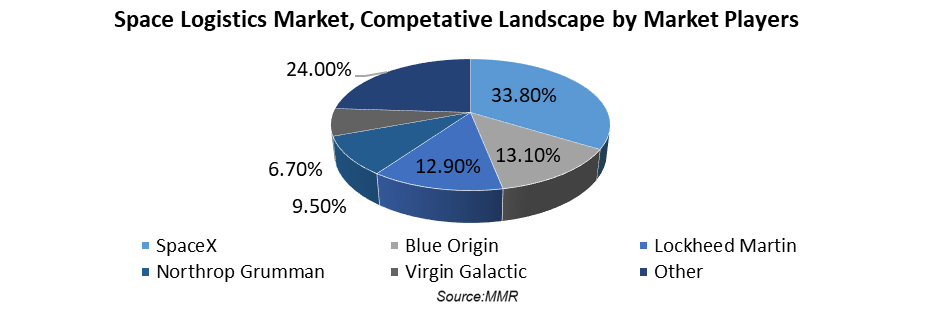
The space logistics market is highly competitive, with a mix of established players and new entrants striving for market share. These companies offer a range of space logistics services, including satellite launches, spacecraft development and manufacturing, and astronaut transportation. They are also investing heavily in research and development to develop new technologies that can improve efficiency and reduce the cost of space missions. For example, SpaceX and Blue Origin are focused on developing reusable rockets and spacecraft to reduce launch costs, while Lockheed Martin is investing in advanced propulsion systems. Other companies, such as Northrop Grumman and Virgin Galactic, are investing in the development of new technologies such as space-based robotics and suborbital space tourism.
SpaceX: SpaceX is a leading player in the space logistics market, with a focus on reducing costs and increasing the efficiency of space transportation. The company has invested heavily in reusable rockets and spacecraft, as well as the development of the Starlink satellite constellation for global internet coverage. In addition, SpaceX has secured contracts with NASA and other government agencies for satellite launches and astronaut transportation. Blue Origin: Blue Origin is another major player in the space logistics market, with a focus on developing reusable rockets and spacecraft for space tourism and other applications. The company has invested in the New Shepard rocket and capsule for suborbital space tourism, as well as the New Glenn rocket for orbital launches.
Lockheed Martin: Lockheed Martin is a leading aerospace and defense company with a strong presence in the space logistics market. The company has developed a range of spacecraft and launch vehicles, including the Orion spacecraft for NASA's Artemis program and the Athena rocket for small satellite launches. Lockheed Martin is also investing in the development of advanced propulsion systems, such as nuclear thermal propulsion. Northrop Grumman: Northrop Grumman is a global aerospace and defense company that offers a range of space logistics services, including satellite manufacturing and launch, as well as spacecraft and mission support. The company is investing in the development of new technologies such as space-based robotics and autonomous systems.
The Virgin Galactic: Virgin Galactic is a space tourism company that is developing reusable spacecraft for suborbital space tourism. The company has invested in the development of the SpaceShipTwo spacecraft and is currently testing its commercial operations. These companies and others are investing heavily in research and development to stay ahead of the competition in the space logistics market and capitalize on the growing demand for space-based activities.
Competitive Landscape:
 Trend:
Small Satellite Launch Innovations Create Lucrative Opportunities for Space Logistics Companies
The space logistics market is an increasing demand for small satellite launches. In recent years, there has been a surge in the number of small satellites being launched into orbit for a variety of applications, such as Earth observation, communications, and scientific research. This has created a new market opportunity for space logistics companies that specialize in small satellite launches, as traditional launch vehicles are often too large and expensive for these types of missions.
To meet this growing demand, space logistics companies are developing new launch vehicles specifically designed for small satellites. For example, Rocket Lab's Electron rocket is a small launch vehicle designed to carry payloads of up to 300 kg into orbit, while SpaceX's Falcon 9 rocket can now launch small satellites as part of its rideshare program. In addition, companies like Virgin Orbit are developing air-launched rockets that provide more flexibility in terms of launch locations and orbital inclinations. The trend towards small satellite launches is expected to continue in the forecast period, driven by advancements in satellite technology and the increasing demand for real-time data and connectivity. This presents a significant growth opportunity for space logistics companies that can develop cost-effective and reliable launch solutions for this market.
Drivers:
Convergence of Technology and Space Logistics Unlocks New Growth Opportunities
The space logistics market is the increased investment from both government and private sector entities. Governments around the world are investing in space exploration and development for a range of purposes, such as scientific research, national security, and economic growth. For example, NASA has a range of programs focused on space exploration and technology development, while the European Space Agency is investing in programs related to Earth observation, climate change, and exploration of the Solar System. At the same time, private sector companies are increasingly investing in space-based activities, such as satellite communications, remote sensing, and space tourism. Companies like SpaceX, Blue Origin, and Virgin Galactic are leading the way in the development of reusable rockets and spacecraft, which are driving down the cost of space transportation and enabling new commercial opportunities.
This increased investment is driving growth in the space logistics market, as companies compete to provide the technology and infrastructure needed to support these activities. Space logistics companies are developing new launch vehicles, spacecraft, and support systems to meet the growing demand for space-based activities. In addition, companies are investing in research and development to develop new technologies that improve efficiency and reduce the cost of space missions. Moreover, the increased investment from both government and private sector entities is a key driver of growth in the space logistics market and is expected to continue in the forecast period as the demand for space-based activities continues to grow.
Space Logistics Market Restraint
High Costs and Technical Challenges Hindering Growth in the Space Logistics Market
Space missions are often complex and require advanced technology and infrastructure, which is expensive to develop and maintain. In addition, the harsh environment of space can pose significant technical challenges, such as radiation, extreme temperatures, and microgravity. As a result, the cost of space missions is prohibitively high, especially for new entrants in the market. This has traditionally limited the number of companies involved in space-based activities to a small group of well-funded players. However, recent advancements in technology, such as reusable rockets and spacecraft, have helped to drive down the cost of space transportation and enable new commercial opportunities.
Technical challenges also remain a significant restraint on growth in the space logistics market. For example, developing spacecraft that withstand the harsh conditions of space and perform their intended functions reliably and safely is a major technical challenge. In addition, the development of space-based infrastructure, such as communication and navigation systems, requires significant investment and expertise. Moreover, the high costs and technical challenges associated with space-based activities are a significant restraint on growth in the space logistics market. While advancements in technology are helping to address some of these challenges, they continue to limit the number of companies that participate in the market and the scale of the activities that are undertaken.
Space Logistics Market Opportunity
Emerging Market for Space Debris Removal Services Creates New Opportunities for Space Logistics Companies
Space debris, such as defunct satellites, spent rocket stages, and other discarded objects, pose a significant risk to active spacecraft and satellites in orbit. The growing accumulation of space debris in low Earth orbit is becoming a serious concern for the long-term sustainability of space-based activities. As a result, there is a growing demand for space debris removal services to help mitigate this risk. Space logistics companies are developing new technologies and strategies to capture and remove space debris from orbit. For instance, companies like Astroscale and ClearSpace are developing spacecraft equipped with robotic arms and nets to capture and remove debris.
This presents a significant growth opportunity for space logistics companies that can develop cost-effective and reliable space debris removal solutions. The demand for these services is expected to grow in the forecast period as the amount of space debris continues to increase, and as regulations and standards for debris, mitigation becomes more stringent. In addition, space debris removal services provide additional revenue streams for space logistics companies that are already involved in other space-based activities, such as satellite launches and servicing. Moreover, the growing demand for space debris removal presents an opportunity for space logistics companies to develop new capabilities and services, and to contribute to the long-term sustainability of space-based activities.
Space Logistics Market Segment Analysis:
Based on Operation, the Space Situational Awareness (SSA) segment has been the dominant segment of the Space Logistics Market and is expected to continue its dominance during the forecast period. Space Situational Awareness (SSA) involves the tracking and monitoring of objects in space, including active satellites, debris, and other objects that pose a risk to spacecraft. With the growing number of objects in orbit, the need for SSA capabilities has become increasingly important for ensuring the safety and efficiency of space operations. The SSA segment of the space logistics market includes a range of services and solutions, including space surveillance and tracking, collision avoidance, and space weather monitoring. As the demand for these services continues to grow, driven by the increasing number of satellites and other objects in space, the SSA segment is expected to remain the dominant segment of the space logistics market.
Based on the Payloads, the Spacecraft and Satellites Systems segment is a significant segment of the space logistics market that deals with the design, manufacturing, and maintenance of spacecraft and satellites. This segment includes a wide range of products and services, including launch vehicles, satellite systems, and communication systems. The demand for satellite-based services has been growing rapidly in recent years, driven by various factors such as the increasing need for data connectivity, remote sensing, and global positioning services.
As a result, the demand for spacecraft and satellite systems has also been on the rise, and this trend is expected to continue during the forecast period. Therefore, it's possible that the Spacecraft and Satellites Systems segment continue to dominate the space logistics market in the forecast period. However, it's important to keep in mind that other segments such as Space Situational Awareness and Space Launch Services also see significant growth and competition in the market.
Space Logistics Market Regional Insights:
North America is the dominant region in the space logistics market, accounting for around 42% of the market share in 2024. The region's strong position is attributed to the presence of major space agencies and private players, such as NASA, SpaceX, and Blue Origin, who are investing heavily in space exploration and commercial space activities. The region is expected to maintain its dominance during the forecast period.
Europe is also a significant player in the space logistics market, with a market share of around 30% in 2024. The region has a strong presence in the commercial space sector, with companies such as Airbus, ArianeGroup, and OHB SE leading the way. Additionally, the European Space Agency (ESA) has been actively involved in space exploration and scientific missions, contributing to the region's growth in the space logistics market. Europe is expected to maintain its position as a major player in the market during the forecast period.
The Asia Pacific region is one of the fastest-growing markets in the space logistics industry, with a market share of around 20% in 2024. The region's growth can be attributed to the increasing investments in space exploration and commercial space activities by countries such as China, India, and Japan. The region also has a growing private space industry, with companies such as SpaceX and Blue Origin growing their presence in the region. Asia Pacific is expected to see significant growth in the space logistics market during the forecast period.
The Middle East and Africa region is a relatively small player in the space logistics market, with a market share of around 3% in 2024. However, the region has been investing in space technology and exploration in recent years, with countries such as the United Arab Emirates (UAE) launching their first mission to Mars in . The region is expected to see modest growth in the space logistics market during the forecast period.
South America is also a small player in the space logistics market, with a market share of around 5% in 2024. However, the region has been investing in space technology and exploration, with countries such as Brazil and Argentina developing their own satellite systems and launching vehicles. The region is expected to see moderate growth in the space logistics market during the forecast period.
Space Logistics Market Scope: Inquiry Before Buying
| Space Logistics Market | |||
|---|---|---|---|
| Report Coverage | Details | ||
| Base Year: | 2024 | Forecast Period: | 2025-2032 |
| Historical Data: | 2019 to 2024 | Market Size in 2024: | USD 6.29 Bn. |
| Forecast Period 2025 to 2032 CAGR: | 18.3% | Market Size in 2032: | USD 24.15 Bn. |
| Segments Covered: | by Operation | Space situational awareness Space Exploration Active debris removal On-orbit servicing assembly and manufacturing Last mile logistics |
|
| by Payloads | Spacecraft and Satellites Systems Cargo and Material Others |
||
Space Logistics Market by Region
North America (United States, Canada, and Mexico)
Europe (UK, France, Germany, Italy, Spain, Sweden, Austria, and the Rest of Europe)
Asia Pacific (China, South Korea, Japan, India, Australia, Indonesia, Malaysia, Vietnam, Taiwan, Bangladesh, Pakistan, and the Rest of APAC)
Middle East and Africa (South Africa, GCC, Egypt, Nigeria, and the Rest of ME&A)
South America (Brazil, Argentina Rest of South America)
Space Logistics Market Key Players
1.Boeing
2.Lockheed Martin
3.Airbus Defense and Space
4. Northrop Grumman
5.Orbital ATK
6.Space Exploration Technologies (SpaceX)
7. Blue Origin
8.Sierra Nevada Corporation
9.Thales Alenia Space
10. Mitsubishi Heavy Industries
11.Honeywell International
12.Dynetics
13.Virgin Galactic
14.Rocket Lab
15.RUAG Space
16.Arianespace
17. NanoRacks
18.Bigelow Aerospace
19.Astrobotic Technology
20. Firefly Aerospace
Frequently Asked Questions:
1] What segments are covered in the Global Space Logistics Market report?
Ans. The segments covered in the Space Logistics Market report are based on Operation, Payloads, and Region.
2] Which region is expected to hold the highest share in the Global Space Logistics Market?
Ans. The North America region is expected to hold the highest share of the Space Logistics Market.
3] What is the market size of the Global Space Logistics Market by 2032?
Ans. The market size of the Space Logistics Market by 2032 is expected to reach USD 24.15 Bn.
4] What is the forecast period for the Global Space Logistics Market?
Ans. The forecast period for the Space Logistics Market is 2025-2032.
5] What was the Global Space Logistics Market size in 2024?
Ans: The Global Space Logistics Market size was USD 6.29 Billion in 2024.