
Snowblower Market - Industry Structure Evaluation, Demand Drivers Analysis, Regional Growth Analysis and Identification, Competitive Positioning / Landscape Review & Global Market Size Forecast to 2032
Overview
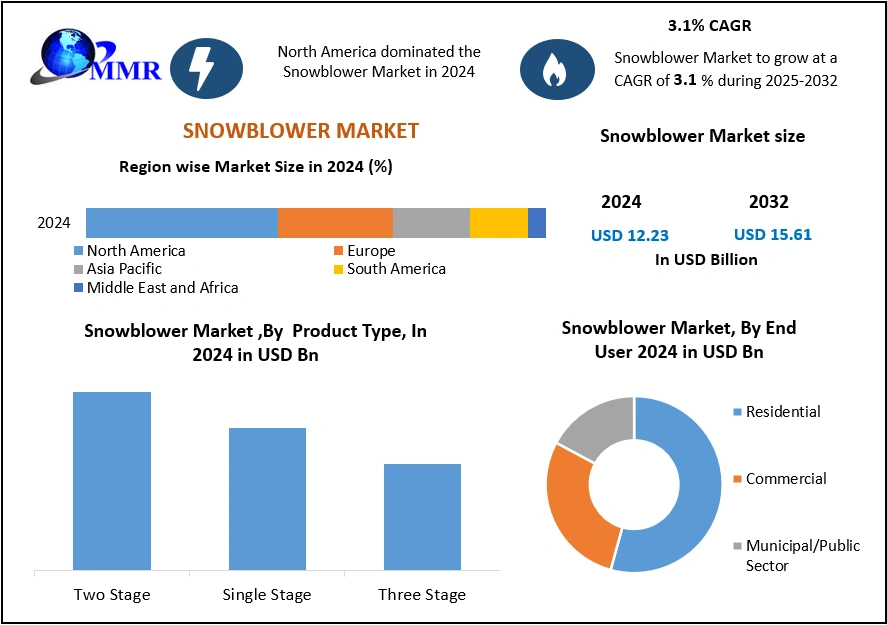
The Snowblower Market size was valued at USD 12.23 Billion in 2024, and the total revenue is expected to grow at CAGR of 3.1 % from 2025 to 2032, reaching nearly USD 15.61 Billion.
The MMR report on the global snowblower market provides a detalied analysis covering climate sensitivity and snowfall volatility impacts, production dynamics, demand patterns, buyer behavior, pricing and margin trends, rental and service-based business models, competitive positioning, aftermarket revenues, substitution threats, and technology innovation. The report evaluates global and regional production volumes, product and power-source splits, manufacturing cost structures, and capacity utilization. It further examines demand by end use, seasonal variability, procurement behavior, pricing drivers, trade flows, supply chain structures, investment and capacity expansion strategies, sustainability transitions, and regulatory frameworks, delivering an integrated view of market performance, risks, and strategic opportunities.
Snowblower Market Overview:
The snowblower market is a vital segment within the outdoor power equipment industry, driven by the need for efficient snow removal solutions in regions prone to heavy snowfall. Snowblowers have various types, including single-stage, two-stage, and three-stage, each offering different power and snow-throwing capabilities. One significant opportunity in the snowblower market is the growing emphasis on environmentally friendly and quieter snow removal solutions. Electric snowblowers, which produce zero emissions and less noise compared to traditional gas-powered models, are gaining traction. As environmental concerns rise, and more communities implement noise regulations, electric snowblowers present a compelling opportunity to cater to environmentally-conscious consumers and urban areas. Electric snowblowers have gained popularity due to their eco-friendly nature and quieter operation. Manufacturers have been focusing on improving battery technology to extend runtime and power for electric models.
 To know about the Research Methodology :- Request Free Sample Report
Snowblower Market Dynamics:
Climate and Weather Conditions to Boost the Snowblower Market Growth
Harsh winters and heavy snowfall are primary drivers for the snowblower market. Regions that experience consistent snowfall and icy conditions have a higher demand for snow removal equipment. As extreme weather events become more frequent due to climate change, the need for efficient snow-clearing equipment like snowblowers becomes essential. Increasing urbanization leads to higher population density in cities and towns, resulting in a greater need for clear and safe roadways, driveways, and sidewalks. Municipalities, commercial establishments, and residential areas require effective snow removal equipment to ensure smooth transportation and prevent accidents. Snowblowers offer a faster and more efficient way to clear snow compared to traditional shoveling methods. As people's lifestyles become busier and time becomes more valuable, the demand for equipment that can expedite snow removal and reduce manual labor drives the market. Advancements in snowblower technology contribute to the market's growth.
These include features like electric start systems, self-propelled models, heated handles, adjustable chute controls, and improved snow-throwing capabilities. Technological innovations enhance user convenience, efficiency, and overall performance, driving demand for upgraded models. The snowblower market experiences seasonal demand, peaking during the colder months. As winter approaches, consumers and businesses begin to prepare for potential snowfall, leading to increased purchases of snow removal equipment. Consumers are increasingly opting for convenient solutions to snow removal. Snowblowers, whether gas-powered or electric, offer an easier and less physically demanding alternative to shoveling. Consumer preferences for convenience and ease of use drive the demand for snowblowers, especially among the aging population.
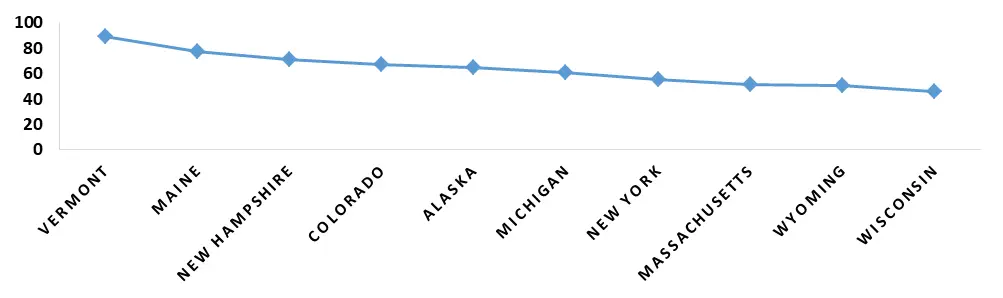
U.S. Average Snow per State (inches)
Dependency on Weather Conditions to Restraint the Snowblower Market Growth
The snowblower market heavily relies on the occurrence of snowfall, especially in regions with consistent winter weather. When snowfall is minimal or irregular, consumers may delay or forgo purchasing snowblowers, affecting manufacturers' revenue streams. This dependency makes the market inherently susceptible to fluctuations in climate patterns, which can impact both short-term and long-term business strategies. The snowblower market experiences pronounced seasonal demand spikes during winter months when snowfall is anticipated. However, this seasonality can lead to operational challenges for manufacturers, including production planning, inventory management, and workforce scheduling. Manufacturers must manage supply chains and resources efficiently to meet peak demand while avoiding excess inventory during off-peak seasons.
The restraint's impact is not uniform across all regions. Areas with consistent and heavy snowfall may experience fewer challenges related to weather dependency compared to regions with more variable winter weather conditions. Consequently, manufacturers operating in regions with unpredictable snowfall patterns may face greater uncertainty and risk. The dependence on weather-driven demand can make it challenging for manufacturers and retailers to maintain consistent revenue streams throughout the year. This dynamic can impact business sustainability, making it difficult to predict financial performance and allocate resources effectively. Manufacturers may need to diversify their product offerings or explore other revenue sources during non-peak seasons to mitigate the impact of this restraint.
Opportunity in the Global Snowblower Market:
The increasing emphasis on sustainability and environmental consciousness presents a significant opportunity for electric snow blowers. Consumers are seeking eco-friendly alternatives that produce fewer emissions and less noise. Manufacturers can develop and market electric models that offer the same performance as traditional gas-powered snow blowers while catering to environmentally-conscious consumers. Integrating advanced technologies and smart features into snow blowers can enhance user experience and convenience. Manufacturers can explore options such as Bluetooth connectivity, mobile apps for remote control, and real-time monitoring. These features appeal to tech-savvy consumers and improve the overall efficiency of snow removal. Hybrid models that combine both gas and electric power sources offer versatility and flexibility.
They allow users to switch between power modes based on the situation, providing eco-friendly operation for lighter snowfall and increased power for heavy snow. Manufacturers can tap into this opportunity by designing hybrid models that cater to different snow removal needs. Snow blower manufacturers can expand their product offerings to include multi-seasonal utility. For example, convertible models that can be used as lawnmowers during warmer months offer additional value to consumers, making the equipment more versatile and practical throughout the year. Offering snow blower rental services during peak snowfall seasons can be a profitable opportunity. Additionally, subscription models where consumers pay a fee for equipment usage during the winter months can provide consistent revenue streams and accommodate varying consumer needs.
Snowblower Market Segment Analysis:
Based on the Product Type, in 2024, Two-Stage Snowblowers dominated the global Snowblower Market due to their higher power, wider clearing capacity, and ability to handle heavy, wet, and compacted snow, making them the preferred choice for residential users in high-snowfall regions as well as commercial and municipal applications.Single-Stage Snowblowers hold a significant share in urban and light-snow regions, driven by their lower cost, compact design, ease of use, and suitability for small driveways and sidewalks. Three-Stage Snowblowers represent a niche but growing segment, primarily adopted by municipalities, contractors, and large commercial users, as their advanced auger–accelerator systems deliver superior performance in extreme snow conditions, ice buildup, and deep drifts. While two-stage models lead overall market value, single-stage units contribute strongly to volume sales, and three-stage models command premium pricing, supporting higher margins within the Snowblower Market.
Based on the End User, in 2024, the Residential segment dominates the global Snowblower Market, driven by high ownership levels in snow-prone regions, frequent household driveway and sidewalk clearing needs, and rising adoption of compact electric and cordless models for personal use. The Commercial segment follows, supported by demand from property management firms, retail complexes, airports, and private contractors requiring reliable, higher-capacity equipment for routine snow removal. The Municipal/Public Sector segment contributes a comparatively smaller share but remains strategically important, driven by government procurement for road maintenance, public spaces, and emergency snow management, with a strong preference for heavy-duty, high-capacity snowblowers and fleet-based purchases.
Snowblower Market Regional Insights:
North America is one of the largest and most established markets for snowblowers due to its diverse climate and significant snowfall. Regions in the northern United States and Canada experience heavy snowfall during winter, driving consistent demand for snow removal equipment. Both residential users and commercial entities rely on snowblowers to clear driveways, sidewalks, parking lots, and pathways. Gas-powered snowblowers, especially two-stage and three-stage models, are popular due to their ability to handle heavy snow accumulation. Additionally, the rise of electric snowblowers caters to environmentally-conscious consumers seeking quieter and eco-friendly options.
European markets vary based on geographical location. Countries with colder climates such as Sweden, Finland, and Russia experience heavy snowfall and rely on snowblowers for efficient snow removal. In contrast, countries with milder climates such as the United Kingdom and parts of Western Europe have limited snowfall and a smaller market for snowblowers. Europe's emphasis on sustainability and environmental awareness has led to an increasing demand for electric and hybrid snowblower models. The continent's historical sites, ski resorts, and urban areas with snowfall contribute to both residential and commercial snowblower usage.
Asia-Pacific's snowblower market is relatively smaller compared to North America and Europe due to milder climates in many regions. Countries like Japan and South Korea experience snowfall, especially in mountainous areas, leading to demand for snow removal equipment. China's growing middle class and interest in outdoor activities contribute to a nascent snowblower market. Australia and New Zealand attract snow enthusiasts during their respective winter seasons, but snowblower usage is limited. Urbanization and changing preferences in countries like China and Japan are driving demand for electric and more compact snowblower models.
Snowblower Market Competitive Landscape:
Prominent global manufacturers, including brands such as Husqvarna Group, Toro Company, MTD Products, and Ariens Company, play a significant role in the snowblower market. These manufacturers offer a diverse range of snowblowers with various features, power sources, and capabilities to cater to different customer segments. They benefit from established brand recognition, extensive distribution networks, and economies of scale. Numerous regional and niche players also contribute to the competitive landscape. These players may focus on specific geographical regions or cater to niche markets with unique snow removal needs. They often emphasize customization, specialization, and responsiveness to local demands. This segment includes companies such as Cub Cadet (United States), Briggs & Stratton (United States), and Honda Power Equipment (Japan). Large retail chains and e-commerce platforms, such as The Home Depot, Lowe's, and Amazon, contribute to the competitive landscape by offering a wide range of snowblower brands and models to consumers. They provide convenience and comparison options, catering to both residential and commercial customers.
Snowblower Market Scope:Inquire Before Buying
| Global Snowblower Market | |||
|---|---|---|---|
| Report Coverage | Details | ||
| Base Year: | 2024 | Forecast Period: | 2025-2032 |
| Historical Data: | 2019 to 2024 | Market Size in 2024: | USD 12.23 Bn. |
| Forecast Period 2025 to 2032 CAGR: | 3.1% | Market Size in 2032: | USD 15.61 Bn. |
| Segments Covered: | by Product Type | Single Stage Two Stage Three Stage |
|
| by Power Source | Gas-Powered Electric (Corded) Electric (Cordless / Battery-Powered) |
||
| by Clearing Width | Up To 24 Inches 25–36 Inches Above 36 Inches |
||
| by Propulsion Type | Push-Type Self-Propelled |
||
| by End Use | Residential Commercial Municipal/Public Sector |
||
| by Distribution Channel | Offline Home Improvement Stores Dealer Networks Online Brand Websites E-commerce Platforms |
||
Snowblower Market, by Region
North America (United States, Canada and Mexico)
Europe (UK, France, Germany, Italy, Spain, Sweden, Austria and the Rest of Europe)
Asia Pacific (China, South Korea, Japan, India, Australia, Indonesia, Malaysia, Vietnam, Taiwan, Bangladesh, Pakistan and the Rest of APAC)
South America (Brazil, Argentina Rest of South America)
Middle East & Africa (South Africa, GCC, Egypt, Nigeria and the Rest of ME&A)
Snowblower Market, Key Players
1. The Toro Company
2. Ariens Company (AriensCo)
3. Husqvarna Group
4. Stanley Black & Decker Outdoor
5. Honda Power Equipment
6. Briggs & Stratton Corporation
7. STIGA Group
8. John Deere
9. Snow Joe LLC
10. Greenworks Tools
11. EGO Power+
12. Snapper Inc.
13. WADO Co., Ltd.
14. PowerSmart USA
15. Ryobi Limited
16. Yard Force
17. Champion Power Equipment
18. Boschung Group (Marcel Boschung)
19. Aebi Schmidt Group
20. Kubota Corporation
21. Yanmar Holdings Co., Ltd.
22. Zhejiang Dobest Power Tools Co., Ltd.
23. RPM Tech
24. Weima Agricultural Machinery
25. Daewoo Power Products
26. Troy-Bilt
27. Cub Cadet
28. M-B Companies
29. Murray
30. KAHLBACHER MACHINERY GMBH
31. Others
Frequently Asked Questions:
1] What segments are covered in the Snowblower Market report?
Ans. The segments covered in the Snowblower Market report are based on Product Type, Power Source, Clearing Width, Propulsion Type, End Use, Distribution Channel and region
2] Which region is expected to hold the highest share of the Snowblower Market?
Ans. The North America region is expected to hold the highest share of the Snowblower Market.
3] What is the market size of the Snowblower Market by 2032?
Ans. The market size of the Snowblower Market by 2032 is USD 15.61 Bn.
4] What is the growth rate of the Snowblower Market?
Ans. The Global Snowblower Market is growing at a CAGR of 3.1% during the forecasting period 2025-2032.
5] What was the market size of the Snowblower Market in 2024?
Ans. The market size of the Snowblower Market in 2024 was USD 12.23 Bn.