
Smart Grid Market – Industry Structure Evaluation, Demand Drivers Analysis, Regional Growth Analysis and Identification, Competitive Positioning Review & Global Market Size Forecast to 2032
Overview
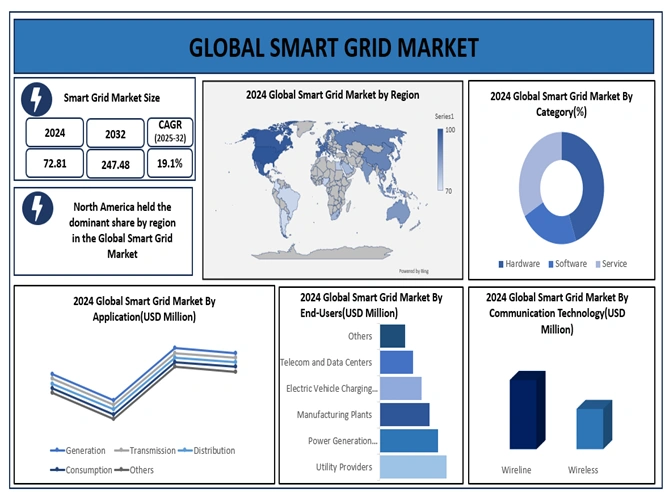
The global Smart Grid Market size was valued at USD 72.81 Mn. in 2024 and the total Smart Grid revenue is expected to grow by 19.1% from 2025 to 2032, reaching nearly USD 247.48 Mn.
Smart Grid Market Overview:
A smart grid is a cutting-edge electricity network that uses digital technology as well as two-way communication to improve the reliability, efficiency, and sustainability of electricity distribution. It stretches beyond the traditional one-way flow of power to allow real-time controlling, monitoring, and management of distribution, electricity production, and transmission. The market is progressively witnessing a rising development owing to increasing emphasis on modernisation of infrastructure to meet the increasing energy demands, integrate renewable sources, and boost grid resilience. In contrast to traditional grids, smart grids use advanced metering infrastructure (AMI), bidirectional communication, and real-time data analytics to allow outage discovery, dynamic load balancing, as well as demand-side management.
 To know about the Research Methodology :- Request Free Sample Report
Report Scope:
The MMR report scope of this Smart Grid Market report provides a comprehensive analysis from 2019 to 2032. It covers market size, competitive landscape, and dynamics, including drivers and challenges. The report examines investment trends, pricing, and regulatory frameworks. It also delves into technological innovations like AI and IoT, supply chain logistics, and adoption patterns across key countries, analyzing influencing factors such as government policies and the demand for reliable and efficient electricity.
The MMR market report utilized a comprehensive research methodology to analyze the Smart Grid Market, estimate market size, and validate findings through both secondary and primary research approaches. The secondary research process began with an extensive review of existing literature, industry reports, and databases to gather relevant data on market trends, competitor analysis, and consumer behavior. Various sources, such as company SEC filings, industry publications, government databases, and paid sources, were utilized to ensure a robust understanding of the market landscape. information gathered from secondary sources underwent rigorous scrutiny to verify its credibility and relevance to the study objectives.
The competitive landscape of the global smart grid market provides a detailed overview of the leading players, their market positioning, and strategic initiatives such as mergers & acquisitions, partnerships, and technological innovations. It highlights how companies compete in areas like advanced metering infrastructure (AMI), grid automation, energy storage integration, and renewable energy management. The landscape also showcases differentiation based on digital platforms, AI- and IoT-enabled grid solutions, and regional expansion strategies. By analyzing market share, product portfolios, and R&D focus, the competitive landscape enables stakeholders to understand the intensity of competition, identify innovation leaders, and evaluate collaboration opportunities to strengthen their presence in the rapidly evolving smart grid ecosystem. Some of the leading key players in the global Smart Grid market include ABB, Schneider Electric, Siemens, GE Vernova (GE Grid Solutions), Eaton, Hitachi Energy, Mitsubishi Electric,Others.
Global Smart Grid Market Dynamics:
Increasing Demand for Energy Efficiency to boost the Smart Grid Market Growth
The rising number of consumers shifting their focus towards the reduction of energy waste, increased sustainability, and lowering of expenses is anticipated to act as a significant role in favoring the market progression. This is attributable to smart grids’ capability to do real-time monitoring of energy consumption, which results in increased energy efficiency and decreased overall expenses. energy-efficient grid operations assist in reducing greenhouse gas emissions to help align with national as well as international energy efficiency goals. The rising consciousness among consumers towards smart grid capabilities on automated energy control and load management is anticipated to have a positive impact on fueling the product demand.
Modernization of Aging Power Infrastructure to Drive the Market Progression
Countries around the world are increasingly shifting their focus towards modernization of power grid to replace outdated systems which are progressively becoming incompetent, unreliable, and vulnerable to failures. Such a shift towards the enhancement of the power grid system is anticipated to play a positive role in favoring Smart Grid market development. The rising decentralized energy generation and electric vehicle adoption propel increased investment towards reliable and efficient smart grid systems. In addition, this rising need to alter and future-proof critical infrastructure is favoring large-scale spending in smart grid systems in developed as well as emerging markets.
Increasing Integration of Renewable Energy Sources to Open Growth Opportunities in the Smart Grid Market
The growing integration of renewable energy sources such as solar, wind, and hydropower presents a major opportunity for the global smart grid market. As governments and utilities worldwide push for decarbonization and sustainable energy transitions, smart grids play a crucial role in balancing variable power generation and ensuring grid stability. Advanced features like real-time monitoring, demand response, and distributed energy resource management systems (DERMS) enable utilities to efficiently manage intermittent renewable power. This not only reduces dependency on fossil fuels but also opens avenues for investment in grid modernization, digital platforms, and energy storage technologies. As a result, the demand for smart grid solutions is expected to accelerate, creating long-term growth opportunities for technology providers and energy companies.
Global Smart Grid Market Segment Analysis
On the basis of category, the market is fragmented into software, hardware, and service. The Hardware Segment is expected to dominate the Smart Grid Market during the forecast period. hardware products such as sensors, smart meters, communication infrastructure, and control systems are gaining massive traction. This is attributable to hardware components' capability to form the backbone of smart grid architecture, allowing real-time monitoring, automation, and two-way communication between Communication Technology and utilities. In contrast, the software and services segments are also witnessing a gradual rise owing to the increasing investments among countries around the world towards the enhancement of their grid system. This is likely to be fuelled by the growing emphasis on owning efficient grid management platforms, data analytics, and cybersecurity to increase productivity.
Based on application, the market is subdivided into generation, transmission, consumption, and others. The distribution segment held the largest market share in 2024, and is expected to hold the largest Smart Grid Market share over the forecast period. the significant role of smart distribution systems, which allow voltage regulation, automated fault detection, real-time monitoring, and load balancing at the grid edge. non-distribution segments of the Smart Grid market are also progressively observing growth owing to technological advancements and evolving energy demands. the increasing inclination towards consumer-driven energy efficiency, renewable adoption, and grid stability is likely to play a significant role in favoring the demand for non-distribution segments.
Smart Grid Market Regional Insights:
North America held the largest Market share in the global smart grid market. This is anticipated to be fuelled by the distinctive combination of cutting-edge infrastructure, strong technology presence, and an aggressive push toward energy efficiency. Likewise, the region’s priority shifting towards lowering carbon emissions and improving energy security in line with the goals of smart grid deployment is expected to have a significant contribution to the market progression. The robust presence of a large number of smart grid solution providers in North America, who put emphasis on meeting the specifics of power grid systems of this region, is expected to have a significant impact on the high adoption of smart grid solutions.
Asia Pacific is anticipated to hold a significant share of the smart grid market. This is attributable to the escalating growth of industrialization and urbanization in this region, which is leading to fuel the need to improve power grid systems to increase efficiency. Moreover, the increasing adoption of solar and wind power to increase energy generation through renewable sources is expected to open a positive path for market development. Additionally, the rising inclination to increase safety and security on power grids to reduce equipment failure and increase the safety and well-being of workers is expected to drive the smart grid market.
Smart Grid Market Recent Development
In October 2024, Schneider Electric announced the launch of its new smart grid solutions at Enlit Europe. These next-generation smart grid solutions come with the ability to enhance flexibility, grid resiliency, and also support net-zero goals. The key innovations comprise virtual substations, DERMS deployment, wildfire/storm mitigation tools, Net Zero dashboards, and AI-driven grid analytics—helping utilities integrate renewables, boost reliability, and efficiently manage distributed energy resources across dynamic, weather-impacted energy landscapes.
In March 2022, Analog Devices and Gridspertise collaborated to advance smart grid resiliency and electrification across the world. This collaboration allows the production of new hardware and software that provide distribution grid self-healing and adaptation in reaction to the crucial changes in energy supply and demand as eco-friendly energy sources are brought online.
Smart Grid Market Recent Trends
| Category | Key Trend | Market Impact |
| Advanced Metering | Smart meters and AMI adoption | Improves energy efficiency, enables real-time monitoring, and reduces losses |
| Grid Automation | Distribution automation | Enhances reliability, reduces outages, and optimizes grid operations |
| Renewable Integration | Integration of solar and wind energy | Supports decarbonization and improves renewable energy management |
| Demand Response | Consumer-driven demand response programs | Reduces peak load and enhances grid stability |
| Energy Storage | Deployment of battery and storage systems | Enables load balancing, renewable integration, and energy resilience |
| Digitalization | IoT, AI, and cloud-based grid management | Improves predictive maintenance, operational efficiency, and fault detection |
| Cybersecurity | Enhanced grid security | Protects critical infrastructure against cyber threats |
| EV Integration | Electric vehicle charging infrastructure | Supports EV adoption and manages grid load during charging |
Smart Grid Industry Ecosystem
Smart Grid Market Scope: Inquire before buying
| Global Smart Grid Market | |||
|---|---|---|---|
| Report Coverage | Details | ||
| Base Year: | 2024 | Forecast Period: | 2025-2032 |
| Historical Data: | 2019 to 2024 | Market Size in 2024: | USD 72.81 Mn. |
| Forecast Period 2025 to 2032 CAGR: | 19.1% | Market Size in 2032: | USD 247.48 Mn. |
| Segments Covered: | by Technology |
Software
Advancement Distribution Management System
Energy Management System (EMS)
Meter Data Management System
SCADA Systems
Smart Grid Security
Others
Hardware
Smart Meters
Sensors
Programmable Logic Controller (PLC)
Others
Services
Consulting
Deployment and Integration
Support and Maintenance
Others
|
|
| by Application | Generation Transmission Distribution Consumption Others |
||
| by End Users | Utility Providers Power Generation Companies Manufacturing Plants Electric Vehicle Charging Infrastructure Providers Telecom and Data Centers Others |
||
| by Communication Technology | Wireline Wireless |
||
Smart Grid Market, by Region
North America (United States, Canada and Mexico)
Europe (UK, France, Germany, Italy, Spain, Sweden, Austria and Rest of Europe)
Asia Pacific (China, South Korea, Japan, India, Australia, Indonesia, Malaysia, Vietnam, Taiwan, Bangladesh, Pakistan and Rest of APAC)
Middle East and Africa (South Africa, GCC, Egypt, Nigeria and Rest of ME&A)
South America (Brazil, Argentina Rest of South America)
Smart Grid Market, Key Players
1. ABB
2. Schneider Electric
3. Siemens
4. GE Vernova (GE Grid Solutions)
5. Eaton
6. Hitachi Energy
7. Mitsubishi Electric
8. Toshiba Energy Systems
9. Alstom Grid
10. Schweitzer Engineering Laboratories (SEL)
11. Itron
12. Landis+Gyr
13. Sensus (Xylem Inc.)
14. Aclara (Hubbell)
15. Kamstrup
16. Elster (Honeywell)
17. EDMI (Osaki Electric)
18. Hexing Electrical
19. ZIV Automation
20. Iskraemeco
21. Enphase Energy
22. SolarEdge Technologies
23. Sonnen (Shell Group)
24. Tesla Energy
25. AutoGrid Systems
26. Sunverge Energy
27. Enbala (Generac)
28. NextEra Energy Resources
29. Fluence Energy (Siemens & AES JV)
30. Stem Inc.
Frequently Asked Questions:
1. Which region has the largest share in the Global Smart Grid Market?
Ans: The North America region held the highest share in 2024.
2. What is the growth rate of the Global Smart Grid Market?
Ans: The Global Market is expected to grow at a CAGR of 19.1% during the forecast period 2025-2032.
3. What is the scope of the Global Smart Grid Market report?
Ans: The Global Smart Grid Market report helps with the PESTEL, PORTER, Recommendations for Investors & Leaders, and market estimation of the forecast period.
4. Who are the key players in the Global Smart Grid market?
Ans: The important key players in the Global Market are – ABB, Schneider Electric, Siemens, GE Vernova (GE Grid Solutions), Eaton, Hitachi Energy, Mitsubishi Electric, and Others
5. What is the study period of this Global Smart Grid market?
Ans: The Global Smart Grid Market is studied from 2024 to 2032.