
Short Range Air Defense System Market Size – Industry Structure Evaluation, Demand Drivers Analysis, Regional Growth Analysis and Identification, Competitive Positioning Review & Global Market Size Forecast to 2032
Overview
Global Short Range Air Defense System Market size was valued at USD 18.11 Billion in 2025 and the total Short Range Air Defense System revenue is expected to grow at a CAGR of 5.4% from 2026 to 2032, reaching nearly USD 26.17 Billion.
Short Range Air Defense System Market Overview:
Short Range Air Defense system market refers to the defense systems designed to protect military forces and assets from low-altitude aerial threats such as aircraft, helicopters, drones, and missiles within a range of up to 10 Km. Short range air defense plays a critical role in modern warfare, and asymmetrical conflicts, where conventional air defense may not be sufficient to counter emerging aerial threats.
The market is expected to show steady growth in the forecast period, and demand for short range air defense systems is expected to drive the market. Also, the factors such as terrorism, border conflicts, and the demand for UAVs are the major drivers for the short range air system market. The market is dominated by some major players, including Lockheed Martin, Raytheon Technologies, Thales Group, Rheinmetall AG, etc. These companies are continuously investing in R&D to develop and enhance technologies, such as radar-guided systems, electro-optical and infrared, and jamming technologies.
North America holds the largest share of the market due to the significant investment made by the US military in developing advanced Short Range Air Defense Systems.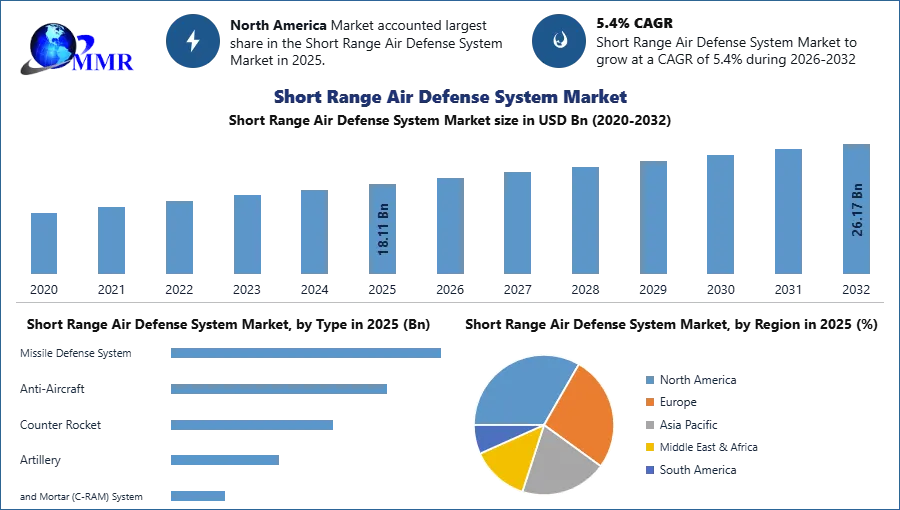 To know about the Research Methodology :- Request Free Sample Report
Key Benefits of Short Range Air Defense System Market Report:
The report delves into the effects of the pandemic on the market, including both short-term and long-term impacts. It provides vital information for companies to prepare strategies on both regional and global levels.
The market Report is a comprehensive analysis that includes market drivers, restraints, opportunities, regional analysis, and competitive landscape. These factors play a crucial role in influencing growth during the forecast period.
The market analysis was conducted using analytical tools, such as SWOT analysis, Porter's Five Forces analysis, and PESTEL analysis, which provide a 360-degree visual and numerical aspect of the market.
The report offers both qualitative and quantitative analysis of the market. It provides insights that help marketers, management authorities, CEOs, and investors to make informed decisions regarding future product launches, technology upgrades, market expansion, marketing tactics, and investment planning.
Also to analyze the regional market and how it works, the report gives an overview of the supply chain, retailers, and market key players.
The report of MMR includes profiles for all top market players with their mergers and acquisition which provide in-depth knowledge of the market and help in decision making.
Short Range Air Defense System Market Dynamics:
Short Range Air Defense System Market Drivers:
The increasing global threat of terrorism and asymmetric warfare is expected to create a demand for the short range air defense system industry to protect military assets from low-altitude aerial threats. The rise in tensions among several countries, such as India-China, India-Pakistan, Israel, China-Japan, and Russia-Ukraine has resulted in the development and advancement of aerial defense systems. Market the growing use of unmanned aerial vehicles (UAVs) in the military, driving the need for advanced systems that can detect and intercept these threats, creating demand for the market. Increasing military spending by governments worldwide to upgrade their defense capabilities is also a major driver for the market. The advancement in technology such as radar-guiding, electro-optical, and infrared sensors systems are improving the short range air defense system with more effectiveness and efficiency.
Short Range Air Defense System Market Restraints:
High development and deployment costs of advanced Short Range Air Short Range Air Defense System market are expected to limit their adoption by some countries with their limited budget. The increasing use of stealth technology in UAVs may make them more difficult to detect and intercept with traditional short range air defense systems. The SHORAD is less effective against high-altitude threats as it can go up to 10 km only.
Short Range Air Defense System Market Challenges:
The development of Short Range Air Defense systems that can operate in a variety of terrain and weather conditions is a main challenge for the market players. Ensuring interoperability between different SHORAD systems used by different branches of the military. Maintenance, reliability, and accuracy of short range air defense systems for a prolonged time is a challenge.
Short Range Air Defense System Market Opportunities:
The growing demand for vehicle-mounted and man-portable Short Range Air Defense System market which offer greater mobility and flexibility on the battlefield is predicted to provide new opportunities in the forecasted period. The development of integrated SHORAD systems that can work together with other defense systems creates new opportunities. Also the increasing investment in research and development to develop advanced systems like SHORAD systems.
Short Range Air Defense Systems Market Segment Analysis
Based on Components, In market the Weapon System segment held the largest market share in 2025, playing a pivotal role in countering short-range aerial threats. Weapon systems within this market encompass a diverse range of advanced technologies, including guided missiles and rapid-fire guns, contributing to the robustness of short-range air defense. The dominance of the Weapon System segment is driven by the continuous advancements in missile technology, the integration of directed energy solutions, and the development of rapid-response gun systems.
The market's emphasis on innovative weapon systems reflects a commitment to staying ahead of evolving threats, ensuring effective and agile defense capabilities against close-range aerial challenges. The market, with its focus on cutting-edge weaponry, remains a key player in the broader defense industry.
Recent developments in the Short Range Air Defense System market underscore the integration of sophisticated technologies across Fire Control Systems and Command and Control Systems. Fire Control Systems are witnessing advancements in radar and sensor technologies, enhancing target identification and tracking capabilities. These systems play a crucial role in guiding weapon systems for precise and effective engagements.
Additionally, Command and Control Systems are evolving with real-time data analytics and communication technologies, enabling seamless coordination and rapid response to emerging threats. The market's dedication to enhancing Fire Control and Command and Control Systems reflects a strategic approach to fortifying short-range air defense capabilities. As the Short Range Air Defence System Market continues to evolve, the integration of cutting-edge technologies across these segments positions it as a key player in addressing contemporary security challenges.
By Geography, The market is segmented into North America, Europe, Asia-Pacific, etc. North America is the largest market, driven by the significant investment made by the US military in developing advanced SHORAD systems. Also, Asia-Pacific is expected to witness significant growth in the forecast period, driven by the increasing military spending by countries such as India, China, and South Korea.
Short Range Air Defense System Market Regional Analysis:
The Short Range Air Defense System market can be analyzed regional, with major regions including North America, Europe, Asia-Pacific, and the Rest of the World. Each region has unique characteristics and trends that impact the Short Range Air Defense System industry.
North America is the largest market for Short Range Air Defense Systems, driven by the significant investment by the US military, and the presence of key players in the regional market. The US Army is currently undertaking a major modernization effort to upgrade its short range air defense systems capabilities, such as Maneuver short range air defense (M-SHORAD), and the initial maneuver short range air defense (IM-SHORAD). General Dynamics Land Systems is the lead integrator and received a USD 1.2 billion contract to build and deliver the system In October 2023.
Europe, the Short Range Air Defense System market is driven by the increasing threat from terrorist groups and to protect critical infrastructure, military installations, and bases. Other European countries such as the UK, France, Italy, and Germany are investing in new Short range air defense systems to improve their air defense. The European Defense Fund (EDF) is providing funding for the development and research of advanced technology expected to boost regional market growth within the forecast period.
Asia-Pacific, the Short Range Air Defense System Market is driven by the increasing military spending by countries such as India, China, and South Korea. China heavily investing in its air defense capabilities, with plans to deploy new systems such as the HQ-17AE with a 15 km range of fire and the HQ-22 has a range of up to 170 kilometers (110 mi) and can strike targets at altitudes from 50 meters (160 ft.) to 27 kilometers (17 mi). India is also modernizing its air defense capabilities, with plans to acquire new systems such as the Akash with an operating range of 4.5 Km to 25 Km and operates at 100 m up to 20 km of altitude, and the Spyder with 250 m to 6 Km operational range and with 3,500 m flight altitude.
The market report includes with remaining major regions which expected to contribute the growth of the market. Also, an in-depth analysis of all regions with the appropriate graphics and illustrations is available in the report.
Short Range Air Defense Systems Market Competitive Landscape:
The market is highly competitive, with several key players operating in the market.
Companies are focusing on developing advanced Short Range Air Defense System market that can create situational awareness, to rapid detection and identification, also effective interception of aerial threats. For example, Raytheon and Saab AB did a partnership to develop advanced systems in 2021, this partnership provides expertise in the field such as command systems, control systems, and missile systems.
Companies are heavily investing in research and development to develop advanced technologies, such as directed energy weapons, sensors, and other support systems for advanced technology that can improve the performance and capabilities of SHORAD systems.For Example, Raytheon Company and UTC in 2020 merged to form Raytheon Technologies Corporation. The merger created a leading provider of advanced aerospace and defense technologies.
Companies are undergoing partnerships and collaborations with other market players to develop systems that performed advanced tasks.
For Example, Lockheed Martin and Raytheon formed a joint venture development of a new advanced SHORAD system for the US Army in 2021.
Overall, the market is expected to remain highly competitive in the coming years, with companies focusing on developing advanced systems and technologies that can provide enhanced performance and capabilities to customers.
The Short Range Air Defense System market report of MMR includes profiles for all top market players with their mergers and acquisition which provide in-depth knowledge of the market and help in decision making. With the advent of new and advanced technologies, and heavy investment in R&D has significantly improved, and the market is expected to witness steady growth in the forecast years.
Short Range Air Defense Systems Market Recent Industry Developments (2025–2026)
| Date | Company | Development | Impact |
|---|---|---|---|
| 11 March 2026 | Rheinmetall AG | The company announced a major expansion of its air-defense portfolio to address surging demand for counter-drone (C-UAS) systems in Europe. | The strategic shift aims to capture a projected €1 billion in air-defense sales for 2026, driven by lessons from the Ukraine conflict and increased national defense budgets. |
| 21 November 2025 | RTX (Raytheon) | The Raytheon-Rafael Protection Systems (R2S) joint venture was awarded a $1.25 billion contract to produce Tamir surface-to-air missiles. | This marks the first production contract for the new East Camden, Arkansas facility, significantly boosting the supply of interceptors for the Iron Dome and SkyHunter systems. |
| 09 December 2025 | Leonardo S.p.A. | The company successfully conducted the first qualification launch for the SAMP/T NG system featuring the KRONOS Grand Mobile High Power radar. | The test validated the radar’s ability to track and intercept threats at extended ranges, solidifying its position as a primary component for the Italian Michelangelo Security Dome. |
| 02 April 2025 | Thales Group | Thales and L3Harris Technologies signed an MOU to develop an integrated Short-Range Air Defence (SHORAD) command and control capability. | The collaboration integrates the Target Orientated Tracking System (TOTS) with the Agile C4I @ Edge (ACE) system to accelerate decision-making in complex battlespaces. |
| 25 August 2025 | Lockheed Martin | The company entered the system and platform integration phase for its NGSRI (Next-Generation Short Range Interceptor) design. | This milestone keeps the program on track for FY 2026 operational demonstrations, aiming to replace the legacy FIM-92 Stinger missile in the M-SHORAD program. |
Short Range Air Defense System Market Scope: Inquire before buying
| Short Range Air Defense System Market | |||
|---|---|---|---|
| Report Coverage | Details | ||
| Base Year: | 2025 | Forecast Period: | 2026-2032 |
| Historical Data: | 2020 to 2025 | Market Size in 2025: | 18.11 USD Bn |
| Forecast Period 2026-2032 CAGR: | 5.4% | Market Size in 2032: | 26.17 USD Bn |
| Segments Covered: | by Type | Missile Defense System Anti-Aircraft Counter Rocket, Artillery, and Mortar (C-RAM) System |
|
| by Platform | Land-Based Systems Naval/Ship-Based Systems Airborne Systems Fixed-Site Systems Mobile Ground Platforms |
||
| by Mobility | Man-Portable Air Defense Systems (MANPADS) Vehicle-Mounted Systems Towed Systems Static/Fixed Systems |
||
| by Component | Weapon System Fire Control System Command and Control System Others |
||
| by End User | Military Homeland Security |
||
Short Range Air Defense System Market, by Region
North America (United States, Canada and Mexico)
Europe (UK, France, Germany, Italy, Spain, Sweden, Austria and Rest of Europe)
Asia Pacific (China, South Korea, Japan, India, Australia, Indonesia, Malaysia, Vietnam, Taiwan, Bangladesh, Pakistan and Rest of APAC)
Middle East and Africa (South Africa, GCC, Egypt, Nigeria and Rest of ME&A)
South America (Brazil, Argentina Rest of South America)
Short Range Air Defense System Market key players
- Lockheed Martin Corporation
- Raytheon Technologies (RTX Corporation)
- Thales Group
- Saab AB
- Rheinmetall AG
- MBDA
- Northrop Grumman Corporation
- Leonardo S.p.A.
- BAE Systems
- Israel Aerospace Industries (IAI)
- Elbit Systems Ltd.
- Kongsberg Defence & Aerospace
- Aselsan A.S.
- L3Harris Technologies, Inc.
- The Boeing Company
- General Dynamics Corporation
- Rafael Advanced Defense Systems Ltd.
- Diehl Defence GmbH & Co. KG
- Bharat Electronics Limited (BEL)
- Hanwha Corporation
- Nexter Systems (KNDS)
- Norinco Group
- Hensoldt AG
- Almaz-Antey Air and Space Defence Corporation
- Bharat Dynamics Limited (BDL)