
Scrubber System Market Size – Industry Structure Evaluation, Demand Drivers Analysis, Regional Growth Analysis and Identification, Competitive Positioning Review & Global Market Size Forecast to 2032
Overview
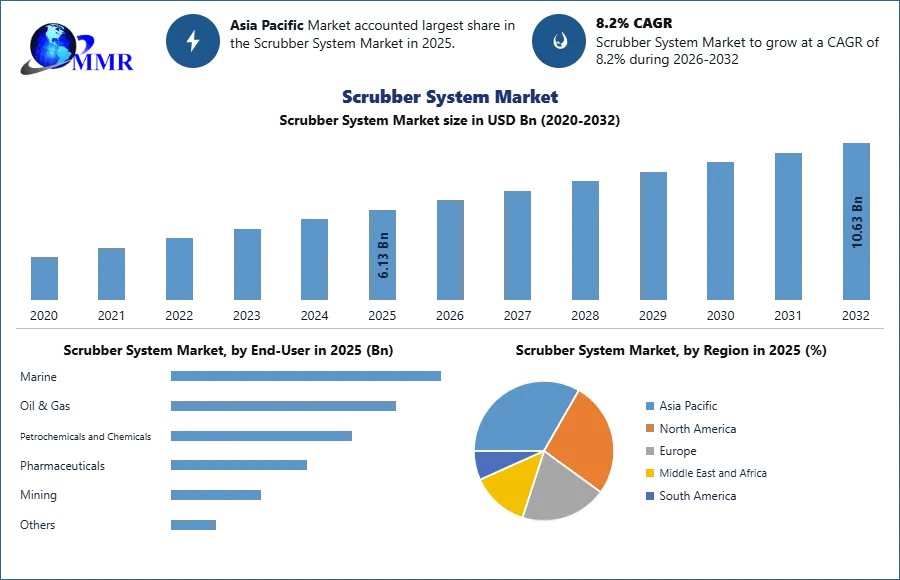
The Scrubber System Market size was valued at USD 6.13 Billion in 2025 and the total Scrubber System revenue is expected to grow at a CAGR of 8.2% from 2026 to 2032, reaching nearly USD 10.63 Billion by 2032.
A scrubber system is a mechanical apparatus designed to eliminate detrimental substances present in industrial exhaust fumes prior to their discharge into the surroundings. Scrubbers are capable of eliminating solid particles, mist, and gases, in addition to facilitating cooling processes. Stringent environmental regulations regarding emissions from industrial activities and the increasing focus on sustainable manufacturing practices driving the growth of scrubber system market. With concerns over air pollution escalating, industries are increasingly investing in scrubber systems to effectively remove harmful substances from their exhaust gases before release into the atmosphere. The Scrubber System Market is expected significant growth across various sectors such as power generation, oil and gas, chemical, and marine.
Rising adoption of scrubbers to comply with emission standards set by regulatory bodies worldwide, coupled with technological advancements enhancing the efficiency and effectiveness of scrubber systems boosting market growth. The growing awareness among industries regarding the environmental and health impacts of air pollutants is boosting the demand for scrubber systems. In recent developments, key market players are focusing on strategic initiatives such as product innovations, mergers and acquisitions, and partnerships to strengthen their market presence and expand their product portfolios. For instance, in 2023, Alfa Laval AB announced the acquisition of certain assets of a leading scrubber manufacturer to strengthen its position in the market. Similarly, Wartsila Corporation introduced a next-generation scrubber system featuring advanced technology for efficient exhaust gas cleaning. These developments underscore the dynamic nature of the scrubber system market and the efforts of key players to address evolving customer demands and regulatory requirements. With the growing emphasis on reducing emissions and promoting sustainable practices, the scrubber system market is expected for rapid growth during forecast period.
To know about the Research Methodology :- Request Free Sample Report
Scrubber System Market Dynamics:
Rising Air Pollution Concerns Driving Scrubber System Market Growth
The implementation of increasingly strict emission standards worldwide, such as the IMO 2020 regulations for sulfur emissions in the maritime industry, has become a significant Scrubber System market growth driver. Industries are now compelled to adopt scrubber systems to ensure compliance and avoid hefty fines. For instance, companies such as Carnival Corporation have invested in scrubber technology for their fleet of cruise ships to meet emission standards and reduce environmental impact. This shift towards cleaner technologies is not just driven by regulatory requirements but also by a growing awareness of the detrimental effects of air pollution on public health.
Cities such as Beijing have implemented measures to combat air pollution, leading industries to install scrubber systems in factories and power plants to curb emissions of pollutants like sulfur dioxide and particulate matter. This growing awareness about the impact of air pollution on public health is pushing industries to deploy scrubber systems to reduce harmful emissions and improve air quality. Furthermore, ongoing advancements in scrubber technology, such as the development of hybrid scrubber systems and innovative filtration techniques, are enhancing the efficiency and effectiveness of pollutant removal, making scrubbers an attractive solution for industries aiming to mitigate their environmental footprint.The rapid industrialization in emerging economies is also contributing to the demand for scrubber systems across various sectors such as power generation, chemical processing, and manufacturing. For example, China's industrial growth has led to increased adoption of scrubber systems in coal-fired power plants to mitigate air pollution and meet stringent emission standards set by the government. The expansion of the global maritime industry, coupled with regulations mandating lower sulfur emissions from ships, is fueling the demand for scrubber systems to enable compliance with emission standards while ensuring uninterrupted operations.
Companies like Maersk Line are investing in scrubber systems for their vessels to comply with IMO regulations and maintain competitiveness in the shipping market. Scrubber systems offer long-term cost savings through reduced fuel consumption and maintenance expenses, making them an attractive investment for industries seeking to improve operational efficiency and reduce environmental impact. By installing scrubber systems on its fleet, companies like the Norwegian ferry operator Fjord Line achieved significant fuel savings and operational cost reductions while complying with emission regulations in environmentally sensitive areas like the Baltic Sea.
Additionally, the growing emphasis on corporate social responsibility and sustainability is driving industries to adopt scrubber systems as part of their commitment to reducing environmental footprint and mitigating climate change. Companies like BP have installed scrubber systems on their offshore platforms to reduce sulfur emissions and minimize environmental impact, aligning with their sustainability goals and contributing to a cleaner energy future.
High initial investment Hinders the Scrubber System Market Growth
The high initial investment costs associated with installing scrubber systems hindering the growth of Scrubber System Market. For instance, Greek shipping company Costamare Inc. hesitated to retrofit scrubbers on its vessels due to concerns over the substantial upfront expenses. This financial barrier can delay adoption decisions and hinder Scrubber System Market growth, particularly for companies operating on tight budgets. The complex maintenance requirements of scrubber systems pose another challenge to market growth. Carnival Corporation, after installing scrubbers on its cruise ships, encountered increased maintenance expenses and operational complexities.
This highlights the ongoing costs and operational challenges associated with maintaining scrubber systems, which can deter some industries from investing in this technology. The limited availability of skilled technicians proficient in scrubber system maintenance exacerbates the maintenance challenges, further impeding market growth. Norwegian Cruise Line Holdings faced difficulties in optimizing scrubber performance across its fleet due to a shortage of skilled technicians, underscoring the need for a trained workforce to support widespread adoption.
Scrubber Systems: Maintenance Needs
| Component | Maintenance Frequency | Maintenance Description | Complexity |
| Scrubber vessel | Quarterly | Internal inspection for corrosion, scaling, and leaks. Cleaning if necessary. | High |
| Spray nozzles | Monthly | Inspection for wear, blockage, and proper alignment. Cleaning or replacement if necessary. | Medium |
| Recirculation pumps | Detroit | Inspection for leaks, vibration, and proper operation. Lubrication and adjustment if necessary. | Medium |
| Demister pads | Biannually | Inspection for clogging and damage. Replacement if necessary. | Medium |
| pH probes | Quarterly | Calibration and verification of accuracy. | Low |
| Control valves | Monthly | Inspection for leaks, proper operation, and wear. Cleaning or repair if necessary. | Medium |
| Instrumentation | Quarterly | Calibration and verification of accuracy. | Low |
| Piping and fittings | Biannually | Inspection for leaks, corrosion, and proper support. Tightening or repair if necessary. | Medium |
| Electrical system | Biannually | Inspection for damage, loose connections, and proper operation. Repair or replacement if necessary. | Medium |
Concerns over the environmental impact of scrubber systems contribute to Scrubber System Market challenges. Environmental groups have raised objections to the use of open-loop scrubber systems, citing potential harm to marine ecosystems from washwater discharge. Regulatory scrutiny and restrictions in certain regions further complicate the adoption of scrubber technology, creating uncertainty for industries investing in emission reduction solutions. These challenges collectively pose obstacles to the widespread adoption and growth of the scrubber system market, requiring innovative solutions and strategic approaches to address them effectively.
Scrubber System Market Segment Analysis:
Based on Type, the wet scrubber segment is the dominanted type in the Scrubber System Market in 2025 due to its high efficiency in removing both particulate matter and harmful gases from industrial exhaust streams. Wet scrubbers operate by introducing a liquid, typically water or a chemical solution, into the contaminated gas stream to capture pollutants such as sulfur oxides (SOx), hydrogen chloride, ammonia, and dust particles. This technology is widely adopted in industries such as power generation, chemical processing, metal manufacturing, marine shipping, and oil & gas because of its ability to handle high-temperature and high-moisture gas streams effectively. In addition, wet scrubbers are highly effective in meeting strict environmental emission regulations imposed by governments and environmental agencies. Their flexibility to treat multiple pollutants simultaneously further strengthens their market dominance. Continuous industrialization and the increasing focus on reducing air pollution and improving environmental compliance are expected to sustain the strong demand for wet scrubber systems globally.
Based on Orientation, the vertical scrubber orientation held the largest share in the Scrubber System Market because of its efficient design, space optimization, and effective gas-liquid contact process. In vertical scrubbers, contaminated gas flows upward while the scrubbing liquid is sprayed downward, creating a counter-current flow that maximizes the contact between pollutants and the scrubbing medium. This configuration significantly improves pollutant removal efficiency compared with other orientations. Vertical scrubbers are widely preferred in industrial facilities such as chemical plants, refineries, and power stations where high removal efficiency and operational reliability are essential. Another key advantage is their compact footprint, which allows industries to install the system in limited plant space without compromising performance. Additionally, vertical scrubbers are easier to integrate with other emission control technologies and require relatively lower maintenance due to their streamlined structure. Increasing environmental regulations and industrial demand for efficient air pollution control solutions continue to drive the adoption of vertical scrubber systems worldwide.
Scrubber System Market Regional Insights:
Asia-Pacific Dominance in the Scrubber System Market
Asia-Pacific region dominated the Scrubber System Market in 2025 driven by rising air pollution concerns and stringent emission regulations in major countries. China, in particular, implemented a national action plan on air pollution, imposing strict limits on coal use and accelerating the adoption of scrubber technologies. Globally, shipping companies are investing heavily in scrubber installations to reduce sulfur emissions, evidenced by significant contracts such as the tender won by the Panama-flagged VLCC Bright Pioneer. This trend is echoed in other major maritime nations like Japan.The region's flourishing economic conditions have led to increased industrial activities, contributing to heightened air pollution levels and consequently driving demand for scrubbers across key countries in the forecast period. The global Scrubber System Market is influenced by distinct regional dynamics, with North America and Europe serving as prominent production hubs. Benefiting from advanced manufacturing capabilities and stringent emission regulations, these regions host established players such as DuPont and CECO Environmental, contributing significantly to the market landscape.
Recent Developments
24 September 2024 – Wärtsilä Corporation
Wärtsilä announced a contract to supply carbon-capture-ready (CCS-Ready) scrubber systems for three container vessels operated by Leonhardt & Blumberg. The system is designed to meet current sulfur emission regulations while allowing future integration of onboard carbon capture technology. This development reflects the industry’s transition toward decarbonization and stricter maritime environmental regulations. By integrating scrubber technology with potential carbon capture solutions, Wärtsilä is strengthening its position in advanced marine exhaust gas cleaning technologies.
In 2024, Alfa Laval introduced a next-generation hybrid marine scrubber system aimed at helping shipowners comply with stricter global emission regulations. The new system provides greater operational flexibility by allowing vessels to operate in both open-loop and closed-loop modes depending on regional environmental rules. The solution improves sulfur oxide removal efficiency while reducing operational costs and energy consumption. The launch supports the growing demand for sustainable maritime technologies as shipping companies adapt to International Maritime Organization (IMO) sulfur cap regulations.
Global Scrubber System Market Scope:Inquire Before Buying
| Scrubber System Market | |||
|---|---|---|---|
| Report Coverage | Details | ||
| Base Year: | 2025 | Forecast Period: | 2026-2032 |
| Historical Data: | 2020 to 2025 | Market Size in 2025: | 6.13 USD Bn |
| Forecast Period 2026-2032 CAGR: | 8.2% | Market Size in 2032: | 10.63 USD Bn |
| Segments Covered: | by Type | Wet Dry Hybrid |
|
| by Orientation | Horizontal Vertical |
||
| by Application | Particulate Cleaning Gaseous/Chemical Cleaning |
||
| by End-User | Marine Oil & Gas Petrochemicals and Chemicals Pharmaceuticals Mining Others |
||
Scrubber System Market, by Region
North America (United States, Canada and Mexico)
Europe (UK, France, Germany, Italy, Spain, Sweden, Austria and Rest of Europe)
Asia Pacific (China, South Korea, Japan, India, Australia, Indonesia, Malaysia, Vietnam, Taiwan, Bangladesh, Pakistan and Rest of APAC)
Middle East and Africa (South Africa, GCC, Egypt, Nigeria and Rest of ME&A)
South America (Brazil, Argentina Rest of South America)
Key players/Competitors profiles covered in the Scrubber System market report in strategic perspective
- DuPont
- CECO Environmental
- Babcock & Wilcox Enterprises, Inc.
- Belco Technologies Corporation
- Evoqua Water Technologies
- Wärtsilä Corporation
- Alfa Laval
- Yara Marine Technologies
- Clean Marine AS
- Hamworthy Combustion Engineering
- Mitsubishi Heavy Industries, Ltd.
- BW Group
- IHI Corporation (Ishikawajima-Harima Heavy Industries)
- Thermax Limited
- Andritz AG
- GEA Group AG
- Valmet Oyj
- Fuji Electric Co., Ltd.
- Ducon Technologies Inc.
- Tri-Mer Corporation
- Nederman Holding AB
- Hamon Group
- Fives Group
- Pollution Systems, Inc.