
Global Public Transportation Market by Mode Type, Distribution Channel, and Region – Global Market Size Estimation, Industry-Wide Analysis, Competitive Landscape Assessment & Long-Term Forecast to 2030
Overview
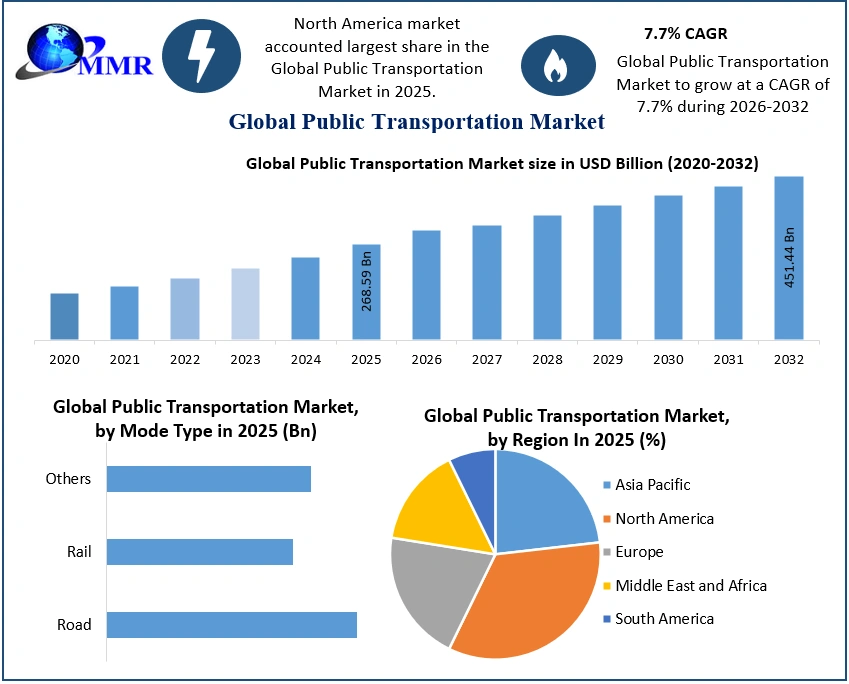
The Public Transportation Market size was valued at USD 268.59 Billion in 2025 and the total Public Transportation revenue is expected to grow at a CAGR of 7.7% from 2026 to 2032, reaching nearly USD 451.44 Billion by 2032.
Public Transportation Market Overview
The market is all about providing transportation services to the general public, focusing on shared options. These services are usually run by government agencies or private companies, primarily in urban areas with high population density and travel demand. This includes not only the physical elements like stations, tracks, and vehicles themselves but also the management systems, ticketing and fare collection systems, scheduling, and maintenance operations. The Public Transportation Market is thoroughly elaborated by offering several pieces of information such as market size, key players and their market value, their recent developments as well as their partnerships, mergers, and acquisitions.
To know about the Research Methodology :- Request Free Sample Report
The graphical representation and structural exclusive information showed dominating region of the Public Transportation Market. The detailed and constructive formation of key drivers, opportunities, and unique segmentation outputs structural and optimistic data. Validated using primary as well as secondary research methodology and scope of the Market.
Public Transportation Market Dynamics
Traffic Congestion, Urbanization, and Environmental Concerns are the major drivers that potentially impact on public transportation market.
The mounting congestion on urban roads motivates individuals to opt for public transportation as an alternative to avoid traffic delays and reduce commuting times. Public transportation provides a way to alleviate congestion on roads and highways caused by private vehicles. Cities are enlarging by the time of upgradation and urbanization is taking place in the process of expanding cities. The demand for efficient and reliable public transportation services is raising for safe and secure traveling.
The growth of urbanization requires the best transportation solutions as the rising number of accommodation effecting on the efficiency and quality of the public transportation market. Growing awareness of environmental issues and the need to reduce carbon emissions and air pollution drive the adoption of public transportation. Mass Transit System is showcasing the potential in significant ways to control the impact on the environment by replacing a number of vehicles with more environmentally-friendly modes of the market.
Energy Efficiency and Sustainability, Government Policies and Initiatives, and Changing Portability Preferences are the factors that showcases the growth in the public transportation market.
The market is driven by the pursuit of sustainable transportation options. The increasing upgradation of more environment-friendly vehicles and adaptation of these options over regular vehicles that can produce more carbon emissions. The electric or hybrid buses and trains aim to reduce reliance on fossil fuels and promote greener alternatives. Governments play a crucial role in elevating and supporting public transportation through the execution of policies, regulations, and investments that are supporting the growth of the public transportation market.
Measures such as subsidies, incentives, and infrastructure development are employed to encourage the use of public transportation and create a favorable market environment. The adapting preferences and behaviors of individuals in terms of transportation impact the public transportation market. Shifting demographic patterns and styles, changing lifestyles, and the growth of the sharing economy impact the demand for public transportation services.
Restraints, Opportunities, and Trends of the Public Transportation Market
Aging Infrastructure, Funding Constraints, Traffic Congestion, Changing Mobility Preferences, and Environmental Concerns are the main challenges that affect the public transportation market.
Many public transportation systems go through tough situations such as outdated infrastructure, resulting in maintenance issues, delays and dues, and inefficiencies. Defeating the challenge of upgrading and modernizing existing systems is of supreme importance. Public transportation projects require substantial investments, yet obtaining adequate funding is arduous. Governments and transportation authorities often encounter budget constraints that hinder their ability to finance necessary expansions and improvements. Escalating traffic congestion in urban areas poses a substantial hurdle for public transportation.
Providing efficient and dependable services amidst heavy traffic conditions presents a complex task. The advent of ride-sharing services like Uber and Lyft has disrupted traditional public transportation models. The convenience and flexibility offered by these services have enticed users away from public transit, necessitating industry adaptation and the provision of superior alternatives. With sustainability assuming global significance, the public transportation market faces mounting pressure to reduce its carbon footprint. Successfully transitioning to cleaner energy sources and implementing eco-friendly practices represents a challenge requiring investment and coordinated efforts.
Technological Advancements in the public transportation market, Public-Private Partnerships and Demand for Sustainable public transportation are the emerging opportunities of public transportation market.
Technological Advancements in the market: Emerging technologies such as electric vehicles, autonomous or semi-electric vehicles, and mass transportation service platforms offer multiple opportunities for transforming the public transportation industry. These innovations improve operational efficiency, reduce emissions, and enhance the passenger experience. These factors pull opportunities in a pleasant way in the market. Collaborations between public transportation agencies and private companies help to enlarge the funding options and improve the opportunities that can affect the public transportation market in a good manner.
Public-private partnerships (PPPs) combine together transform with expertise solutions, funding options, and innovative ideas, enabling the development of new infrastructure and services. Raising environmental concerns and the growing desire for good quality transportation options create an opportunity for public transportation to attract new clientele. By putting the spotlight on the environmental benefits of utilizing public transit, authorities encourage more consumers to choose public transportation over private vehicles.
Mobility as a Service (MaaS), Electric Vehicles (EVs), and Data-controlled Decision Making are the current trends in the public transportation market.
MaaS platforms focus on to integrate multiple transportation modes and services into a unified app or platform, providing consumers with seamless and convenient mobility options. MaaS offers passengers to plan, book, and pay for their journeys through different modes of public transportation. The upgrading demand for electric vehicles in the automotive industry enlarges the demand for public transportation in the public transportation market. Electric buses and trains are gaining attraction as cities strive to reduce emissions and improve air quality.
Public transportation systems increasingly leverage data to optimize operations, enhance service reliability, and improve the passenger experience. Real-time data on ridership patterns, traffic conditions, and maintenance needs allow for better decision-making and resource allocation. The adoption of contactless payment systems and digital ticketing solutions streamlines the passenger experience, making it more convenient and hygienic. Mobile apps, smart cards, and digital wallets facilitate quick and secure transactions.
Public Transportation Market Segmentation Analysis
Based on Distribution Channel: The market is segmented into Online and Offline. The Online segment is expected to grow at a high rate during the forecast period. The offline segment held the largest Public Transportation Market share in 2025. In many developing nations, both travelers and market participants heavily rely on offline ticketing distribution channels for public transit. Consequently, this segment has garnered a substantial portion of the global market. The swift global urbanization has heightened the demand for enhanced public transportation networks. The increasing population density is placing significant pressure on transportation and mobility infrastructures in cities lacking adequate public transit and safe roadways, leading to traffic congestion. In response, various governing bodies are adopting digital transformation initiatives, incorporating smart technologies and sophisticated online platforms, to alleviate congestion.
Regional Insights of the Public Transportation Market
In North America, various cities such as New York, Chicago, and Toronto are well-developed public transportation systems. Increasing prominence on sustainable transportation options, such as upgrading the usage of electric buses and implementing bike-sharing programs. Growing investments in smart transportation technologies, including real-time passenger information systems and contactless payment systems. Significant funding was allocated to high-speed rail projects to enhance intercity connectivity. In Europe, immersive and well-integrated public transportation networks, specifically in cities such as London, Paris, and Berlin. Huge emphasis on Intermodal transportation, seamlessly integrating buses, trains, trams, and cycling infrastructure.
Robust support for sustainable transportation initiatives, including the promotion of electric vehicles and the expansion of pedestrian zones. Increasing popularity of mobility-as-a-service (MaaS) platforms, facilitating integrated transportation options through a unified app or platform. In Asia Pacific, the speedy expansion of public transportation systems, mainly in heavily crowded cities such as Tokyo, Beijing, and Singapore. Showcases multiple investments in mass rapid transit (MRT) systems, high-speed rail, and bus rapid transit (BRT) systems in the public transportation market. Rising adoption of smart transportation technologies, such as intelligent transportation systems (ITS) and digital payment solutions are boosting the market growth. Focus on addressing last-mile connectivity challenges through initiatives like bike-sharing programs and on-demand shuttle services.
In Latin America, Diverse levels of public transportation infrastructure among different cities and countries, with enlarged developed systems in cities such as Sao Paulo, Mexico City, and Buenos Aires. Enlargement of bus rapid transit (BRT) systems as a cost-effective solution for improving and upgrading public transportation services are conquering the public transportation industry. Efforts to enhance accessibility and affordability, particularly for low-income communities are supporting the public transportation market for enlargement of the market. Implementation of fare integration systems to simplify ticketing and improve passenger convenience.
In the Middle East and Africa, Increasing investments in projects such as public transportation infrastructure, specifically in cities such as Dubai, Abu Dhabi, and Johannesburg are one of the major reasons to boost the public transportation market. Expansion of metro and light rail systems to enhance urban mobility. Focus on introducing innovative transportation solutions, including autonomous shuttles and electric taxis. Emphasis on enhancing public transportation services for major events and tourist destinations.
Competitive Landscape Analysis of Public Transportation Market
Siemens has formed partnerships and collaborations with various technology companies, transportation authorities, and cities to implement intelligent transportation solutions, such as advanced traffic management systems and digitalization initiatives. Siemens has expanded its portfolio in the signaling and control systems sector through the acquisition of a rail automation company. Alstom has collaborated with transportation companies and technology providers to develop innovative solutions for sustainable mobility, including energy-efficient trains and digital platforms for integrated transport management.
Alstom has strengthened its market presence and diversified its product offerings through the acquisition of a major rail transport company. Bombardier has partnered with public transportation authorities and industry partners to emerge and upgrade advanced rail solutions, such as high-speed trains and automated systems. Bombardier's transportation division merged with multiple European rail manufacturers showed an enhanced public transportation market presence and evolved product development capabilities. CRRC Corporation Limited has engaged in collaborations with international transportation companies and research institutions to drive technological advancements in rail transportation, including joint research projects and knowledge-sharing initiatives.
CRRC has expanded its global public transportation market reach and product portfolio through the acquisition of several regional rail and transportation companies. GE, through its subsidiary GE Transportation, offers transportation solutions that encompass locomotives, digital systems for rail operations, and freight and passenger transportation services. The company focuses on innovation and digitalization in the transportation industry. Recent developments involve the integration of digital solutions into their transportation offerings, enabling efficient rail operations and improved customer experiences.GE Transportation has partnered with technology firms and transportation operators to develop digital solutions for rail operations, such as predictive maintenance systems and optimization tools.
Volvo Group is a prominent manufacturer of commercial transportation vehicles, concluded buses, and trucks in the public transportation market. They prioritize sustainable transportation solutions and are known for their advanced technologies and commitment to safety. Recent developments include the introduction of eco-friendly buses and trucks with enhanced fuel efficiency and reduced emissions. Volvo Group has also established strategic partnerships to promote sustainable transport initiatives and expand in market reach. Daimler is a global automotive company that manufactures buses and coaches alongside its other automotive products.
Their bus division, Mercedes-Benz Buses, offers a diverse range of city buses, intercity buses, and touring coaches. Recent developments include the integration of innovative technologies in their bus models, focusing on improved fuel efficiency and passenger comfort. Daimler has also pursued collaborations to integrate intelligent transportation solutions and enhance the overall mobility experience. FirstGroup is a leading transport services provider in the UK and North America, offering bus, rail, and tram services, as well as student transportation and consultancy services. Recent developments include the implementation of innovative technologies in their transport systems, such as real-time tracking and ticketing solutions.
FirstGroup has also engaged in partnerships and collaborations to strengthen its service offerings and provide integrated transportation solutions. Recent development in the National Express Group such as customer-centric initiatives, including improved ticketing systems and enhanced passenger amenities. National Express has also pursued strategic acquisitions and collaborations to expand its geographic reach and diversify its service portfolio in the public transportation market.
Public Transportation Market Scope: Inquire before buying
| Global Public Transportation Market | |||
|---|---|---|---|
| Report Coverage | Details | ||
| Base Year: | 2025 | Forecast Period: | 2026-2032 |
| Historical Data: | 2020 to 2025 | Market Size in 2025: | USD 268.59 Bn. |
| Forecast Period 2026 to 2032 CAGR: | 7.7% | Market Size in 2032: | USD 451.44 Bn. |
| Segments Covered: | by Mode Type | Road Rail Others |
|
| by Distribution Channel | Online Offline |
||
Public Transportation Market, by Region
North America (United States, Canada and Mexico)
Europe (UK, France, Germany, Italy, Spain, Sweden, Austria and Rest of Europe)
Asia Pacific (China, South Korea, Japan, India, Australia, Indonesia, Malaysia, Vietnam, Taiwan, Bangladesh, Pakistan and Rest of APAC)
Middle East and Africa (South Africa, GCC, Egypt, Nigeria and Rest of ME&A)
South America (Brazil, Argentina Rest of South America)
Public Transportation Key Players
1. Siemens AG
2. Alstom SA
3. Bombardier Transportation
4. CRRC Corporation Limited
5. General Electric Company (GE)
6. Volvo Group
7. Daimler AG
8. Transdev
9. FirstGroup plc
10. National Express Group
11. MTR Corporation Limited
12. Keolis Group
13. RATP Group
14. Hyundai Rotem Company
15. Kawasaki Heavy Industries, Ltd.
16. Thales Group
17. Cubic Corporation
18. Škoda Transportation
19. New Flyer Industries Inc.
20. Proterra Inc.
Frequently Asked Questions about Public Transportation Market
1. What role do public-private partnerships (PPPs) play in the public transportation market?
Ans: Public-private partnerships (PPPs) are collaborative arrangements between public entities and private companies to develop, operate, and maintain public transportation infrastructure or services. PPPs help leverage private sector expertise, funding, and innovation, fostering efficiency and enabling the delivery of high-quality transportation services.
2. How does technology impact the public transportation market?
Ans: Technology has a significant impact on the public transportation market, enabling improvements in service efficiency, passenger experience, safety, and sustainability. Advancements in areas like ticketing systems, real-time passenger information, intelligent transportation systems, digital platforms, and electric and autonomous vehicles are transforming the industry.
3. How does the public transportation market contribute to sustainable development?
Ans: The public transportation market contributes to sustainable development by promoting environmentally friendly transportation options, reducing greenhouse gas emissions, conserving energy, and minimizing traffic congestion. It supports urban planning initiatives, enhances accessibility, and improves air quality in cities by reducing reliance on private vehicles.
4. What are the challenges faced by the public transportation industry?
Ans: The public transportation industry faces challenges such as funding constraints, infrastructure maintenance, rising operational costs, changing passenger expectations, competition from other transportation modes, and addressing safety and security concerns. Additionally, adapting to evolving technology and ensuring service reliability in diverse operating conditions can be challenging.
5. What factors contribute to the growth of the public transportation market?
Ans: Several factors contribute to the growth of the public transportation market, including urbanization, population growth, environmental concerns, traffic congestion, government initiatives, and advancements in transportation technology. Increasing awareness of the benefits of public transportation and the need for sustainable mobility solutions also drive market growth.