
Population Health Management Market - Industry Structure Evaluation, Demand Drivers Analysis, Regional Growth Analysis and Identification, Competitive Positioning / Landscape Review & Global Market Size Forecast to 2032
Overview
Population Health Management Market was valued at USD 24.6 Bn. in 2025. Global Population Health Management Market size is expected to grow at a CAGR of 13.5% through the forecast period.
Population Health Management Market Overview:
In a program called population health management, patient data are collected from multiple sources of health information technology. As a result, healthcare practitioners can analyze these compiled data to create a single, accessible patient record, which helps improve the clinical and financial outcomes of their patients. A business intelligence tool is typically used in population healthcare management programs to combine information, enabling healthcare providers to create an accurate and precise clinical picture of each individual patient.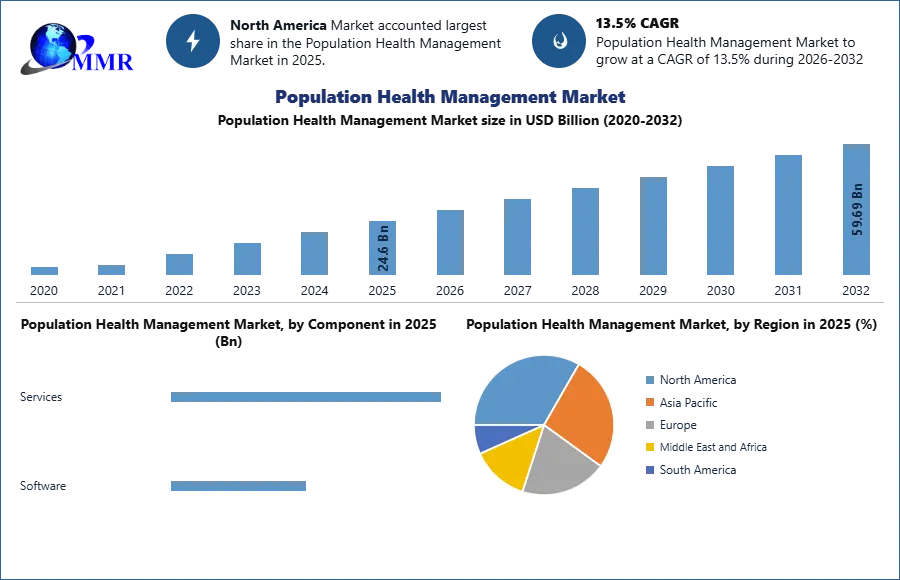 To know about the Research Methodology :- Request Free Sample Report
Population Health Management Market Dynamics:
Market Trend:
Value-Based Payment (VBP) Model Usage in the Healthcare Sector to Boost Up the Market: Switch from fee-for-service (FFS) to value-based payment (VBP) in the healthcare market. Afterward, this is primarily due to the fact that organizations that effectively collect data and analyze population health data afterward are better able to coordinate and administer care. By doing this, these healthcare organizations and businesses are able to increase their revenue growth, which stimulates the growth of the market. Value-based payment is replacing traditional fee-for-service (FFS) reimbursement (VBP). In this method, clinicians ask health insurers for reimbursement after taking into account the whole quality of care delivered, including clinical outcomes.
A comprehensive approach to care is used in value-based care models, which calls for coordination and communication between clinicians in various disciplines, which community health management easily allow.
Increased prevalence of chronic illnesses: A major force driving population health management is a chronic illness. Long-term illnesses are treated in clinics by patients. Maintaining and monitoring patient records is essential in cases of chronic illness. Chronic illness has resulted in an increase in the development of more efficient treatment in recent years. Additional healthcare management services are needed due to the rise in treatment demand.
Market Drivers
growing emphasis on personalized medicine: Moreover, the growing emphasis on individualized treatments will present advantageous chances for population health management to advance (PHM). Businesses in the healthcare market can treat each patient individually using advanced analytics and predictive modeling tools, resulting in the best possible outcomes. Analytics are increasingly being utilized to customize the treatment of cancer and other diseases.
Additionally, the growing focus on value-based healthcare and the rise in emerging economies will provide more favorable conditions for the population health management (PHM) market's growth over the duration of the forecast period. The market's growth rate will also be boosted by technical development and the implementation of multiple government initiatives to promote health.
Demand for healthcare IT will be driven by the need for better clinical and financial outcomes for patients: The growing need for better patient outcomes, including powerful economic and therapeutic outcomes, is one of the most important driving forces in the market. Medical professionals can obtain aggregated patient data from many medical specializations thanks to population health management systems.
It also enables patients to experience cheaper treatment costs and enables clinicians to make better, more informed clinical decisions that improve treatment outcomes. This is particularly true in the current situation, where individuals have a variety of chronic illnesses like diabetes and heart disease. PHM allows clinicians to use a longitudinal care model, which can produce remarkably effective therapeutic results. This makes it possible for doctors to prevent costly, singularly unpredictable medical events induced by these chronic medical diseases.
These factors have caused market players to continually focus on innovating and launching fresh population health management software and solutions on the market. Healthcare institutions can provide patients with targeted care due to these services and software, which also helps their businesses save more money. A number of market players are also focusing on home healthcare, which also significantly aids doctors in making even better clinical judgments.
Market Restraints
Cybersecurity concerns and weak healthcare systems in developing nations could prevent the use of PHM: Despite the growing technical sophistication and accuracy, as well as the growing demand for patients to have better financial and clinical results, there are several challenges preventing community health management from becoming more widely used. Concerns about cyber security are one of the main things trying to hold back the market's growth. Numerous private information stored in population health management programs may be compromised due to data security problems. One of the main factors preventing the growth of the PHM market is the insufficient health infrastructure in underdeveloped countries, which further restricts the adoption of these programs.
Population Health Management Market Segment Analysis:
The services segment holds the largest market share, accounting for more than 50–60% of the market in recent years. This dominance is mainly due to the increasing need for implementation, consulting, training, integration, and maintenance services when healthcare organizations deploy population health management platforms. Hospitals and healthcare providers often rely on external service providers to manage complex healthcare IT systems and ensure smooth integration with electronic health records (EHRs) and other digital health tools. Additionally, the shift toward value-based care and data-driven healthcare management is increasing demand for specialized services to optimize patient outcomes and reduce healthcare costs.
In terms of platform, one other important segment is on-premise. During the forecast period, the segment's growth rate is expected to be driven by the on-premise platform's increased security and higher customization flexibility for PHM solutions.
Regional Insights:
In North America, the PHM market size was 15.84 billion USD in 2025. An advanced healthcare infrastructure and greater adoption of healthcare IT, together with the presence of major market players and their products in the region, are characteristics of the region's larger market share. These elements, together with a greater patient population understanding of population health management and the region's growing rapidly home healthcare market, account for the region's dominant market share . During the forecast period, a relatively higher CAGR is expected to be achieved in the markets in Europe and Asia-Pacific.
The objective of the report is to present a comprehensive analysis of the global Population Health Management Market to the stakeholders in the industry. The past and current status of the industry with the forecasted market size and trends are presented in the report with the analysis of complicated data in simple language. The report covers all the aspects of the industry with a dedicated study of key players that include market leaders, followers, and new entrants.
PORTER, PESTEL analysis with the potential impact of micro-economic factors of the market have been presented in the report. External as well as internal factors that are supposed to affect the business positively or negatively have been analyzed, which will give a clear futuristic view of the industry to the decision-makers.
The reports also help in understanding the Population Health Management Market dynamic, structure by analyzing the market segments and projecting the Population Health Management Market size. Clear representation of competitive analysis of key players by Vehicle type, price, financial position, product portfolio, growth strategies, and regional presence in the Population Health Management Market make the report investor’s guide.
Population Health Management Market Scope: Inquire before buying
| Population Health Management Market | |||
|---|---|---|---|
| Report Coverage | Details | ||
| Base Year: | 2025 | Forecast Period: | 2026-2032 |
| Historical Data: | 2020 to 2025 | Market Size in 2025: | 24.6 USD Billion |
| Forecast Period 2026-2032 CAGR: | 13.5% | Market Size in 2032: | 59.69 USD Billion |
| Segments Covered: | by Component | Services Software |
|
| by Platform | Cloud-based On-Premise |
||
| by End-User | Healthcare Providers Healthcare Payers Others |
||
Population Health Management Market by Region
Asia Pacific (China, South Korea, Japan, India, Australia, Indonesia, Malaysia, Vietnam, Taiwan, Bangladesh, Pakistan and Rest of APAC)
Europe (UK, France, Germany, Italy, Spain, Sweden, Austria and Rest of Europe)
North America (United States, Canada and Mexico)
Middle East and Africa (South Africa, GCC, Egypt, Nigeria and Rest of ME&A)
South America (Brazil, Argentina Rest of South America)
Key Players / Competitores Proflies Coverd Population Health Management Market Report in Strategic Perspective
1. Athena health, Inc (US)
2. Cerner Corporation (US)
3. Medecision (US)
4. Xerox Corporation (US)
5. Allscripts Healthcare, LLC (US)
6. Fonemed (Canada)
7. Well Centive, Inc. (US)
8. General Electric Company (US)
9. HealthBI (US)
10. NXGN Management, LLC (US)
11. Optum Inc. (US)
12. i2i Population Health (US)
13. Conifer Health Solutions, LLC (US)
14. IBM (US)
15. Koninklijke Philips N.V. (Netherlands)
16. Siemens Healthcare GmbH (Germany)
17. Arthrex (US)