
Plant Factory Market Size – Industry Structure Evaluation, Demand Drivers Analysis, Regional Growth Analysis and Identification, Competitive Positioning Review & Global Market Size Forecast to 2032
Overview
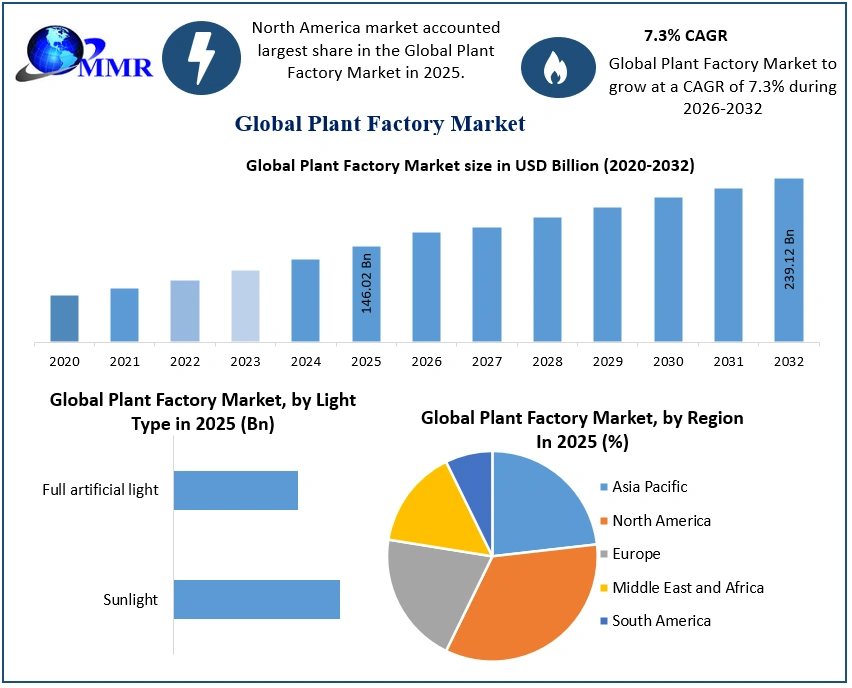
The Plant Factory Market size was valued at USD 146.02 Billion in 2025 and the total Plant Factory revenue is expected to grow at a CAGR of 7.3% from 2026 to 2032, reaching nearly USD 239.12 Billion by 2032.
Plant Factory Market Overview
A plant factory known as a vertical farm or indoor farm, is a sophisticated form of controlled environment agriculture in which plants are cultivate in indoor facilities under artificial light. It is a high tech farming factors, including light, temperature, humidity and nutrient levels.
The main goal of a Plant Factory is to create an ideal environment for plant growth, allowing crops to grow faster, with higher crops, and in a more controlled manner compared to old-fashioned outdoor farming methods. These facilities are equipped with advanced technologies, such as LED grow lights, aeroponic systems, automated climate control, and precision nutrient delivery.
To know about the Research Methodology :- Request Free Sample Report
Plant Factory Market Dynamics
The growing demand for fresh, locally grown produce to propel market growth
The demand for fresh, locally grown produce is driving the growth of the plant factory market. Consumers increasingly prioritize the freshness, nutritional value, and sustainability of their food. Plant factories are meeting this demand by offering year-round crop production regardless of weather conditions. Through controlled environment agriculture and vertical farming technologies, plant factories provide optimal growing conditions indoors, ensuring consistent crop quality. This is particularly advantageous in regions with harsh climates or limited arable land. Consumers choose locally grown produce for food security, reduced carbon footprint, and support local economies. Plant factories located in urban areas bring food production closer to consumers, ensuring fresher and more sustainable production. By employing sustainable practices, such as efficient resource usage and minimal pesticide use, plant factories align with consumers' environmental concerns. The market is expected to continue to grow as consumer demand for fresh, locally-grown produce remains strong.
Plant Factory Market Flourishes as Sustainability Takes Center Stage
The increased focus on sustainability has become a driving force behind the growth of the market. Compared to traditional farming methods, plant factories offer a more sustainable approach to food production. These facilities utilize advanced technologies, such as vertical farming and hydroponics, which significantly reduce resource consumption. Water usage in plant factories is highly efficient, as crops are grown in a controlled environment with precise irrigation systems. This efficiency helps conserve water, a critical global concern and minimize the need for pesticides by maintaining a sterile environment that prevents the intrusion of pests and diseases.
Plant factories require less land compared to traditional agriculture, as crops are cultivated vertically. This vertical stacking allows for higher crop yields within a smaller footprint. Moreover, the ability to establish plant factories closer to urban areas reduces the carbon footprint associated with transportation and distribution, as produce can be delivered locally, reducing food miles. By embracing sustainable practices and reducing resource consumption, plant factories contribute to environmental conservation, address food security challenges, and promote a more efficient and eco-friendly approach to agriculture. As sustainability continues to gain prominence, the plant factory market is poised for further expansion and adoption as a key player in the future of sustainable food production.
Advancements in Technology and Automation to boost the Plant Factory Market Growth
Technological advancements play a pivotal role in driving the expansion and innovation within the market. Breakthroughs in LED lighting technology have significantly improved energy efficiency and reduced operating costs for indoor farming. Advanced automation and control systems enable precise monitoring and adjustment of environmental factors such as temperature, moisture, and nutrient delivery, ensuring optimal plant growth conditions. These technological advancements enhance operational efficiency, increase productivity, and improve resource utilization within Plant Factories. As technology continues to evolve, the scalability and viability of Market are enhanced, attracting investments and fostering innovation within the industry.
Trends in Plant Factory Market
Expansion of Vertical Farming and Urban Agriculture:
The trend of vertical farming and urban agriculture is gaining momentum in the market. As urbanization continues to increase and available arable land becomes limited, Plant Factories offer a viable solution for growing crops in densely populated areas. The vertical farming approach, with stacked layers of cultivation, maximizes land utilization and enables production closer to consumers.
Internet of Things (IoT) and Artificial Intelligence (AI)
The incorporation of IoT and AI technologies in Plant Factory Market is a significant trend in the market. IoT enables the collection of real-time data on environmental conditions, crop growth, and nutrient levels. This data can be analyzed using AI algorithms to optimize plant growth, automate processes, and enhance resource management. IoT and AI technologies facilitate precision farming practices, enabling Plant Factory operators to achieve higher yields, reduce resource wastage, and improve overall operational efficiency.
Diversification of Crop Varieties
The market is primarily focused on leafy greens and herbs due to their shorter growth cycles and suitability for indoor farming. However, there is a growing trend of diversifying crop varieties within Plant Factories. This includes the cultivation of fruits, vine crops, root vegetables, and even ornamental plants. Technological advancements, such as improved lighting systems and nutrient delivery methods, have broadened the range of crops that can be successfully grown in Plant Factories. This trend expands the market opportunities for Plant Factory Market operators and caters to a wider range of consumer demands.
Plant Factory Market Restraint
The market faces several restraints that hinder its growth and widespread adoption. One significant constraint is the high upfront costs associated with establishing a plant factory. This includes expenses for acquiring the facility, purchasing equipment, and implementing advanced technology. These substantial initial investments make it challenging for small businesses and start-ups to enter the market, limiting its overall expansion. Plant Factory Market has high upfront costs, plant factories also incur significant operating expenses. These include energy consumption, water usage, and labor costs
Consumer acceptance is another factor that affects the growth of the Market. As a relatively new concept, plant factories may face skepticism or unfamiliarity from consumers. The perception of the quality and safety of produce grown in these controlled environments impacts consumer trust and acceptance. Educating consumers about the benefits and rigorous quality control measures of plant factory-grown produce is essential for building confidence and expanding market share. Addressing these restraints is crucial for the sustained growth and success of the plant factory market.
Plant Factory Market Regional Analysis
North America held the largest market share with 30% and is expected to dominate the market during the forecast period with the United States being the largest market in North America. The growth of the market in North America is being driven by the increasing demand for fresh, locally-grown produce the rising awareness about the benefit of plant-based diets, and the growing focus on sustainability. In 2025, the North American plant factory market accounted for 1.9 Bn 2025 and is projected to reach USD 8.9 Bn growing at a CAGR of 25.7% during the forecast period. The region’s cold climate and limited agricultural land have fuelled the adoption of indoor farming technologies, including plant factories. The United States government has been actively supporting the growth of vertical farming and has invested in research and development initiatives in this field.
Asia Pacific region is another dominating player in the Market with 24% of the market share in 2025. Asia pacific market is driving growth due to population, rapid urbanization, limited arable land, and a growing focus on sustainable agriculture driving the adoption of plant factories. China is the largest market in Asia Pacific, followed by Japan, and South Korea. The chinas government has implemented policies to promote urban agriculture and enhance food security.
Plant Factory Market Segment Analysis
Based on Crop Type: The market is segmented into Vegetables, Fruits, Flowers & Ornamentals and Others. The Vegetables segment dominated the global market with the largest Plant Factory Market share in 2025. By creating optimal growing conditions, plant factories can cultivate vegetables with uniform size, color, and flavor, devoid of pesticides and impurities. Furthermore, advanced methods like hydroponics and aeroponics enable precise nutrient delivery to plant roots, minimizing fertilizer usage and enhancing nutrient absorption efficiency. Consequently, the outcome is produced devoid of hazardous chemical residues and contaminants, fostering a healthier and safer food choice for consumers.

Competitive Landscape
The competitive landscape of the plant factory market is characterized by intense competition among key players aiming to capture a significant market share. Established companies and startups are actively involved in research and development to enhance their technological capabilities, crop varieties, and production efficiency. Companies are investing in advanced lighting systems, climate control technologies, and automation solutions to optimize crop growth and maximize yields. The market witnesses partnerships and collaborations between plant factory operators, technology providers, and research institutes that are fostering innovation and knowledge exchange. Market leaders are also focusing on expanding their global presence through strategic acquisitions, mergers, and geographical expansions to gain a competitive edge in the growing plant factory market.
Plant Factory Industry Ecosystem
Plant Factory Market Scope: Inquire before buying
| Global Plant Factory Market | |||
|---|---|---|---|
| Report Coverage | Details | ||
| Base Year: | 2025 | Forecast Period: | 2026-2032 |
| Historical Data: | 2020 to 2025 | Market Size in 2025: | USD 146.02 Bn. |
| Forecast Period 2026 to 2032 CAGR: | 7.3% | Market Size in 2032: | USD 239.12 Bn. |
| Segments Covered: | By Growing System | Soil-based Non-soil based Hybrid |
|
| By Facility Type | Greenhouses Indoor farms Other facility types |
||
| By Light Type | Sunlight Full artificial light |
||
| By Crop Type | Vegetables Fruits Flowers & Ornamentals Others |
||
Plant Factory Market, by Region
North America (United States, Canada and Mexico)
Europe (UK, France, Germany, Italy, Spain, Sweden, Austria and the Rest of Europe)
Asia Pacific (China, South Korea, Japan, India, Australia, Indonesia, Malaysia, Vietnam, Taiwan, Bangladesh, Pakistan and Rest of APAC)
Middle East and Africa (South Africa, GCC, Egypt, Nigeria and Rest of ME&A)
South America (Brazil, Argentina Rest of South America)
Plant Factory Market, key players
1. AeroFarms
2. Gotham Greens
3. AppHarvest
4. Bowery Farming
5. Plenty Unlimited Inc.
6. Mirai Co. Ltd.
7. Farminova
8. Iron Ox,
9. Taiksha Ltd.
10. Crop One
11. Vertical Harvest
12. Farmone
13. Smallhold
14. Oishii
15. Agricool (France)
16. AppHarvest (US)
17. BrightFarms
18. Farminova
19. Taiksha
20. Farmone
21. Smallhold
Frequently Asked Questions:
1] What is the growth rate of the Global Plant Factory Market?
Ans. The Global Plant Factory Market is growing at a significant rate of 7.3% over the forecast period.
2] Which region is expected to dominate the Global Plant Factory Market?
Ans. North American region is expected to dominate the Plant Factory Market over the forecast period.
3] What is the expected Global Plant Factory Market size by 2032?
Ans. The market size of the Plant Factory Market is expected to reach USD 239.12 Bn by 2032.
4] Who are the top players in the Global Plant Factory Market Industry?
Ans. The major key players in the Global Plant Factory Market are AeroFarms, Gotham Greens, AppHarvest, and Bowery Farming
5] Which factors are expected to drive the Global Plant Factory Market growth by 2032?
Ans. The growing demand for fresh, locally grown produce has become a significant driver in the plant factory market over the forecast period (2026-2032).