
Global Pipeline Equipment Market Size by Segmentation, and Region – Segment-Level Market Assessment, Growth Opportunity Analysis, Competitive Mapping & Forecast to 2032
Overview
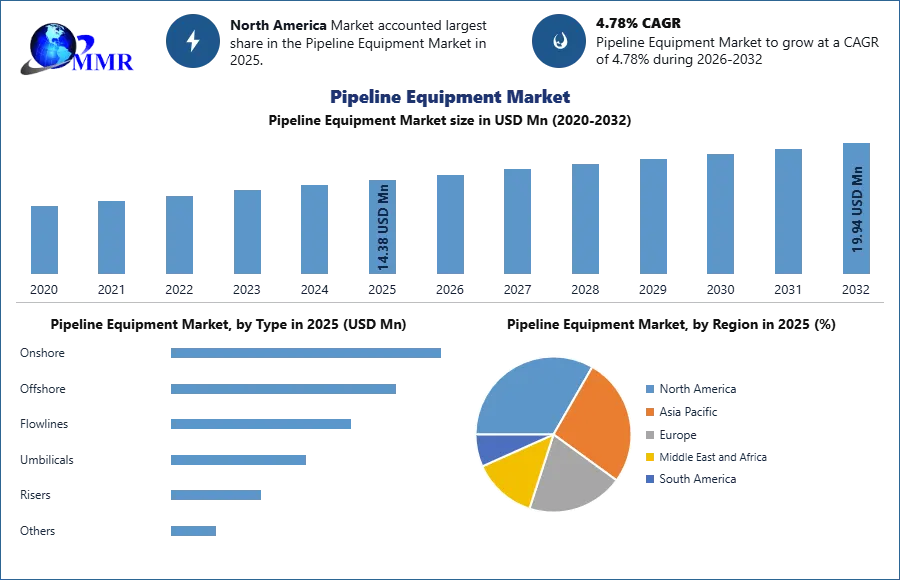
The Pipeline Equipment Market size was valued at USD 14.38 Billion in 2025 and the total Pipeline Equipment Market is expected to grow at a CAGR of 4.78% from 2026 to 2032, reaching nearly USD 19.94 Billion.
Pipeline equipment refers to all the materials and equipment used in the construction, operation, and maintenance of pipelines. This includes pipes, fittings, valves, flanges, actuators, gaskets, and other related components. These are essential parts of the pipeline system that allow for the safe and efficient transportation of liquids or gases from one location to another. Proper selection and maintenance of pipeline equipment is crucial to ensure the integrity and reliability of the pipeline system. The pipeline equipment market is constantly evolving, with new technologies and materials being developed to improve the performance and efficiency of pipeline equipment. The industry plays a crucial role in the transportation of oil, gas, and chemical resources, and is expected to continue to grow and innovate during the forecast period.
The increase in offshore activities, particularly deep water and ultra-deep water production and development, is driving the growth of the oil and gas pipeline market. Offshore oil and gas reserves are becoming increasingly important as onshore reserves are being depleted, and advancements in technology and engineering have made it possible to explore and produce oil and gas from deeper waters. Offshore pipelines are used to transport oil and gas from offshore production platforms to onshore facilities, and they are essential to the success of offshore projects.
Deep-water and ultra-deep water pipelines require specialized equipment and materials to withstand the high pressures and corrosive environments found in these offshore locations. The offshore oil and gas pipeline market is expected to continue to grow during the forecast period as more offshore projects are developed and demand for oil and gas remains strong. However, the pipeline equipment market is also subject to a range of challenges, including regulatory and environmental issues, geopolitical risks, and fluctuations in oil and gas prices.
To know about the Research Methodology :- Request Free Sample Report
Pipeline Equipment Market Dynamics
Natural gas consumption increased significantly, which is driving the oil and gas pipeline equipment market
Natural gas consumption has been increasing significantly over the past few years. In economy developing countries, which is driving the growth of the oil and gas pipeline equipment market. Natural gas is a cleaner-burning fossil fuel compared to coal and oil, and it is being increasingly used to generate electricity and heat homes and businesses. To transport natural gas from production sites to consumers, pipelines are required, which makes pipeline equipment crucial to the natural gas industry.
The pipeline equipment market includes various types of equipment such as valves, compressors, pumps, meters, and fittings, which are essential to the construction, operation, and maintenance of natural gas pipelines. The growth of the natural gas industry is expected to continue during the forecast period, with increased demand from both domestic and industrial consumers. As a result, the oil and gas pipeline equipment market is also expected to grow as new pipelines are constructed and existing pipelines are upgraded and maintained to meet the growing demand for natural gas.
The availability of abundant natural gas reserves in comparison to other fossil fuels has led to a growth of pipeline equipment market.
The availability of abundant natural gas reserves and its lower cost in comparison to other fossil fuels like oil and coal, along with its cleaner-burning properties, have made natural gas an increasingly popular choice for power generation and other end-use sectors. This has led to a growing demand for natural gas pipelines to transport the gas from production sites to end-users. In addition to power generation, natural gas is also used in industries such as petrochemicals, fertilizers, and transportation.
The demand for natural gas in these sectors is also expected to grow, further boosting the demand for gas pipelines. Furthermore, the development of unconventional gas resources like shale gas and tight gas has increased the availability of natural gas in many regions, leading to increased production and transportation needs. This has created opportunities for pipeline companies to expand their infrastructure and services. The increasing demand for natural gas from multiple end-use sectors, coupled with the availability of abundant natural gas reserves and the lower cost in comparison to other fossil fuels, is expected to drive the growth of the pipeline equipment market during the forecast period.
Pipeline equipment usage in a different end user markets
The use of pipeline equipment is increasing rapidly in various end-use industries, including oil and gas, chemical processing, food manufacturing, and water and wastewater management. Pipelines are a cost-effective way to transport large quantities of oil, refined oil products, and natural gas over land, and they offer several advantages over other modes of transportation, such as trucks, trains, and ships. The use of pipeline equipment in the oil and gas industry is particularly important as it offers a safe and reliable means of transporting large quantities of hydrocarbons over long distances. Additionally, the use of pipeline equipment in the food manufacturing and water and wastewater industries allows for the efficient transport of liquids and chemicals in a safe and environmentally-friendly manner. As a result, these factors are boosting the pipeline equipment market growth across the world,
Chemicals play a critical role in industrialization and the development of modern civilization. Pipelines are widely used in the chemical industry to transport chemicals from refineries and chemical plants to storage and other processing facilities or distribution centers. The transport of chemicals through pipelines is a safe and efficient method that reduces the risks associated with transportation by road or rail. Chemical pipelines are designed to transport a variety of chemicals, including gases, liquids, and solids, in a safe and reliable manner. They are made of materials that are resistant to corrosion and can withstand high pressure and temperatures.
Ammonia is one of the most commonly transported chemicals through pipelines. Large quantities of ammonia are produced in ammonia plants and then transported to other plants where it is used as a raw material to produce various derivatives such as nitric acid, fertilizers, and explosives. Pipelines provide a safe and cost-effective means of transporting ammonia, as it is a highly toxic and hazardous chemical that requires special handling and transportation precautions. Thus, pipeline equipment market is expected to grow at significant growth rate through the forecast period.
The use of pipeline equipment in the food and beverage industry
Pipeline equipment is widely used in the food and beverage industry for the transportation of liquid and semi-solid products. Dairy products such as milk and yogurt, as well as beverages like wine and beer, are commonly transported through pipelines. The use of pipeline equipment ensures the safe and efficient transport of these products, reducing the risk of contamination and minimizing the need for manual handling. In addition, the growth of the food processing industry in developing countries like India has led to an increased demand for pipeline equipment. As the population and urbanization in these countries continue to rise, the demand for processed and packaged food products is expected to increase, which will further drive the growth of the pipeline equipment market in this sector.
Germany is a leading country in the food and beverage industry and is home to numerous large-scale food and beverage processing companies. As such, pipeline equipment is widely used in this industry to transport liquid and semi-solid products such as beverages, dairy products, and sauces. The equipment is used to ensure the efficient and hygienic transport of these products between processing stages and storage facilities. Additionally, pipeline equipment is also used in the transportation of ingredients such as oils and syrups. One example of a current project in Germany that utilizes pipeline equipment in the food and beverage industry is the construction of a new beer pipeline in the city of Wacken.
The pipeline will transport beer from a local brewery to a music festival venue, eliminating the need for trucks to deliver the beer and reducing the festival's carbon footprint. The pipeline is expected to transport up to 400,000 liters of beer over a distance of 7 kilometers. This project showcases the use of pipeline equipment in the food and beverage industry for transportation purposes, which in turn, expected to drive the pipeline equipment market growth in Germany.
Pipeline Equipment industry Competitive Landscapes:
The pipeline equipment industry is highly competitive and includes numerous companies that operate globally. These companies are involved in the manufacture, design, and supply of pipeline equipment, including valves, pumps, compressors, fittings, and other components. The industry is also characterized by the presence of several regional and local players, which provide specialized pipeline equipment and services to specific markets. In addition, there has been a trend towards consolidation in the pipeline equipment industry, with several large mergers and acquisitions taking place in recent years. This trend is expected to continue as companies seek to increase their pipeline equipment market share and expand their product offerings.
For example, General Electric Company (GE) is a multinational conglomerate based in the United States with operations in various industries, including the oil and gas sector. GE provides a wide range of pipeline equipment, including valves, compressors, and monitoring and control systems. GE announced its plan to focus on the development of cleaner energy technologies, including wind, solar, and hydropower. However, GE still maintains its presence in the oil and gas industry, particularly in the pipeline equipment segment, where it provides innovative and efficient solutions. One of GE's key pipeline equipment offerings is its Masoneilan control valves, which are designed to provide accurate and reliable control of process fluids in harsh and challenging environments.
These valves are used in various applications, including gas and liquid pipelines, refineries, and chemical processing plants. Another notable product from GE's pipeline equipment portfolio is its PGT25+G4 gas turbine, which is designed for offshore and onshore applications in the oil and gas industry. This turbine provides high efficiency and reliability, making it a preferred choice for pipeline applications. In terms of strategic plans, GE is focusing on digitalization and the use of advanced analytics to improve the performance of its pipeline equipment. The company has developed digital solutions that allow operators to monitor and control pipeline equipment remotely, improving efficiency, reducing downtime, and enhancing safety. GE remains a major player in the pipeline equipment market, offering innovative and efficient solutions for various applications in the oil and gas industry.
Pipeline Equipment Market Segment Analysis:
Based on End Use, the Pipeline Equipment Market is segmented by Oil and Gas, Chemical, Water and Wastewater, Energy and Others. Oil and Gas segment accounted for the largest market share in 2025. The increasing demand for oil and gas from various end-use industries, such as power generation, transportation, and industrial processes, is driving the growth of the oil and gas segment in the pipeline equipment market. Additionally, the expansion of offshore activities, such as deep water and ultra-deep water production and development, is also driving the demand for pipeline equipment in the oil and gas sector.
Based on Application, the Pipeline Equipment Market is segmented into Liquid Pipeline, Gas Pipeline. The Gas Pipeline segment is expected to grow at a significant rate during the forecast period due to the increasing demand for natural gas as a cleaner energy source, which requires a dedicated pipeline infrastructure for transportation. Moreover, the growing adoption of liquefied natural gas (LNG) as a fuel in various industries, such as power generation and transportation, is expected to drive the demand for gas pipelines. The development of shale gas reserves in regions such as North America and Europe is also expected to contribute to the growth of the gas pipeline segment as it requires a robust pipeline network for transportation to end-users.
Pipeline Equipment Market Regional Insights:
North America accounted for the largest market share in the global Pipeline Equipment market in 2025. The region's growth is driven by the presence of top detection and management technologies, along with the Mexican government's support for the expansion of the country's gas infrastructure. The development of favourable guidelines by the Energy Regulatory Commission to coordinate with National Pipeline Systems based on roll-in rates resulted in the formation of the National Integrated Transportation and Storage System, which will provide opportunities for the growth of the pipeline equipment market.
The extensive pipeline infrastructure and the large number of pipeline systems in the U.S., along with the Colonial Pipeline system, which is the largest pipeline system for refined oil products in the country, are some of the key factors driving the growth of the pipeline equipment market in North America. Additionally, the increasing use of advanced technologies like augmented reality in pipeline maintenance operations is also contributing to the growth of the market in this region.
India and China, in particular, have emerged as major players in the region, thanks to their huge populations and the resulting demand for oil and resources to power their economies and transportation networks. In addition, the presence of developing countries in the region has created a significant demand for pipeline equipment, as these nations work to modernize their infrastructure and implement the latest technologies. As a result, countries like India, China, Japan, and others are experiencing high levels of demand for pipeline equipment, driven by increased investment in the development of various manufacturing industries. This trend presents ample opportunities for the growth and development of the pipeline equipment market in the Asia-Pacific region, as companies seek to meet the rising demand for advanced equipment and technologies.
Recent Developments
2025: Emerson – Plantweb Pipeline Digital Twin Platform
In 2025, Emerson launched its Plantweb Pipeline Digital Twin platform, delivering real-time analytics and predictive maintenance for pipeline networks. Integrating advanced sensors, IoT connectivity, and machine learning, the platform allows operators to visualize pipeline performance, anticipate failures, and optimize maintenance schedules. By simulating pipeline behavior digitally, it reduces downtime, improves safety, and enhances operational efficiency. This innovation is critical for energy and industrial companies managing complex, long-distance pipelines, enabling smarter, data-driven operational decisions.
2025: Schneider Electric – GIS & AVEVA Integration
In 2025, Schneider Electric partnered with Esri to integrate Geographic Information Systems (GIS) with AVEVA pipeline modeling software. The collaboration enables operators to combine spatial data with engineering models, enhancing asset management and operational decision-making. The integrated solution supports real-time monitoring, predictive maintenance, and risk assessment, improving efficiency and safety. By visualizing pipeline assets alongside engineering data, companies achieve faster incident response, better planning, and regulatory compliance across complex pipeline networks.
Pipeline Equipment Market Scope: Inquiry Before Buying
| Pipeline Equipment Market | |||
|---|---|---|---|
| Report Coverage | Details | ||
| Base Year: | 2025 | Forecast Period: | 2026-2032 |
| Historical Data: | 2020 to 2025 | Market Size in 2025: | 14.38 USD Mn |
| Forecast Period 2026-2032 CAGR: | 4.78% | Market Size in 2032: | 19.94 USD Mn |
| Segments Covered: | by Type | Onshore Offshore Flowlines Umbilicals Risers Others |
|
| by Equipment | Pipe Fittings Valves Pumps Compressors Others |
||
| by Material | Steel Plastic Composite Concrete Others |
||
| by Application | Liquid Pipeline Gas Pipeline Others |
||
| by End Use | Oil and Gas Chemical Mining Water and Wastewater Energy & Power Others |
||
Key players/Competitors profiles covered in the Pipeline EquipmentMarket report in strategic perspective
- General Electric Company
- Siemens AG
- Emerson Electric Co.
- Honeywell International Inc.
- Schneider Electric SE
- ABB Ltd.
- Rockwell Automation, Inc.
- Mitsubishi Electric Corporation
- Yokogawa Electric Corporation
- Baker Hughes Company
- National Oilwell Varco, Inc.
- Halliburton Company
- Schlumberger Limited
- Weatherford International plc
- Transneft
- Flowserve Corporation
- Cameron International Corporation
- KBR, Inc.
- Aker Solutions ASA
- TechnipFMC plc
- Saipem S.p.A.
- Hitachi ABB Power Grids
- ValvTechnologies, Inc.
- Pentair plc