
Paraben Market by Product Type, End-User, Application and Region - Global Market Size Estimation, Industry-Wide Analysis, Competitive Landscape Assessment & Long-Term Forecast to 2032
Overview
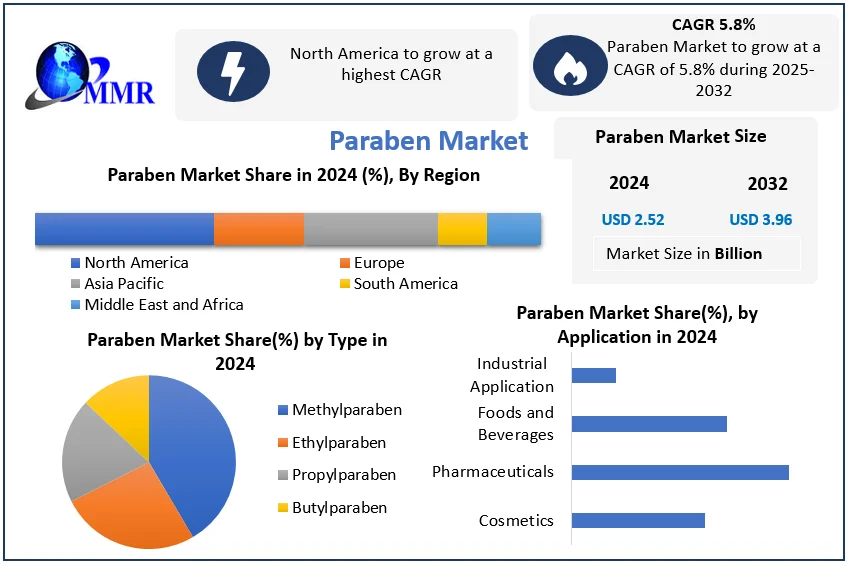
Paraben Market size was valued at USD 2.52 Billion in 2024 and the total Global Paraben Market revenue is expected to grow at a CAGR of 5.8% from 2025 to 2032, reaching nearly USD 3.96 Billion.
Paraben Market Overview
Global paraben market is undergoing a significant transformation as regulatory bodies and consumers increasingly question the safety of paraben-based preservatives. Growing awareness about their potential health risks, particularly hormone disruption and allergic reactions demand for paraben-free alternatives. The European Union banned several parabens in cosmetics, while the U.S. is enforcing stricter reviews under the Modernization of Cosmetics Regulation Act (MoCRA) 2023. These regulatory changes are major paraben market drivers, prompting reformulations across the personal care and cosmetics industry.
A key development occurred in April 2025 when Arabian Chemicals Company Ltd. (Saudi Arabia) expanded its export focus on paraben-free formulations to Africa and Asia. Skincare remains the dominating segment due to daily usage and direct skin contact. The shift presents opportunities for innovation in natural preservative technologies.
Trade and tariff regulations are disrupting the paraben market by increasing raw material costs and limiting exports due to regional bans. Free trade agreements in Asia offer some relief, but rising demand for natural alternatives is shifting focus toward local production.
 To know about the Research Methodology :- Request Free Sample Report
Paraben Market Dynamics
Stringent Regulatory Standards to Drive the Market Growth
Regulatory bodies, such as the Food and Drug Administration (FDA) and the European Chemicals Agency (ECHA), have set limits on the concentration of parabens in consumer products. These regulations aim to ensure the safety of consumers and protect them from potential health risks associated with excessive paraben exposure. Compliance with these regulations necessitates the use of effective preservatives like parabens, driving their demand in the market.
Increasing Consumer Awareness: Rising consumer awareness regarding the potential adverse effects of certain chemicals in personal care and food products has significantly influenced the Paraben market. Consumers are increasingly seeking products that are perceived as safe, natural and free from potentially harmful ingredients. This growing awareness has fuelled the demand for paraben alternatives and preservatives with cleaner labels, such as natural or organic options. Manufacturers are responding to this demand by developing and introducing paraben-free and natural preservative solutions, leading to a shift in consumer preferences and influencing the market dynamics.
Technological Innovation to Create the Market Growth
Preservative and formulation technology offers Paraben market prospects. New preservative solutions with antibacterial action, safety, and sustainability are being developed. Encapsulation and nanotechnology are being investigated to improve preservative stability and efficacy. Research and innovation provide manufacturers with an edge by developing superior paraben alternatives or enhanced formulations that match industrial needs.
Demand for paraben-free products is a restraint of the Market
As consumer awareness of paraben health hazards rises, paraben-free or alternative preservatives are becoming more popular. This shift in customer tastes challenges firms that mainly use parabens as preservatives. They must invest heavily in R&D to reformulate or create paraben-free products. Parabens may be banned in consumer products or subject to greater regulatory scrutiny. Chemicals used in cosmetics and food are reviewed by regulatory authorities worldwide. Regulatory agencies may restrict or ban parabens if new research suggests health hazards. Manufacturers who use parabens as preservatives must find alternatives and maybe reformulate their products due to governmental actions that disrupt the market.
Paraben Market Segmentation
Based on Product Type: The market is segmented based on the type of paraben used such as methylparaben, ethyl paraben, propylparaben, butylparaben and others. Each type of paraben may have specific applications and formulation requirements, catering to different industry sectors.
Based on Application: The Paraben market segmented based on the specific applications of parabens, such as skincare products, haircare products, oral care products, pharmaceutical formulations, processed foods and beverages. Different applications may require different types and concentrations of parabens, depending on factors like product stability, pH levels and regulatory guidelines. Segmenting by end-use industry allows for a detailed analysis of the demand for parabens in different sectors. For example, the cosmetic industry may be a significant consumer of parabens in skincare and haircare products, while the pharmaceutical industry may primarily utilize parabens in drug formulations. Understanding the specific needs, regulations and growth prospects of each industry segment help market players tailor their strategies and offerings accordingly.
Paraben Market Regional Analysis
North America is a prominent market for Paraben driven by well-established healthcare and cosmetic industries. The region's stringent regulatory standards, coupled with increasing consumer demand for safer and sustainable products, have led to the development of paraben-free alternatives. Moreover, the rising trend of natural and organic products has influenced the demand for natural preservatives, impacting the Paraben market in North America.
Paraben Market Competitive Landscape
Top key players of the Paraben Market, Ashland Inc., Dow Chemical Company and Stepan Company in 2024. With a strong set in the Ashland Inc., personal care and pharmaceutical materials, in 2014, a of 2.3 billion USD revenue reported, inspired by the demand of permanent and multi-coloured preservatives, including bio-based options for parabens. The Dow Chemical Company remains a major force, producing more than USD 45 billion in the revenue of 2024, with significant investment in R&D and its characteristic and circular solutions in consumer product segments.
A major surfactant supplier, Stepan Company posted 2.6 billion WASD in net sales in 2024, took advantage of the increase in light, sulphate-free formulations and expanded its south American market through recent acquisitions. All three companies are intensifying efforts in stability, innovation and global expansion to catch consumer and regulatory trends developed in the chemical sector.
Paraben Market Trends
Shift toward "Ultra-Free" Clean Beauty in North America
According to Mintal's 2024 report Driven by rising health awareness, over 63% of skincare products in North America adopted “free-from” labels in 2024. In response, L’Oréal committed to eliminating all parabens by 2026 under its "Future" initiative.
Rise of Natural Preservatives in Paraben Alternatives
In February 2024, Ashland Inc. launched Phyteq Raspberry I, a plant-based antimicrobial solution. This reflects the industry's shift toward clean-label, sustainable alternatives to traditional parabens.
Regulatory Pressure Drives Paraben-Free Formulations
Europe's strict ban on five parabens and upcoming U.S. MoCRA 2023 enforcement are reshaping the market. In 2024, over 78% of newly approved EU cosmetics excluded restricted parabens.
Key Development Paraben Market
| Date | Company | Country | Development |
| 18 March 2024 | L’Oréal | France | Announced plan to eliminate all parabens from its global product portfolio by 2026. |
| 12 March 2024 | BASF SE | Germany | Expanded Luviset and Irgasan lines with paraben-free formulations. |
| 8 March 2025 | Kao Corporation | Japan | Partnered with biotech startups to create natural alternatives to synthetic preservatives, including parabens. |
| 14 August 2024 | Oxiteno S.A. | Brazil | Launched a green chemistry initiative focused on developing bio-based alternatives to parabens. |
| 18 April 2025 | Arabian Chemicals Company Ltd. | Saudi Arabia | Expanded focus on paraben-free formulations and ramped up exports to Africa and Asia. |
Paraben Market Scope: Inquire before buying
| Global Paraben Market | |||
|---|---|---|---|
| Report Coverage | Details | ||
| Base Year: | 2024 | Forecast Period: | 2025-2032 |
| Historical Data: | 2019 to 2024 | Market Size in 2024: | USD 2.52 Billion. |
| Forecast Period 2025 to 2032 CAGR: | 5.8% | Market Size in 2032: | USD 3.96 Billion. |
| Segments Covered: | by Product Type | Methylparaben Ethyl paraben Propylparaben Butylparaben |
|
| by End-User | Cosmetics Pharmaceutical Foods & Beverages Industrial Applications |
||
| by Application | Skincare Products Haircare Products Oral Care Products Pharmaceutical Formulations Processed Foods & Beverages |
||
Paraben Market by Region
North America (United States, Canada, and Mexico)
Europe (UK, France, Germany, Italy, Spain, Sweden, Austria, and the Rest of Europe)
Asia Pacific (China, South Korea, Japan, India, Australia, Indonesia, Philippines, Malaysia, Vietnam, Thailand and Rest of APAC)
Middle East & Africa (South Africa, GCC, Nigeria, Rest of ME&A)
South America (Brazil, Argentina, Rest of South America)
Key Players of the Paraben Market
North America
1. Ashland Inc. (USA)
2. The Dow Chemical Com (USA)
3. Stepan Company (USA)
4. Lonza Group (North America) (USA)
5. DuPont de Nemours, Inc. (USA)
6. Inolex (USA)
7. International Flavors & Fragrances Inc. (USA)
Europe
8. BASF SE (Germany)
9. Clariant AG (Switzerland)
10. L’Oréal S.A. (France)
11. Croda International (UK)
12. Evonik Industries AG (Germany)
13. Merck KGaA (Germany)
14. Symrise AG (Germany)
15. Procter & Gamble (P&G Europe) (Switzerland)
Asia-Pacific
16. Ueno Fine Chemicals Industry Ltd. (Japan)
17. Shandong Ailitong New Materials (China)
18. Zhongshan Uniproma Chemical Co., Ltd. (China)
19. Jiangsu Huanxin High-Tech Materials (China)
20. Gujarat Organics Ltd. (India)
21. Galaxy Surfactants Ltd. (India)
22. Kao Corporation ( Japan)
23. Zhejiang Shengxiao Chemical Co., Ltd. (China)
South America
24. Oxiteno S.A. (Brazil)
25. Grupo Clarochem (Mexico)
26. Industrias Químicas Cusache (Peru)
Middle East & Africa
27. Sabinsa Corporation (MEA Ops) (UAE)
28. Spectra Chemicals (South Africa)
29. Arabian Chemicals Company Ltd. (Saudi Arabia)
Frequently Asked Questions
1. Which paraben type dominated the global market in 2024?
Ans: Methylparaben dominated the global market in 2024 due to its widespread use, high solubility, and cost-effectiveness.
2. What is driving the shift away from traditional parabens in cosmetics?
Ans: Increasing consumer awareness of health risks and regulatory actions—like the EU banning several parabens—are pushing demand for paraben-free alternatives.
3. Which segment is dominating in terms of application?
Ans: Skincare products dominate the market, due to their daily use and direct skin contact.
4. What major regulatory development is influencing the North American paraben market?
Ans: The U.S. FDA is enforcing stricter safety reviews under MoCRA 2023, with full implementation expected in 2025.
5. What key development occurred in April 2025 regarding paraben-free products?
Ans: Arabian Chemicals Company Ltd. expanded its paraben-free cosmetic formulations and export reach to Africa and Asia.