
Nutritional Analysis Market – Global Market Size, Strategic Growth Drivers, Risk Assessment Framework, Regulatory Landscape Review, Competitive Intensity Mapping & Long-Term Industry Outlook to 2032
Overview
The Nutritional Analysis Market reached a value of US$ 5.97 Bn. in 2025. The global market is expected to grow at a CAGR of 8.54% during the forecast period. The market is expected to reach a value of US$ 10.6 Bn. by 2032.
Nutritional Analysis Market Overview:
Nutrition analysis is the process of concentrating food while also allowing for biosynthesis, catabolism, excretion, assimilation, and absorption. Nutritional analysis guarantees that food quality is improved and secure. Nutritional analysis is most commonly used in the retail food packaging industry, in the form of nutrition fact menus and panel labelling. The nutritional makeup of foods can be discovered and measured accurately through nutritional analysis. This is significant because the nutritional composition of food is extremely essential to both consumers and authorities.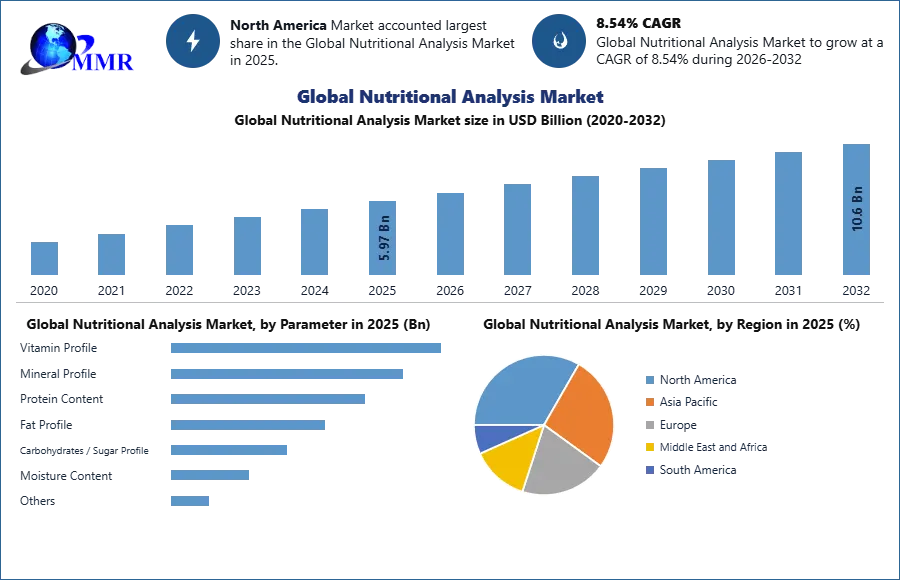 To know about the Research Methodology :- Request Free Sample Report
Variable food label policies are incentivizing market participants to use nutritional analysis. Government rules relating to food safety and higher quality are major factors considered in this market. It is an important aspect of analytical chemistry that gives data on the chemical composition, processing, quality control, and contamination of food. It ensures that commerce and food rules are followed.
Nutritional Analysis Market Dynamics:
In the packaged retail food market, nutritional analysis is commonly used in the form of nutrition fact panels and menu labelling:
Changing food label policies are causing market participants to employ nutritional analysis, which is likely to fuel the market's revenue growth. By revealing product contents and assuring that the products are safe to ingest, this technology helps the brand build goodwill. Furthermore, rising consumer demand for safe and nutritious food is likely to boost nutritional analysis demand. The worldwide nutritional analysis market is benefiting from government laws relating to food safety and higher quality.
The Comptroller and Auditor General of India released an audit report on the 'Implementation of Food Safety and Standards Act, 2006 in December 2017. As a result of tight food labelling requirements in the United States, nutrition information is required on packaged retail items in the form of nutrition facts panels. Nutritional labelling is a method of minimizing information asymmetry between producers and consumers, in which manufacturers offer information to consumers that would otherwise be unavailable to them. These factor is fuelling the growth of the nutritional analysis market.
In developing countries, a lack of food control infrastructure and resources is hindering the market expansion:
Organizations, sophistication, and the necessary technologies for food nutrition assessment are lacking in developing regions. Due to limited resources, inadequate technology, and poor management, the infrastructure of food analysis laboratories in underdeveloped nations is predicted to be sparse. The market for nutritional analysis has been reserved for matters such as a lack of institutional coordination, out-of-date technology, and a lack of information for the implementation of rules at low levels, equipment, and updated ethics. Food safety laboratories are understaffed and underequipped, particularly in nations like Ethiopia, Cuba, and Bangladesh, where trained analysts are in short supply.
New entrants to the industry are likely to capitalise on revenue potential by investing in R&D:
Newmarket entrants are likely to capitalise on revenue opportunities by investing in the research and development of cost-effective and innovative technologies. Increased consumer awareness about health and wellness, as well as changing legislation related to food nutrition and labelling in various countries throughout the world, are likely to give a huge opportunity for market expansion. The nutritional analysis evaluates the number of nutrients in the food as well as their nutritional value in percentages or grammes.
Testing procedures that take a long time which is a major challenging factor for the market:
Food nutritional analysis testing has seen advancements in technology, with nutritional analysis now taking one to three weeks with the help of improved and quick testing. Sample preparation, which includes the extraction of analyses and the separation of prospective analyses, accounts for around 60% of the overall time spent analyzing the sample. The report preparation is projected to take 20-25% of the entire time. These factors are considered as major challenging aspects for the market.
Nutritional Analysis Market Segment Analysis:
By Parameter, the market is segmented into Vitamin Profile, Mineral Profile, Proteins, Fat Profile, Sugar Profile, and Moisture. The Vitamin Profile segment is expected to hold 28.9 % of the overall market share in terms of revenue by 2032. Vitamin Profiles are intended to help in the management of nutritional deficiencies and imbalances. The Vitamin Profiles allow for the detection of a specific vitamin, nutrient, and critical co-factor imbalances that can lead to prevalent chronic disorders. Apart from this, a vitamin profile test is used to keep track of vitamin and mineral levels, as well as other nutrients, in the blood. This aids in the detection of inadequacies in the body that can lead to a variety of health problems.
However, the Mineral Profile segment is expected to grow at a CAGR of 4.4% during the forecast period. Minerals are necessary for the body's wellbeing. They are used by the body for a variety of functions, including keeping bones, muscles, heart, and brain in good functioning order. Minerals are also required for enzyme and hormone synthesis. Trace minerals are only needed in very small amounts.
By Product, the Nutritional Analysis Market is segmented into Beverages, Snacks, Meat & Poultry, and Dairy & Deserts. The Beverages segment is expected to hold 68% of the overall market share in terms of revenue by 2032. Beverages can be a source of additional nutrients in addition to providing needed hydration. Some drinks can comprise vitamins and minerals, protein, lipids, and other carbs in adding to the energy. Fruit juice, vegetable juice, whole milk, sports drinks, vitamin-enhanced waters, and alcoholic beverages all fall within this segment. Each has advantages and disadvantages. Owing to these factors this segment is a constant rise.
However, the Snacks segment is expected to grow at a CAGR of 4.4% during the forecast period. Unwanted weight gain if snacking portions or frequency are excessive, resulting in an excess of calories. Snacking excessively can lessen hunger at mealtimes or encourage people to skip meals entirely, putting them in danger of missing out on essential nutrients.
Regional Insights:
The North American region accounted for the largest market share of 35.2% in 2025. The market for nutritional analysis in North America has been continuously rising as a result of foodborne disease outbreaks. The nutritional analysis industry in this country is booming, with the help of rising worries about how food is processed, fermented, brined, or brewed, all of which necessitate proper lab testing. The growth of the US and Canadian markets initiatives the North American market. Food safety rules, labelling laws, enforcement and effective monitoring of these laws, a substantial focus on consumer protection and interests, and various sample tests were undertaken about food production and trade are all factors that are fuelling the growth of the market.
However, the Asia Pacific region is expected to grow at a CAGR of 9.12% during the forecast period. The implementation of strict restrictions, as well as the growing demand for nutritional labelling of food to market items as healthy to eat in APAC nations. Apart from this due to growing awareness and worries about how food is processed, fermented, brined, or brewed, all of which demand adequate lab testing, the nutritional analysis sector in this region is growing rapidly.
Nutritional Analysis Market Recent Developments:
| Exact Date | Company | Development | Impact |
|---|---|---|---|
| 25 February 2026 | Regulatory Bodies | Implementation of Plain English Allergen Labelling (PEAL) mandates becomes fully effective, ending all stock-in-trade exemptions. | This forces manufacturers to perform rigorous nutritional and allergen analysis to maintain market access and ensure consumer safety. |
| 20 January 2026 | Lactalis Ingredients | Launch of new protein-enriched and fiber-fortified ingredient solutions aimed at the healthy-aging and convenience snacking segments. | These ingredients enable faster product reformulation and analytical validation for brands targeting the longevity-focused consumer. |
| 15 December 2025 | Industry Consortiums | Major retailers and manufacturers formalized agreements to adopt nitrite-free meat processing standards across European markets. | This shift mandates expanded chemical analysis to ensure product stability and safety in the absence of traditional preservatives. |
| 06 November 2025 | Innova Market Insights | Publication of the 2026 Food and Beverage Trends report identifying "Powerhouse Protein" and "Gut Health" as primary drivers of innovation. | The report accelerates demand for precision nutrient profiling as companies rush to validate high-protein and probiotic claims in new product launches. |
The objective of the report is to present a comprehensive analysis of the global market to the stakeholders in the industry. The past and current status of the industry with the forecasted market size and trends are presented in the report with the analysis of complicated data in simple language. The report covers all the aspects of the industry with a dedicated study of key players that include market leaders, followers, and new entrants.
PORTER, PESTEL analysis with the potential impact of micro-economic factors of the market have been presented in the report. External as well as internal factors that are supposed to affect the business positively or negatively have been analyzed, which will give a clear futuristic view of the industry to the decision-makers. The reports also help in understanding the market dynamics, structure by analyzing the market segments and projecting the market size. Clear representation of competitive analysis of key players by Technology, price, financial position, product portfolio, growth strategies, and regional presence in the global market makes the report investor's guide.
Nutritional Analysis Market Scope: Inquire before buying
| Global Nutritional Analysis Market | |||
|---|---|---|---|
| Report Coverage | Details | ||
| Base Year: | 2025 | Forecast Period: | 2026-2032 |
| Historical Data: | 2020 to 2025 | Market Size in 2025: | 5.97 USD Billion |
| Forecast Period 2026-2032 CAGR: | 8.54% | Market Size in 2032: | 10.6 USD Billion |
| Segments Covered: | by Parameter | Vitamin Profile Mineral Profile Protein Content Fat Profile Carbohydrates / Sugar Profile Moisture Content Others |
|
| by Product | Beverages Snacks & Processed Foods Meat & Poultry Dairy Products Bakery & Confectionery Others |
||
| by Objective | New Product Development Product Labeling Regulatory Compliance Quality Control |
||
| by Nutrients | Macronutrients Micronutrients |
||
Nutritional Analysis Market by Region
North America (United States, Canada and Mexico)
Europe (UK, France, Germany, Italy, Spain, Sweden, Austria and Rest of Europe)
Asia Pacific (China, South Korea, Japan, India, Australia, Indonesia, Malaysia, Vietnam, Taiwan, Bangladesh, Pakistan and Rest of APAC)
Middle East and Africa (South Africa, GCC, Egypt, Nigeria and Rest of ME&A)
South America (Brazil, Argentina Rest of South America)
Key Players
1. Nestlé Health Science
2. Abbott Laboratories
3. Danone S.A.
4. Fresenius Kabi AG
5. Otsuka Holdings Co., Ltd.
6. Ajinomoto Co., Inc.
7. DSM-Firmenich AG
8. Arla Foods Ingredients Group
9. Synlait Milk Ltd.
10. Glanbia plc
11. Amway Corporation
12. Herbalife Ltd.
13. The Kraft Heinz Company
14. The Hain Celestial Group, Inc.
15. Kellogg Company
16. Unilever PLC
17. PepsiCo Inc.
18. General Mills Inc.
19. FrieslandCampina N.V.
20. Fonterra Co-operative Group Limited
21. Meiji Holdings Co., Ltd.
22. Morinaga Milk Industry Co., Ltd.
23. Yakult Honsha Co., Ltd.
24. AAK AB
25. Ingredion Incorporated
26. Tate & Lyle PLC
27. Baxter International Inc.
28. Sanofi S.A.
29. Pfizer Inc.
30. GlaxoSmithKline plc.
Others