
Next-Generation Sequencing Data Analysis Market: by Product, by Workflow, by Mode, by Read Length, by End User - Forecast Period
Overview
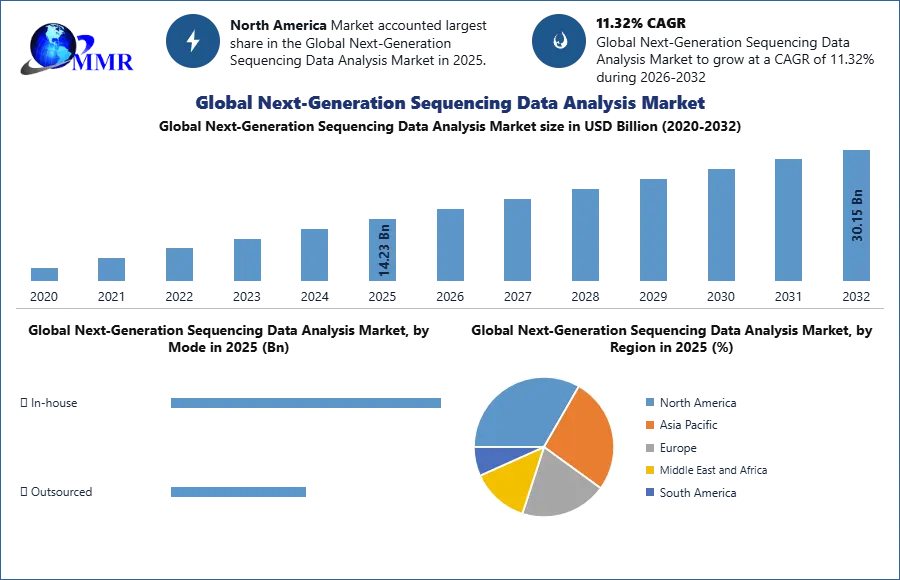
Next-Generation Sequencing Data Analysis Market is expected to reach USD 30.15 billion by 2032 at a CAGR of 11.32% during the forecast period 2026-2032.
The global Next-Generation Sequencing Data Analysis Market report is a comprehensive analysis of the industry, market, and key players. The report has covered the market by demand and supply-side by segments. The global Next-Generation Se6quencing Data Analysis report also provides trends by market segments, technology, and investment with a competitive landscape.
To know about the Research Methodology :- Request Free Sample Report
Next-Generation Sequencing Data Analysis Market Overview:
NGS, also known as high throughput sequencing, is a concept that is used to describe a variety of advanced sequencing technologies. Due to the high throughput, scalability, and speed of next-generation sequencing, researchers can investigate biological processes in depth. Because of the complexities involved in genomic science, a higher degree of understanding is now needed than that provided by traditional DNA sequencing methods.
As a result, next-generation sequencing has filled in the holes to meet these higher-level understanding requirements and has become a popular analysis method. The scalability of next-generation sequencing allows for changing the level of precision to satisfy laboratory needs, making it a digital alternative to sequence-based gene expression.
The use of NGS approaches in conjunction with the clinical diagnosis for customized treatment of many disorders, as well as genomic testing, necessitates the development of fast and accurate algorithms and sequencing visualization techniques that can process data more quickly.
Next-Generation Sequencing Data Analysis Market Dynamics:
Drivers:
Next-generation sequencing has aided in the investigation of epigenomic and genomic patterns linked to a variety of biological processes. Storage, maintenance, and accessing knowledge issues are projected to create future R&D opportunities for the sector, resulting in market growth. Laboratory Information Management Systems (LIMS) are needed for the handling and archiving of sequencing data in research communities that use high-throughput sequencers.
NGS methods have been used extensively in oncology precision medicine, primarily for lung and breast cancers. To improve their markets, companies are now concentrating on creating low-cost genome sequencing solutions.
Cloud-based platforms are a good choice for computationally intensive activities like NGS data processing. As a result, acquiring computing resources to perform large-scale NGS data analysis has become a fast and simple method. As a result, the market is projected to be driven by the growth of cloud-based bioinformatics platforms and services for large-scale NGS data processing.
Furthermore, owing to the high genetic data production and concurrent decrease in sequencing costs, the scale of sequencing ventures is expected to expand. As a result, there is a greater need for complex bioinformatics pipelines with cutting-edge and effective solutions.
Restraints:
However, the expense of infrastructural advancement of algorithms and applications is expected to stifle demand growth to some degree. Furthermore, the time-consuming aspect of NGS data collection is stifling the market's expansion. Commercial service providers, on the other hand, would have lucrative opportunities to build and build newer technologies and shorter delivery times as a result of this.
Next-Generation Sequencing Data Analysis Market Segment Analysis:
Based on Product, the services dominated the global next-generation sequencing data analysis industry with sales over 54% in 2025. Establishments that lack the necessary resources for data management, research, and interpretation readily implement cost-effective NGS data analysis services. Exome interpretation, variant calling, visualization, annotation, and other resources are available from companies including ThermoFisher Scientific, Igenbio, Inc, and Toldot Genetics.
QIAGEN's CLC Genomics Workbench is a data interpretation platform that combines epigenomics, genomics, metagenomics, and transcriptomics into a single application.
Based on Workflow, the tertiary workflow division led the sector with a market share of over 48% in 2025. For NGS tertiary data processing, a variety of annotation methods are used, and organizations are taking strategic steps to extend the reach of these tools.
Field-programmable gate arrays (FPGAs) are logic circuits that are more efficient and faster than traditional CPUs, making them ideal for personalized genomic analysis. Cloud service providers, such as Amazon Web Services, have massive storage centers with the capacity to handle a large number of samples at the same time.
Based on Mode, the in-house mode division accounted for over 65 percent of total sales, in 2025. Companies that use NGS for disease testing and evaluation while doing their research using available hardware and software resources are considered in-house. The number of these businesses is exponentially growing. Furthermore, many universities and scientific institutes' annual allocations for in-house data processing are more than double those of outsourced data analysis.
The in-house research also enables bioinformatics pipelines to quickly incorporate novel experimental workflows. These variables account for the majority of this segment's revenue, and they are expected to continue to do so during the projected period.
Based on Reading Length, the short-read sequencing held a 77.37 % share of the global market in 2020 owing to the widespread acceptance and availability of alignment instruments and algorithms for short-read sequencing results. BaseSpace Sequence Hub is a cloud computing environment for genomics that provides a series of short-read sequencing data processing software that can be used in a variety of experiments and can ease the management of sequencing data. Long and very long read sequencing segments demonstrate promising market potential. Guppy is a data processing toolkit from Oxford Nanopore that provides bioinformatic post-processing functionality and base-calling algorithms.
Based on End User, the academic institutes and research centers made significant improvements in 2020 due to an increase in the implementation of next-generation sequencing data processing workflows in academic institutions. For example, To help researchers with their ongoing academic research and programs, the University of Pittsburgh has developed centers for sequencing, bioinformatics processing, and high-performance computing.
Next-Generation Sequencing Data Analysis Market Regional Insights:
In 2025, North America had a commanding share of 48.56 percent. This is due to the involvement of a large number of major players, including Illumina, Thermo Fisher Scientific, Agilent Technologies, and several companies that use data processing tools.
However, in the coming years, Asia Pacific is expected to rise significantly in this region. This is mostly attributed to an increase in the number of grants awarded for sequencing programs in this region's developed countries. This is mostly attributed to an increase in the number of grants awarded for sequencing programs in this region's developed countries.
Furthermore, promising R&D results that encourage the use of high-throughput sequencing in clinical diagnosis are expected to drive the NGS data sequencing market in the Asia Pacific to new heights.
The objective of the report is to present a comprehensive analysis of the global Next-Generation Sequencing Data Analysis Market to the stakeholders in the industry. The past and current status of the industry with the forecasted market size and trends are presented in the report with the analysis of complicated data in simple language. The report covers all the aspects of the industry with a dedicated study of key players that include market leaders, followers, and new entrants.
PORTER, SVOR, PESTEL analysis with the potential impact of micro-economic factors of the market have been presented in the report. External as well as internal factors that are supposed to affect the business positively or negatively have been analyzed, which will give a clear futuristic view of the industry to the decision-makers.
The report also helps in understanding the global Next-Generation Sequencing Data Analysis Market dynamics, structure by analyzing the market segments and project the global Next-Generation Sequencing Data Analysis Market size. Clear representation of competitive analysis of key players by product, price, financial position, product portfolio, growth strategies, and regional presence in the global Next-Generation Sequencing Data Analysis Market make the report investor’s guide.
Next-Generation Sequencing Data Analysis Market Key Developments:
In July 2024, Thermo Fisher Scientific partnered to enhance clinical research and treatment of myeloid cancers through Next-Generation Sequencing (NGS) technology. This collaboration aims to deepen the understanding of myeloid cancer genetics, enabling more accurate diagnostics and targeted therapies. The increasing use of NGS in cancer research is driving demand for advanced data analysis solutions, contributing to the growth of the Next-Generation Sequencing Data Analysis Market.
Next-Generation Sequencing Data Analysis Market Scope: Inquire before buying
| Global Next-Generation Sequencing Data Analysis Market | |||
|---|---|---|---|
| Report Coverage | Details | ||
| Base Year: | 2025 | Forecast Period: | 2026-2032 |
| Historical Data: | 2020 to 2025 | Market Size in 2025: | 5 USD Billion |
| Forecast Period 2026-2032 CAGR: | 4.5% | Market Size in 2032: | 6.8 USD Billion |
| Segments Covered: | by Product | Services NGS Commercial Software o Platform OS/UI o Analytical Software o Alignment Tools & Softwares DNA Sequence Alignment RNA Sequence Alignment Protein Sequence Alignment o QC/Pre-processing Tools o Others |
|
| by Workflow | Primary Secondary o Read Mapping o Variant Alignment & Variant Calling Tertiary o Variant Annotation o Application-Specific
|
||
| by Mode | In-house Outsourced |
||
| by Read Length | Short Read Long Read Very Long Read |
||
| by End User | Academic Research Clinical Research Hospitals & Clinics Pharma & Biotech Entities Other End Users |
||
Next-Generation Sequencing Data Analysis Market Key Players
1. Thermo Fisher Scientific, Inc.
2. QIAGEN N.V.
3. Illumina, Inc.
4. F. Hoffmann‑La Roche Ltd. (Roche)
5. Agilent Technologies, Inc.
6. Bio‑Rad Laboratories, Inc.
7. DNAnexus Inc.
8. Eurofins Scientific
9. Partek Incorporated
10. Fabric Genomics, Inc.
11. SOPHiA GENETICS
12. Seven Bridges (Seven Bridges Genomics)
13. PierianDx (Optra Health)
14. Golden Helix, Inc.
15. Congenica Ltd.
16. Genuity Science
17. WuXi NextCODE / WuXi AppTec
18. Benchling
19. Google Cloud (genomics data analysis tools)
20. Microsoft Azure (genomics analytics)
21. Amazon Web Services (AWS) — Genomics Solutions
22. Qlucore (bioinformatics software)
23. Computomics (bioinformatics services)
24. PerkinElmer, Inc.
25. DNASTAR, Inc.
26. BGI Genomics Co., Ltd. (data analysis support)
27. Precigen Bioinformatics GmbH
28. SciGenom Labs Pvt. Ltd.
29. Verily Life Sciences (Alphabet)
30. Clear Labs (genomics data analysis)
Frequently Asked Questions:
1. What is the growth rate of Global Next-Generation Sequencing Data Analysis Market?
Ans: The Global Next-Generation Sequencing Data Analysis Market is growing at a CAGR of 11.32% during forecasting period 2022-2029.
2. What is scope of the Global Next-Generation Sequencing Data Analysis market report?
Ans: Global Next-Generation Sequencing Data Analysis Market report helps with the PESTEL, PORTER, COVID-19 Impact analysis, Recommendations for Investors & Leaders, and market estimation of the forecast period.
3. Who are the key players in Global Next-Generation Sequencing Data Analysis market?
Ans: The important key players in the Global Next-Generation Sequencing Data Analysis Market are – Thermo Fisher Scientific, Inc., Illumina, Inc., QIAGEN, F. Hoffman-La Roche Technologies, Agilent Technologies, Intrexon Bioinformatics Germany GmbH, Partek, Inc., PierianDx, DNASTAR, Inc., Eurofins Scientific, Congenica Ltd., Bio Rad Laboratories, Inc., Genuity Science, DNAnexus Inc., SciGenom Labs Pvt. Ltd, Golden Helix, Inc., and Other Key Players
4. What is the study period of this market?
Ans: The Global Next-Generation Sequencing Data Analysis Market is studied from 2026-2032.