
Nanoceramic Powder Market Size by Powder Type, Nature, Application, End-User, Region – Segment-Level Market Assessment, Growth Opportunity Analysis, Competitive Mapping & Forecast to 2032
Overview
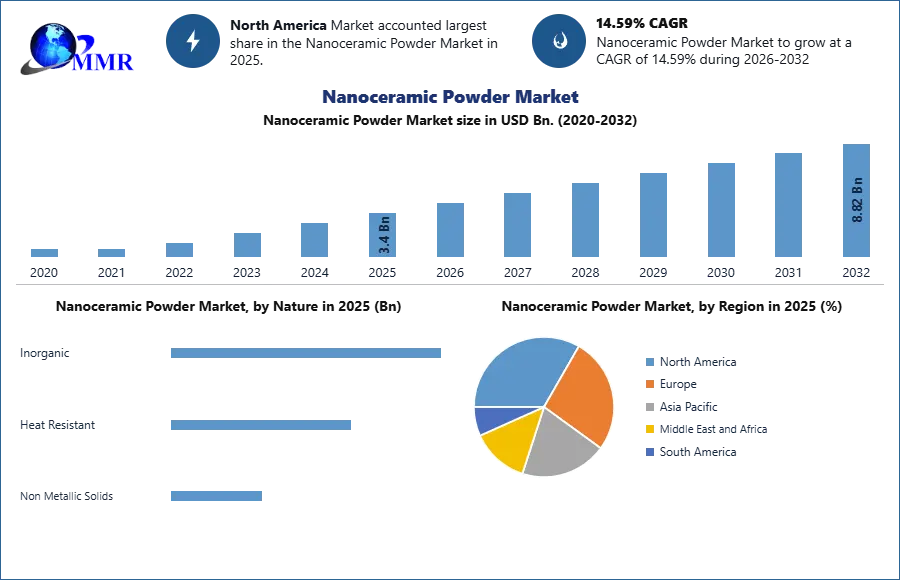
The Nanoceramic Powder Market size was valued at USD 3.4 Billion in 2025 and the total Nanoceramic Powder revenue is expected to grow at a CAGR of 14.59% from 2026 to 2032, reaching nearly USD 8.82 Billion.
Nanoceramic Powder Market Overview:
Nanoceramic powder refers to ceramic material that has been processed to have a particle size in the nanometer range (typically less than 100 nanometers). This ultrafine particle size gives the material unique properties such as high surface area, high reactivity, and enhanced mechanical strength. Nanoceramic powders is made from a variety of ceramic materials including oxides, carbides, nitrides, and others. They have a wide range of applications in areas such as electronics, energy storage, biomedical devices, and coatings.
Nanoceramic powders are produced using specialized processing techniques such as sol-gel synthesis, hydrothermal synthesis, and high-energy ball milling. These techniques enable the creation of homogeneous, high-purity powders with controlled particle sizes and shapes.
To know about the Research Methodology :- Request Free Sample Report
Nanoceramic Powder Market Dynamics:
Growing demand from various end-use industries to boost the Nanoceramic Powder Market growth
Nanoceramic powder is used in a wide range of applications, including electronics, energy, aerospace, defense, and biomedical industries. With the increasing demand for high-performance materials in these industries, the demand for nanoceramic powder is also rising. Advances in nanotechnology have led to the development of new and advanced nanoceramic powders with improved properties such as high strength, durability, and resistance to wear and corrosion. This has increased the demand for nanoceramic powder in various industries. Governments and private companies are investing heavily in research and development of nanoceramic powders to develop new applications and improve existing products and is expected to boost the Nanoceramic Powder Industry growth.
Nanoceramic powder is considered to be a more environmentally friendly alternative to traditional materials due to its durability and resistance to wear and corrosion and has led to an increase in demand for nanoceramic powder companies as they strive to meet environmental regulations. Nanoceramic powder is used in a wide range of medical applications, such as dental implants, bone substitutes, and drug delivery systems. With the increasing demand for advanced medical treatments and devices, the demand for nanoceramic powder is also increasing and is significantly contributing for the Nanoceramic Powder Market growth.
High production costs to boost the Nanoceramic Powder industry growth
The production of nanoceramic powder is a complex and expensive process, which can make the final product more costly and limit the adoption of nanoceramic powder in certain industries, particularly those with cost-sensitive markets. There are concerns over the potential health and safety risks associated with the use of nanoceramic powder. Inhalation of nanoparticles may cause respiratory problems and skin contact may lead to skin irritation. These concerns is expected to limit the adoption of nanoceramic powder in certain applications. The availability of raw materials needed for the production of nanoceramic powder is limited and is expected to hinder the growth of the Nanoceramic Powder market. There is a lack of standardized testing and characterization methods for nanoceramic powders, which can lead to inconsistencies in quality and performance. Nanoceramic powder faces competition from other advanced materials, such as carbon nanotubes, graphene, and advanced polymers and limit the growth of the nanoceramic powder market.
Nanoceramic Powder Market Trends:
Increasing demand for high-performance materials: Industries such as electronics, aerospace, and biomedical seek to improve performance and reduce costs, the demand for high-performance materials such as nanoceramic powder is increasing.
Growing interest in additive manufacturing: Additive manufacturing technologies such as 3D printing are being increasingly used to produce complex geometries and customized parts. This is driving demand for nanoceramic powders that can be used in these processes.
Rising demand for biomedical applications: The use of nanoceramic powder in biomedical applications is increasing due to its biocompatibility, high strength, and resistance to wear and corrosion and is driving demand for nanoceramic powder in the medical industry.
Development of new nanoceramic powder formulations: Researchers are developing new formulations of nanoceramic powder with improved properties such as increased strength, flexibility, and thermal stability and is expected to expand the range of applications for nanoceramic powder market growth.
Increasing collaborations and partnerships: Collaboration and partnerships among companies, research institutions, and government organizations are increasing, which is expected to drive innovation and product development , along with growth in Nanoceramic Powder market share.
Nanoceramic Powder Market Regional Analysis:
North America region dominated the Nanoceramic Powder industry in 2025 and is expected to dominate the market over the forecast period by accounting largest Nanoceramic Powder Market share. North America is home to several major end-use industries, including aerospace, defense, electronics, and biomedical, which are key users of nanoceramic powder. This is expected to drive demand for nanoceramic powder in the region. Growing investment in research and development by institutions and companies that are investing heavily in research and development of nanoceramic powders. This is expected to drive innovation and product development in the region.
Favorable regulatory environment for nanoceramic powder, with clear guidelines and standards for the use and production of nanomaterials and is expected to encourage adoption of nanoceramic powder in various industries and is expected to influence the Nonceramic Powder market growth. The demand for nanoceramic powder in biomedical applications is growing rapidly in North America due to its biocompatibility, high strength, and resistance to wear and corrosion. This is expected to drive growth in the nanoceramic powder market. North America is home to several major players in the nanoceramic powder market, which is expected to drive competition and innovation in the regional market.
European region is expected to fuel the Nanoceramic Powder market over the forecast period. The demand for energy-efficient materials is growing rapidly in Europe, driven by government initiatives to reduce carbon emissions. Nanoceramic powder is expected to play a key role in the development of energy-efficient materials, which is expected to drive growth in the nanoceramic powder market. The demand for nanoceramic powder in biomedical applications is growing rapidly in Europe due to its biocompatibility, high strength, and resistance to wear and corrosion. This is expected to drive growth in the nanoceramic powder market.
Nanoceramic Powder Market Segment Analysis
Based on Powder type, the market is segmented by Oxide Powder, Carbide Powder, Nitride Powder, Boron Powder, Magnesia Powder, and Zirconia Fiber Powder. The Zirconia Fiber powder segment is expected to dominate the market over the forecast period. Zirconia is a popular oxide powder type used in the Nanoceramic powder market. The powder is used in applications such as dental implant, fuel cells, and sensors. Zirconia Fiber powder is known for its high strength, toughness, and biocompatibility. Zirconia fiber powder is known for its electrical conductivity, which makes it suitable for use in electronics component such as sensors, capacitors, and batteries. The powder includes reinforcing fiber in composites, thermal insulation in furnaces and kilns, and as a compound in biomedical implants.
Based on Application, the market is segmented into Bone repair, Energy & Supply Storage, Coatings, Electronics, Catalysis, Automotive, and Textiles. Bone repair segment dominated the Nanoceramic powder industry in 2024 and is expected to continue the dominance over the forecast period. Nanoceramic Powder is the most common material used in the medical sector, and especially in bone repair treatment. Concerns of surgeons is to treat large and critical-sized bone defects and to promote bone regeneration, which can be treated with the use of Nanoceramic powder. Zirconia Nanoceramic is mostly used structures for extensive bone repair. It has mechanical properties that make it suitable for the manufacture of highly porous structures for extensive bone repair treatment and is expected to boost the Nanoceramic Powder market growth.
Nanoceramic Powder Market Competitive Landscape:
The Nanoceramic Powder industry is having various opportunities for new market entrants to a continuous shift in consumer preference towards a healthy lifestyle. Application of Nanoceramic Powder in various industries presents a lucrative opportunity for Nanoceramic Powder manufacturers in various parts of the globe. Beside this factors such as territorial market size, competition intensity, capacity and local infrastructure influence the value chain of the product. Nanoceramic Powder companies are directly involved in retail activity and are investing in e-commerce to gain benefits from the market.
The Nanoceramic Powder key players are implementing growth strategies for marketing different schemes to gain a competitive advantage in the market. The strategies adopted by the major player, such as expansion of product portfolio, mergers & acquisitions, geographical expansion, and collaborations, to enhance the Nanoceramic Powder market penetration. These companies are involved in various activities in the Nanoceramic Powder market, including soybean processing, oil refining, distribution, and marketing. The Nanoceramic Powder key players are Powder Processing & Technology, TQ Abrasive Machining, SCI Engineered Materials, and Reade Advanced Materials.
Recent Industry Developments (2025–2026)
| Exact Date | Company | Development | Impact |
|---|---|---|---|
| 10 February 2026 | Tosoh Corporation | The company expanded its nanoceramic powder production capacity in Japan to meet the surging demand for high-purity zirconia in the semiconductor industry. | This expansion strengthens Tosoh's market leadership in high-end electronics and ensures a stable supply chain for 6G hardware manufacturing. |
| 23 January 2026 | CeramTec GmbH | The company launched a new line of biocompatible nanoceramic coatings specifically designed for 3D-printed orthopedic implants. | This development significantly accelerates osseointegration in medical patients, providing a competitive edge in the high-growth healthcare ceramics segment. |
| 15 December 2025 | CoorsTek Inc. | CoorsTek implemented an eco-friendly powder synthesis technique at its U.S. facilities, reducing manufacturing waste by 7%. | The move aligns with global sustainability targets and reduces long-term operational costs for alumina-based ceramic production. |
| 04 September 2025 | Fraunhofer IKTS | At the ECerS Conference, Fraunhofer presented a breakthrough in hybrid nanoceramic powders for solid-state batteries. | This technical milestone paves the way for next-generation energy storage with improved thermal stability and energy density. |
| 14 May 2025 | 3M Company | The company introduced a series of silicon nitride nanoceramic powders engineered for extreme-wear aerospace applications. | This product launch improves component durability in hypersonic flight environments, securing 3M’s position in defense supply chains. |
| 12 February 2025 | Kyocera Corporation | Kyocera debuted high-frequency nanoceramic substrates optimized for AI server hardware and 6G telecommunications. | The development enables faster heat dissipation in compact electronics, directly addressing critical bottlenecks in high-speed computing. |
Nanoceramic Powder Market Scope: Inquire before buying
| Nanoceramic Powder Market | |||
|---|---|---|---|
| Report Coverage | Details | ||
| Base Year: | 2025 | Forecast Period: | 2026-2032 |
| Historical Data: | 2020 to 2025 | Market Size in 2025: | 3.4 USD Bn. |
| Forecast Period 2026-2032 CAGR: | 14.59% | Market Size in 2032: | 8.82 USD Bn. |
| Segments Covered: | by Powder Type | Oxide Powder Carbide Powder Nitride Powder Boron Powder Magnesia Powder Zirconia Fiber Powder |
|
| by Nature | Inorganic Heat Resistant Non Metallic Solids |
||
| by Application | Bone repair Energy & Supply Storage Coatings Electronics Catalysis Automotive Textiles |
||
| by End User | Electrical & Electronics Industrial Transportation Healthcare Chemical Defense Building & Construction |
||
Nanoceramic Powder Market, by Region:
North America (United States, Canada and Mexico)
Europe (UK, France, Germany, Italy, Spain, Sweden, Austria and Rest of Europe)
Asia Pacific (China, South Korea, Japan, India, Australia, Indonesia, Malaysia, Vietnam, Taiwan, Bangladesh, Pakistan and Rest of APAC)
Middle East and Africa (South Africa, GCC, Egypt, Nigeria and Rest of ME&A)
South America (Brazil, Argentina Rest of South America)
Key Players / Competitors Profiles Covered in Brief in Global Nanoceramic Powder Market Report in Strategic Perspective:
- 3M Company
- CeramTec GmbH
- Kyocera Corporation
- Saint-Gobain
- CoorsTek Inc.
- Tosoh Corporation
- Morgan Advanced Materials plc
- Nanophase Technologies Corporation
- Nishimura Advanced Ceramics Co., Ltd.
- Cerion LLC
- Innovnano-Materiais Avançados SA
- Inframat Corporation
- American Elements
- Advanced Ceramic Manufacturing
- McDanel Advanced Ceramic Technologies
- Rauschert Steinbach GmbH
- Blasch Ceramics
- Nitto Denko Corporation
- Zimmer Biomet
- Lithoz GmbH
- H.C. Starck GmbH
- Showa Denko K.K.
- Bayer AG
- Evonik Industries AG