
Military Battery Market Size by Type, Offering, Composition, Platform, Energy Consumption, Region, Industry-Wide Analysis, Competitive Landscape Assessment & Long-Term Forecast to 2032
Overview
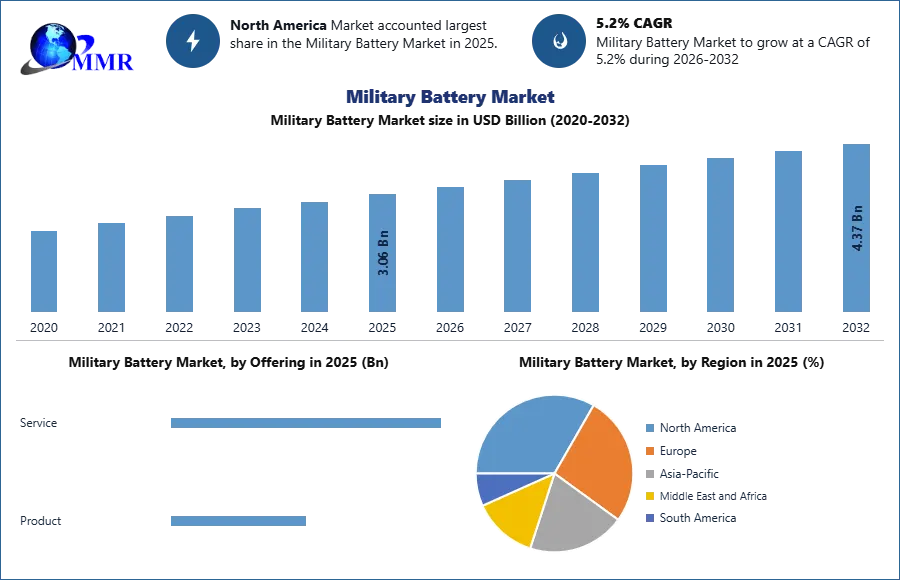
The Military Battery Market size was valued at USD 3.06 Billion in 2025, and the total revenue is expected to grow at a CAGR of 5.2% from 2026 to 2032, reaching nearly USD 4.37 Billion.
Military Battery Market Overview
The Military Battery Market is expanding steadily due to the increasing modernization of defense technologies and the gradual shift toward alternative energy solutions across armed forces. Rising environmental concerns, volatility in crude oil prices, and logistical challenges associated with fuel transportation have accelerated the adoption of advanced energy storage systems within military operations. Unlike conventional industrial or commercial batteries, military batteries are specifically engineered to deliver high energy density, rugged durability, extended lifecycle performance, and reliable operation under extreme environmental and combat conditions.
Military batteries play a critical role in soldier system assemblies, ensuring an uninterrupted power supply for communication devices, navigation systems, surveillance equipment, and wearable technologies on the battlefield. They also support unmanned aerial vehicles (UAVs), ground robots, and tactical vehicles, maintaining operational continuity when traditional power sources are unavailable. Increasing demand for lightweight, portable defense equipment, growing deployment of UAVs, and the long-term cost efficiency of battery-powered systems compared to fossil fuel alternatives are key factors driving growth in the Military Battery Market.
 To know about the Research Methodology :- Request Free Sample Report
Military Battery Market Dynamics
Rising Electrification and Mobile Warfare Requirements
Evolving warfare strategies and the growing reliance on mobile, connected battlefield technologies are significantly driving the Military Battery Market. Modern soldier systems increasingly integrate radios, thermal imaging devices, night-vision systems, sensors, GPS units, and advanced weapon platforms, all of which require lightweight, high-energy-density power sources. The limitations of solar power in combat zones and the need for reliable, portable energy storage solutions have accelerated demand for advanced military-grade batteries. Furthermore, the expansion of unmanned systems, including UAVs, ground robots, and remotely operated vehicles, has strengthened the requirement for durable and long-lasting battery systems capable of operating in extreme environmental conditions.
In addition, rising fuel price volatility and logistical challenges associated with transporting conventional fuels in conflict zones have encouraged defense forces to adopt electrified and hybrid technologies. Several countries, including United Kingdom, France, Germany, and United Arab Emirates, have aligned with emission reduction targets under the Paris Climate Agreement, prompting large-scale electrification of military ground equipment. Companies such as Epsilor-Electric Fuel Ltd. have introduced advanced military battery solutions, including the COMBATT 6T product line, to support high-performance communication and vehicle systems. These developments collectively reinforce sustained demand within the Military Battery Market.
Budget Constraints and Infrastructure Gaps
Despite strong growth drivers, the Military Battery Market faces notable challenges. Defense budget constraints in both developed and developing economies can delay procurement cycles and limit large-scale deployment of advanced battery technologies. Additionally, the lack of charging and maintenance infrastructure for electric military vehicles and hybrid systems restricts rapid adoption, particularly in remote or combat-intensive regions. High development costs, strict safety standards, and the need for ruggedized battery performance further add to implementation complexity, moderating the pace of market expansion.
Military Battery Market Segment Analysis:
By Type:
Growing deployment of hybrid-powered military equipment is expected to support strong demand across both rechargeable and non-rechargeable categories in the Military Battery Market. Non-rechargeable military batteries continue to maintain relevance in mission-critical applications requiring immediate, high-reliability power with minimal maintenance. However, increasing electrification of defense platforms and environmental sustainability initiatives have accelerated adoption of rechargeable military batteries. Demand for rechargeable variants increased by approximately 2.3% during the recent period, particularly across developed defense markets such as the United States, China, and France, driven by lifecycle cost efficiency and reusability advantages.
By Offering:
The need for integrated infrastructure to support battery-operated defense systems is projected to drive the services segment, including software integration, maintenance, and repair solutions, within the Military Battery Market. As armed forces increasingly deploy battery-powered systems in geographically challenging combat zones, aftersales support and system optimization services become critical. Additionally, procurement of advanced battery systems recorded an estimated 3.1% increase in demand during the latter half of the decade in countries such as Russia, Turkey, and Saudi Arabia, reflecting modernization initiatives and battlefield mobility requirements.
By Composition:
Lead-acid batteries continue to witness stable adoption due to their non-spillable design, cost-effectiveness, and high charge retention capabilities, with demand rising by nearly 3.8% in developing defense economies. Nickel-based batteries also observed an estimated 3.1% growth in adoption, particularly in cold-region military operations where performance stability under low temperatures is critical. Nevertheless, lithium-based batteries are projected to dominate the battery composition segment of the Military Battery Market in the coming years, owing to their superior specific energy, higher energy density, lighter weight, and extended lifecycle performance.
Military Battery Market Regional Insights
North America emerged as the largest regional market for military batteries in 2025, accounting for an estimated 41% of global revenue. The region’s dominance is driven by sustained defense spending in the United States and Canada, where government budgets prioritize modernization of military platforms such as unmanned vehicles, portable soldier systems, naval vessels, and communication equipment. Strategic emphasis on energy security, deployment readiness, and electronics-heavy warfare systems has accelerated procurement of advanced battery technologies including lithium-ion and hybrid chemistries.
Europe holds the second-largest share of the Military Battery Market in 2025, supported by increasing defense collaborations among NATO members and growing focus on enhancing military mobility, interoperability, and power efficiency. Countries such as the UK, Germany, and France are updating armored vehicles, naval vessels, and tactical systems with next-generation battery technologies to improve operational endurance and reduce logistics burdens.
Military Battery Market Recent Developments (2025–2026)
| Exact Date | Company | Development | Impact |
|---|---|---|---|
| 11 December 2025 | Denchi Group | Appointed Astute Group as an authorized distribution partner to expand access to its high-performance lithium-ion battery systems for mission-critical sectors. | The partnership streamlines the procurement of ruggedized power systems for unmanned aerial (UAV) and ground (UGV) platforms across the defense and aerospace sectors. |
| 11 September 2025 | EnerSys | Launched the Hawker® ARMASAFE™ iON-X 24-volt lithium-ion batteries in 105 Ah and 162 Ah models for military vehicle applications. | These 6T size batteries provide high-current starting and energy storage for modern mobile command centers, enhancing onboard electronic reliability. |
| 11 August 2025 | EaglePicher Technologies | Broke ground on a second 20,000 square foot manufacturing facility in Pittsburg, Kansas, to produce components for long-lasting thermal batteries. | The expansion targets the production of headers for missile batteries, significantly boosting the supply chain for U.S. Department of Defense weapon systems. |
| 30 April 2025 | Saft America Inc. | Secured a $7.5 million firm-fixed-price contract from the U.S. Department of Defense for storage batteries supporting H1, Seahawk, and CH-53 helicopters. | This three-year base contract ensures the operational readiness of critical aircraft fleets across the Navy, Air Force, and Marine Corps through 2028. |
The objective of the report is to present a comprehensive analysis of the Military Battery Market to the stakeholders in the industry. The past and current status of the industry with the forecasted market size and trends are presented in the report with the analysis of complicated data in simple language. The report covers all the aspects of the industry with a dedicated study of key players that include market leaders, followers, and new entrants.
PORTER, SVOR, PESTEL analysis with the potential impact of micro-economic factors of the market have been presented in the report. External as well as internal factors that are supposed to affect the business positively or negatively have been analyzed, which will give a clear futuristic view of the industry to the decision-makers.
The report also helps in understanding the Military Battery Market dynamics, structure by analyzing the market segments and Project the Military Battery Market size. Clear representation of competitive analysis of key players by product, price, financial position, product portfolio, growth strategies, and regional presence in the Military Battery Market make the report investor’s guide.
Military Battery Market Scope: Inquire before buying
| Military Battery Market | |||
|---|---|---|---|
| Report Coverage | Details | ||
| Base Year: | 2025 | Forecast Period: | 2026-2032 |
| Historical Data: | 2020 to 2025 | Market Size in 2025: | 3.06 USD Billion |
| Forecast Period 2026-2032 CAGR: | 5.2% | Market Size in 2032: | 4.37 USD Billion |
| Segments Covered: | by Type | Rechargeable Non-rechargeable |
|
| by Offering | Service Product |
||
| by Composition | Lithium Battery Lead Acid Battery Nickel Battery Thermal Battery |
||
| by Platform | Land Marine Aviation Space Munitions |
||
| by Energy Consumption | Less than 12 Volts 12 Volts - 24 Volts More than 24 Volts |
||
Military Battery Market, by Region
North America (United States, Canada and Mexico)
Europe (UK, France, Germany, Italy, Spain, Sweden, Austria, Turkey, Russia and Rest of Europe)
Asia Pacific (China, India, Japan, South Korea, Australia, ASEAN and Rest of APAC)
Middle East and Africa (South Africa, GCC, Egypt, Nigeria and Rest of ME&A)
South America (Brazil, Argentina, Columbia and Rest of South America)
Key Players/Competitors Profiles Covered in Brief Military Battery Market Report in Strategic Perspective
- Saft Group SA
- EnerSys
- Ultralife Corporation
- EaglePicher Technologies, LLC
- Bren-Tronics Inc.
- Arotech Corporation
- BAE Systems PLC
- General Dynamics
- GS Yuasa Corporation
- Kokam (SolarEdge)
- Epsilor-Electric Fuel Ltd.
- Denchi Group (Denchi Power)
- Concorde Battery Corporation
- Mathews Associates, Inc.
- Lincad Ltd.
- BST Systems, Inc.
- Teledyne Technologies Incorporated
- Navitas Systems LLC
- Cell-Con, Inc.
- Amara Raja Batteries Limited
- HBL Power Systems Ltd.
- Incitec Pivot Limited (Dyno Nobel)
- K+S Aktiengesellschaft
- Tessenderlo Group
- Uralchem JSC