
Global Medical Exoskeleton Market Size by Type, Extremity, and Region – Segment-Level Market Assessment, Growth Opportunity Analysis, Competitive Mapping & Forecast to 2032
Overview
Medical Exoskeleton Market Market size was valued at USD 0.69 Bn in 2025 and is expected to reach USD 5.98 Bn by 2032, at a CAGR of 36.2%.
Medical Exoskeleton Market Overview:
A wearable electromechanical device known as a medical exoskeleton was created to help patients with mobility difficulties recover from their injuries and motor function in their partly or fully paralyzed lower extremities. The gadgets can improve biological abilities, such as orthotics devices that help people regain their ability to walk or move. This wearable gadget thereby allows patients more mobility, strength, and endurance. People with physical disabilities including spinal cord injuries, neurological disorders, paralysis, or elderly individuals live better due to medical exoskeletons.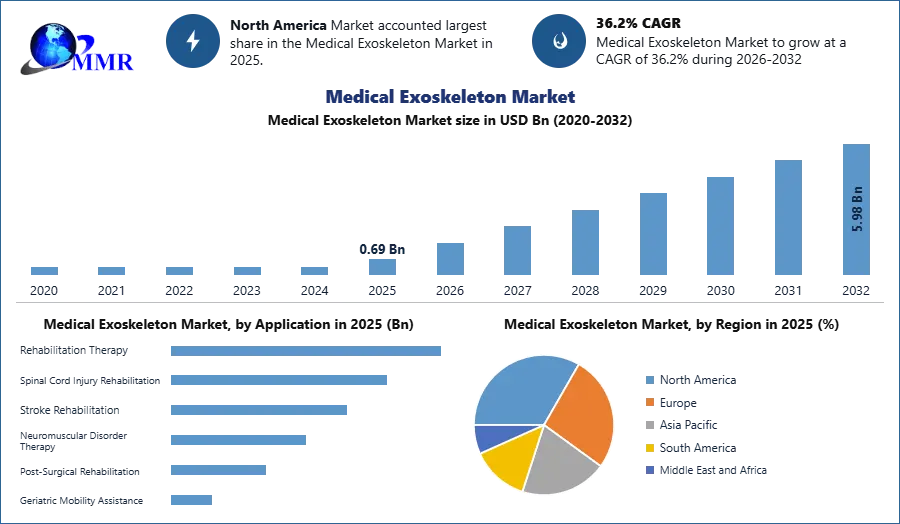 To know about the Research Methodology:-Request Free Sample Report
Some of the medical exoskeletons are used in physiotherapy and rehabilitation facilities for inpatient treatment and mobility. This technology is also used by other sectors, including the military and citizens, to increase soldier mobility and cargo capacity as well as load handling skills. The gadget is used in the medical field to teach patients with motor nerve degradation and cognitive-motor limitations as well as to restore lost capability and prolong patient life.
2025 is considered as a base year to forecast the market from 2026 to 2032. 2025’s market size is estimated on real numbers and outputs of the key players and major players across the globe. Past five years' trends are considered while forecasting the market through 2029. 2021 is a year of exception and analysis especially with the impact of lockdown by region.
Medical Exoskeleton Market Dynamics:
Market Drivers:
Affordable exoskeleton with improved sensory systems with numerous degrees of flexibility: In order to accomplish effective parallel control, the rapid improvements in robotics & virtual reality need more complicated human-machine interfaces. The exoskeleton is just wearable equipment that costs a lot of money and requires a lot of data processing to capture multidimensional human actions.
A triboelectric bi-directional sensor, as an alternative to a specialized exoskeleton, can monitor all of the moveable joints in the human upper limbs with the least amount of power. The virtual character and robotic arms are controlled in real-time using the matching movements, which comprise two degrees of freedom (DOF) shoulders revolutions, wrist-twisting, and bending motions.
Due to the structural similarity between the exoskeleton as well as the human body, the following kinetic analysis provides additional physical characteristics without the need for extra sensors. A high-tech, low-cost human-machine interface for handling items in the physical and virtual worlds, such as in robotic process automation, healthcare, and training, holds great potential for this exoskeleton sensory system. As a result of the above factors, the sector is expected to lead during the forecast period.
Growing need for orthopedic rehabilitation in the healthcare market: In addition to other variables, such as an aging population, an increase in road accidents & severe trauma injuries, and an increase in the frequency of stroke, the number of persons with physical impairments is rising globally.
Exoskeletons for rehabilitation are used to help patients recover from serious physical injuries or to aid them with normal tasks. According to MMR, more than 2,95,000 Americans suffer serious spinal injuries each year. Paraplegia strikes about 54% of these people. The National Center for Biotechnology Information (NCBI) estimates that there were 2.1 million persons living with limb loss in the United States in 2017 and that this figure will double by 2050. To assist patients suffering from a stroke or other diseases, many important players are developing exoskeletons for orthopedic rehabilitation.
Rising stroke incidences: One of the most common causes of acquired severe disability, stroke has a higher chance of surviving as medical science and treatment methods advance. Rehab treatment methods would be required due to the region's aging population, which is susceptible to strokes & mobility problems. Exoskeleton demand is rising as a result of an aging population with stroke-related impairments and people who have trouble communicating and moving.
Market Restraints:
Difficulties in obtaining regulatory approvals for exoskeleton medical applications: The key concerns in the advancement of medical devices are user safe and device reliability. Manufacturers' technical design skills and knowledge are critical during product testing. Because a medical equipment failure might be harmful, exoskeletons used for healthcare reasons must be properly reviewed.
Also, only a few standards now apply directly to the exoskeleton sector. Only items that have acquired FDA approval can be offered to clients, and the FDA accepts ISO standards which can apply to relevant firms. According to reports released on September 29, 2020, the European Parliament has passed strict resolutions prohibiting the direct use of automation and artificial intelligence, emphasizing the reason that contact is expected to generate several ethical, legal, and social difficulties.
Market Trends:
In March 2021, At the Hannover Messe Digital Edition 2021 event, Ottobock introduced the Paexo Shoulder Jacket, Paexo Thumb Slim, and Paexo Cool Sleeve products. During strenuous duties like moving heavy packages or performing overhead labor, these devices provide the body with excellent relaxation.
In August 2020, A leading provider of exoskeleton technologies for medical and industrial applications, Ekso Bionics Holdings Inc., launched EVOTM, an upper-body assistance exoskeleton that increases endurance and lessens the strain of repetitive work. The next development in industrial exoskeleton technology is EVO, which builds on the company's ground-breaking EksoVest technology.
Medical Exoskeleton Market Segment Analysis:
Based on Type, the powered segment dominated the market with 57% share in 2025.The rising demand for personal safety and performance, as well as the existence of multiple controlling features and sensors to monitor tilt, speed, and motion, are major drivers of the growth of this segment. The increasing usage by construction personnel to move large things is likely to support the growth of this market. The existence of various regulating functions and sensors in this type of exoskeletons to measure tilt, speed, and motion is also boosting the segment's growth.
The passive exoskeleton segment will be at a fast rate as a result of its affordability and lighter weight.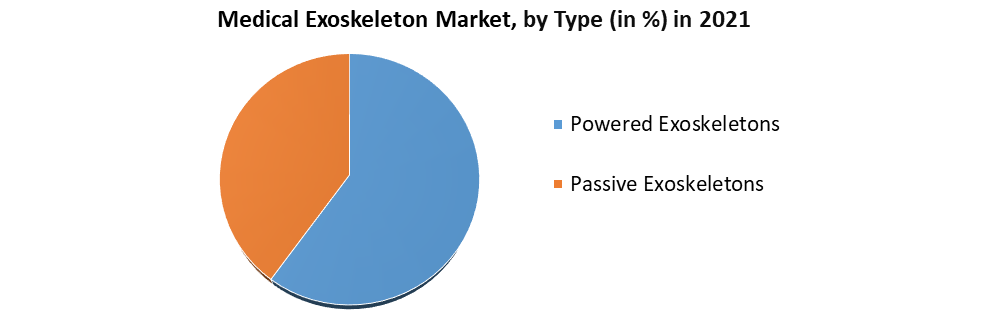
Based on the Extremity, the lower extremity Medical Exoskeletons segment dominated the market with 42% share in 2025. This can be attributed to their benefits, such as a rise in neurological injuries, which can lead to significant muscle weakness as well as impaired motor control, severely affecting individuals' gait and motion abilities. Another important factor driving the increased need for lower extremity exoskeletons is orthopedic rehabilitation training, which typically entails performing certain motions to induce motor plasticity and, eventually, better motor recovery. Patients must develop their musculoskeletal power and motor control while minimizing functional limitations.
Medical Exoskeleton Market Regional Insights:
The North America region dominated the market with 34% % share in 2021. This is because of the rising geriatric population, increased incidence of strokes as well as traumatic brain injuries, rising prevalence of neurological disorders, and increasing government focus on providing access to health care services to such indications all assisted market growth in this region. The increased occurrence of spinal cord injury is one of the key causes driving the expansion of exoskeletons in this region
The Asia Pacific region is expected to witness significant growth at a CAGR of 39.1% through the forecast period. Rapid population growth and rising economic development are driving the expansion of this area in the exoskeleton industry. Countries in this area, such as China, and India are some of the most technologically growing in the world, giving significant potential opportunities for market players.
The objective of the report is to present a comprehensive analysis of the global Medical Exoskeleton Market to the stakeholders in the industry. The past and current status of the industry with the forecasted market size and trends are presented in the report with the analysis of complicated data in simple language. The report covers all the aspects of the industry with a dedicated study of key players that include market leaders, followers, and new entrants.
PORTER, PESTEL analysis with the potential impact of micro-economic factors of the market have been presented in the report. External as well as internal factors that are supposed to affect the business positively or negatively have been analyzed, which will give a clear futuristic view of the industry to the decision-makers.
The reports also help in understanding the Medical Exoskeleton Market dynamic, structure by analyzing the market segments and projecting the Medical Exoskeleton Market size. Clear representation of competitive analysis of key players by product, price, financial position, product portfolio, growth strategies, and regional presence in the Medical Exoskeleton Market make the report investor’s guide.
Medical Exoskeleton Market Recent Industry Developments (2025–2026)
| Date | Company | Development | Impact |
|---|---|---|---|
| 21 January 2026 | CYBERDYNE Inc. | The company signed a strategic Memorandum of Understanding (MoU) with Carnegie Mellon University to accelerate the research and social implementation of Cybernics technology. | This collaboration aims to establish a new medical and healthcare ecosystem in the United States, utilizing Physical AI for advanced rehabilitation. |
| 04 December 2025 | Ekso Bionics Holdings, Inc. | The company entered an exclusive agreement to become the U.S. distributor for MediTouch’s BalanceTutor rehabilitation system. | The partnership integrates 4D perturbation technology with Ekso’s existing healthcare portfolio to enhance reactive balance training in U.S. clinics. |
| 06 March 2025 | Hocoma AG (DIH Medical) | The Hobbs Rehabilitation center completed specialized training for the LokomatPro Sensation and Andago robotic systems. | This milestone established the first site in the UK to offer combined paediatric and adult robotic gait rehabilitation using advanced Hocoma technology. |
| 03 March 2025 | Lifeward, Inc. (formerly ReWalk) | Lifeward received FDA 510(k) clearance for the ReWalk 7, the latest generation of its personal robotic exoskeleton. | This regulatory approval allows for the commercialization of updated hardware designed to improve home-based mobility for individuals with spinal cord injuries. |
Medical Exoskeleton Market Scope: Inquire before buying
| Medical Exoskeleton Market | |||
|---|---|---|---|
| Report Coverage | Details | ||
| Base Year: | 2025 | Forecast Period: | 2026-2032 |
| Historical Data: | 2020 to 2025 | Market Size in 2025: | 0.69 USD Bn |
| Forecast Period 2026-2032 CAGR: | 36.2% | Market Size in 2032: | 5.98 USD Bn |
| Segments Covered: | by Type | Powered Exoskeletons Passive Exoskeletons |
|
| by Extremity | Upper Extremity Medical Exoskeletons Lower Extremity Medical Exoskeletons Full Body |
||
| by Component | Hardware Software Sensors Actuators Control Systems Power Sources |
||
| by Application | Rehabilitation Therapy Spinal Cord Injury Rehabilitation Stroke Rehabilitation Neuromuscular Disorder Therapy Post-Surgical Rehabilitation Geriatric Mobility Assistance |
||
Medical Exoskeleton Market by Region
North America (United States, Canada and Mexico)
Europe (UK, France, Germany, Italy, Spain, Sweden, Austria and Rest of Europe)
Asia Pacific (China, South Korea, Japan, India, Australia, Indonesia, Malaysia, Vietnam, Taiwan, Bangladesh, Pakistan and Rest of APAC)
Middle East and Africa (South Africa, GCC, Egypt, Nigeria and Rest of ME&A)
South America (Brazil, Argentina Rest of South America)
Medical Exoskeleton Market key players
- Ekso Bionics Holdings, Inc.
- Lifeward, Inc. (formerly ReWalk Robotics)
- CYBERDYNE Inc.
- Ottobock SE & Co. KGaA
- Hocoma AG (DIH Medical)
- Parker Hannifin Corporation
- B-Temia Inc.
- Bionik Laboratories Corp.
- Myomo, Inc.
- Rex Bionics Ltd.
- ExoAtlet
- Fourier Intelligence
- Marsi Bionics
- Gogoa Mobility Robots SL
- Wearable Robotics srl
- Tyromotion GmbH
- Neofect
- Wandercraft
- Gloreha (Idrogenet srl)
- MediTouch
- Trexo Robotics
- ABLE Human Motion
- Honda Motor Co., Ltd.
- Technaid S.L.
- Human in Motion Robotics Inc.