Marine Fully Electric Propulsion Market – Global Market Size, Strategic Growth Drivers, Risk Assessment Framework, Regulatory Landscape Review, Competitive Intensity Mapping & Long-Term Industry Outlook to 2032

11.5%
CAGR (2026-2032)
10.82 USD Bn.
Market Size
301
Report Pages
158
Market Tables

Overview

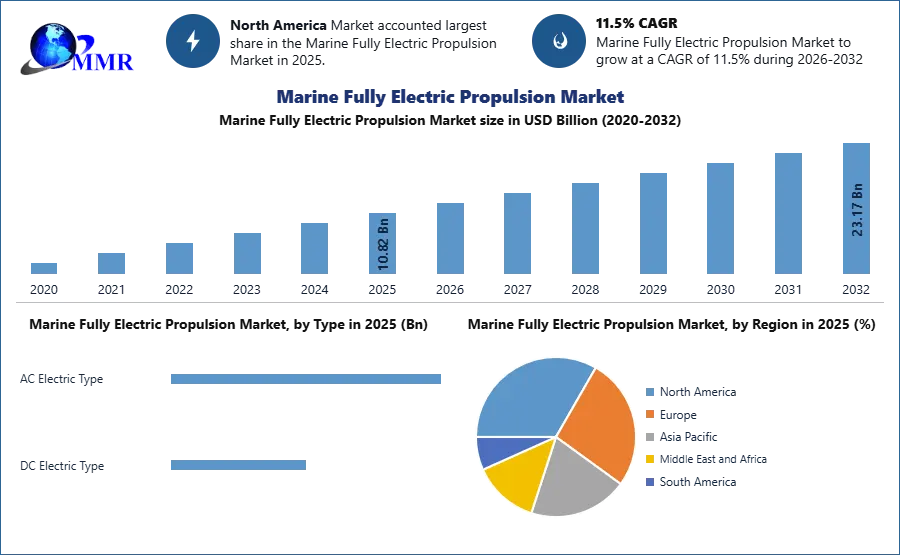
Global Marine Fully Electric Propulsion Market size was valued at USD 10.82 Bn. in 2025, and the total Marine Fully Electric Propulsion Market revenue is expected to grow by 11.5% from 2026 to 2032, reaching nearly USD 23.17 Bn.

Marine Fully Electric Propulsion Market Overview:

Marine Fully Electric Propulsion is a system, either battery-electric or fuel-cell electric, that entirely powers a vessel’s propulsion motor without using onboard fossil fuels.

Marine Fully Electric Propulsion Report evaluates the market scope, noting its strong presence in small craft (ferries, yachts) and expanding adoption in larger vessels (offshore support, cargo ships, ferries, and cruise ships. The availability of such propulsion systems has grown with greater production from key OEMs and rising deployments in short-sea operations and inland waterways. On the demand side, regulatory drivers (e.g., EU emissions limits, IMO targets) and incentives are prompting shipowners to invest, while supply-side strength is driven by advancing battery and fuel cell technologies and collaboration among equipment manufacturers, shipbuilders, and energy firms.

Regionally, North America dominated the Marine Fully Electric Propulsion Market, accounting for roughly 35% of revenue, with Europe close behind (28%), and Asia Pacific showing the fastest growth due to robust maritime trade and green policies.

Report Covered Major Marine Fully Electric Propulsion Market players profiled include ABB, Siemens, Wartsila, MAN Energy Solutions, GE, Rolls-Royce, Caterpillar, and Torqeedo, all highlighted in the report’s competitive landscape section. End-user segments: ferries and yachts lead in pure electric uptake, while tugboats, offshore vessels, and defense ships gravitate toward hybrid systems, balancing range and reliability. Lynchpin insights include market segmentation, regional dominance, supply–demand dynamics, and strategic alignment of key players to regulatory forces.
To know about the Research Methodology :- Request Free Sample Report

The market for tissue-engineered skin substitutes is expected to grow significantly in the future, thanks to the use of onboard renewable energy sources for charging the battery. Developed and developing economies are spending significantly on the defense sector. Demand for full-electric marine propulsion systems in various major economies is gaining momentum owing to the rise in the manufacture of new vessels, increasing seaborne trade, and growing upgrade of present vessels into full-electric propulsion ones. The imposition of stringent regulations associated with the minimization of harmful CO2 emissions is driving the demand for fuel-efficient propulsion systems like full electric marine propulsion systems. So, governments of various countries are supporting and funding the development and adoption of the newest technologies in marine propulsion systems.

The report covers the segments in the marine fully electric propulsion market, such as type and application. By application, the cargo ships segment was valued at US$ xx Bn.. in 2025 and is expected to reach US$ xx Bn. by 2032 at a CAGR of 33% over the forecast period. This is attributed to the increasing trade activities among several countries and regions. The rapidly growing marine electric vehicles (EVs) market will reach US$3 billion in 2032. It is unusually varied with average unit costs rising as the larger craft are electrified to improve performance, green credentials, and cost over life. The market contains underwater electric vehicles and on-water for inland waterways, and the sea. Military electric craft is the largest market industry by value nowadays, but e-workboats and other, smaller market sub-sectors will upsurge their share of the market by value over the upcoming decade.

Marine Fully Electric Propulsion Market Dynamics

Zero-Emission Shipping Zones and Government Support to Drive the Marine Fully Electric Propulsion Market Growth

The marine fully electric propulsion market is primarily driven by stringent international and regional emission regulations aimed at decarbonizing the maritime industry. Policies from the International Maritime Organization (IMO) targeting greenhouse gas reduction, along with regional zero-emission zones in Europe and North America, are pushing shipowners to adopt cleaner propulsion technologies. Growing environmental awareness among stakeholders, rising fuel costs, and advancements in high-capacity battery technologies further bolster market adoption. Additionally, government incentives, subsidies for green vessel construction, and significant investments in port electrification infrastructure are accelerating the deployment of fully electric propulsion systems, especially in short-sea shipping and inland waterways.

Retrofitting, Innovation to Create the Marine Fully Electric Propulsion Market Opportunity

The market report highlights several lucrative opportunities for stakeholders through 2025. Notably, there is immense growth potential in retrofitting existing vessels with fully electric or hybrid systems to extend vessel lifecycles while meeting new sustainability mandates. Emerging markets in Asia-Pacific are showing strong demand for electric ferries and harbor crafts as coastal cities tackle pollution and adopt green port initiatives. Technological advancements, such as next-generation solid-state batteries and hydrogen fuel cells, offer manufacturers avenues for product differentiation and improved vessel range. Collaborations between shipbuilders, battery manufacturers, and energy companies to develop integrated energy storage and charging solutions further open new revenue streams and strengthen market competitiveness.

High Cost and Technical Barriers to Create the Marine Fully Electric Propulsion Market Challenges

The high initial capital cost for fully electric vessels, driven by expensive batteries and advanced power management systems, remains a significant barrier, especially for small and medium ship operators with limited budgets. Additionally, the limited energy density of current battery technology restricts the operational range of large ocean-going vessels, confining fully electric propulsion mostly to ferries, short-sea, and inland applications. Insufficient charging infrastructure at ports and the time required for high-capacity recharging also pose logistical hurdles. Overcoming these technical and economic constraints will require continued innovation, supportive policies, and large-scale investments in port electrification and battery development.

Competing Alternatives and Regulatory Uncertainty to Restrain the Marine Fully Electric Propulsion Market

The report outlines key restraints that hinder the widespread adoption of fully electric propulsion in the marine sector. One primary restraint is the technological maturity and cost-competitiveness of alternative low-emission solutions, such as LNG, hybrid diesel-electric systems, and biofuels, which are often perceived as more practical interim steps for longer voyages.

Furthermore, shipowners remain cautious due to concerns over battery lifespan, recycling challenges, and the environmental impact of large-scale battery production and disposal. Regulatory uncertainty in some regions regarding future emissions standards can also delay fleet electrification decisions. These factors collectively necessitate clear policy frameworks, industry standards, and innovations in battery sustainability to fully unlock the market’s potential.

Marine Fully Electric Propulsion Market Segment Analysis

Based on Application, the commercial passenger ships segment is dominated the Marine Fully Electric Propulsion Market in 2025, because short-distance passenger ferries, inland waterway vessels, and urban water taxis are ideally suited for fully electric propulsion due to their predictable, relatively short operating routes and frequent port stops, which make regular recharging practical and cost-effective. Many governments and port authorities prioritize electrifying public transportation vessels to reduce air pollution in populated coastal cities and meet zero-emission goals quickly. Additionally, public funding, subsidies, and strict emission regulations in Europe and North America have accelerated the deployment of electric ferries and passenger boats, solidifying this segment’s leadership in market share.

Based on type, the AC Electric Segment dominated the Marine Fully Electric Propulsion Market in 2025, because it efficiently handles the higher power requirements of medium to large vessels like ferries, cargo ships, and naval ships, where reliable, high-capacity power transmission is critical for safe and continuous operation. AC systems offer easier integration with large propulsion motors, better efficiency over longer distances within the ship’s power grid, and lower maintenance needs compared to DC systems for high-output applications, making them the preferred choice for large-scale marine electrification projects.

Marine Fully Electric Propulsion Market Regional Analysis

By region, North America is expected to continue to hold the largest 35% share in the marine fully electric propulsion market, thanks to the growing adoption of electric propulsion naval vessels by the U.S. Navy for strategic missions. Additionally, the presence of major energy storage systems companies like Corvus Energy is driving the growth of the North American Marine Fully Electric Propulsion Market.

Europe also plays an important role in the marine fully electric propulsion market, with a market of US$ xx Bn in 2025 and is expected to reach US$ xx Bn in 2032, with a CAGR of xx%. It is attributed to investments by leading key players such as ABB Group, Siemens, and BAE Systems in the development of electric ships.

The report covers all the aspects of the industry with a dedicated study of key players that includes market leaders, followers, and new entrants. PORTER, SVOR, PESTEL analysis with the potential impact of micro-economic factors of the market has been presented in the report. External as well as internal factors that are supposed to affect the business positively or negatively have been analyzed, which will give a clear futuristic view of the industry to the decision-makers.

The report also helps in understanding global market dynamics, structure by analyzing the market segments, and projects the global market size. Clear representation of competitive analysis of key players by Application, price, financial position, Product portfolio, growth strategies, and regional presence in the global market, the report investor’s guide.

Marine Fully Electric Propulsion market Recent key developments

Exact Date Company Development Impact
12 January 2026 ABB ABB received Approval in Principle (AiP) from DNV for its ABB Dynafin™, an all-electric propulsion concept that mimics a whale's tail. The system eliminates mechanical gearboxes and is predicted to reduce fuel consumption by up to 20% compared to traditional electric drives.
17 November 2025 Torqeedo Torqeedo unveiled the Deep Blue G3N series, featuring new Intelligent Control Units (ICU) for high-power electric propulsion systems up to 400 kW. The new 400V/800V ecosystem enhances scalability for OEMs and fleet operators transitioning to high-performance zero-emission boating.
02 June 2025 Siemens & Arc Boat Co. Arc Boat Company adopted the Siemens Xcelerator portfolio to design and simulate its next-generation high-performance fully electric boats. This integration allows for rapid parametric 3D modeling and digital twin testing to optimize weight distribution in heavy battery-powered vessels.

Key trends shaping the Marine Fully Electric Propulsion Market

1. Expansion of Large-Scale Fully Electric Ferries
There is a strong trend toward deploying larger, high-capacity fully electric ferries to meet zero-emission targets for short-sea and inland routes. Operators and shipbuilders are scaling up battery capacity and vessel size to accommodate more passengers and vehicles while ensuring practical ranges.

Examples:
1. Incat Tasmania launched Hull 096 in May 2025 — the world’s largest battery-electric ferry (40 MWh battery, ~2,100 passengers, 225 vehicles).

2. Germany’s E-Kat ferry by Damen Group is the first fully electric seagoing ferry in the region, with capacity for ~150 passengers and fast shore charging.

3. Stockholm’s Candela P-12 hydrofoil offers all-electric, high-speed commuter service, cutting emissions by 98% compared to diesel ferries.

2. Advances in High-Power Charging and Bidirectional Infrastructure
To support the growing fleet of electric vessels, ports are investing in rapid, high-capacity charging systems and exploring smart bidirectional charging (vessel-to-grid) solutions to optimize grid loads and energy use.

Examples:
1. Aqua SuperPower’s bidirectional marine charger (May 2025) enables vessels to discharge excess energy back to the grid.

2. E-Kat’s 1,800 kW shore power station supports quick turnaround for ferry operations.

3. European ports (Oslo, Stockholm, Copenhagen) are expanding mega-watt-level fast-charging hubs for electric ferries and harbor craft.

3. Integration of Lightweight Designs and Efficient Propulsion
Manufacturers are combining lightweight hulls, hydrofoil technology, and advanced energy management systems to maximize range and speed while minimizing battery weight and drag, making full electrification viable for new vessel types.

Examples:
1. Candela P-12 hydrofoil “flies” over water to reduce drag by 80% and energy use by 50%.

2. Electric passenger boats and water taxis under 30 meters are increasingly using modular, lightweight battery packs for urban commuting.

3. Norway’s Future of the Fjords ferry employs carbon-fiber composite construction with all-electric propulsion for zero-emission fjord tourism.

Marine Fully Electric Propulsion Market Scope: Inquire before buying

Marine Fully Electric Propulsion Market
Report Coverage Details
Base Year: 2025 Forecast Period: 2026-2032
Historical Data: 2020 to 2025 Market Size in 2025: 10.82 USD Billion
Forecast Period 2026-2032 CAGR: 11.5% Market Size in 2032: 23.17 USD Billion
Segments Covered: by Vessel Type Passenger Vessels
Commercial Vessels
Offshore Support Vessels
Recreational Boats & Yachts
Others
by Power Rating Low Power (<500 kW)
Medium Power (500 kW – 2 MW)
High Power (>2 MW)
by Component Batteries
Electric Motors
Power Electronics & Controllers
Charging & Dockside Infrastructure
Software & Monitoring Systems
by Type AC Electric Type
DC Electric Type
by Application Commercial Passenger Transport
Cargo & Logistics
Offshore Energy Support
Recreational & Pleasure
Defense & Surveillance

Marine Fully Electric Propulsion Market, by Region

North America (United States, Canada and Mexico)
Europe (United Kingdom, France, Germany, Italy, Spain, Sweden, Russia, Rest of Europe)
Asia Pacific (China, Japan, South Korea, India, Australia, Malaysia, Thailand, Vietnam, Indonesia, Philippines, Rest of APAC)
Middle East and Africa (South Africa, GCC, Nigeria, Egypt, Turkey, Rest of MEA)
South America (Brazil, Argentina, Colombia, Chile, Peru, Rest of South America)

Key Players/Competitors Profiles Covered in Brief Marine Fully Electric Propulsion Market Report in Strategic Perspective

  1. ABB Ltd. (Switzerland)
  2. Siemens AG (Germany)
  3. Wärtsilä Corporation (Finland)
  4. Rolls-Royce Holdings plc (UK/Norway)
  5. Damen Shipyards Group (Netherlands)
  6. Candela Technology AB (Sweden)
  7. Torqeedo GmbH (subsidiary of DEUTZ AG) (Germany)
  8. General Electric Company (GE Power Conversion) (USA)
  9. Caterpillar Marine (USA)
  10. BAE Systems Inc. (USA)
  11. Vard Marine Inc. (Canada)
  12. All American Marine Inc. (USA)
  13. Crowley Maritime Corporation (USA)
  14. Glosten (USA)
  15. Mitsubishi Heavy Industries Ltd. (Japan)
  16. Hyundai Heavy Industries Co., Ltd. (South Korea)
  17. Samsung Heavy Industries Co., Ltd. (South Korea)
  18. Kawasaki Heavy Industries Ltd. (Japan)
  19. CSIC (China State Shipbuilding Corporation) (China)
  20. Incat Tasmania Pty Ltd (Australia)
  21. Zhuhai Yunzhou Intelligent Technology Co., Ltd. (China)
  22. MAN Energy Solutions (Germany)
  23. Corvus Energy (Norway)
  24. Kongsberg Gruppen (Norway)
  25. Schottel Group (Germany)

Table of Contents

1. Marine Fully Electric Propulsion Market Introduction
1.1. Study Assumption and Market Definition
1.2. Scope of the Study
1.3. Executive Summary
2. Global Marine Fully Electric Propulsion Market: Competitive Landscape
2.1. MMR Competition Matrix
2.2. Competitive Landscape
2.3. Key Players Benchmarking
2.3.1. Company Name
2.3.2. Business Segment
2.3.3. End-user Segment
2.3.4. Revenue (2025)
2.3.5. Company Locations
2.4. Leading Marine Fully Electric Propulsion Market Companies, by market capitalization
2.5. Market Structure
2.5.1. Market Leaders
2.5.2. Market Followers
2.5.3. Emerging Players
2.6. Mergers and Acquisitions Details
3. Marine Fully Electric Propulsion Market: Dynamics
3.1. Marine Fully Electric Propulsion Market Trends by Region
3.1.1. North America Marine Fully Electric Propulsion Market Trends
3.1.2. Europe Marine Fully Electric Propulsion Market Trends
3.1.3. Asia Pacific Marine Fully Electric Propulsion Market Trends
3.1.4. Middle East and Africa Marine Fully Electric Propulsion Market Trends
3.1.5. South America Marine Fully Electric Propulsion Market Trends
3.2. Marine Fully Electric Propulsion Market Dynamics by Region
3.2.1. North America
3.2.1.1. North America Marine Fully Electric Propulsion Market Drivers
3.2.1.2. North America Marine Fully Electric Propulsion Market Restraints
3.2.1.3. North America Marine Fully Electric Propulsion Market Opportunities
3.2.1.4. North America Marine Fully Electric Propulsion Market Challenges
3.2.2. Europe
3.2.2.1. Europe Marine Fully Electric Propulsion Market Drivers
3.2.2.2. Europe Marine Fully Electric Propulsion Market Restraints
3.2.2.3. Europe Marine Fully Electric Propulsion Market Opportunities
3.2.2.4. Europe Marine Fully Electric Propulsion Market Challenges
3.2.3. Asia Pacific
3.2.3.1. Asia Pacific Marine Fully Electric Propulsion Market Drivers
3.2.3.2. Asia Pacific Marine Fully Electric Propulsion Market Restraints
3.2.3.3. Asia Pacific Marine Fully Electric Propulsion Market Opportunities
3.2.3.4. Asia Pacific Marine Fully Electric Propulsion Market Challenges
3.2.4. Middle East and Africa
3.2.4.1. Middle East and Africa Marine Fully Electric Propulsion Market Drivers
3.2.4.2. Middle East and Africa Marine Fully Electric Propulsion Market Restraints
3.2.4.3. Middle East and Africa Marine Fully Electric Propulsion Market Opportunities
3.2.4.4. Middle East and Africa Marine Fully Electric Propulsion Market Challenges
3.2.5. South America
3.2.5.1. South America Marine Fully Electric Propulsion Market Drivers
3.2.5.2. South America Marine Fully Electric Propulsion Market Restraints
3.2.5.3. South America Marine Fully Electric Propulsion Market Opportunities
3.2.5.4. South America Marine Fully Electric Propulsion Market Challenges
3.3. PORTER's Five Forces Analysis
3.4. PESTLE Analysis
3.5. Technology Roadmap
3.6. Regulatory Landscape by Region
3.6.1. North America
3.6.2. Europe
3.6.3. Asia Pacific
3.6.4. Middle East and Africa
3.6.5. South America
3.7. Key Opinion Leader Analysis For Marine Fully Electric Propulsion Industry
3.8. Analysis of Government Schemes and Initiatives For Marine Fully Electric Propulsion Industry
3.9. Marine Fully Electric Propulsion Market Trade Analysis
3.10. The Global Pandemic Impact on Marine Fully Electric Propulsion Market
4. Marine Fully Electric Propulsion Market: Global Market Size and Forecast by Segmentation (in USD Billion) 2025-2032
4.1. Marine Fully Electric Propulsion Market Size and Forecast, by Vessel Type (2025-2032)
4.1.1. Passenger Vessels
4.1.2. Commercial Vessels
4.1.3. Offshore Support Vessels
4.1.4. Recreational Boats & Yachts
4.1.5. Others
4.2. Marine Fully Electric Propulsion Market Size and Forecast, by Power Rating (2025-2032)
4.2.1. Low Power (<500 kW)
4.2.2. Medium Power (500 kW – 2 MW)
4.2.3. High Power (>2 MW)
4.3. Marine Fully Electric Propulsion Market Size and Forecast, by Component (2025-2032)
4.3.1. Batteries
4.3.2. Electric Motors
4.3.3. Power Electronics & Controllers
4.3.4. Charging & Dockside Infrastructure
4.3.5. Software & Monitoring Systems
4.4. Marine Fully Electric Propulsion Market Size and Forecast, by Type (2025-2032)
4.4.1. AC Electric Type
4.4.2. DC Electric Type
4.5. Marine Fully Electric Propulsion Market Size and Forecast, by Application (2025-2032)
4.5.1. Commercial Passenger Transport
4.5.2. Cargo & Logistics
4.5.3. Offshore Energy Support
4.5.4. Recreational & Pleasure
4.5.5. Defense & Surveillance
4.6. Marine Fully Electric Propulsion Market Size and Forecast, by Region (2025-2032)
4.6.1. North America
4.6.2. Europe
4.6.3. Asia Pacific
4.6.4. Middle East and Africa
4.6.5. South America
5. North America Marine Fully Electric Propulsion Market Size and Forecast by Segmentation (in USD Billion) 2025-2032
5.1. North America Marine Fully Electric Propulsion Market Size and Forecast, by Vessel Type (2025-2032)
5.1.1. Passenger Vessels
5.1.2. Commercial Vessels
5.1.3. Offshore Support Vessels
5.1.4. Recreational Boats & Yachts
5.1.5. Others
5.2. North America Marine Fully Electric Propulsion Market Size and Forecast, by Power Rating (2025-2032)
5.2.1. Low Power (<500 kW)
5.2.2. Medium Power (500 kW – 2 MW)
5.2.3. High Power (>2 MW)
5.3. North America Marine Fully Electric Propulsion Market Size and Forecast, by Component (2025-2032)
5.3.1. Batteries
5.3.2. Electric Motors
5.3.3. Power Electronics & Controllers
5.3.4. Charging & Dockside Infrastructure
5.3.5. Software & Monitoring Systems
5.4. North America Marine Fully Electric Propulsion Market Size and Forecast, by Type (2025-2032)
5.4.1. AC Electric Type
5.4.2. DC Electric Type
5.5. North America Marine Fully Electric Propulsion Market Size and Forecast, by Application (2025-2032)
5.5.1. Commercial Passenger Transport
5.5.2. Cargo & Logistics
5.5.3. Offshore Energy Support
5.5.4. Recreational & Pleasure
5.5.5. Defense & Surveillance
5.6. North America Marine Fully Electric Propulsion Market Size and Forecast, by Country (2025-2032)
5.6.1. United States
5.6.1.1. United States Marine Fully Electric Propulsion Market Size and Forecast, by Vessel Type (2025-2032)
5.6.1.1.1. Passenger Vessels
5.6.1.1.2. Commercial Vessels
5.6.1.1.3. Offshore Support Vessels
5.6.1.1.4. Recreational Boats & Yachts
5.6.1.1.5. Others
5.6.1.2. United States Marine Fully Electric Propulsion Market Size and Forecast, by Power Rating (2025-2032)
5.6.1.2.1. Low Power (<500 kW)
5.6.1.2.2. Medium Power (500 kW – 2 MW)
5.6.1.2.3. High Power (>2 MW)
5.6.1.3. United States Marine Fully Electric Propulsion Market Size and Forecast, by Component (2025-2032)
5.6.1.3.1. Batteries
5.6.1.3.2. Electric Motors
5.6.1.3.3. Power Electronics & Controllers
5.6.1.3.4. Charging & Dockside Infrastructure
5.6.1.3.5. Software & Monitoring Systems
5.6.1.4. United States Marine Fully Electric Propulsion Market Size and Forecast, by Type (2025-2032)
5.6.1.4.1. AC Electric Type
5.6.1.4.2. DC Electric Type
5.6.1.5. United States Marine Fully Electric Propulsion Market Size and Forecast, by Application (2025-2032)
5.6.1.5.1. Commercial Passenger Transport
5.6.1.5.2. Cargo & Logistics
5.6.1.5.3. Offshore Energy Support
5.6.1.5.4. Recreational & Pleasure
5.6.1.5.5. Defense & Surveillance
5.6.2. Canada
5.6.2.1. Canada Marine Fully Electric Propulsion Market Size and Forecast, by Vessel Type (2025-2032)
5.6.2.1.1. Passenger Vessels
5.6.2.1.2. Commercial Vessels
5.6.2.1.3. Offshore Support Vessels
5.6.2.1.4. Recreational Boats & Yachts
5.6.2.1.5. Others
5.6.2.2. Canada Marine Fully Electric Propulsion Market Size and Forecast, by Power Rating (2025-2032)
5.6.2.2.1. Low Power (<500 kW)
5.6.2.2.2. Medium Power (500 kW – 2 MW)
5.6.2.2.3. High Power (>2 MW)
5.6.2.3. Canada Marine Fully Electric Propulsion Market Size and Forecast, by Component (2025-2032)
5.6.2.3.1. Batteries
5.6.2.3.2. Electric Motors
5.6.2.3.3. Power Electronics & Controllers
5.6.2.3.4. Charging & Dockside Infrastructure
5.6.2.3.5. Software & Monitoring Systems
5.6.2.4. Canada Marine Fully Electric Propulsion Market Size and Forecast, by Type (2025-2032)
5.6.2.4.1. AC Electric Type
5.6.2.4.2. DC Electric Type
5.6.2.5. Canada Marine Fully Electric Propulsion Market Size and Forecast, by Application (2025-2032)
5.6.2.5.1. Commercial Passenger Transport
5.6.2.5.2. Cargo & Logistics
5.6.2.5.3. Offshore Energy Support
5.6.2.5.4. Recreational & Pleasure
5.6.2.5.5. Defense & Surveillance
5.6.3. Mexico
5.6.3.1. Mexico Marine Fully Electric Propulsion Market Size and Forecast, by Vessel Type (2025-2032)
5.6.3.1.1. Passenger Vessels
5.6.3.1.2. Commercial Vessels
5.6.3.1.3. Offshore Support Vessels
5.6.3.1.4. Recreational Boats & Yachts
5.6.3.1.5. Others
5.6.3.2. Mexico Marine Fully Electric Propulsion Market Size and Forecast, by Power Rating (2025-2032)
5.6.3.2.1. Low Power (<500 kW)
5.6.3.2.2. Medium Power (500 kW – 2 MW)
5.6.3.2.3. High Power (>2 MW)
5.6.3.3. Mexico Marine Fully Electric Propulsion Market Size and Forecast, by Component (2025-2032)
5.6.3.3.1. Batteries
5.6.3.3.2. Electric Motors
5.6.3.3.3. Power Electronics & Controllers
5.6.3.3.4. Charging & Dockside Infrastructure
5.6.3.3.5. Software & Monitoring Systems
5.6.3.4. Mexico Marine Fully Electric Propulsion Market Size and Forecast, by Type (2025-2032)
5.6.3.4.1. AC Electric Type
5.6.3.4.2. DC Electric Type
5.6.3.5. Mexico Marine Fully Electric Propulsion Market Size and Forecast, by Application (2025-2032)
5.6.3.5.1. Commercial Passenger Transport
5.6.3.5.2. Cargo & Logistics
5.6.3.5.3. Offshore Energy Support
5.6.3.5.4. Recreational & Pleasure
5.6.3.5.5. Defense & Surveillance
6. Europe Marine Fully Electric Propulsion Market Size and Forecast by Segmentation (in USD Billion) 2025-2032
6.1. Europe Marine Fully Electric Propulsion Market Size and Forecast, by Vessel Type (2025-2032)
6.2. Europe Marine Fully Electric Propulsion Market Size and Forecast, by Power Rating (2025-2032)
6.3. Europe Marine Fully Electric Propulsion Market Size and Forecast, by Component (2025-2032)
6.4. Europe Marine Fully Electric Propulsion Market Size and Forecast, by Type (2025-2032)
6.5. Europe Marine Fully Electric Propulsion Market Size and Forecast, by Application (2025-2032)
6.6. Europe Marine Fully Electric Propulsion Market Size and Forecast, by Country (2025-2032)
6.6.1. United Kingdom
6.6.1.1. United Kingdom Marine Fully Electric Propulsion Market Size and Forecast, by Vessel Type (2025-2032)
6.6.1.2. United Kingdom Marine Fully Electric Propulsion Market Size and Forecast, by Power Rating (2025-2032)
6.6.1.3. United Kingdom Marine Fully Electric Propulsion Market Size and Forecast, by Component (2025-2032)
6.6.1.4. United Kingdom Marine Fully Electric Propulsion Market Size and Forecast, by Type (2025-2032)
6.6.1.5. United Kingdom Marine Fully Electric Propulsion Market Size and Forecast, by Application (2025-2032)
6.6.2. France
6.6.2.1. France Marine Fully Electric Propulsion Market Size and Forecast, by Vessel Type (2025-2032)
6.6.2.2. France Marine Fully Electric Propulsion Market Size and Forecast, by Power Rating (2025-2032)
6.6.2.3. France Marine Fully Electric Propulsion Market Size and Forecast, by Component (2025-2032)
6.6.2.4. France Marine Fully Electric Propulsion Market Size and Forecast, by Type (2025-2032)
6.6.2.5. France Marine Fully Electric Propulsion Market Size and Forecast, by Application (2025-2032)
6.6.3. Germany
6.6.3.1. Germany Marine Fully Electric Propulsion Market Size and Forecast, by Vessel Type (2025-2032)
6.6.3.2. Germany Marine Fully Electric Propulsion Market Size and Forecast, by Power Rating (2025-2032)
6.6.3.3. Germany Marine Fully Electric Propulsion Market Size and Forecast, by Component (2025-2032)
6.6.3.4. Germany Marine Fully Electric Propulsion Market Size and Forecast, by Type (2025-2032)
6.6.3.5. Germany Marine Fully Electric Propulsion Market Size and Forecast, by Application (2025-2032)
6.6.4. Italy
6.6.4.1. Italy Marine Fully Electric Propulsion Market Size and Forecast, by Vessel Type (2025-2032)
6.6.4.2. Italy Marine Fully Electric Propulsion Market Size and Forecast, by Power Rating (2025-2032)
6.6.4.3. Italy Marine Fully Electric Propulsion Market Size and Forecast, by Component (2025-2032)
6.6.4.4. Italy Marine Fully Electric Propulsion Market Size and Forecast, by Type (2025-2032)
6.6.4.5. Italy Marine Fully Electric Propulsion Market Size and Forecast, by Application (2025-2032)
6.6.5. Spain
6.6.5.1. Spain Marine Fully Electric Propulsion Market Size and Forecast, by Vessel Type (2025-2032)
6.6.5.2. Spain Marine Fully Electric Propulsion Market Size and Forecast, by Power Rating (2025-2032)
6.6.5.3. Spain Marine Fully Electric Propulsion Market Size and Forecast, by Component (2025-2032)
6.6.5.4. Spain Marine Fully Electric Propulsion Market Size and Forecast, by Type (2025-2032)
6.6.5.5. Spain Marine Fully Electric Propulsion Market Size and Forecast, by Application (2025-2032)
6.6.6. Sweden
6.6.6.1. Sweden Marine Fully Electric Propulsion Market Size and Forecast, by Vessel Type (2025-2032)
6.6.6.2. Sweden Marine Fully Electric Propulsion Market Size and Forecast, by Power Rating (2025-2032)
6.6.6.3. Sweden Marine Fully Electric Propulsion Market Size and Forecast, by Component (2025-2032)
6.6.6.4. Sweden Marine Fully Electric Propulsion Market Size and Forecast, by Type (2025-2032)
6.6.6.5. Sweden Marine Fully Electric Propulsion Market Size and Forecast, by Application (2025-2032)
6.6.7. Austria
6.6.7.1. Austria Marine Fully Electric Propulsion Market Size and Forecast, by Vessel Type (2025-2032)
6.6.7.2. Austria Marine Fully Electric Propulsion Market Size and Forecast, by Power Rating (2025-2032)
6.6.7.3. Austria Marine Fully Electric Propulsion Market Size and Forecast, by Component (2025-2032)
6.6.7.4. Austria Marine Fully Electric Propulsion Market Size and Forecast, by Type (2025-2032)
6.6.7.5. Austria Marine Fully Electric Propulsion Market Size and Forecast, by Application (2025-2032)
6.6.8. Rest of Europe
6.6.8.1. Rest of Europe Marine Fully Electric Propulsion Market Size and Forecast, by Vessel Type (2025-2032)
6.6.8.2. Rest of Europe Marine Fully Electric Propulsion Market Size and Forecast, by Power Rating (2025-2032)
6.6.8.3. Rest of Europe Marine Fully Electric Propulsion Market Size and Forecast, by Component (2025-2032)
6.6.8.4. Rest of Europe Marine Fully Electric Propulsion Market Size and Forecast, by Type (2025-2032)
6.6.8.5. Rest of Europe Marine Fully Electric Propulsion Market Size and Forecast, by Application (2025-2032)
7. Asia Pacific Marine Fully Electric Propulsion Market Size and Forecast by Segmentation (in USD Billion) 2025-2032
7.1. Asia Pacific Marine Fully Electric Propulsion Market Size and Forecast, by Vessel Type (2025-2032)
7.2. Asia Pacific Marine Fully Electric Propulsion Market Size and Forecast, by Power Rating (2025-2032)
7.3. Asia Pacific Marine Fully Electric Propulsion Market Size and Forecast, by Component (2025-2032)
7.4. Asia Pacific Marine Fully Electric Propulsion Market Size and Forecast, by Type (2025-2032)
7.5. Asia Pacific Marine Fully Electric Propulsion Market Size and Forecast, by Application (2025-2032)
7.6. Asia Pacific Marine Fully Electric Propulsion Market Size and Forecast, by Country (2025-2032)
7.6.1. China
7.6.1.1. China Marine Fully Electric Propulsion Market Size and Forecast, by Vessel Type (2025-2032)
7.6.1.2. China Marine Fully Electric Propulsion Market Size and Forecast, by Power Rating (2025-2032)
7.6.1.3. China Marine Fully Electric Propulsion Market Size and Forecast, by Component (2025-2032)
7.6.1.4. China Marine Fully Electric Propulsion Market Size and Forecast, by Type (2025-2032)
7.6.1.5. China Marine Fully Electric Propulsion Market Size and Forecast, by Application (2025-2032)
7.6.2. S Korea
7.6.2.1. S Korea Marine Fully Electric Propulsion Market Size and Forecast, by Vessel Type (2025-2032)
7.6.2.2. S Korea Marine Fully Electric Propulsion Market Size and Forecast, by Power Rating (2025-2032)
7.6.2.3. S Korea Marine Fully Electric Propulsion Market Size and Forecast, by Component (2025-2032)
7.6.2.4. S Korea Marine Fully Electric Propulsion Market Size and Forecast, by Type (2025-2032)
7.6.2.5. S Korea Marine Fully Electric Propulsion Market Size and Forecast, by Application (2025-2032)
7.6.3. Japan
7.6.3.1. Japan Marine Fully Electric Propulsion Market Size and Forecast, by Vessel Type (2025-2032)
7.6.3.2. Japan Marine Fully Electric Propulsion Market Size and Forecast, by Power Rating (2025-2032)
7.6.3.3. Japan Marine Fully Electric Propulsion Market Size and Forecast, by Component (2025-2032)
7.6.3.4. Japan Marine Fully Electric Propulsion Market Size and Forecast, by Type (2025-2032)
7.6.3.5. Japan Marine Fully Electric Propulsion Market Size and Forecast, by Application (2025-2032)
7.6.4. India
7.6.4.1. India Marine Fully Electric Propulsion Market Size and Forecast, by Vessel Type (2025-2032)
7.6.4.2. India Marine Fully Electric Propulsion Market Size and Forecast, by Power Rating (2025-2032)
7.6.4.3. India Marine Fully Electric Propulsion Market Size and Forecast, by Component (2025-2032)
7.6.4.4. India Marine Fully Electric Propulsion Market Size and Forecast, by Type (2025-2032)
7.6.4.5. India Marine Fully Electric Propulsion Market Size and Forecast, by Application (2025-2032)
7.6.5. Australia
7.6.5.1. Australia Marine Fully Electric Propulsion Market Size and Forecast, by Vessel Type (2025-2032)
7.6.5.2. Australia Marine Fully Electric Propulsion Market Size and Forecast, by Power Rating (2025-2032)
7.6.5.3. Australia Marine Fully Electric Propulsion Market Size and Forecast, by Component (2025-2032)
7.6.5.4. Australia Marine Fully Electric Propulsion Market Size and Forecast, by Type (2025-2032)
7.6.5.5. Australia Marine Fully Electric Propulsion Market Size and Forecast, by Application (2025-2032)
7.6.6. Indonesia
7.6.6.1. Indonesia Marine Fully Electric Propulsion Market Size and Forecast, by Vessel Type (2025-2032)
7.6.6.2. Indonesia Marine Fully Electric Propulsion Market Size and Forecast, by Power Rating (2025-2032)
7.6.6.3. Indonesia Marine Fully Electric Propulsion Market Size and Forecast, by Component (2025-2032)
7.6.6.4. Indonesia Marine Fully Electric Propulsion Market Size and Forecast, by Type (2025-2032)
7.6.6.5. Indonesia Marine Fully Electric Propulsion Market Size and Forecast, by Application (2025-2032)
7.6.7. Malaysia
7.6.7.1. Malaysia Marine Fully Electric Propulsion Market Size and Forecast, by Vessel Type (2025-2032)
7.6.7.2. Malaysia Marine Fully Electric Propulsion Market Size and Forecast, by Power Rating (2025-2032)
7.6.7.3. Malaysia Marine Fully Electric Propulsion Market Size and Forecast, by Component (2025-2032)
7.6.7.4. Malaysia Marine Fully Electric Propulsion Market Size and Forecast, by Type (2025-2032)
7.6.7.5. Malaysia Marine Fully Electric Propulsion Market Size and Forecast, by Application (2025-2032)
7.6.8. Vietnam
7.6.8.1. Vietnam Marine Fully Electric Propulsion Market Size and Forecast, by Vessel Type (2025-2032)
7.6.8.2. Vietnam Marine Fully Electric Propulsion Market Size and Forecast, by Power Rating (2025-2032)
7.6.8.3. Vietnam Marine Fully Electric Propulsion Market Size and Forecast, by Component (2025-2032)
7.6.8.4. Vietnam Marine Fully Electric Propulsion Market Size and Forecast, by Type (2025-2032)
7.6.8.5. Vietnam Marine Fully Electric Propulsion Market Size and Forecast, by Application (2025-2032)
7.6.9. Taiwan
7.6.9.1. Taiwan Marine Fully Electric Propulsion Market Size and Forecast, by Vessel Type (2025-2032)
7.6.9.2. Taiwan Marine Fully Electric Propulsion Market Size and Forecast, by Power Rating (2025-2032)
7.6.9.3. Taiwan Marine Fully Electric Propulsion Market Size and Forecast, by Component (2025-2032)
7.6.9.4. Taiwan Marine Fully Electric Propulsion Market Size and Forecast, by Type (2025-2032)
7.6.9.5. Taiwan Marine Fully Electric Propulsion Market Size and Forecast, by Application (2025-2032)
7.6.10. Rest of Asia Pacific
7.6.10.1. Rest of Asia Pacific Marine Fully Electric Propulsion Market Size and Forecast, by Vessel Type (2025-2032)
7.6.10.2. Rest of Asia Pacific Marine Fully Electric Propulsion Market Size and Forecast, by Power Rating (2025-2032)
7.6.10.3. Rest of Asia Pacific Marine Fully Electric Propulsion Market Size and Forecast, by Component (2025-2032)
7.6.10.4. Rest of Asia Pacific Marine Fully Electric Propulsion Market Size and Forecast, by Type (2025-2032)
7.6.10.5. Rest of Asia Pacific Marine Fully Electric Propulsion Market Size and Forecast, by Application (2025-2032)
8. Middle East and Africa Marine Fully Electric Propulsion Market Size and Forecast by Segmentation (in USD Billion) 2025-2032
8.1. Middle East and Africa Marine Fully Electric Propulsion Market Size and Forecast, by Vessel Type (2025-2032)
8.2. Middle East and Africa Marine Fully Electric Propulsion Market Size and Forecast, by Power Rating (2025-2032)
8.3. Middle East and Africa Marine Fully Electric Propulsion Market Size and Forecast, by Component (2025-2032)
8.4. Middle East and Africa Marine Fully Electric Propulsion Market Size and Forecast, by Type (2025-2032)
8.5. Middle East and Africa Marine Fully Electric Propulsion Market Size and Forecast, by Application (2025-2032)
8.6. Middle East and Africa Marine Fully Electric Propulsion Market Size and Forecast, by Country (2025-2032)
8.6.1. South Africa
8.6.1.1. South Africa Marine Fully Electric Propulsion Market Size and Forecast, by Vessel Type (2025-2032)
8.6.1.2. South Africa Marine Fully Electric Propulsion Market Size and Forecast, by Power Rating (2025-2032)
8.6.1.3. South Africa Marine Fully Electric Propulsion Market Size and Forecast, by Component (2025-2032)
8.6.1.4. South Africa Marine Fully Electric Propulsion Market Size and Forecast, by Type (2025-2032)
8.6.1.5. South Africa Marine Fully Electric Propulsion Market Size and Forecast, by Application (2025-2032)
8.6.2. GCC
8.6.2.1. GCC Marine Fully Electric Propulsion Market Size and Forecast, by Vessel Type (2025-2032)
8.6.2.2. GCC Marine Fully Electric Propulsion Market Size and Forecast, by Power Rating (2025-2032)
8.6.2.3. GCC Marine Fully Electric Propulsion Market Size and Forecast, by Component (2025-2032)
8.6.2.4. GCC Marine Fully Electric Propulsion Market Size and Forecast, by Type (2025-2032)
8.6.2.5. GCC Marine Fully Electric Propulsion Market Size and Forecast, by Application (2025-2032)
8.6.3. Nigeria
8.6.3.1. Nigeria Marine Fully Electric Propulsion Market Size and Forecast, by Vessel Type (2025-2032)
8.6.3.2. Nigeria Marine Fully Electric Propulsion Market Size and Forecast, by Power Rating (2025-2032)
8.6.3.3. Nigeria Marine Fully Electric Propulsion Market Size and Forecast, by Component (2025-2032)
8.6.3.4. Nigeria Marine Fully Electric Propulsion Market Size and Forecast, by Type (2025-2032)
8.6.3.5. Nigeria Marine Fully Electric Propulsion Market Size and Forecast, by Application (2025-2032)
8.6.4. Rest of ME&A
8.6.4.1. Rest of ME&A Marine Fully Electric Propulsion Market Size and Forecast, by Vessel Type (2025-2032)
8.6.4.2. Rest of ME&A Marine Fully Electric Propulsion Market Size and Forecast, by Power Rating (2025-2032)
8.6.4.3. Rest of ME&A Marine Fully Electric Propulsion Market Size and Forecast, by Component (2025-2032)
8.6.4.4. Rest of ME&A Marine Fully Electric Propulsion Market Size and Forecast, by Type (2025-2032)
8.6.4.5. Rest of ME&A Marine Fully Electric Propulsion Market Size and Forecast, by Application (2025-2032)
9. South America Marine Fully Electric Propulsion Market Size and Forecast by Segmentation (in USD Billion) 2025-2032
9.1. South America Marine Fully Electric Propulsion Market Size and Forecast, by Vessel Type (2025-2032)
9.2. South America Marine Fully Electric Propulsion Market Size and Forecast, by Power Rating (2025-2032)
9.3. South America Marine Fully Electric Propulsion Market Size and Forecast, by Component (2025-2032)
9.4. South America Marine Fully Electric Propulsion Market Size and Forecast, by Type (2025-2032)
9.5. South America Marine Fully Electric Propulsion Market Size and Forecast, by Application (2025-2032)
9.6. South America Marine Fully Electric Propulsion Market Size and Forecast, by Country (2025-2032)
9.6.1. Brazil
9.6.1.1. Brazil Marine Fully Electric Propulsion Market Size and Forecast, by Vessel Type (2025-2032)
9.6.1.2. Brazil Marine Fully Electric Propulsion Market Size and Forecast, by Power Rating (2025-2032)
9.6.1.3. Brazil Marine Fully Electric Propulsion Market Size and Forecast, by Component (2025-2032)
9.6.1.4. Brazil Marine Fully Electric Propulsion Market Size and Forecast, by Type (2025-2032)
9.6.1.5. Brazil Marine Fully Electric Propulsion Market Size and Forecast, by Application (2025-2032)
9.6.2. Argentina
9.6.2.1. Argentina Marine Fully Electric Propulsion Market Size and Forecast, by Vessel Type (2025-2032)
9.6.2.2. Argentina Marine Fully Electric Propulsion Market Size and Forecast, by Power Rating (2025-2032)
9.6.2.3. Argentina Marine Fully Electric Propulsion Market Size and Forecast, by Component (2025-2032)
9.6.2.4. Argentina Marine Fully Electric Propulsion Market Size and Forecast, by Type (2025-2032)
9.6.2.5. Argentina Marine Fully Electric Propulsion Market Size and Forecast, by Application (2025-2032)
9.6.3. Rest Of South America
9.6.3.1. Rest Of South America Marine Fully Electric Propulsion Market Size and Forecast, by Vessel Type (2025-2032)
9.6.3.2. Rest Of South America Marine Fully Electric Propulsion Market Size and Forecast, by Power Rating (2025-2032)
9.6.3.3. Rest Of South America Marine Fully Electric Propulsion Market Size and Forecast, by Component (2025-2032)
9.6.3.4. Rest Of South America Marine Fully Electric Propulsion Market Size and Forecast, by Type (2025-2032)
9.6.3.5. Rest Of South America Marine Fully Electric Propulsion Market Size and Forecast, by Application (2025-2032)
10. Company Profile: Key Players
10.1. ABB Ltd. (Switzerland)
10.1.1. Company Overview
10.1.2. Business Portfolio
10.1.3. Financial Overview
10.1.4. SWOT Analysis
10.1.5. Strategic Analysis
10.1.6. Scale of Operation (small, medium, and large)
10.1.7. Details on Partnership
10.1.8. Regulatory Accreditations and Certifications Received by Them
10.1.9. Awards Received by the Firm
10.1.10. Recent Developments
10.2. Siemens AG (Germany)
10.3. Wärtsilä Corporation (Finland)
10.4. Rolls-Royce Holdings plc (UK/Norway)
10.5. Damen Shipyards Group (Netherlands)
10.6. Candela Technology AB (Sweden)
10.7. Torqeedo GmbH (subsidiary of DEUTZ AG) (Germany)
10.8. General Electric Company (GE Power Conversion) (USA)
10.9. Caterpillar Marine (USA)
10.10. BAE Systems Inc. (USA)
10.11. Vard Marine Inc. (Canada)
10.12. All American Marine Inc. (USA)
10.13. Crowley Maritime Corporation (USA)
10.14. Glosten (USA)
10.15. Mitsubishi Heavy Industries Ltd. (Japan)
10.16. Hyundai Heavy Industries Co. Ltd. (South Korea)
10.17. Samsung Heavy Industries Co. Ltd. (South Korea)
10.18. Kawasaki Heavy Industries Ltd. (Japan)
10.19. CSIC (China State Shipbuilding Corporation) (China)
10.20. Incat Tasmania Pty Ltd (Australia)
10.21. Zhuhai Yunzhou Intelligent Technology Co. Ltd. (China)
10.22. MAN Energy Solutions (Germany)
10.23. Corvus Energy (Norway)
10.24. Kongsberg Gruppen (Norway)
10.25. Schottel Group (Germany)
11. Key Findings
12. Industry Recommendations
13. Marine Fully Electric Propulsion Market: Research Methodology
14. Terms and Glossary

Custom Market Research Services

We Will Customise The Research For You, In Case The Report Listed Above Does Not Meet With Your Requirements