
Global Mammalian Cell Fermentation Technology Market Size by Type, Application, End User, and Region – Segment-Level Market Assessment, Growth Opportunity Analysis, Competitive Landscape & Forecast to 2032
Overview
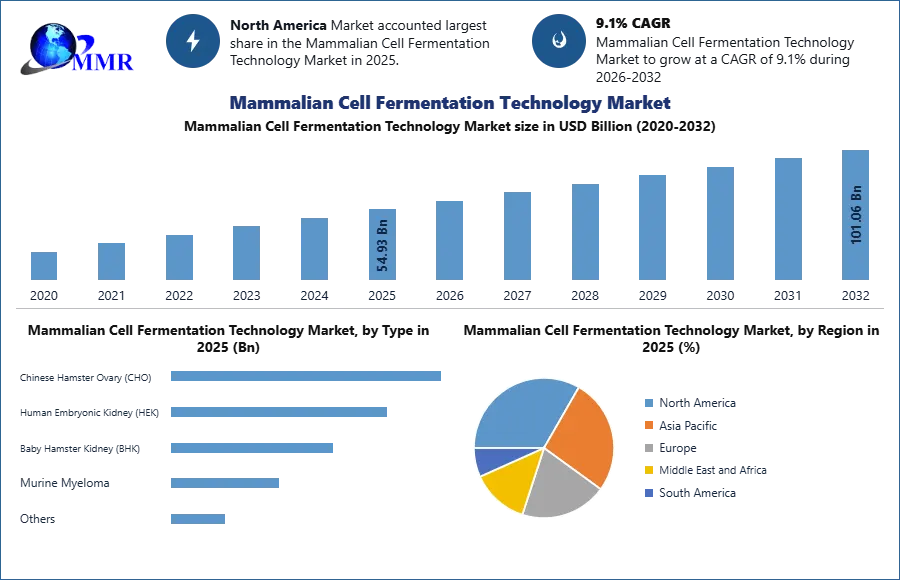
Mammalian Cell Fermentation Technology Market size was valued at USD 54.93 Bn in 2025 and is expected to reach USD 101.06 Bn by 2032, at a CAGR of 9.1%. The growth is driven by advancements in cell biology research, increasing demand for cell-based therapies, and expanding applications in various industries.
Mammalian Cell Fermentation Technology Market Overview:
Mammalian cell technology finds extensive use in pharmaceutical and biotechnology companies, academic research institutions, and regenerative medicine. North America dominates the market, followed by Europe and the Asia Pacific region. Key players such as Lonza Group, Thermo Fisher Scientific, and Merck KGaA hold prominent market positions through product innovation and strategic collaborations. The market presents promising opportunities for both existing and new players in the mammalian cell technology industry.
Advancements in cell biology research and the growing need for cell-based therapies are driving the demand for mammalian cell technology in the pharmaceutical sector. Additionally, the rising adoption of regenerative medicine and tissue engineering is fuelling market growth. In the academic and research field, mammalian cell technology plays a crucial role in various applications, including drug discovery, disease modelling and cell-based assays. The technology is also vital in the production of biologics and vaccines. The market landscape is characterized by intense competition and a focus on technological advancements. Collaborations, partnerships, and mergers and acquisitions are key strategies employed by market players to expand their product portfolios and strengthen their market presence. As the demand for mammalian cell technology continues to rise, the market holds growth potential for the future.
To know about the Research Methodology:- Request Free Sample Report
Research Methodology:
The research methodology for the mammalian cell Fermentation technology market involves a combination of quantitative and qualitative elements. The market is extensively researched using primary and secondary data sources. Primary research involves collecting data through surveys, interviews, and focus groups with key stakeholders such as industry experts, manufacturers, and end-users to gather insights on market trends, consumer preferences, and industry challenges specific to mammalian cell technology. This primary research helps in understanding the current market landscape and growth potential, identifying emerging trends, and gaining first-hand information from industry participants.
Secondary research involves gathering data from published industry reports, company websites, annual reports, trade journals, scientific papers, and databases related to mammalian cell technology. Additionally, information on technology developments, market trends, and advancements in the field of mammalian cell fermentation technology is synthesized from a wide range of sources such as industry and government websites, blogs, magazines, conference proceedings, and association publications. Paid sources like Questel Orbit, Factiva, Bloomberg, and other relevant databases are also utilized to gather comprehensive information. To estimate the market size, growth potential and forecast for the mammalian cell fermentation technology market, a bottom-up approach is used. The market size for top-level markets and sub-segments is normalized, and various factors such as inflation, economic conditions, regulatory changes, and other variables are taken into account in the market forecast.
Multiple data triangulation methodologies are applied to ensure accurate estimation of market size and forecasts. The percentage splits, market shares, and breakdowns of the mammalian cell fermentation technology market segments are derived based on weights assigned to each segment, considering factors such as their utilization rate and average sale price. This information is obtained through a combination of primary research and secondary data analysis. The data is then analysed and synthesized to provide a comprehensive view of the market structure and segment-wise distribution. Country-wise analysis of the overall market and its sub-segments is conducted based on the percentage adoption or utilization of mammalian cell fermentation technology in the respective region or country.
This analysis takes into account factors such as regulatory frameworks, government initiatives, and market maturity in different geographical regions. It provides insights into regional variations and helps in identifying growth opportunities and potential challenges specific to each market. The report includes a comprehensive competitive analysis of key players in the mammalian cell fermentation technology market. Major players are identified through secondary research based on indicators such as market revenue, price, services offered, technological advancements, mergers and acquisitions, and joint ventures. The report also presents a clear representation of the competitive analysis of key players, considering factors such as pricing, financial position, growth strategies, and regional presence in the mammalian cell fermentation technology market, catering to the needs of potential investors.
The market dynamics and factors affecting the growth of the mammalian cell fermentation technology market, both external and internal, are analysed in the report. These factors include technological advancements, research and development activities, government regulations, industry collaborations, and market demand. The analysis helps in understanding the drivers, restraints, opportunities, and challenges influencing the market growth. It also provides insights into the prospects and potential risks associated with the mammalian cell fermentation technology market. The report also includes a clear representation of the market segments and projects the market size for mammalian cell fermentation technology. This segmentation is based on various factors such as cell type, application, end-user, and region.
The market size estimation and forecasting are performed using statistical techniques and models to provide reliable and accurate projections. The segmentation analysis helps in understanding the specific market dynamics and opportunities within each segment and facilitates strategic decision-making for market players and investors. The research methodology for the mammalian cell technology market combines primary and secondary research, market sizing and forecasting techniques, competitive analysis, and in-depth market dynamics evaluation. This approach ensures the comprehensive coverage of the market, reliable data sources, and meaningful insights for stakeholders in the mammalian cell fermentation technology industry.
Mammalian Cell Fermentation Technology Market Scope:
The report provides a comprehensive analysis of the global mammalian cell fermentation technology market. It covers the current market size and future growth prospects of the market, along with the key drivers, restraints, and opportunities influencing the market. The report also includes an in-depth analysis of the competitive landscape, market trends, and product innovations in the mammalian cell fermentation technology market. The scope of the report includes a detailed segmentation analysis of the mammalian cell fermentation technology market based on product type, application, and region. The market is segmented by product type into bioreactors, cell culture media, cell culture instruments, and others. Based on application, the market is segmented into biopharmaceutical production, vaccine production, stem cell research, and others.
It also covers the regional analysis, including the market trends, challenges, and opportunities that are likely to shape the market growth in the forecast years. The mammalian cell fermentation technology market is driven by factors such as the increasing demand for biopharmaceuticals, advancements in cell culture techniques, and the growing adoption of single-use bioreactors. The expanding applications of mammalian cell fermentation technology in areas such as regenerative medicine and cell-based therapies are also contributing to market growth.
Certain factors may hinder the growth of the mammalian cell fermentation technology market, such as the high cost of equipment and the challenges associated with scaling up production. Additionally, regulatory requirements and the need for specialized technical expertise may pose challenges to market growth. Opportunities in the mammalian cell fermentation technology market lie in the development of novel cell culture media formulations, the integration of automation and digital technologies, and the expansion of contract manufacturing services. The increasing focus on personalized medicine and the emergence of cell-based immunotherapies offer significant growth prospects for the market. The report is intended to assist stakeholders, including biopharmaceutical companies, research institutions, contract manufacturing organizations, and investors, in making informed decisions and formulating effective strategies to capitalize on the opportunities in the mammalian cell fermentation technology market and expand their business.
Mammalian Cell Fermentation Technology Market Dynamics:
The mammalian cell fermentation technology market is influenced by various drivers, restraints, opportunities, and trends. Understanding these dynamics is crucial for stakeholders in making informed decisions and capitalizing on market growth potential.
Market Drivers:
Increasing Demand for Biopharmaceuticals: The rising prevalence of chronic diseases and the growing need for effective therapeutics have led to a surge in the demand for biopharmaceuticals. Mammalian cell fermentation technology plays a vital role in the production of biopharmaceuticals, driving the market's growth.
Advancements in Cell Culture Techniques: Ongoing advancements in cell culture techniques, including media optimization, cell line development, and bioreactor design, have significantly improved the productivity and efficiency of mammalian cell fermentation. These advancements drive the adoption of mammalian cell fermentation technology.
Growing Investments in Research and Development: Increased investments by pharmaceutical and biotechnology companies in research and development activities related to biopharmaceutical production fuel the demand for mammalian cell fermentation technology. The focus on developing novel therapies and personalized medicine further supports market growth.
Market Restraints:
High Cost of Technology: Implementing mammalian cell fermentation technology involves significant capital investment, making it a costly endeavor for small and medium-sized enterprises. The high costs associated with equipment, infrastructure, and skilled personnel limit the adoption of this technology.
Regulatory Challenges: The biopharmaceutical industry is subject to strict regulatory requirements to ensure product quality, safety, and efficacy. Complying with these regulations, such as Good Manufacturing Practices (GMP) and quality control standards, can pose challenges for companies utilizing mammalian cell fermentation technology.
Market Opportunities:
The mammalian cell fermentation technology market presents several opportunities for growth and development:
Emerging Markets: Increasing healthcare expenditure and a rising focus on developing advanced biopharmaceutical manufacturing capabilities in emerging markets, such as China, India, and Brazil, provide significant opportunities for market expansion. These regions offer a large patient pool and cost advantages for production.
Contract Manufacturing Organizations (CMOs): The outsourcing of biopharmaceutical production to contract manufacturing organizations presents an opportunity for mammalian cell fermentation technology providers. CMOs offer expertise, specialized facilities, and scalability, enabling companies to access advanced manufacturing capabilities without heavy investments.
Mammalian Cell Fermentation Technology Market Trends:
The adoption of single-use bioreactors and disposable systems is increasing due to their advantages, such as reduced cross-contamination risk, simplified cleaning processes, and flexibility in facility design. This trend is driven by the need for greater operational efficiency and cost-effectiveness. The shift from batch processing to continuous manufacturing is gaining traction in the biopharmaceutical industry. Continuous mammalian cell fermentation allows for higher productivity, consistent product quality, and shorter production timelines. This trend is driven by the desire for process intensification and improved manufacturing efficiency. The mammalian cell fermentation technology market is driven by the increasing demand for biopharmaceuticals, advancements in cell culture techniques, and growing investments in research and development. However, high costs and regulatory challenges act as restraints. Emerging markets, contract manufacturing organizations, single-use systems, continuous manufacturing, and automation represent.
Mammalian Cell Fermentation Technology Market Segment Analysis:
By Type, Chinese Hamster Ovary (CHO) cells dominated cell type in the Mammalian Cell Fermentation Technology Market in 2025, due to their proven reliability, scalability, and regulatory acceptance. CHO cells are widely used in commercial biomanufacturing because they can produce complex recombinant proteins with human-like post-translational modifications, particularly glycosylation. Their adaptability to suspension culture and serum-free media makes them highly suitable for large-scale bioreactor production. In addition, CHO cells demonstrate strong genetic stability and high productivity, enabling consistent yields in monoclonal antibody and recombinant protein manufacturing. Regulatory agencies across major markets have approved numerous CHO-based biologics, further strengthening industry preference for this system. Continuous advancements in cell line engineering, gene amplification technologies, and fed-batch or perfusion processes have enhanced output efficiency. Due to these advantages, CHO cells account for the largest revenue share among mammalian expression systems and remain the preferred platform for biopharmaceutical companies worldwide.
By Application Monoclonal antibodies are the leading application segment in the Mammalian Cell Fermentation Technology Market, accounting for the largest share of production demand. The rapid rise in chronic diseases such as cancer, autoimmune disorders, and inflammatory conditions has significantly increased the need for antibody-based therapeutics. Mammalian cell systems, particularly CHO cells, are essential for producing monoclonal antibodies because they ensure correct protein folding and human-compatible glycosylation patterns, which are critical for therapeutic efficacy and safety. The strong clinical success rate of antibody drugs, combined with expanding biosimilar development, continues to drive large-scale manufacturing requirements. In addition, advancements in antibody engineering, including bispecific antibodies and antibody-drug conjugates, have further expanded production volumes. Pharmaceutical and biotechnology companies are heavily investing in bioreactor capacity expansion to meet global demand. As a result, monoclonal antibodies remain the dominant and fastest-growing application segment within mammalian cell fermentation technology.
Contact Manufacturing Organizations (CMOs): CMOs provide contract manufacturing services to biopharmaceutical companies and utilize mammalian cell fermentation technology to meet the growing demand for biologics. The mammalian cell fermentation technology market can be segmented based on product, application, geography, and end user. This segmentation provides insights into the diverse aspects of the market and helps stakeholders understand the specific dynamics and opportunities within each segment.
Mammalian Cell Fermentation Technology Market Regional Insights
North America dominated Mammalian Cell Fermentation Technology Market in 2025. This region has a strong presence in biopharmaceutical production and stem cell research, with key market players and advanced infrastructure. Europe is a significant market for mammalian cell fermentation technology, driven by increasing investment in research and development activities, especially in the field of biopharmaceuticals. The Asia Pacific region is witnessing rapid growth in the mammalian cell fermentation technology market, fuelled by the presence of emerging economies like China and India, which are investing in biotechnology and healthcare infrastructure.
Mammalian Cell Fermentation Technology Market Regional Analysis:
North America dominates the market, benefiting from major players, advanced research infrastructure, and a high demand for mammalian cell fermentation technology in the biopharmaceutical and biotechnology industries. The region has well-established sectors requiring cell fermentation technology for the production of recombinant proteins, monoclonal antibodies, and vaccines. In Europe, robust regulatory framework and high-quality standards, which contribute to the adoption of mammalian cell fermentation technology for the production of biologics and biosimilars.
The Asia-Pacific region emerges as a rapidly growing market, fuelled by the expansion of the biopharmaceutical industry, increasing investments in research and development, and growing demand for biologics and personalized medicine. Countries like China, India, and South Korea are witnessing significant growth in the adoption of mammalian cell fermentation technology.
Mammalian Cell Fermentation Technology Market Competitive Landscape:
The competitive landscape of the mammalian cell fermentation technology market features prominent players who offer a diverse range of products to meet the needs of end-users in the industry. Key players in this market include Merck KGaA, Thermo Fisher Scientific, Inc., Sartorius AG, GE Healthcare, and Lonza Group Ltd.
To maintain their market positions and expand their product offerings, these key players employ various strategies such as product innovation, mergers and acquisitions, partnerships, and collaborations. For example, Merck KGaA has introduced advanced mammalian cell fermentation technologies that enable higher yields and improved process efficiency for biopharmaceutical manufacturing. Thermo Fisher Scientific, Inc. has expanded its portfolio through acquisitions and collaborations, enhancing its capabilities in mammalian cell fermentation technology.
Companies in the mammalian cell fermentation technology market are heavily investing in research and development to drive innovation and remain competitive. Sartorius AG recently launched a new bioreactor system with advanced control features for optimal cell cultivation and improved productivity. GE Healthcare has partnered with leading biopharmaceutical companies to develop novel cell fermentation technologies, strengthening its market presence.
The report suggests that competition in the mammalian cell fermentation technology market is expected to intensify further due to the growing demand for biopharmaceuticals and the entry of new players. Therefore, major market players are anticipated to focus on product innovation and strategic partnerships to sustain growth and retain their market share in the mammalian cell fermentation technology market.
Mammalian Cell Fermentation Technology Market Scope: Inquire before buying
| Mammalian Cell Fermentation Technology Market | |||
|---|---|---|---|
| Report Coverage | Details | ||
| Base Year: | 2025 | Forecast Period: | 2026-2032 |
| Historical Data: | 2020 to 2025 | Market Size in 2025: | 54.93 USD Billion |
| Forecast Period 2026-2032 CAGR: | 9.1% | Market Size in 2032: | 101.06 USD Billion |
| Segments Covered: | by Type | Chinese Hamster Ovary (CHO) Human Embryonic Kidney (HEK) Baby Hamster Kidney (BHK) Murine Myeloma Others |
|
| by Application | Monoclonal Antibodies Recombinant Proteins Vaccines Hormones Enzymes Others |
||
| by End-Use | Biopharmaceutical Companies CMOs & CDMOs Academic & Research Institutes Others |
||
Mammalian Cell Fermentation Technology, by Region
North America (United States, Canada and Mexico)
Europe (UK, France, Germany, Italy, Spain, Sweden, Austria and Rest of Europe)
Asia Pacific (China, South Korea, Japan, India, Australia, Indonesia, Malaysia, Vietnam, Taiwan, Bangladesh, Pakistan and Rest of APAC)
Middle East and Africa (South Africa, GCC, Egypt, Nigeria and Rest of ME&A)
South America (Brazil, Argentina Rest of South America)
Key Players/Competitors Profiles Covered in the Mammalian Cell Fermentation Technology Market Report in a Strategic Perspective
- Thermo Fisher Scientific, Inc.
- Merck KGaA
- Danaher Corporation
- Sartorius AG
- Lonza Group Ltd.
- Hoffmann-La Roche Ltd
- Pfizer Inc.
- Amgen Inc.
- Bristol-Myers Squibb Company
- AstraZeneca plc
- Gilead Sciences, Inc.
- Regeneron Pharmaceuticals, Inc.
- Moderna, Inc.
- Boehringer Ingelheim GmbH
- Biocon Limited
- Samsung Biologics Co., Ltd.
- WuXi Biologics
- Catalent, Inc.
- AGC Biologics
- Fujifilm Diosynth Biotechnologies
- KBI Biopharma Inc.
- Avid Bioservices, Inc.
- Repligen Corporation
- Pall Corporation
- Eppendorf AG
- Bio-Rad Laboratories, Inc.
- Getinge AB
- Cytiva
- AbbVie Inc.
- Takeda Pharmaceutical Company Limited
Frequently Asked Questions :
1] What segments are covered in the Mammalian Cell Fermentation Technology Market report?
Ans. The segments covered in the Mammalian Cell Fermentation Technology Market report are based on Type, Application, End-user, and Region.
2] Which region is expected to hold the highest share in Mammalian Cell Fermentation Technology Market?
Ans. The North America region is expected to hold the highest share in the Mammalian Cell Fermentation Technology Market.
3] What is the market size of the Mammalian Cell Fermentation Technology by 2032?
Ans. The market size of the Mammalian Cell Fermentation Technology Market by 2032 is expected to reach US$ 101.06 billion.
4] What is the forecast period for the Mammalian Cell Fermentation Technology Market?
Ans. The Forecast period for the Mammalian Cell Fermentation Technology Market is 2026-2032.
5] What was the market size of the Mammalian Cell Fermentation Technology Market in 2025?
Ans. The market size of Mammalian Cell Fermentation Technology Market in 2025 was US $ 54.93 billion.