
Linoleic Acid Market – Global Market Size, Strategic Growth Drivers, Risk Assessment Framework, Regulatory Landscape Review, Competitive Intensity Mapping & Long-Term Industry Outlook to 2032
Overview
The Global Linoleic Acid Market size was valued at USD 3.41 Bn. in 2024, and the total Linoleic Acid Market revenue is expected to grow by 3.1% from 2025 to 2032, reaching nearly USD 4.35 Bn.
Linoleic Acid Market Overview
Linoleic acid, a polyunsaturated omega-6 fatty acid, is an essential nutrient critical to human health, which is not synthesized by the body and obtained through dietary intake. Predominantly sourced from plant-based oils such as sunflower, safflower, and corn oils, linoleic acid is also found in nuts and seeds, providing a versatile nutritional profile. It plays a vital role in maintaining cellular membrane integrity, promoting healthy skin, and regulating inflammatory responses and immune function. These multifaceted benefits have positioned linoleic acid as a key ingredient across a wide range of applications, including food and nutrition, pharmaceuticals, personal care, and industrial uses. With the rising global emphasis on health and wellness, the demand for linoleic acid is expected to grow significantly, drives Linoleic Acid Market growth.
Functional foods, fortified oils, and nutraceuticals enriched with linoleic acid are gaining traction among health-conscious consumers, particularly in developed regions where dietary supplementation is part of everyday health management. The use of linoleic acid in pharmaceuticals and topical formulations, targeting skin repair, cholesterol regulation, and immune modulation, further expands its applications and Linoleic Acid Market potential. Advances such as micro-encapsulation improve the stability of linoleic acid in different formulations. Bio-based production methods and novel extraction technologies help manufacturers achieve higher purity and consistency. These techniques meet strict standards for pharmaceutical and personal care applications. Such technological improvements are driving the expansion of the Linoleic Acid Industry.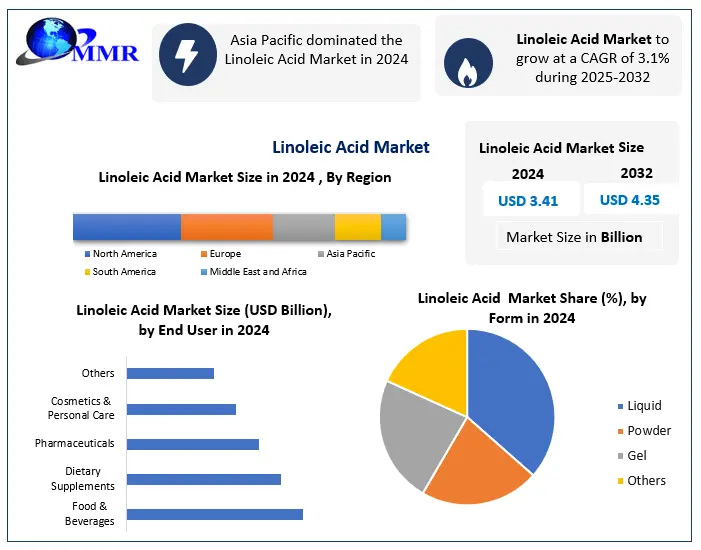 To know about the Research Methodology:-Request Free Sample Report
Linoleic Acid Market Dynamics
Increasing Demand Across Food, Supplements, and Personal Care to Drive the Linoleic Acid Market
Increasing consumer awareness of the health benefits associated with essential fatty acids, particularly linoleic acid, is driving the Linoleic Acid Market. Linoleic acid, an omega-6 fatty acid, plays a crucial role in promoting cardiovascular health, improving skin health, and supporting metabolic functions. Functional foods, fortified oils, and nutraceuticals are increasingly incorporating linoleic acid to meet the rising health-conscious consumer demand, particularly in developed regions such as North America and Europe.
The shift toward plant-based and clean-label ingredients is boosting adoption, as plant-derived linoleic acid from sources such as soybean, sunflower, and safflower oils aligns with consumer preferences for sustainable and natural ingredients. The cosmetics and personal care industry is contributing to the Linoleic Acid Market growth, leveraging linoleic acid in formulations for skin moisturization, anti-aging, and barrier protection. Innovations in extraction and purification technologies are enabling manufacturers to produce high-purity linoleic acid at scale, which is critical for pharmaceutical and high-end cosmetic applications. Moreover, increasing investments by major players in research and development to create value-added formulations are strengthening the market further.
Raw Material Volatility and Supply Chain Uncertainty to Restrain Linoleic Acid Market
Linoleic acid production is heavily dependent on vegetable oils such as soybean, sunflower, safflower, and corn oils. Fluctuations in crop yields caused by adverse climatic conditions, pests, or soil degradation directly affect raw material availability and cost. The geopolitical tensions and trade restrictions disrupt import-export flows, leading to increased procurement costs and impacting production margins. Smaller and mid-sized manufacturers in the Linoleic Acid Market are particularly vulnerable to these fluctuations, which hinder their ability to scale operations or invest in innovation. The reliance on agricultural outputs introduces seasonality in supply, complicating consistent production for end-use industries such as food, pharmaceuticals, and cosmetics. The stringent regulatory standards in major markets require manufacturers to adhere to quality, purity, and safety guidelines, which adds to production costs.
Linoleic Acid Market Segment Analysis
Based on Source, the market is segmented into the Plant-Based Oils (Soybean oil, Sunflower oil, Safflower oil, Corn oil and Others) and Animal-Based Oils (Fish oil, Butter and Others). Plant-based oils dominated the global Linoleic Acid Market in 2024. This is due to largely attributed to the abundance, cost-effectiveness, and wide availability of sources such as soybean, sunflower, safflower, and corn oils. Soybean oil remains a key contributor due to its high linoleic acid content and extensive cultivation in North and South America, making it a preferred raw material for large-scale production.
Sunflower and safflower oils are highly valued for their purity and nutritional profiles, which cater to the increasing demand for functional foods and dietary supplements. Corn oil is another significant source, primarily used in processed foods and industrial applications. The rising consumer preference for plant-based, non-GMO, and sustainable ingredients further reinforces the prominence of this segment. The plant-based linoleic acid aligns with trends in vegan and natural cosmetic formulations, supporting its integration into personal care and pharmaceutical products. Advances in extraction, purification, and refinement technologies allow manufacturers to produce high-purity linoleic acid suitable for multiple applications, which boosts the Linoleic Acid Market growth.
Based on Grade, the market is categorized into the Food Grade, Pharmaceutical Grade and Industrial Grade. Food Grade is expected to dominate the Linoleic Acid Market over the forecast period. The increasing consumer awareness of health and nutrition, food-grade linoleic acid is extensively used in dietary supplements, fortified foods, cooking oils, and functional foods, driving the Linoleic Acid Market growth. Its essential role in supporting cardiovascular health, skin function, and overall well-being has propelled demand in both developed and emerging markets. The growing popularity of plant-based diets and clean-label products has further strengthened the adoption of food-grade linoleic acid. Pharmaceutical-grade linoleic acid, though important in specialized medical formulations and nutraceuticals, captures a smaller market share due to higher regulatory standards and production costs. Industrial-grade linoleic acid, used in paints, coatings, adhesives, and bio-based materials, caters primarily to industrial applications but remains secondary to the robust demand from the food and nutrition sector.
Linoleic Acid Market Regional Insights
Asia Pacific dominated the Linoleic Acid Market in 2024 and is expected to continue its dominance over the forecast period. The region benefits from large-scale cultivation of key oilseed crops such as soybean, sunflower, safflower, and corn, which serve as primary raw materials for linoleic acid production. Countries such as China, India, and Indonesia contribute significantly to both production and consumption, driven by growing demand in food, nutraceuticals, and cosmetics. Rising health awareness and increasing disposable incomes are driving the adoption of functional foods, dietary supplements, and personal care products enriched with linoleic acid, driving the growth of the Linoleic Acid Market.
The expanding pharmaceutical and cosmetic industries in the region are increasingly integrating linoleic acid into high-value formulations, further strengthening market growth. Technological advancements in extraction and purification processes, combined with supportive government policies and initiatives for sustainable agriculture, enable manufacturers to meet rising demand efficiently. North America and Europe are key markets, driven by health-conscious consumers and regulatory emphasis on high-quality, plant-based, and clean-label ingredients.
Linoleic Acid Market Competitive Landscape:
The global Linoleic Acid Market is characterized by a fragmented competitive landscape, featuring a blend of multinational corporations and specialized regional suppliers. Tier 1 players such as Eastman Chemical Company, BASF SE, and Merck & Millipore lead the market through large-scale production capabilities, high-purity offerings, and adherence to stringent regulatory standards across various regions. These companies serve diverse industries, including food and beverages, pharmaceuticals, cosmetics, and industrial applications. Tier 2 companies such as Avantor, Cayman Chemical, and Univar Solutions provide versatile grades of linoleic acid tailored for research, nutraceuticals, and specialty formulations, often emphasizing product quality and customer-specific solutions. Tier 3 suppliers such as Sisco Research Laboratories and Beijing Lys Chemicals focus on regional and custom formulation needs, offering competitive pricing and flexible batch sizes to meet local market demands.
Linoleic Acid Market Key Development:
• December 23, 2024 – BASF has entered into a binding agreement to divest its Food and Health Performance Ingredients business to Louis Dreyfus Company (LDC), a leading global merchant and processor of agricultural goods. The transaction includes a production site and state-of-the-art R&D center in Illertissen, Germany, along with three application laboratories located outside Germany. Approximately 300 employees are expected to transfer from BASF to LDC upon closing. This strategic move allows BASF to focus on its core Nutrition & Health divisions, such as vitamins, carotenoids, and feed enzymes, while LDC aims to strengthen its position in the growing plant-based ingredients market.
Linoleic Acid Market Key Trends:
| Trend | Description |
| Next-Gen Immunotherapy Expansion | Next-Gen Immunotherapy Expansion significantly broadens treatment possibilities for PD-L1 low and refractory head and neck cancer (HNC) patients by strategically targeting multiple immune pathways. This approach aims to overcome tumor resistance mechanisms that limit the effectiveness of conventional therapies. |
| Precision & ADC-Facilitated Therapy | Precision and ADC-Facilitated Therapy works by delivering cytotoxic agents directly to tumor cells, thereby maximizing therapeutic efficacy in HPV-negative and platinum-resistant patients. This targeted approach minimizes exposure to healthy tissues, significantly reducing systemic toxicity and adverse side effects commonly associated with conventional chemotherapy. By combining precision targeting with antibody-drug conjugates (ADCs), the therapy enhances tumor cell eradication, improves patient outcomes. |
| Biomarker-Guided Therapy | Biomarker-Guided Therapy personalizes cancer treatment by identifying patients most likely to respond to specific therapies, ensuring that interventions are both effective and tailored to individual tumor profiles. By using predictive biomarkers, clinicians can optimize therapeutic outcomes, maximize efficacy, and reduce the risk of unnecessary toxicity from ineffective treatments. |
The scope of Linoleic Acid Market: Inquire before buying
| Linoleic Acid Market | |||
|---|---|---|---|
| Report Coverage | Details | ||
| Base Year: | 2024 | Forecast Period: | 2025-2032 |
| Historical Data: | 2019 to 2024 | Market Size in 2024: | USD 3.41 Bn. |
| Forecast Period 2025 to 2032 CAGR: | 3.1% | Market Size in 2032: | USD 4.35 Bn. |
| Segments Covered: | by Source | Plant-Based Oils Soybean oil Sunflower oil Safflower oil Corn oil Others Animal-Based Oils Fish oil Butter Others |
|
| by Grade | Food Grade Pharmaceutical Grade Industrial Grade |
||
| by Form | Liquid Powder Gel Others |
||
| by End Use Industry | Food & Beverages Dietary Supplements Pharmaceuticals Cosmetics & Personal Care Others |
||
Linoleic Acid Market, by Region
North America (United States, Canada and Mexico)
Europe (United Kingdom, France, Germany, Italy, Spain, Sweden, Russia and the Rest of Europe)
Asia Pacific (China, South Korea, Japan, India, Australia, Indonesia, Malaysia, Philippines, Thailand, Vietnam and the Rest of the Asia Pacific)
Middle East and Africa (MEA) (South Africa, GCC, Nigeria and the Rest of MEA)
South America (Brazil, Argentina, Colombia, Chile and the Rest of South America)
Linoleic Acid Market Key Players
North America
1. Eastman Chemicals (USA)
2. Merck & Millipore (USA)
3. Univar Solutions (USA)
4. Cayman Chemicals (USA)
5. Penta Manufacturing (USA)
6. Avantor (USA)
7. Charkit Chemical (USA)
8. Wilshire Technologies (USA)
9. Spectrum Chemical (USA)
Europe
1. BASF SE (Germany)
2. Croda International Plc (UK)
3. Evonik Industries (Germany)
4. Lluch Essence SL (Spain)
5. Synerzine (France)
6. Caila & Pares (Spain)
7. Cognis GmbH (Germany)
8. Univar Europe (Netherlands)
9. Maruha Nichiro Europe (Netherlands)
10. Arkema (France)
Asia-Pacific
1. Sisco Research Laboratories Pvt. Ltd. (India)
2. Acme Synthetic (India)
3. Beijing Lys Chemicals (China)
4. Wuxi Jinyuan Chemicals (China)
5. Shanghai Keli Chemical (China)
6. Zhenjiang Yihua (China)
7. Kaneka Corporation (Japan)
8. Ajinomoto Co., Inc. (Japan)
9. TCI Chemicals (Japan)
10. Mitsui Chemicals (Japan)
FAQ’S
1. What is the market size of the Global Linoleic Acid Market in 2024?
Ans. The market size Global Linoleic Acid Market in 2024 was USD 3.41 billion.
2. What are the different segments of the Global Linoleic Acid Market?
Ans. The Global Linoleic Acid Market is segmented into Source, Grade, Form and End User industry.
3. What is the study period of this market?
Ans. The Global Linoleic Acid Market is studied from 2024 to 2032.
4. Which region dominated the Global Linoleic Acid Market share in 2024?
Ans. The Asia Pacific dominated the Global Linoleic Acid Market share in 2024.
5. What is the Forecast Period of the Global Linoleic Acid Market?
Ans. The Forecast Period of the market is 2025-2032 in the Linoleic Acid Market.