
Laser Therapy Devices Market Size by Product, Application, End-Use, Region, Industry-Wide Analysis, Competitive Landscape Assessment & Long-Term Forecast to 2032
Overview
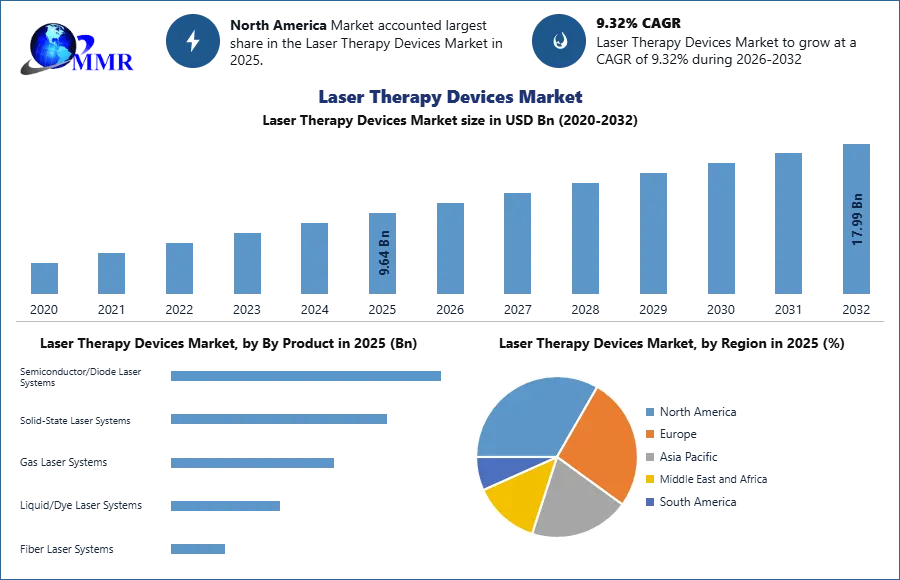
Laser Therapy Devices Market was valued at USD 9.64 Bn in 2025 and is expected to reach USD 17.99 Bn by 2032, growing at a CAGR of 9.32% during the forecast period.
Laser Therapy Devices Market Overview:
Laser therapy is a noninvasive medical process that utilizes light of a given wavelength to cure malignancies and abnormal growth, remove kidney stones, and heal damaged retinas, among other things. Laser treatment is a sort of medical therapy that is highly advanced. Lasers enable surgeons to perform with extraordinary accuracy in medicine by focusing on a specific place. This treatment produces less harm to the target than typical surgical procedures. However, laser treatment is expensive and may need many visits to the surgeon.
Thanks to its advantages, the laser therapy devices market are growing, and this device is also used to block abrupt nerve endings during surgery or procedures, to assist lymph vessels in decreasing swelling, and to assist blood vessels in preventing blood loss. Laser surgery has now become an essential component of ophthalmology. The therapy in laser-based ophthalmology relies on a beam of light that reshapes the cornea, increasing corneal focus immediately. Laser therapy can also be utilized to create a particular channel in the eye to reduce the changing intraocular pressures caused by glaucoma or a significant number of tiny hemorrhages.
The increase in the popularity of noninvasive laser treatments in aesthetic treatment is driving the global laser therapy devices market. In addition, the growth in the prevalence of cancer and technical improvements in laser therapy techniques such as cold laser therapy is expected to increase the global market throughout the forecast period. Meanwhile, benefits over traditional surgical procedures, such as shorter hospital stays and no need for surgical procedures, encourage patients and healthcare providers to choose laser therapy. However, stringent regulations and the risk of cancer from laser therapy as well as High cost and adverse effects attributed to laser surgeries may significantly hamper laser therapy devices market growth throughout the forecast period.
 To know about the Research Methodology :- Request Free Sample Report
Laser Therapy Devices Market Dynamics:
Increasing demand for minimally invasive surgeries
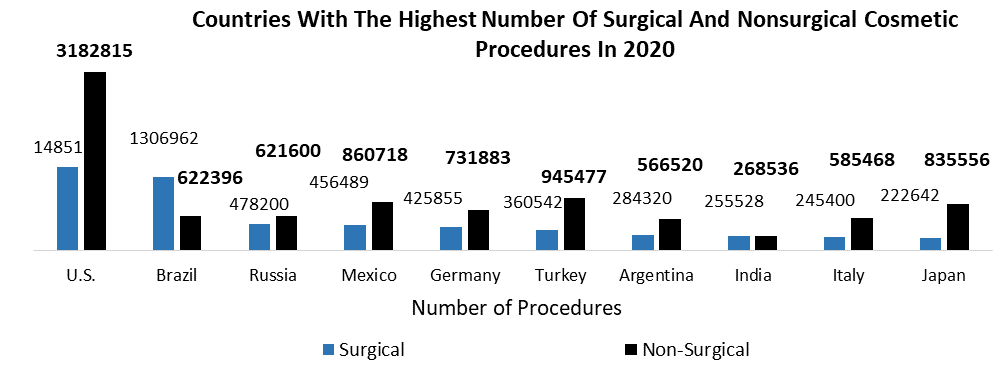
The growing popularity of minimally invasive surgeries, the increasing number of cosmetic surgeries, and the rising frequency of eye problems are all driving factors in the laser therapy devices market's growth. Likewise, the rising prevalence of congenital heart disease, coronary artery disease, glaucoma, age-related macular edoema, and other disorders is expected to boost market size during the forecast period. For example, the American Society of Plastic Surgeons (ASPS) estimates that around 15.6 million surgical and minimally invasive cosmetic operations were performed in the United States in 2020.
The advent of novel lasers, and procedure-specific uses. Advanced technological incorporation is one of the primary aspects that increase the market over the forecast period. For instance, in August 2020, Cosmetic and medical laser producer Erchonia Corporation introduced a new low-level green laser targeted for body fat removal. This gadget shoots 10 green lasers onto the skin to emulsify the adipose tissue and remove extra fatty molecules. The rising number of cosmetic treatments and the introduction of innovative startup businesses are factors driving the laser therapy devices market's growth.
 High adoption of Technologically Advanced Aesthetic Lasers
One of the factors driving individuals throughout the world to choose minimally invasive cosmetic treatments is a growing awareness of their physical appearance. As a result, the need for minimally invasive and less time-consuming laser aesthetic treatments is increasing rapidly all around the world. This factor is expected to boost market demand for aesthetic laser systems and consumables. The emergence of technologically improved procedure-specific aesthetic laser systems is enticing women to undertake skin treatments in order to get better outcomes in less time. The increased demand for -specific laser treatments drives leading market participants to launch innovative energy-based aesthetic laser systems. For example, Quanta System - El.En. S.p.A. successfully created a new laser lithotripsy technology, NextGen laser development technology termed UHPTDL, with the broadest frequency range. The new approach claims to provide kidney stone-cleaning treatments that are both quick and effective. Thus, the technologically advanced aesthetic lasers boosted the laser therapy devices market growth during the forecast period.
High cost and adverse effects attributed to laser surgeries
The high cost of laser surgical techniques restricts their use in both established and emerging economies. In the United States, for example, the average cost of LASIK surgery in 2020 was USD 2,632 per eye. This was a somewhat greater cost than in 2019. Additionally, scarring, koebnerization, dyschromia, and other problems associated with laser operations restrict the laser therapy devices market growth. To minimize difficulties, healthcare practitioners choose alternative therapies that are less expensive and have minimum side effects than laser operations. This is exacerbated further by the high cost of laser equipment, particularly procedure-specific laser systems in emerging economies. This has reduced the acceptance and demand for new laser systems in global markets, resulting in the establishment of a market for reconditioned systems. The aforementioned issues have all played a role in reducing demand for new laser systems in the global market. As a result, this is expected to impact on global laser therapy devices market.
Rising adoption of laser therapy devices in oncology
According to the Cancer Atlas, there were an anticipated 18.1 million active cancer cases in 2018, with more than 9 million cancer deaths. Additionally, approximately 44 million people suffering from malignancy that same year had been diagnosed during the preceding five years. This burden is expected to rise by more than 60% by 2040. As a result, healthcare practitioners are offering cutting-edge treatments. In recent years, a slew of non-invasive techniques has been developed, including laser therapy, which has shown to be extremely helpful in lowering the incidence. Lasers can be used in two ways: to utilize heat to shrink or eliminate a tumor, or to activate a chemical (also known as a photosensitizing agent) that exclusively kills cancerous cells. Although lasers can be used on their own, they are frequently utilized in conjunction with other cancer therapies such as radiation therapy or chemotherapy. As a result, in oncology, the demand for the laser therapy devices market is expected to grow. Many manufacturers are benefiting from such advanced applications. BIOSPEC (Russia), Lynton Lasers Ltd. (England), Modulight USA Inc., and Pioneer Optics Co. (USA) are among the prominent oncology-grade laser system players.
Laser Therapy Devices Market Segment Analysis:
Based on the Product, the Semiconductor/Diode Laser Systems segments dominated the global laser therapy devices market in terms of value and volume in 2025. The segment is further expected to grow at the highest CAGR of 9.28% and maintain its dominance in terms of revenue share by end of the forecast period. Lasers are widely used throughout the field of medicine, from diagnostic imaging and clinical testing to surgical treatments and the latest aesthetic procedures. Diode lasers, in particular, have now become the primary laser type in an application for therapeutic medical operations. This is because these workhorse devices provide a lower cost of ownership, a wider choice of output wavelengths and power levels, compact rugged packaging, and superior (semiconductor) reliability when compared to other laser types.
Diode lasers (DLs), are the most energy-efficient and cost-effective lasers. Therefore, they have found more and more applications in the field of medical therapies. Semiconductor laser light sources provide several benefits over other types of light sources in a wide range of medical applications. Emphasis is on conversion efficiency, temperature sensitivity, and cost rather than beam quality and brightness, which tend to be the driving factors for the segment. The increase in the adoption of semiconductor/ diode lasers in dental treatments is expected to be the primary growth driver for the segment.
 Diode lasers were used mainly for photobiomodulation (PBM), also known as biostimulation or low-level laser therapy, LLLT procedures, as well as for photodynamic therapy, where the wavelength is more crucial than high power. The significance of PBM in cell culture studies, resistance to fungal infections, mitigation of the side-effects of cancer therapy, pain and inflammation therapies, wound healing, muscle performance, etc. has become clearer. In addition, High power (above 5 W) DL applications for surgery have taken place in dermatology and oral surgical procedures.
Laser Therapy Devices Market Regional Insights:
North America dominated the global laser therapy devices market with the highest revenue share of 52% in 2025. The region is further expected to grow at a CAGR of 8.89% and maintain its dominance by end of the forecast period. The key elements responsible for the region's dominance include the rising need for minimally invasive medical operations, a high preference for aesthetic procedures, and a high rate of adoption of innovative technology. According to an article released by Ocular Surgery News, the number of laser vision correction treatments performed at Pacific Vision Institute in San Francisco increased by 42.0% in 2025 compared to 2014. Similarly, the American Society of Plastic Surgeons estimates that the overall spending on cosmetic procedures in 2024 would be USD 20.17 billion. Besides that, developing healthcare infrastructures, rising governmental initiatives in the healthcare service, and a significant presence of manufacturers in the regions are factors driving the regional market growth.
Various laser therapy device manufacturers and start-ups are entering the market with the most highly technological laser therapy devices. The market's availability of numerous innovative technologies enables medical practitioners to improve patients' health by increasing treatment efficiency. For example, IRIDEX Corporation, a producer of ophthalmic laser-based medical products, launched an upgraded second-generation version of the MicroPulse P3 Device to treat glaucoma in February 2020, and the device upgrades are expected to significantly reduce intraocular pressure suitable for glaucoma patients without incisions. As a result of higher technological advancements and new product launches in the industry, the North American laser treatment devices market is likely to rise over the forecast period.
In addition, the growing fitness and beauty trend has raised the demand for cosmetic products. As a result, technological improvements have prompted various companies to produce products that support healthy skin. In June 2019, Belle51, a Los Angeles-based business, released its laser-based technology Solèy. The device is intended for use at home and may be used to easily eliminate dark spots, melasma, unsightly moles, stretch marks, and acne scars. The device is available for purchase in the United States and is sold internationally. Such product launches are expected to continue to drive regional laser therapy devices market growth during the forecast period.
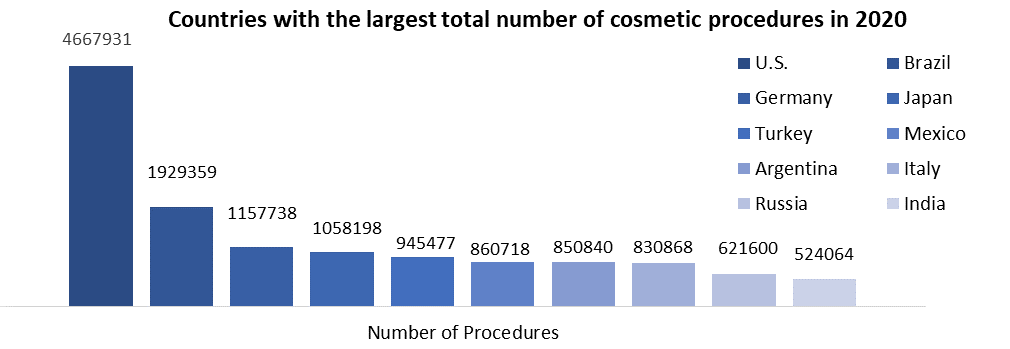 Europe is expected to grow at a CAGR of 8.58% during the forecast period and is expected to hold the second-highest position in terms of the revenue by end of the forecast period. The rising prevalence of ocular disorders in countries including Germany, the United Kingdom, and others lead to a significant patient population requiring treatment. This is boosting the amount of LASIK surgical operations performed in these countries, as well as the need for ophthalmic lasers. This, together with a rising number of individuals undergoing cosmetic operations in Europe, is expected to boost demand for laser therapy devices and drive revenue growth in the laser therapy devices market during the forecast period.
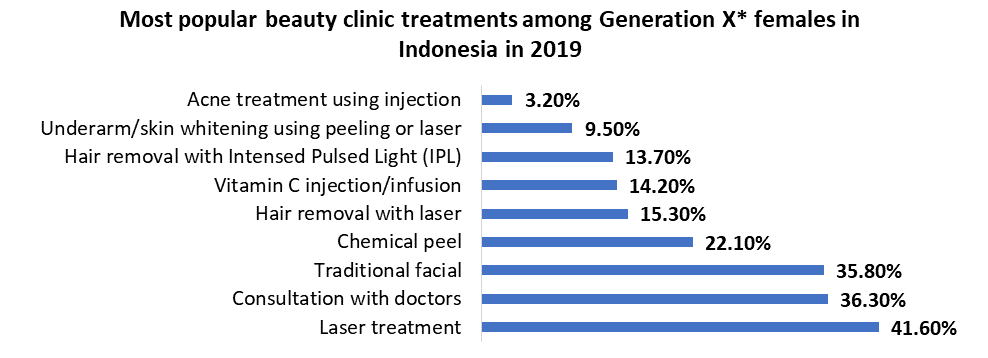
Asia Pacific market is expected to grow at a CAGR of 7.78% during the forecast period and is expected to offer lucrative growth opportunities for the market players. The developing healthcare infrastructure and the increasing number of laser centers are expected to be major factors for regional market growth. Meanwhile, rising demand for anti-aging therapies, rising need for minimally invasive medical surgeries, high demand for aesthetic treatments, and an increase in the number of hair removal surgeries are expected to drive demand for laser devices during the forecast period. In Japan and India, for example, 387,793 and 97,920 hair removal treatments were conducted in 2020, respectively.
South America, Middle East & African markets are expected to grow at a moderate CAGR during the forecast period. The increasing aging population is responsible for the growth of the market in South America. According to Med Device Online, by 2060, about 30 countries in this area would have a higher proportion of senior people than youngsters under the age of 15. The region has 71 million individuals over the age of 60, which is expected to double by 2035.
Laser Therapy Devices Market Scope: Inquiry Before Buying
| Laser Therapy Devices Market | |||
|---|---|---|---|
| Report Coverage | Details | ||
| Base Year: | 2025 | Forecast Period: | 2026-2032 |
| Historical Data: | 2020 to 2025 | Market Size in 2025: | 9.64 USD Bn |
| Forecast Period 2026-2032 CAGR: | 9.32% | Market Size in 2032: | 17.99 USD Bn |
| Segments Covered: | By Product | Semiconductor/Diode Laser Systems Solid-State Laser Systems Gas Laser Systems Liquid/Dye Laser Systems Fiber Laser Systems |
|
| By Application | Dermatology Dentistry Gynecology Ophthalmology Oncology |
||
| By End-Use | Hospitals Ambulatory Surgical Centers Specialized Clinics Academic and Research Institutes Homecare Settings |
||
| By Technology | Continuous Wave Laser Systems Pulsed Laser Systems Low-Level Laser Therapy (LLLT) High-Intensity Laser Therapy (HILT) Photobiomodulation Therapy |
||
Key Players /Competitor Profiles Covered in the Laser Therapy Devices Market Report from a Strategic Perspective.
- Boston Scientific Corporation
- Coherent Corp.
- Hologic Inc.
- Danaher Corporation
- BIOLASE Inc.
- Cutera Inc.
- IRIDEX Corporation
- AngioDynamics
- BTL Industries
- Erchonia Corporation
- IPG Photonics Corporation
- Novanta Inc.
- Lumentum Holdings Inc.
- Cynosure Inc.
- Fotona d.o.o.
- Biolitec AG
- Jenoptik AG
- Bystronic Laser AG
- Lumibird
- Alma Lasers
- Sisram Medical Ltd.
- Lumenis Ltd.
- Quanta System S.p.A.
- Sciton Inc.
- El.En. S.p.A.