
Laser Interferometer Market Size by Type, Interferometer Type, Application, End-User, Region, Industry-Wide Analysis, Competitive Landscape Assessment & Long-Term Forecast to 2032
Overview
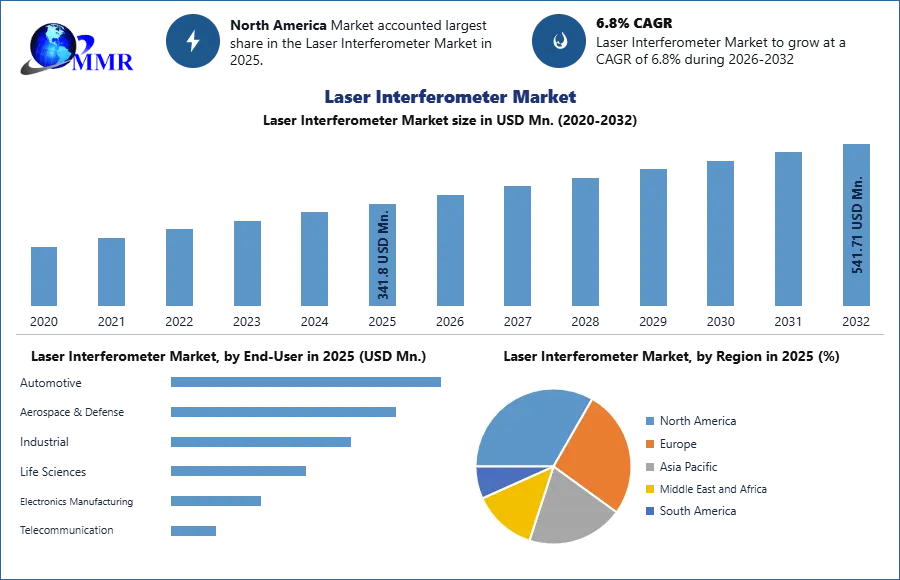
The Laser Interferometer market size reached USD 341.8 million in 2025 and is expected to reach USD 541.71 million by 2032, growing at a CAGR of 6.8% during the forecast period.
Interferometry is simply the use of optical interference to perform precise measurements of extremely small linear dimensions. Laser interferometers are interferometers that use lasers and electronic controls to inspect machine parts for straightness, parallelism, and flatness, as well as to measure very small diameters and calibrate slip gauges. Laser-based interferometers have recently gained popularity in metrology applications. The increase in the demand for laser interferometers in the automotive sector is significantly driving the global Laser Interferometer market. In this sector, laser interferometers are used for alignment, dimensional measurement, profiling, and control.
Many companies in the Asia Pacific region are working to establish a global presence by developing manufacturing plants. The rise in focus on quality control through automation in the manufacturing industry, along with an increase in demand for 3D metrology services is fueling the growth of the global laser interferometer market during the forecast period. In 2022, the 4D Technology Corporation launched the newest member of the PhaseCam series of dynamic interferometers, as well as 4Sight Focus Acquisition and Analysis Software. The PhaseCam dynamic interferometers detect motion, turbulence, vibration, and cryo/vacuum environmental chambers.
 To know about the Research Methodology:- Request Free Sample Report
Laser Interferometer Market Dynamics:
The widespread usage of laser interferometers in a variety of end-user sectors
Technological advancements are one of the key drivers fueling end-user demand for measurement devices such as laser interferometers and optical devices. Rising demand for automobiles, especially in developing countries such as India, China, Japan, and Australia, and rising R&D expenditure by market leaders are major drivers to drive the Laser Interferometer Market during the forecast period. The requirement for consistent approvals and quality control processes to ensure proper standard maintenance across the automotive, aerospace, and other industry verticals has been rapidly increasing in recent years.
Quality control is an essential part of the manufacturing process for interferometers used in a variety of applications. The market for laser interferometers is expected to increase in the coming years with the rising demand for quality control across industries. The market participants are constantly engaged in various R&D activities to improve the quality of existing interferometers and create new and advanced ones. They are also trying to increase their geographical presence by establishing new manufacturing plants in major regions of the world. All of these reasons are paving the way for the global Laser Interferometers market to grow in the next years.
3D meteorology in Laser Interferometer
Manufacturers are trying to offer devices with enhanced capabilities and flexible architecture in response to rising innovations, new application areas, and technical advancements. 3D metrology can be used for measurement modeling, which involves visualizing measurements during the production process of a product whose quality can be controlled through statistical sampling. A large amount of 3D data is required to adequately define a product for precision inspection. 3D modeling is employed in critical industries such as aerospace and defense, automotive, heavy machinery, medical, electronics, energy, and power. 3D models created from 3D objects are a collection of data points generated by optical measurement systems such as vision measuring machines (VMMs) or Coordinate Measuring Machines (CMMs) that are merged with intelligent data models and data integration tools. Laser interferometers are used to measure displacements and other parameters in a reliable, quick, and accurate manner.
Technological advancements in recent years have improved metrology. Best-in-class metrology solutions are the major driver for higher precision, faster throughput, and fewer rejections. As a result, laser interferometry has become an essential component of an efficient automated manufacturing process. Several significant players are attempting to reach a wider range of industries by providing more accurate and cost-effective solutions through the use of laser interferometers. As a result, the increased need for 3D metrology in various sectors is likely to drive the Laser Interferometer market during the forecast period.
Development of a Phase-Shifting Laser Fizeau Interferometry Improves Performance and Testing Confidence
Laser with phase shifting Fizeau interferometry is capable of offering optical testing with minimal uncertainty in precise measurements and performance-based operation. Because of vibration and turbulence, classic phase-shifting laser-based interferometers provide inconsistent findings. Better phase-shifting interferometry efficiency and acute measurement capacity are expected to improve in the coming years. The usage of interferometry is expected to increase in the next years due to its capacity to give a full-field view, high measurement sensitivity, and measurement results in a short period of time.
The development of the spatiotemporal phase-shifting method (ST-PSM), which is capable of producing extremely precise results and is considered the robust phase analysis method, can improve the stability of the phase-shifting method. The spatiotemporal phase-shifting method also eliminates the potential of periodic errors, which serves as a significant advantage and enhances the likelihood of its application in a wide variety of end-use industries. For example, in the automobile sector to achieve the extremely accurate non-contact shape and deformation measurement. Interferometers are used in life and material sciences to measure the thickness of transparent materials. This development is expected to increase the Laser Interferometer market growth.
Laser Interferometer market Restraint
Customers in the measurement ecosystem often choose low-cost, cutting-edge measurement devices. Engineers and manufacturers have been forced to widely upgrade old technologies as a result of increased demand for more advanced specifications and features, as well as a rise in the number of applications. The high cost of laser interferometer-based systems as well as the challenges associated with the system are limiting the market growth. Laser interferometers can be used by big organizations because of the high costs of setting up measurements and calibrating equipment. To save operational costs, end-user industries such as aerospace and defense, communications, automotive, and industrial electronics frequently use measuring equipment rental and leasing services rather than purchasing new measurement equipment. These services are suitable for consumers with short-term needs or those with a small budget that prevents them from purchasing these instruments.
Laser Interferometer Market Segment Analysis:
Based on the Interferometer Type, the Fizeau Interferometer segment dominated the global market in the year 2025. The popularity of the Fizeau interferometer across the world is the most important factor in the growth of the laser interferometer market share. The development of the phase-shifting Fizeau Interferometer is also attracting several customers who are looking for laser interferometers to improve surface topology.
The problem of inaccurate results in highly turbulent applications and problems in operations related to vibration in phase-shifting Fizeau Interferometer is eliminated by the spatiotemporal phase-shifting method that boosts the market sales of the Fizeau Interferometry segment.
Based on Type, the heterodyne interferometer category had the highest revenue share in 2025. In heterodyne interferometers, only one detector is required to measure both displacement and direction, making object alignment easier. Heterodyne interferometry has various advantages, including clear direction sensing, high dynamic precision, multiaxis synchronized measuring capabilities, and insensitivity to fluctuations in source intensity. Furthermore, current applications such as Optical Coherence Tomography (OCT), LIDAR, photolithography, vibrometry, displacement measurement, and photolithography all depend on heterodyne laser interferometric methods that are expected to increase the growth of this segment.
A homodyne interferometer utilizes a single-frequency laser source, whereas a heterodyne interferometer uses two close-frequency laser sources. As position sensors, most commercial Fourier-Transform (FT) spectrometers currently employ Helium-Neon (HeNe) laser interferometers. Heterodyne interferometers are primarily used in precision instruments for modern industrial and scientific applications, which is likely to drive the laser interferometer market growth.
Based on End-User, the automotive segment is expected to dominate the laser interferometer market throughout the forecast period. Rising car sales, due to rising disposable income and purchasing power in various nations throughout the world, are likely to drive the growth of the laser interferometer market's automotive segment. The increasing use of optical interferometry for object verification, high-precision dimensional measurement, and geometrical tolerances has resulted in the growth of the automotive segment. A laser interferometer can calibrate a whole machine in hours and perform a full-functioning inspection in less than an hour. Laser interferometers can also measure straightness, perpendicularity, dynamics, and vibration.
Laser Interferometer Market Regional Insights
In North America, the Laser Interferometer market accounted for the highest revenue share in 2025. North America is home to numerous renowned Laser Interferometer developers, as well as a base of operations for many clients operating in many end-user sectors. Many laser interferometer manufacturers are extending their product portfolios to increase their target customer base and increase the use of laser interferometers in research institutions and calibration laboratories.
The Europe region dominated the global Laser Interferometer market share in 2025. Rapid technical advancements and rising automation use in the region's automotive and aerospace & defense industries are likely to boost the market growth in Europe. Manufacturers of laser interferometers are utilizing advanced technology to ensure smooth industrial operations. Germany and the United Kingdom are the major contributors to Europe's laser interferometer market. End-user sectors such as automotive, biomedical, aerospace and defense are well established in these nations. Furthermore, the usage of laser interferometers in water treatment plants and the automotive sector is likely to drive growth in the region's laser interferometer market. Inorganic growth has been adopted by players such as Carl Zeiss, located in Germany.
These companies are trying to dominate the market by acquiring companies that have significant growth potential in the global market. The acquisitions also help the organization to widen its product portfolio. The companies may grow their sustainable innovation infrastructure to produce more advanced market solutions. Zygo Corporation, which is a laser interferometry manufacturer is making advancements in their products to enhance their applications in surface form metrology. The market is likely to benefit significantly from the increased use of 3D imaging services. The market for laser interferometers is expected to rise rapidly in the coming years with the growing desire of customers in the United States and Canada for optical and non-contact imaging for accurate production measurements.
This study focuses on the major driving factors and restraints that affect the Laser Interferometer market. Global and regional players in the Laser Interferometer industry are discussed in depth, including revenue data and market share information. The Laser Interferometer market analysis includes trends in Laser Interferometers, information about the potential market and needs, and lists of potential competitors. MMR has segmented the global Laser Interferometer Market report based on Type, Interferometer Type, Application, End-User, and region. The report contains strategic profiling of top key players in the market, a wide-ranging analysis of their core competencies, and their strategies like new product launches, growths, agreements, joint ventures, partnerships, and acquisitions that apply to the businesses. Our team of analysts can also provide you with data in excel files and pivot tables or can assist you in creating presentations from the data sets available in the report.
Laser Interferometer Industry Ecosystem
Laser Interferometer Market Scope: Inquiry Before Buying
| Laser Interferometer Market | |||
|---|---|---|---|
| Report Coverage | Details | ||
| Base Year: | 2025 | Forecast Period: | 2026-2032 |
| Historical Data: | 2020 to 2025 | Market Size in 2025: | 341.8 USD Mn. |
| Forecast Period 2026-2032 CAGR: | 6.8% | Market Size in 2032: | 541.71 USD Mn. |
| Segments Covered: | by Type | Heterodyne Homodyne |
|
| by Interferometer Type | Michelson Interferometer Fabry-Perot Interferometer Fizeau Interferometer Mach-Zehnder Interferometer Sagnac Interferometer Twyman-Green Interferometer |
||
| by Application | Surface Topology Engineering Applied Science Biomedical Semiconductor Detection |
||
| by End-User | Automotive Aerospace & Defense Industrial Life Sciences Electronics Manufacturing Telecommunication |
||
Laser Interferometer Market, by Region
North America (United States, Canada and Mexico)
Europe (UK, France, Germany, Italy, Spain, Sweden, Austria and Rest of Europe)
Asia Pacific (China, South Korea, Japan, India, Australia, Indonesia, Malaysia, Vietnam, Taiwan, Bangladesh, Pakistan and Rest of APAC)
Middle East and Africa (South Africa, GCC, Egypt, Nigeria and Rest of ME&A)
South America (Brazil, Argentina Rest of South America)
Key Players/Competitors Profiles Covered in Brief Laser Interferometer Market Report in Strategic Perspective
- Renishaw plc
- Keysight Technologies, Inc.
- Carl Zeiss AG
- Zygo Corporation (AMETEK, Inc.)
- Bruker Corporation
- Mahr GmbH
- SIOS Meßtechnik GmbH
- Thorlabs, Inc.
- Newport Corporation (MKS Instruments, Inc.)
- Tosei Engineering Corp. (Tokyo Seimitsu Co., Ltd.)
- 4D Technology Corporation
- QED Technologies International, Inc.
- SmarAct GmbH
- Luna Innovations Incorporated
- API Metrology
- Haag-Streit Group
- MÖLLER-WEDEL OPTICAL GmbH
- Trioptics GmbH
- Attocube Systems AG
- Polytec GmbH
- Jenoptik AG
- Keyence Corporation
- Holmarc Opto-Mechatronics Ltd.
- AdlOptica Optical Systems GmbH
- Fujifilm Holdings Corporation