
IoT in Aviation Market by Component, Connectivity Technology, Application, End User, and Region - Global Market Size Estimation, Industry-Wide Analysis, Competitive Landscape Assessment & Long-Term Forecast to 2032
Overview
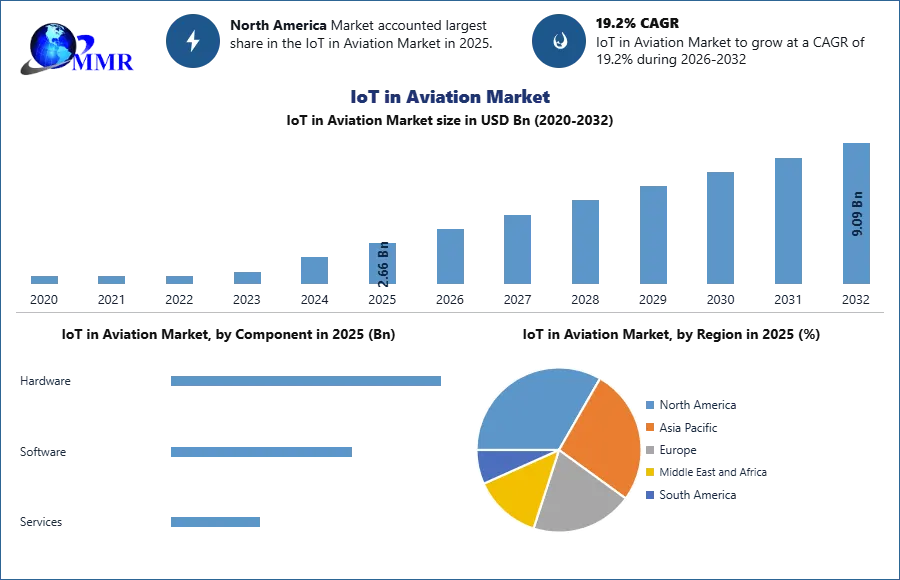
IoT in Aviation market size reached USD 2.66 Bn in 2025 and is expected to reach USD 9.09 Bn by 2032 , growing at a CAGR of 19.2 % during the forecast period.
The Internet of Things (IoT) has the potential to revolutionize the aviation industry by providing innovative solutions that can enhance safety, efficiency, and the passenger experience. IoT technology is being used in various areas of aviation, including air traffic management, aircraft operations, passenger experience, and maintenance. The global IoT in Aviation market is expected to grow during the forecast period from 2026-2032. The growth is being driven by increasing air traffic, the need to reduce operational costs, the growing demand for passenger comfort and safety, and the increasing adoption of IoT technology in the aviation industry. North America is expected to be the largest market for IoT in aviation due to the high level of technology adoption in the region and the presence of several leading aviation companies.
Airport authorities and airline operators across the world are rapidly adopting the latest technologies to streamline their operations and manage the unrelenting growth in passenger numbers. The strong focus on improving the passenger experience, combined with the exponential growth in air passenger traffic, is expected to drive the growth of the IoT in Aviation market during the forecast period. Airbus is among the leading IoT companies in the aviation industry, utilizing IoT technology in the development of its new A350 XWB aircraft. The company has installed sensors throughout the aircraft to collect data on various aspects, which is then transmitted to the ground to enhance aircraft efficiency and reduce maintenance costs.
IoT in Aviation Market offers a comprehensive overview of the current market situation and provides a forecast until 2032. This report provides qualitative and quantitative information that highlights important market developments, trends, challenges, competition, and new opportunities within the IoT in Aviation Market. This report aims to provide a comprehensive presentation of the global market for IoT in Aviation, with both quantitative and qualitative analysis to help readers develop business/growth strategies, assess the market competitive situation, and analyze their position in the current marketplace.
The report also discusses technological trends and new product developments. It includes Porter’s Five Forces analysis, which explains the five forces: buyers' bargaining power, supplier's bargaining power, the threat of new entrants, and the degree of competition in the IoT in Aviation Market. The report also focuses on the competitive landscape of the IoT in Aviation Market. The analysis will help the IoT in Aviation market players to understand the present situation of the market.
To know about the Research Methodology :- Request Free Sample Report
IoT in Aviation Market Dynamics:
Increase in air traffic all around the world to Drive the IoT in Aviation Market
The aviation industry has witnessed a significant increase in air traffic in recent years, driven by globalization and an increase in disposable income. This increase in air traffic has created challenges for airlines, airport operators, and aviation authorities to ensure the safe and efficient operation of air travel. Asia Pacific is expected to add 2.1 billion passenger journeys per year by 2030, providing opportunities for developing economies. The Federal Aviation Administration (FAA) manages over 45,000 daily flights in the US.
The rise in air passenger traffic has encouraged airline companies to expand their aircraft fleet and enhance the comfort level and services in both domestic and international flights. IoT-compatible devices within airports and aircraft provide opportunities for revenue generation over the forecast period. As a result, airport operators and airlines are expected to invest in IoT-compatible devices for airports and aircraft, creating revenue generation opportunities for IoT in Aviation Market during the forecast period.
Need to enhance the passenger experience to Support Growth of the IoT in Aviation Market
As airports worldwide look to improve passenger experience and operational efficiency, there has been a surge in investments in smart airport technologies. Smart airports are designed to leverage advanced technologies such as the Internet of Things (IoT) to create a seamless and connected travel experience for passengers. By leveraging IoT technologies, airports can enhance the passenger experience while also reducing operational costs over time. For instance, using IoT-enabled systems to monitor and regulate temperature and lighting can lead to significant energy savings, and smart security systems can help airports optimize security processes and reduce security-related delays. As investments in smart airports continue to rise, the increased adoption of advanced IoT technologies enhances the passenger experience, improves operational efficiency, and saves money in the long run.
The Asia Pacific region is expected to experience significant growth in IoT in Aviation Market, driven by increasing demand for smart Airports in countries such as China and India. The IoT in Aviation Market is also expected to benefit from the growing deployment of IoT-enabled infrastructure in the aviation industry and the rising demand for technologically advanced connected electronic flight bags, as well as in-flight Wi-Fi connectivity for mobile devices. The use of IoT-enabled sensors and data analytics tools can help airport operators optimize energy usage, reduce waste, and improve the overall efficiency of airport operations. Additionally, IoT-enabled devices such as smart luggage tags, automated check-in kiosks, and mobile apps can help passengers navigate the airport with ease and reduce waiting times.
Increasing the Government's initiative to modernize IoT to streamline traffic and ensure safe and timely operations
Governments around the world are realizing the importance of investing in modernized IoT and ATM (air traffic management) solutions to improve the safety and efficiency of air travel. These technologies enable real-time data exchange between various stakeholders in the aviation industry, including airlines, airports, and air traffic controllers. By implementing advanced IoT and ATM solutions, governments can streamline air traffic management and reduce delays, while ensuring safe and timely operations.
For example, in the United States, the FAA (Federal Aviation Administration) is implementing NextGen, a modernized ATM system that uses advanced technologies such as satellite-based navigation and digital communications to improve air traffic management. In Europe, the Single European Sky ATM Research (SESAR) program is working to develop a more integrated and efficient air traffic management system using IoT and other advanced technologies. In addition to improving safety and efficiency, modernized IoT and ATM solutions can also help reduce the environmental impact of air travel. By optimizing routes and reducing delays, these solutions can help airlines and airports save fuel and reduce their carbon footprint. Overall, the adoption of advanced IoT and ATM solutions is expected to have a significant positive impact on the IoT in Aviation Market in the coming years.
Intense competition and various government authorities are key challenges that can restrict IoT in Aviation market growth.
The aviation industry is highly competitive with airlines constantly trying to outdo one another in terms of passenger experience, comfort, and services provided. This intense competition can pose a challenge to the growth of the IoT in Aviation market as airlines may face difficulties in keeping up with the latest technologies and innovations to meet the expectations of their customers. Additionally, various government authorities are responsible for regulating and monitoring the industry, which can also create challenges for the market. Stringent regulations and compliance requirements can make it difficult for airlines and other aviation-related companies to operate, leading to delays and increased costs. It is important for industry players to stay up-to-date with the latest trends and regulatory requirements to overcome these challenges and achieve growth in the IoT in Aviation market.
IoT in Aviation Market Segment Analysis:
Based on the Component, the Software segment held a leading position in 2025 and is expected to continue to maintain the lead during the forecast period. The integration of Internet of Things (IoT) software applications is transforming the aviation industry by providing new opportunities to optimize operations, enhance safety, and improve the passenger experience. which have increased the demand for the Software segment impacting the IoT in Aviation market growth.
Based on the End User, the Airline segment dominated the global market in 2025 and is expected to continue this trend during the forecast period because of the leveraging IoT technology to enhance the travel experience of customers. Airlines are under pressure to improve operational efficiency and reduce costs. IoT technology can help airlines to achieve these goals by providing real-time data on aircraft performance, crew schedules, and ground operations. IoT in airlines is used to optimize schedules, minimize delays, and reduce maintenance costs which are also contributing to the segment growth during the forecast period.
IoT in Aviation Market Regional Insights
North America IoT in aviation market is expected to be the largest market during the forecast period because of several factors, including the high level of technology adoption in the region, the presence of several leading aviation companies, and the increasing demand for innovative solutions that can enhance safety, efficiency, and the passenger experience. The demand for IoT solutions in the aviation industry is increasing due to the growing focus on reducing operational costs, enhancing the passenger experience, and improving safety.
Several leading IoT in Aviation companies in North America is investing heavily in IoT technology to stay ahead of the competition. For example, Delta Air Lines has launched an IoT-enabled predictive maintenance program that uses sensors to monitor aircraft components and predict maintenance requirements before they become critical. American Airlines has also implemented an IoT-enabled baggage tracking system to provide passengers with real-time updates on their luggage's location. Thus, the North American IoT in Aviation market is expected to continue growing in the coming years, driven by increasing technology adoption, growing demand for innovative solutions, and the presence of several leading aviation companies in the region.
Asia-Pacific is the second-largest growing region across the globe in the IoT in Aviation market. The region's growth is driven by the increasing demand for in-flight connectivity and connected electronic devices, as well as heavy investments in IoT solutions by airport authorities and airline operators. Several leading airlines in the Asia Pacific region have already implemented IoT solutions to improve their operations and enhance the passenger experience. For example, Japan Airlines has implemented IoT sensors in its aircraft to monitor various parameters such as fuel consumption, engine performance, and weather conditions to optimize its operations and improve fuel efficiency.
AirAsia has implemented an IoT-enabled predictive maintenance system that uses sensors to monitor aircraft components and detect potential issues before they cause any problems. In addition, several governments in the Asia Pacific region are also investing heavily in the development of smart airports and air traffic management systems, which is expected to drive the adoption of IoT in the aviation market during the forecast period.
Recent Developments
Honeywell International Inc.
January 8, 2025: Honeywell unveiled updates to its Anthem connected flight deck platform, showcasing expanded IoT capabilities that integrate real-time aircraft sensor data, AI-driven analytics, and enhanced cockpit connectivity. The system enables predictive maintenance alerts, automated system health reporting, and improved situational awareness for pilots. Additionally, Anthem’s cloud-native architecture supports streamlined data exchange between aircraft and ground operations, helping airlines optimize operational decision-making and reduce unscheduled maintenance events.
Cisco Systems, Inc.
2025: Cisco expanded its private 5G and Wi-Fi 6E networking solutions at major international airports, improving connectivity for IoT devices used in baggage tracking, sensor networks, and real-time operational monitoring. The enhanced network infrastructure supports secure, low-latency communications for aircraft ground systems and airport digital services. Cisco also integrated AI-driven network analytics to proactively manage performance issues, helping airports and airlines scale IoT deployments while strengthening cybersecurity protections across connected aviation environments.
IoT in Aviation Market Scope: Inquiry Before Buying
| IoT in Aviation Market | |||
|---|---|---|---|
| Report Coverage | Details | ||
| Base Year: | 2025 | Forecast Period: | 2026-2032 |
| Historical Data: | 2020 to 2025 | Market Size in 2025: | 2.66 USD Bn |
| Forecast Period 2026-2032 CAGR: | 19.2% | Market Size in 2032: | 9.09 USD Bn |
| Segments Covered: | by Component | Hardware Software Services |
|
| by Connectivity Technology | Wide-Area Networks (WAN) Local-Area Networks (LAN) Short-Range & Low-Power IoT Networks Others |
||
| by Application | Aircraft Operations Ground Operations Passenger Experience Asset Management Others |
||
| by End User | Airlines Airports Air Navigation Service Providers (ANSPs) MROs Aircraft OEM Others |
||
IoT in Aviation Market, by Region
North America (United States, Canada and Mexico)
Europe (UK, France, Germany, Italy, Spain, Sweden, Austria, Turkey, Russia and Rest of Europe)
Asia Pacific (China, India, Japan, South Korea, Australia, ASEAN and Rest of APAC)
Middle East and Africa (South Africa, GCC, Egypt, Nigeria and Rest of ME&A)
South America (Brazil, Argentina, Columbia and Rest of South America)
Key players/Competitors profiles covered in the IoT in Aviation Market report in a strategic perspective
1. Honeywell International Inc.
2. Cisco Systems, Inc.
3. IBM Corporation
4. SITAONAIR
5. Huawei Technologies Co., LTD.
6. Tata Sons Private Limited
7. Aeris
8. Happiest Minds Technologies
9. Amadeus It Group Sa
10. Tech Mahindra Limited
11. Sendum Wireless Corporation
12. Microsoft Corporation
13. Palantir Technologies
14. Walkbase
15. Blip Systems
16. SAP SE
17. Arrow Electronics, Inc.
18. Wind River Systems, Inc.
19. Zestiot
20. Undagrid