
Intratumoral Cancer Therapy Market Size by Technology, Application, End-User and Region – Segment-Level Market Assessment, Growth Opportunity Analysis, Competitive Mapping & Forecast to 2030
Overview
The Intratumoral Cancer Therapy Market size was valued at USD 210.07 Billion in 2023 and the total Intratumoral Cancer Therapy Market revenue is expected to grow at a CAGR of 9.7% from 2024 to 2030, reaching nearly USD 410.62 Billion by 2030.
Intratumoral Cancer Therapy Market Overview
Cancer is a leading cause of global death, with nearly 10 million deaths in 2023. The treatment example of Cancer has transformed with several therapies such as chemotherapies, radiation therapies, and immunotherapies available to treat cancer. The available therapies are due to severe side effects, resistance to available therapies, and non-eligibility for a particular therapy.
In the intratumoral cancer therapy market, Intratumoral immunotherapy is a potential therapeutic strategy that targets the tumor using it as a vaccine against itself. It is a promising way that includes direct injection into the tumors thereby targeting the local tumor immunity barriers directly. It also is leveraged to tackle any tumor that lies in close anatomical nearness to a tumor with the goal of direct acceptance by tumors.
There are different categories of intratumoral therapies: cytokines, pathogen-associated molecular patterns (PAMPs), oncolytic viruses, cancer gene therapy, monoclonal antibodies, and small molecules. The present Intratumoral cancer therapy market comprises only three approved therapies namely Imlygic (Talimogene laherparepvec/T-VEC; Amgen), Hensify (NBTXR3; Nanobiotix), and Delytact (teserpaturev/G47∆; Daiichi Sankyo). Imlygic is the first oncolytic virus that received approval from the US FDA for the local treatment of unresectable cutaneous, subcutaneous, and nodal lesions in patients with melanoma recurrent after initial surgery in 2015. While Hensify got recommendations from the EU in April 2020, for the treatment of locally advanced soft tissue sarcoma (STS), however, it is not yet launched. The most recent, conditional, and time-limited approval from the Japan Ministry of Health, Labor and Welfare (MHLW) for the treatment of patients with malignant glioma in June 2021.
The present outlook of the Intratumoral cancer therapy market is majorly focused on the treatment of cancers such as Melanoma, Nonmelanoma Skin Cancer, Pancreatic Cancer, Renal Cell Carcinoma, Colorectal Cancer, Breast Cancer, Brain Cancer, and Soft Tissue Sarcoma, however, the major focus lies on Melanoma, Head and neck cancer, Brain cancer, Nonmelanoma skin cancer and Colorectal cancer. One of the reasons behind this could be the high incidence of these cancers. MMR analyzed that Nonmelanoma skin cancer (NMSC) contributed to the highest incident number with 774,926 cases in 2023 in the 7MM.
In the intratumoral cancer therapy market there are several pharma and biotech companies including Checkmate Pharmaceuticals, OncoSec Medical Incorporated, Merck, Istari Oncology, Replimune/ Regeneron, Philogen, Exicure, Sirnaomics, Nanobiotix, Intensity Therapeutics, NanOlogy, Lokon Pharma, Immunicum, DNAtrix, Treovir, Idera Pharmaceuticals, Immunovative Therapies, and others are developing Intratumoral cancer therapies at different stages of clinical trials. The emerging Intratumoral cancer therapies are majorly targeting Melanoma, Brain cancer, Nonmelanoma skin cancer, Head and neck cancer and colorectal cancer include areVidutolimod, Tavo, CAVATAK, PVSRIPO, RP1, Daromun, Cavrotolimod, Cotsiranib, Hensify, INT230-6, NanoPac, Delolimogene mupadenorepvec, Intuvax, Tasadenoturev, G207, Tilsotolimod, AlloStim, and several others.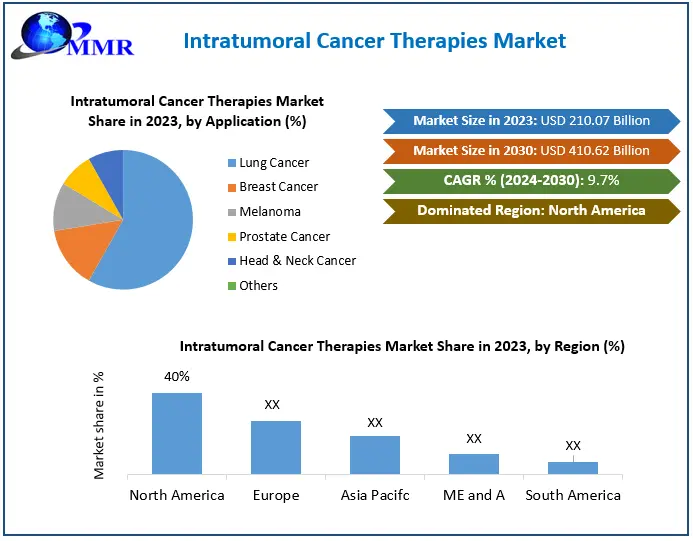 To know about the Research Methodology :- Request Free Sample Report
Intratumoral Cancer Therapy Market Trends:
The growing focus on advanced immunotherapy, leveraging the body's immune system to target and destroy cancer cells within the tumor microenvironment. The use of oncolytic viruses, immune checkpoint inhibitors, and adoptive cell therapy, shows promising results in various types of cancer. Innovative drug delivery systems (like Targeted Drug Delivery Systems) are developed to enhance the localized delivery of therapeutics directly into tumors and create new trends in the intratumoral cancer therapy market. Nanoparticles and liposomes, Targeted delivery, and Improving efficacy with minimal systemic side effects all innovations are come under the Nanotechnology-based platforms.
Researchers are exploring combination therapies involving intratumoral treatments alongside systemic therapies or other local modalities like radiation therapy and surgery. This approach aims to achieve synergistic effects, enhance treatment response, and overcome resistance mechanisms to the intratumoral cancer therapy market. Focused on intratumoral therapies reflects the growing interest and investment in this field are increasing the number of clinical trials and research initiatives, driving innovation, and growing the therapeutic store against cancer.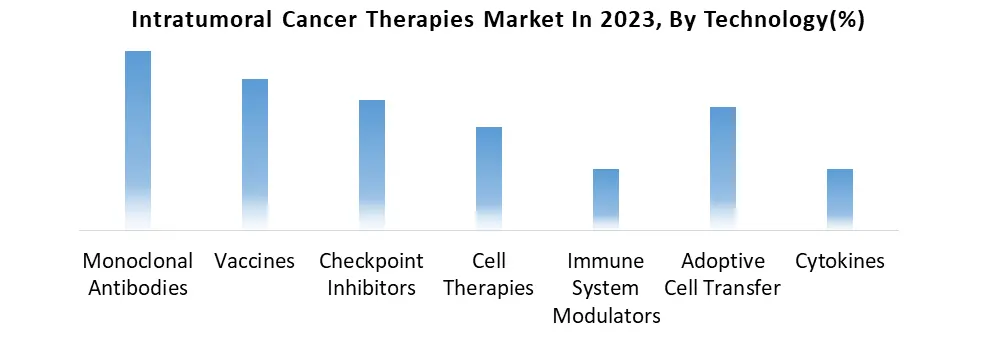
Intratumoral Cancer Therapy Market Dynamics:
Increasing Developments in the Intratumoral Cancer Therapy Market
The intratumoral cancer therapy market is majorly focused on the treatment of cancers One of the reasons behind this could be the high incidence of these cancers. MMR analyzed that Nonmelanoma skin cancer (NMSC) contributed to the highest incident number with 675, 815 cases in 2020. The intratumoral cancer therapy industry includes various technologies like Monoclonal Antibodies, Vaccines, Checkpoint Inhibitors, Cell Therapies, Immune System Modulators, Adoptive Cell Transfer, Cytokines, and Others. The monoclonal antibody technology has the most significant growth in 2023, owing to a surge in monoclonal antibodies for cancer immunotherapy. These technologies exhibit different properties where the immune technique is modulated, and thus they activate the molecules targeted on the immune system. Monoclonal antibody technology also generates the antitumor immune response. There are various monoclonal antibodies, such as naked, conjugated, and bispecific monoclonal antibodies.
Immunotherapy has come a long way with its benefits and advantages over conventional cancer treatment methods widely acceptable and known. The direct inoculation of immune-stimulating agents into tumors gives added advantages. It helps in avoiding off-target toxicities, dose-limiting toxicities, and adverse effects with immune stimulation, and requires overall lower dosages by local administration. While some of the challenges are addressable, some leave a significant burden. The increasing intratumoral cancer therapy market developments in the global intratumoral cancer therapies market is expected to boost the global market growth during the forecast period. For instance, in January 2023, AstraZeneca, a UK-based, science-driven biopharmaceutical corporation completed the acquisition of Neogene Therapeutics Inc., for $120 million and this acquisition is expected to unlock further routes for AstraZeneca for the treatment of cancer. Moreover, in 2022, Regeneron completed the acquisition of Checkmate Pharmaceutical, a clinical-stage biopharmaceutical corporation, and its investigational immune activator for probable usage in multiple tumor types. Furthermore, growing awareness, cases, and research activities among other factors are also expected to contribute to the global market growth during the forecast period.
Side Effects Associated with These Intratumoral Cancer Therapies
The large number of common and uncommon severe side effects caused by cancer therapy are expected to hamper the global intratumoral cancer therapy market growth during the forecast period. The lack of approved treatments available, high cost, and a deficient number of professionals are among the additional factors hampering the global market growth. Intratumoral cancer therapies need high development and administration costs. Limited compensation coverage for these novel treatments discourages patients and healthcare providers from opting for them, impacting intratumoral cancer therapies market growth. Technical challenges related to formulation, delivery devices, and optimizing drug release kinetics are essential for enhancing Intratumoral drug delivery techniques and treatment effectiveness. These challenges require determined efforts from stakeholders, including increased research investment, collaboration among industry players and regulatory bodies, and continued innovation in drug delivery technologies and treatment strategies.
Intratumoral Cancer Therapy Market Regional Insights:
North America is expected to dominate the global intratumoral cancer therapy market during the forecast period with increasing government investments, growing cancer cases, and increasing product authorizations among others. According to MMR Research, it estimated that 2,281,658 new cancer cases were diagnosed in the USA in 2020, with nearly 612,390 deaths. In 2020, The most common cancers were breast (253,465), lung (227,875), prostate (209,512), and colon (101,809) in the USA. In another instance, in 2023, the US government announced a budget of USD 7.8 billion to the National Cancer Institute (NCI) for cancer research.
The North America intratumoral cancer therapy market is the most lucrative market with a revenue share of 40%. The presence of various biotechnology and medical device firms in the region is driving the market. North America is likely to maintain its lead during the forecast period with factors such as increased spending for Research and Development initiatives and widespread use of new technology. The government and private organizations' investment to increase the research and development of cancer therapies in the region is driving the growth of the North American intratumoral Cancer Therapy Market.
Intratumoral Cancer Therapy Market Scope: Inquiry Before Buying
| Intratumoral Cancer Therapy Market | |||
|---|---|---|---|
| Report Coverage | Details | ||
| Base Year: | 2023 | Forecast Period: | 2024-2030 |
| Historical Data: | 2018 to 2023 | Market Size in 2023: | US $ 210.07 Bn. |
| Forecast Period 2024 to 2030 CAGR: | 9.7% | Market Size in 2030: | US $ 410.62 Bn. |
| Segments Covered: | by Technology | Monoclonal Antibodies Vaccines Checkpoint Inhibitors Cell Therapies Immune System Modulators Adoptive Cell Transfer Cytokines |
|
| by Application | Lung Cancer Breast Cancer Melanoma Prostate Cancer Head & Neck Cancer Others |
||
| by End-User | Hospitals Cancer Research Centres Clinics |
||
Intratumoral Cancer Therapy Market by Region:
1. North America (United States, Canada, and Mexico)
2. Europe (UK, France, Germany, Italy, Spain, Sweden, Austria, and the Rest of Europe)
3. Asia Pacific (China, South Korea, Japan, India, Australia, Indonesia, Malaysia, Vietnam, Taiwan, Bangladesh, Pakistan, and the Rest of APAC)
4. Middle East and Africa (South Africa, GCC, Egypt, Nigeria, and the Rest of MEA)
5. South America (Brazil, Argentina Rest of South America)
Leading Intratumoral Cancer Therapy Market Key Players:
1. Pfizer (New York, United States)
2. Bristol-Myers Squibb co. pipeline (New Jersey, United States)
3. Merck and co. (Rahway, New Jersey,)
4. Biogen Inc. (Cambridge, Massachusetts)
5. Istari Oncology (North Carolina, United States)
6. Sirnaomics(Gaithersburg, united States)
7. Intensity Therapeutics (New York, United States)
8. NanOlogy(Texas, United States)
9. Immunovative Therapies (Jerusalem)
10. DNAtrix(Texas, United States)
11. Idera Pharmaceuticals (United States)
12. Treovir (Pennsylvania, United States)
13. Philogen (Siena, Italy)
14. Hoffmann la Roche (Basel, Europe)
15. Nanobiotix (France, Europe)
16. Sanofi (Paris, France)
17. Boehringer Ingelheim (Ingelheim, Germany)
18. Daiichi Sayko (Tokyo, Japan)
19. AstraZeneca (Cambridge, United Kingdom)
20. Immunocore (United Kingdom)
21. Lokon Pharma (Uppsala County, Sweden)
22. Immunicum (Stockholm, Sweden)
FAQs:
1. Which segment dominates the Intratumoral Cancer Therapy market based on the product?
Ans. The Lung cancer segment dominates the market growth.
2. Which region is expected to lead the global Intratumoral Cancer Therapy Market during the forecast period?
Ans. North America is expected to lead the global market during the forecast period.
3. What is the projected market size and growth rate of the Intratumoral Cancer Therapy Market?
Ans. The Intratumoral Cancer Therapy Market size was valued at USD 210.07 Billion in 2023 and the total Intratumoral Cancer Therapy Market revenue is expected to grow at a CAGR of 9.7 % from 2024 to 2030, reaching nearly USD 410.62 Billion by 2030.
4. What segments are covered in the Intratumoral Cancer Therapy Market report?
Ans. The segments covered in the market report are Technology, Application, End-Users, and region.