
Industrial Wastewater Treatment Market by Technology, Offering, Type, Application, End-User, and Region – Global Market Size Estimation, Industry-Wide Analysis, Competitive Landscape Assessment & Long-Term Forecast to 2032
Overview
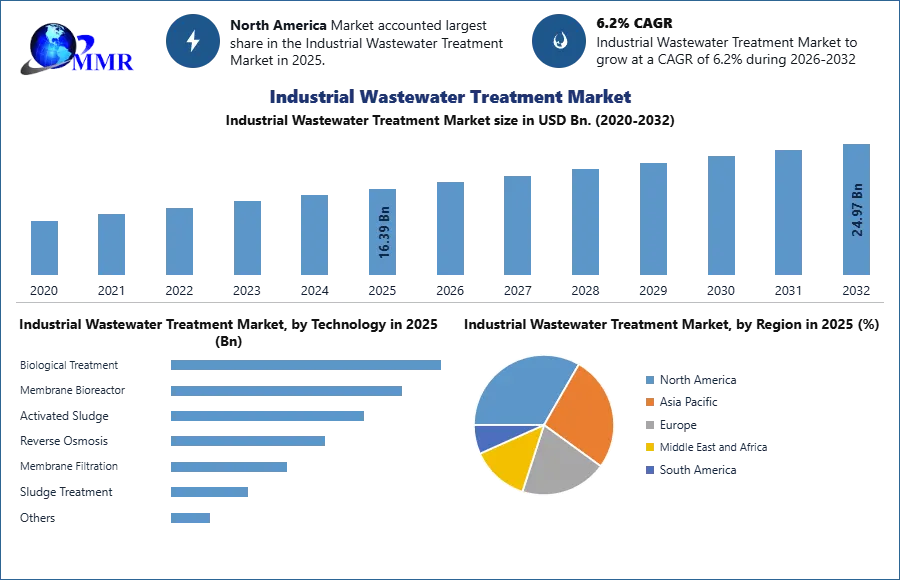
Industrial Wastewater Treatment market size reached USD 16.39 billion in 2025 and is expected to reach USD 24.97 billion by 2032, growing at a CAGR of 6.2 % during the forecast period.
Wastewater treatment is the process of removing organic matter and other pollutants from wastewater. These treatments use to make the wastewater clean and safe enough to discharge back into the environment without affecting nearby populations or the local ecosystem. Water resources are under serious threat all around the world because of the discharge of untreated wastewater into water bodies. Today, approx. 80% of all wastewater is discharged into the world's rivers, which poses health, environmental, and climate-related concerns. Industries are constantly using freshwater as a coolant and solvent to improve the quality of their products. Exposing this used water directly to the environment can severely intoxicate it. Industries must therefore construct a wastewater treatment plant on their premises to ensure that discharge standards. Increasing Water stress and the need for high-quality water are expected to drive the demand for advanced water treatment and recycle-and-reuse systems across the world.
For instance, Key players are increasing their R&D capabilities to come up with advanced technologies, which would provide more results along with cost savings and fulfill the stringent government norms. Industrial Wastewater Treatment Market players are focusing on the adoption of new technologies such as biological treatment, membrane bioreactors, and activated sludge. They are also focusing on focusing on the implementation of ZLD technology to broaden their revenue streams. Most industries treat their effluent on-site before discharging it into a river or sewer. Governments are implementing stringent rules to prevent water pollution, which is fuelling the growth of the Industrial wastewater treatment market.
This study focuses on the major driving factors and restraints that affect the Industrial Wastewater Treatment market. Global and regional players in the Wastewater Treatment Services industry are discussed in depth, including revenue data and market share information. The Industrial Wastewater Treatment market analysis includes trends in industrial wastewater treatments, information about the potential market and needs, and lists of potential competitors. MMR has segmented the global Industrial Wastewater Treatment Market report based on Vehicle Type, Drive Type, and region. The report contains strategic profiling of top key players in the market, a wide-ranging analysis of their core competencies, and their strategies like new product launches, growths, agreements, joint ventures, partnerships, and acquisitions that apply to the businesses. Our team of analysts can also provide you with data in excel files and pivot tables or can assist you in creating presentations from the data sets available in the report.
To know about the Research Methodology :- Request Free Sample Report
Industrial Wastewater Treatment Market Dynamics:
Implementation of Stringent Government regulations to drive the Industrial Wastewater Treatment market
There has been a rise in awareness about the protection of the environment from the discharge of harmful wastewater effluents. Regulatory bodies govern wastewater discharge norms in many countries around the world. These bodies have been enforcing severe laws and guidelines for industrial facilities to satisfy effluent standards to slow the risk of water pollution. Environmental organizations and government agencies have developed and implemented a variety of policies to encourage water conservation and reduce water pollution.
Strict regulations and restrictions are anticipated to result in the establishment of a number of new water treatment plants in emerging countries. Several bodies have established guidelines to encourage the deployment of industrial wastewater treatment technology. These include the EU Water Framework Directive in the European Union, the Effluent Limitation Guidelines (ELGs) established by the Environmental Protection Agency in the United States, the Wastewater Effluent Discharge Limit Mandates established by Mexico's Secretariat of Environment and Natural Resources (SEMARNAT), Regulatory Directives established by India's Central Pollution Control Board (CPCB), and relevant action plans and directives established by the State Council of China and the Ministry of Environment.
Treated Sewage Standards:
| Parameter | Required Standards |
| pH | 6.5-8.5 |
| BOD(5th day) | <10mg/l |
| COD | <50mg/l |
| Suspended Solids | <10mg/l |
| Ammonical Nitrogen | <5mg/l |
| Total Nitrogen | <5mg/l |
| Fecal Coliform | <100 MPN/100 ml |
Demand for water recycling and internet of things (IoT)-based solutions to boost the Industrial Wastewater Treatment Market
The Internet of Things establishes a network of physical objects by utilizing various sensors as endpoints, allowing for large-scale remote monitoring. This network in a wastewater management system allows the competent authorities to closely monitor various activities in the water treatment facility. A network of various sensors allows for the monitoring of various water characteristics such as temperature, pressure, chemical composition, TDS, and so on. This data may be used by an automation and analytics-infused centralized platform to synthesize the data into actionable insights.
Smart water flow meters may also be used to measure the flow rate of water throughout the treatment facility. IoT in wastewater Treatment may also be used to calculate residual chemicals after treatment. This information may then be used to determine the effectiveness of the treatment process and ensure that water quality standards are satisfied before it is discharged into a body of water.
Increasing demand for clean water is likely to drive the Industrial Wastewater Treatment market
Six billion people are predicted to suffer a scarcity of clean water by 2050 as a result of rising water demand, decreasing water resources, and increasing water pollution. The industrialization has increased the volume of wastewater, particularly in industries such as food and beverage, power generation, oil and gas, chemicals, pulp and paper, and mining. Furthermore, untreated polluted water discharged into rivers and lakes, which are key sources of freshwater, pollutes the freshwater with harmful, toxic, and hazardous compounds and chemicals. This leads to a decline in water quality and a decrease in the availability of clean water sources fit for human consumption. Various environmental organizations and government agencies have implemented stringent laws to reduce water pollution and promote water conservation. Wastewater recycling and treatment reduce the contamination of fresh water.
Companies are adopting a more sustainable approach through reduce-recycle-reuse programs. The three Rs goal is to reduce waste and safeguard natural resources. Water recycling is the practice of reusing treated wastewater for beneficial applications such as agriculture and landscape irrigation, industrial activities, flushing toilet, and groundwater replenishment (referred to as groundwater recharge). Water recycling conserves resources and saves money. The treatment of wastewater can be tailored to satisfy the water quality criteria of a planned reuse. Water is an important resource in any industry. Thus, reusing wastewater is vital; these 3Rs will help any industry in becoming more sustainable.
High Efficiency in the Operation of ZLD Systems to Fuel the Industrial Wastewater Treatment Market
Industries and government regulatory agencies from Europe, North America, China, and India, among the world's largest industrial water consumers, are rapidly shifting to ZLD systems to recover all liquid from wastewater effluent and return it to the system as clean, reusable water. These systems produce a completely dry, solid, and crystallized waste product, which decreases pollution, meets stringent regulatory standards and has the potential to reduce water-borne diseases. ZLD desalination techniques are primarily utilized to treat cooling water from power plants and industrial waste. Some of the most common ZLD desalination processes are evaporation ponds and industrial water streams. As a result, the deployment of ZLD desalination in industrial sectors is likely to fuel the Industrial Wastewater Treatment market growth throughout the forecast period.
High installation and maintenance costs pose a threat to market growth
Treatment of wastewater requires advanced technologies that increase the overall cost of the treatment plant installation which limits the growth of the industrial wastewater treatment market during the forecast period. The cost of a wastewater treatment facility is determined by several variables including the contaminants in the water, system equipment, manpower, and long-term maintenance. Expenses vary based on the type of system and industry. Wastewater treatment plant construction costs vary by location and are influenced by a variety of factors such as size, project type, and labor and equipment costs.
A plant with a capacity of 8-10 KLD will cost between Rs. 2.5-3 lakhs or more to install. Furthermore, automated operations at some WWTPs require the use of technical equipment such as remote monitoring systems, predictive maintenance systems, analytics software, and cybersecurity. One of the most significant challenges hampering market revenue growth is the cost-intensive factor combined with low margins.
Industrial Wastewater Treatment Market Segment Analysis:
Based on the Technology, the biological treatment segment dominated the global industrial wastewater treatment market in 2025. A biological wastewater treatment system is a method that cleans water primarily through the use of bacteria, protozoa, and maybe other specialist microorganisms. When these microbes degrade organic pollutants for food, they stick to each other and cause a flocculation action that permits the organic matter to settle out of the solution. This results in a more controllable sludge, which is dewatered and disposed of as solid waste.
population growth increased the demand for purified water across the world. The government taking various initiatives for water treatment which is expected to be one of the driving factors for the growth of biological wastewater treatment.
Based on End Use Industry, the food and beverage segment is expected to expand at the fastest rate during the forecast period. The increased need for wastewater reuse in the F&B industry to improve water efficiency and ensure reliable, clean water supplies in process operations is attributed to the segment's growth. Increased global dairy production, high organic matter content of dairy wastewater, increased use of dairy wastewater to generate renewable energies such as biogas, and increased utilization of advanced membrane bioreactor and membrane filtration technologies for treating and producing water for reuse are also expected to support the market's rapid growth during the forecast period.
Industrial Wastewater Treatment Market Regional Insights
In North America, the Industrial Wastewater Treatment market accounted for the highest revenue share in 2025. The United States is the main consumer of wastewater treatment equipment. Rising water-intensive gas development operations, along with significant demand for industrial water reuse in the region, are likely to boost growth in the coming years. GE Water & Process Technologies (formerly SUEZ) and Ecolab, Inc. are two key market players with a strong presence in this nation. Companies are focusing on increasing business growth by using various growth strategies. They are establishing strategic alliances with regional players and providing technical expertise for industrial wastewater treatment in industries such as oil and gas and pulp and paper.
Membrane separation equipment is expected to increase rapidly in the short term because it uses cost-effective and environmentally friendly treatment technologies. This type of equipment utilizes activated sludge as well as other physical and chemical processes such as dewatering, thickening, and thermal oxidation. This segment treats both municipal and industrial waste slime. The growing need for a reduced global water footprint and higher treated water quality yields has increased the number of membrane bioreactor installations, particularly in North America and Europe. This is expected to fuel demand for tertiary treatment technologies and, as a result, propel the Industrial Wastewater Treatment market growth.
The Asia-Pacific region dominated the worldwide Industrial Wastewater Treatment market share in 2023 owing to large population size, portable water scarcity, and rapid industrialization in countries such as India, Japan, and China. China is investing a huge amount of money in the environmental protection industry. And water treatment industry is one of the main focuses for the upcoming years. Many government authorities and organizations are taking initiatives to increase awareness regarding using safe water during manufacturing and other purposes in the food industry. These initiatives are rising the demand for wastewater treatment services in the food industry, which is fuelling the growth of the wastewater treatment market during the forecast period.
Recent Industry Developments (2025–2026)
| Exact Date | Company | Development | Impact |
|---|---|---|---|
| 11 March 2026 | DuPont | Launched the FilmTec Fortilife XC160UHP reverse osmosis elements designed for ultra-high-pressure industrial wastewater reuse. | Enables Zero Liquid Discharge (ZLD) strategies with lower energy consumption for high-salinity industrial streams. |
| 17 December 2025 | SUEZ | Signed an agreement with Lianyun Economic Development Zone to build a 50,000 m³ per day industrial water treatment plant in China. | Addresses critical water scarcity for over 1,000 manufacturing companies while promoting high-quality industrial water recycling. |
| 30 October 2025 | Ecolab | Introduced an AI-driven data analytics platform for real-time monitoring of wastewater reuse in microelectronics data centers. | Optimizes resource recovery in the rapidly growing AI infrastructure sector, targeting a 20% increase in industrial water reuse. |
| 09 October 2025 | Veolia | Implemented a water reuse solution at Rhodia's textile unit in Brazil, achieving a 94% wastewater recycling rate. | Sets a sustainability benchmark for the textile industry, significantly reducing freshwater withdrawal in water-stressed regions. |
Industrial Wastewater Treatment Market Scope: Inquire before buying
| Industrial Wastewater Treatment Market | |||
|---|---|---|---|
| Report Coverage | Details | ||
| Base Year: | 2025 | Forecast Period: | 2026-2032 |
| Historical Data: | 2020 to 2025 | Market Size in 2025: | 16.39 USD Bn. |
| Forecast Period 2026-2032 CAGR: | 6.2% | Market Size in 2032: | 24.97 USD Bn. |
| Segments Covered: | by Technology | Biological Treatment Membrane Bioreactor Activated Sludge Reverse Osmosis Membrane Filtration Sludge Treatment Others |
|
| by End Use Industry | Oil & Gas Food and Beverage Chemical Mining Power Pharmaceutical Pulp & Paper Others |
||
| by Type | Corossion Inhibitors Scale Inhibitors Coagulants & Flocculants, Anti-foaming agents Chelating agents pH Adjusters and stabilizers Biocides & disinfectants |
||
| by Application | Boiler Feed Water Chemical Production Cooling Towers Closed Loop Chillers Air Compressors Air Washers Pharmaceutical Production Others |
||
Industrial Wastewater Treatment Market, by Region
North America (United States, Canada and Mexico)
Europe (UK, France, Germany, Italy, Spain, Sweden, Austria and Rest of Europe)
Asia Pacific (China, South Korea, Japan, India, Australia, Indonesia, Malaysia, Vietnam, Taiwan, Bangladesh, Pakistan and Rest of APAC)
Middle East and Africa (South Africa, GCC, Egypt, Nigeria and Rest of ME&A)
South America (Brazil, Argentina Rest of South America)
Key Players / Competitors Profiles Covered in Brief in Global Industrial Wastewater Treatment Market Report in Strategic Perspective:
- Veolia Group
- SUEZ
- Xylem Inc.
- Ecolab Inc.
- Pentair plc
- DuPont Water Solutions
- BASF SE
- Kemira Oyj
- Kurita Water Industries Ltd.
- Thermax Limited
- Aquatech International LLC
- Solenis
- Alfa Laval AB
- Evoqua Water Technologies
- Ion Exchange (India) Ltd.
- Bio-Microbics Inc.
- Axius Water
- Gradiant
- Hubert Staubermann GmbH
- VA TECH WABAG LIMITED
- Calgon Carbon Corporation
- Microvi Analysis
- OriginClear Inc.
- Trojan Technologies
- Ovivo