
Indonesia Electric Vehicle Market by Product ( BEV, PHEV, HEV ) Vehicle Type ( Two-Wheeler, Passenger Car, Commercial Vehicle ) End User ( Residential, Commercial, Others) Forecast to 2030
Overview
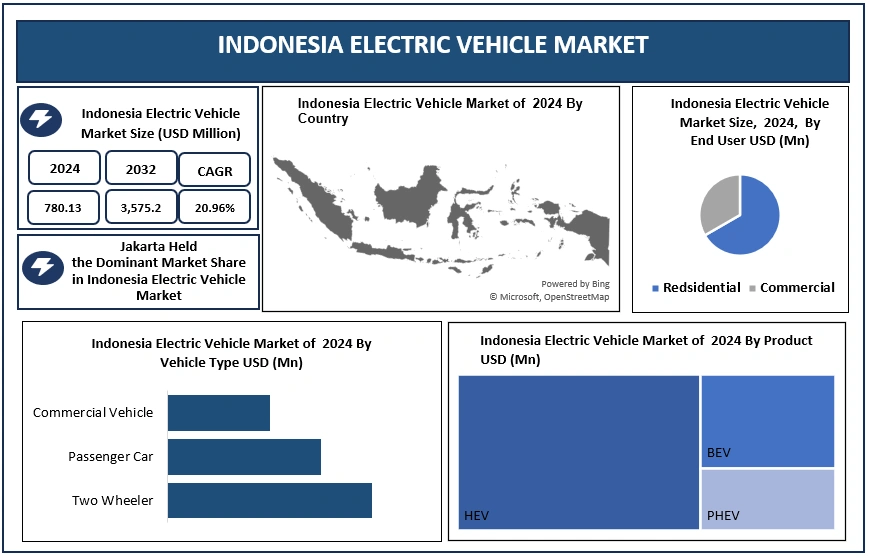
Indonesia Electric Vehicle Market was valued at USD 780.13 Mn. in 2024. Indonesia Electric Vehicle Market size is estimated to grow at a CAGR of 20.96%. The market is expected to reach a value of USD 3,575.24 Mn. in 2032.
Indonesia Electric Vehicle Market Overview:
Globally, the development of electric vehicles (EVs) signaled a fundamental shift in the Indonesian transportation sector's policies. Indonesia is ideally positioned to become a major player in the EV supply chain, given the country's nickel reserves. The Indonesia Electric Vehicle Market is growing due to government incentives, rising fuel costs, growing environmental awareness, and increasing adoption of electric two-wheelers and passenger cars across the country. To be a part of the region's EV future, Indonesia needs to invest in technology, talent resources, renewable energy, and infrastructure. To keep things in context, the world's largest island accounts for nearly a fourth of the world's nickel reserves. Nickel is an important component in the manufacture of batteries. Nickel reserves were around 94 million metric tons in 2022. Indonesia has 21 million metric tons of those totals, while Australia has 20 million metric tons. According to Indonesia's Coordinating Minister for Maritime Affairs and Investment, the country will require up to US$35 billion in investment over the next five to 10 years to develop its EV ecosystem and secure a vital position in the EV supply chain.
 To know about the Research Methodology:- Request Free Sample Report
Indonesia Electric Vehicle Market Dynamics:
Abundant natural resources:
Nickel is considered a vital component in the production of electric car batteries. Indonesia boasts one of the world's largest nickel deposits and is a major hub for EV battery raw materials. Indonesia is home to a quarter of the world's known nickel resources. Indonesia produced 760,000 tons of nickel in 2022, with a total nickel reserve of 21 million metric tons. In addition to having the world's greatest gold reserve, Indonesia's Grasberg mine also has the world's second-largest copper deposit, which is required for the production of electric vehicle batteries.
Indonesia's Electric Vehicle Roadmap:
Indonesia has ambitious intentions to become a prominent player in the global EV market, with a $17 billion roadmap. The goal is to have 2.1 million electric motorcycles and 400,000 electric vehicles on the road by 2025, with 20% of them being manufactured locally. One of its objectives is to have an all-electric bus fleet for Jakarta's metropolitan mass public transportation system in less than seven years, requiring 14,000 electric buses. PLN, the state-owned power company, has committed to installing over 31,000 additional EV charging stations by 2030. PLN has made USD 3.7 billion available for commercial and public sector investment in Indonesia to meet its 10-year pledge. Various government programmes to improve EV manufacturing and EV technology are underway.
Investors appear to be protected due to strong government participation in the Indonesian EV industry. Hyundai and LG signed an MoU with the Indonesian government to form a joint venture firm specialising in EV battery manufacturing, representing a $1.1 billion investment to produce 150,000 EV batteries per year.
The Indonesian Electric Vehicle Market is still in its beginnings:
The electric vehicle industry in Indonesia is still in its infancy, with EVs accounting for only 0.2% of vehicle sales in 2019. However, a University of Indonesia study in September 2022 found that over 70% of Indonesians are interested in purchasing an EV, citing environmental concerns, showing rising EV consumer awareness.
According to MMR, Indonesia's EV sales will grow exponentially through 2030. Electric passenger vehicle sales are forecast to reach 250,000 units in 2030, accounting for 16% of all new car sales. Electric motorcycles are expected to reach 1.9 million units, driven by strong demand for sustainable mobility. With 22% of the world's nickel deposits and government actions to reduce emissions by 29%, Indonesia offers a strong environment for EV manufacturers and EV investors.
Government Incentives for Electric Vehicles:
The Indonesian EV industry is a priority sector in the government's Positive Investment List. Benefits such as foreign ownership allowances and multiple tax incentives attract global EV investors, which boosts the Indonesia Electric Vehicle Market. Companies investing more than IDR 500 billion receive a 100% corporate income tax credit; those investing IDR 100–500 billion receive 50%.
The government announced its official EV roadmap in September 2022 under Minister of Industry Regulation No. 27/2022. The roadmap aims to achieve a local production capacity of 600,000 four-wheeled EVs and 2.45 million two-wheeled EVs annually by 2030.
The supportive regulations, such as MoEMR Regulation No. 13/2022 and the updated Positive Investment List, offer incentives, including 0% luxury vehicle tax for zero-emission vehicles.
Indonesia Electric Vehicle Market Segment Analysis:
Based on product, the market is segmented into BEV, PHEV, and HEV. The Hybrid Electric Vehicle (HEV) segment led the market in 2022, with hybrids dominating due to limited charging infrastructure and lower cost compared to other segments. The lower upfront no charging infrastructure dependency, as well as and consumer familiarity boost this product preferences among consumers.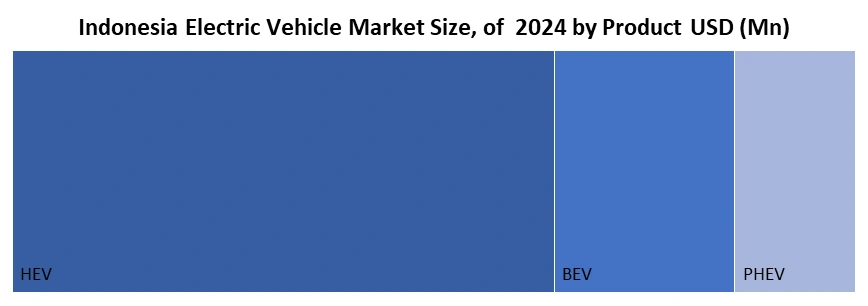
Report Objective:
The report provides a comprehensive analysis of the Indonesia Electric Vehicle Market, covering market leaders, trends, segmentation, competitive landscape, and future market projections. It includes PORTER and PESTEL analyses and insights into micro- and macroeconomic factors influencing the EV industry outlook.
Indonesia Electric Vehicle Market Competitive Landscape
Market players in Indonesia’s EV sector are progressively shifting their focus on investing in premium, high-performance, and locally made electric vehicles to attract personal and commercial consumers. Major differences include using domestic nickel reserves for batteries, integrating battery management systems, and adopting fast-charging and IoT-enabled technologies. Companies are also focusing on sustainable production, local supply chain improvements, and reducing carbon footprints through green energy-powered assembly plants. Using automated manufacturing, digital logistics, and predictive maintenance systems helps improve efficiency, consistency, and safety. Strategic partnerships, government incentives, and an expanding charging infrastructure further boost competitiveness. This positions players to capture Indonesia Electric Vehicle Market .
Recent Developments
• On August 7, 2024, The Indonesian government, along with China's BTR New Material Group, opened a large plant for anode materials used in EV batteries in Central Java (Kendal). This plant aims to support local EV battery production. The companies invested $478 million in the facility, which will produce 80,000 metric tons of materials each year, according to the Coordinating Ministry of Maritime and Investment Affairs. The start date for production has not been announced yet.
• On May 22, 2025, PT PLN reported that it has built 3,772 public charging stations (SPKLU) for four-wheelers, 9,956 for two-wheelers, and 2,240 battery swap units (SPBKLU). PLN has provided home charging services to 33,086 customers and developed the Super Apps PLN Mobile. To encourage its use, electric vehicle (EV) users get a 30% discount on charging during off-peak hours, from 10 PM to 5 AM. Additionally, PLN offers EV owners a 98% discount on power capacity upgrades (tambah daya) and up to 88% off the installation cost of a home charging station.
Indonesia Electric Vehicle Market Scope: Inquire before buying
| Indonesia Electric Vehicle Market | |||
|---|---|---|---|
| Report Coverage | Details | ||
| Base Year: | 2024 | Forecast Period: | 2025-2032 |
| Historical Data: | 2019 to 2024 | Market Size in 2024: | USD 780.13 Bn. |
| Forecast Period 2025 to 2032 CAGR: | 20.96% | Market Size in 2032: | USD 3575.24 Bn. |
| Segments Covered: | by Product | BEV PHEV HEV |
|
| by Vehicle Type | Two-Wheeler Passenger Car Commercial Vehicle |
||
| by End User | Residential Commercial |
||
Indonesia Electric Vehicle Market Key Players
1. BMW AG
2. DFSK Motors
3. Honda Motor Co., Ltd.
4. Isuzu Motors Limited
5. Mazda
6. Mitsubishi Motors Corporation
7. Nissan Motor
8. Suzuki Motor Corporation
9. Toyota Motor Corporation
10. Wuling Motor (SGMW Motors)
11. Mercedes Benz
12. Tesla
13. Hyundai Motor Company
14. Kia Corporation
15. BYD Auto
16. Chery Automobile
17. Ora
18. MG Motor
19. Hozon Auto
20. Seres Auto
21. Xiaomi Auto
22. VinFast
23. Foton Motor
24. JAC Motors
25. Skywell / Skyworth Auto
26. Hino Motors
27. FAW Group
28. Maxus
29. Yadea
30. Segway–Ninebot
Frequently Asked Questions:
1] What segments are covered in the Indonesia Electric Vehicle Market report?
Ans. The segments covered in the Indonesia Electric Vehicle Market report are based on Product, Vehicle Type and End-User.
2] Who are the top 5 key players for Indonesia Electric vehicle market?
Ans. BMW AG, DFSK Motors, Honda motor, Mazda and Nissan motors.
3] What is the market size of the Indonesia Electric Vehicle Market by 2032?
Ans. The market size of the Indonesia Electric Vehicle Market by 2032 is USD 3,57513 Mn.
4] What is the forecast period for the Indonesia Electric Vehicle Market?
Ans. The Forecast period for the Indonesia Electric Vehicle Market is 2025-2032.
5] What was the market size of the Indonesia Electric Vehicle Market in 2024?
Ans. The market size of the Indonesia Electric Vehicle Market in 2024 was worth USD 780.13 Mn.