
Immunoprotein Diagnostic Testing Market – Global Market Size, Strategic Growth Drivers, Risk Assessment Framework, Regulatory Landscape Review, Competitive Intensity Mapping & Long-Term Industry Outlook to 2029
Overview
Immunoprotein Diagnostic Testing Market size is expected to reach US$ 5.32 Bn. at a CAGR of 6.6 % during the forecast period 2029.
Immunoprotein Diagnostic Testing Market Overview:
Immunoproteins are proteins that are utilised as targets for immunological probes and treatments. Immunoprotein diagnostic testing is a process for determining the number of immunoproteins in the body in order to diagnose disorders involving specific proteins like immunoglobulin, pre-albumin, and others.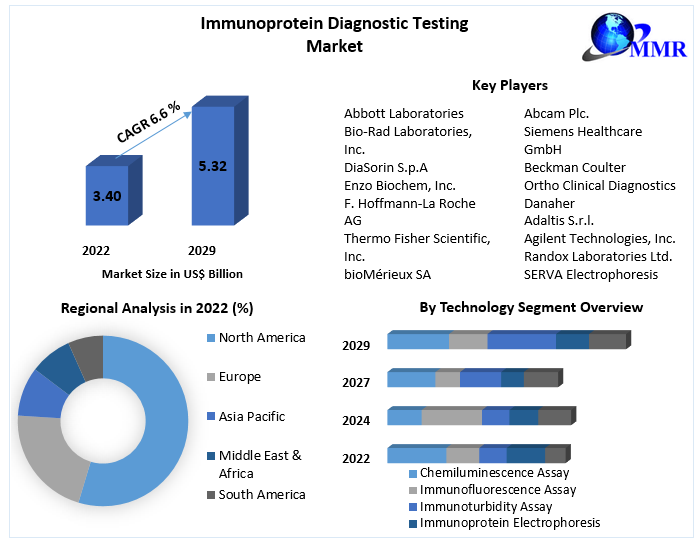 To know about the Research Methodology :- Request Free Sample Report
Immunoprotein Diagnostic Testing Market Dynamics:
Rising prevalence of chronic diseases is expected to contribute to the market growth.
The rise in the prevalence and incidence rate of chronic diseases is the primary driver of increased demand for immunoprotein diagnostic testing services. According to WHO data from the Global Health Observatory (GHO), diabetes kills roughly 1.6 million people each year, accounting for 2.8 percent of all deaths. According to the National Cancer Institute, over 1,685,210 new cancer cases were diagnosed in the United States in 2016, with 595,690 individuals predicted to die from cancer. Chemiluminescence assays were developed as a result of technological advances in immunoprotein diagnostics. With fully automated tools and great throughput, this technology aids in the quick detection of chronic diseases. Chemiluminescence tests need only a few minutes of processing time, usually 30 to 45 minutes.
The rise in the elderly population, as well as the increasing prevalence and incidence rates of chronic diseases, are driving the global immunoprotein diagnostic testing market. According to the World Health Organization, the number of diabetics has increased from 108 million in 1980 to 422 million in 2014, indicating a fast rise in diabetes prevalence and incidence. Awareness of early diagnosis among the people, well-established healthcare systems, and the rise in the frequency of infectious diseases in developing nations due to unsanitary circumstances are some of the main drivers of the global immunoprotein diagnostic testing market. However, the items' short shelf life and low per capita income in diverse countries limit their use hampering the market growth.
Driver:
Increasing Prevalence of Infectious and Chronic Diseases: The rising incidence of infectious diseases, such as COVID-19, as well as chronic conditions like cancer and autoimmune disorders, has created a substantial demand for immunoprotein diagnostic testing. These tests play a crucial role in the accurate and timely diagnosis of these diseases, leading to their increased adoption.
Technological Advancements in Immunodiagnostics: Rapid advancements in immunodiagnostic technologies have enhanced the accuracy, sensitivity, and specificity of immunoprotein tests. The introduction of automated and high-throughput systems, such as enzyme-linked immunosorbent assays (ELISA), chemiluminescence immunoassays (CLIA), and multiplex immunoassays, has significantly improved the efficiency and speed of diagnostic testing, driving market growth.
Growing Geriatric Population: The global geriatric population is expanding, leading to an increased prevalence of age-related diseases, including cancer, cardiovascular disorders, and autoimmune conditions. As older adults are more susceptible to these diseases, there is a growing need for immunoprotein diagnostic testing to aid in their early detection and management.
Rising Demand for Point-of-Care Testing (POCT): Point-of-care testing has gained immense popularity due to its convenience, rapid results, and potential for decentralized testing. Immunoprotein diagnostic tests that can be performed at the point of care provide real-time information, enabling prompt decision-making and facilitating better patient management.
Restrain:
High Cost of Immunoprotein Diagnostic Tests: Immunoprotein diagnostic tests often involve sophisticated equipment, reagents, and trained personnel, resulting in high overall costs. These costs can pose a significant barrier, particularly in resource-constrained settings and developing countries, limiting the widespread adoption of these tests.
Lack of Awareness and Infrastructure in Developing Regions: Many developing regions lack awareness regarding the benefits of immunoprotein diagnostic testing, coupled with inadequate healthcare infrastructure. Limited access to healthcare facilities, skilled personnel, and diagnostic laboratories can impede the growth of the market in these regions.
Opportunity:
Expansion of the Biotechnology and Pharmaceutical Industries: The biotechnology and pharmaceutical industries continue to expand, with extensive research and development activities focused on discovering new drugs and therapies. Immunoprotein diagnostic tests play a vital role in drug development by facilitating the identification of suitable drug targets and monitoring the immune response to new therapies. The growth of these industries positively impacts the demand for immunoprotein diagnostic testing.
Increasing Focus on Early Disease Detection and Prevention: Early detection of diseases significantly improves patient outcomes and reduces healthcare costs. Immunoprotein diagnostic tests offer high sensitivity and specificity, making them valuable tools for early disease detection and prevention. Governments, healthcare organizations, and stakeholders are increasingly emphasizing preventive healthcare, creating a favorable environment for the growth of immunoprotein diagnostic testing.
Strategic Collaborations and Partnerships: Key players in the immunoprotein diagnostic testing market are actively engaging in collaborations and partnerships to expand their product portfolios, enhance technological capabilities, and strengthen their market presence. Collaborative efforts between diagnostic companies, research institutions, and academic centers contribute to advancements in the field, driving market growth.
Immunoprotein Diagnostic Testing Market Segment Analysis:
The Immunoprotein Diagnostic Testing Market is segmented on the basis of Technology and Application.
Based on Technology, the Enzyme-based Immunoassay (EIA) segment is expected to hold a dominant market share XX% by 2029. In many companies and laboratories, it can be utilized as a diagnostic tool as well as a quality control tool. Furthermore, the bulk of the big businesses have a large array of EIA-capable analyzers. For example, Abcam's Human Complement C3 ELISA Kit employs this technique to diagnose. These are some of the variables that contribute to EIA's dominant market share. Due to its high specificity and sensitivity, as well as its ability to identify antigens in human serum and plasma samples, the chemiluminescence assay is predicted to increase at the fastest rate over the projected period. Chemiluminescence assays are widely referred to as crucial tools for the rapid diagnosis of a variety of diseases, and they have been proven to be more accurate than fluorescence-based detection of tagged molecules.
Based on Application, the Endocrine segment is expected to account for significant market share in the forecast years. In the immunoprotein diagnostic testing market, the endocrine segment is predicted to grow steadily. The rising prevalence of endocrine illnesses including diabetes, as well as the development of products connected to immuno diagnostic testing, are driving the segment's growth. According to the Centers for Disease Control and Prevention, 1.5 million new cases of diabetes were identified in adults aged 18 and up in the United States in 2018.
Immunoprotein Diagnostic Testing Market Regional Insights:
North America accounted for largest market share in 2022.
Because of the growing elderly population and disease load, North America is likely to be a leading region. The DALYS were estimated to be at 24,305 in 2017 by the Institute of Health Metrics and Evaluation. According to the US Census Bureau, around 52 million people in the United States were 65 or older in 2018. According to a 2018 report by the National Institute of Diabetes and Digestive and Kidney Diseases, diabetes affects about a quarter of the elderly population, and the figure is predicted to rise quickly in the future decades. As a result, there is a greater demand for early disease identification and treatment. As a result, it is expected to have a favourable impact on the immunoprotein diagnostic testing market.
The report also helps in understanding Global Immunoprotein Diagnostic Testing Market dynamics, structure by analyzing the market segments and project the Global Immunoprotein Diagnostic Testing Market size. Clear representation of competitive analysis of key players by product, price, financial position, product portfolio, growth strategies, and regional presence in the Global Immunoprotein Diagnostic Testing Market make the report investor’s guide.
Immunoprotein Diagnostic Testing Market, Key Developments:
• In June 2019, Eurobio scientific reached an exclusive agreement with Vivo medical group to acquire Pathway Diagnostics Ltd and Personal Diagnostics Ltd, two British companies that specialise in the development and distribution of in vitro diagnostic tests in the United Kingdom and Ireland, as well as self-tests for consumers and professionals via an e-commerce platform.
Immunoprotein Diagnostic Testing Market Scope: Inquire before buying
| Immunoprotein Diagnostic Testing Market | |||
|---|---|---|---|
| Report Coverage | Details | ||
| Base Year: | 2022 | Forecast Period: | 2023-2029 |
| Historical Data: | 2017 to 2022 | Market Size in 2022: | US $ 3.40 Bn. |
| Forecast Period 2023 to 2029 CAGR: | 6.6 % | Market Size in 2029: | US $ 5.32 Bn. |
| Segments Covered: | by Technology | 1.Chemiluminescence Assay 2. Immunofluorescence Assay 3.Immunoturbidity Assay 4.Immunoprotein Electrophoresis |
|
| by Application | 1.Infectious Disease 2.Endocrine 3.Toxicology 4.Other Applications |
||
Immunoprotein Diagnostic Testing Market, by Region
North America (United States, Canada and Mexico)
Europe (UK, France, Germany, Italy, Spain, Sweden, Austria and Rest of Europe)
Asia Pacific (China, South Korea, Japan, India, Australia, Indonesia, Malaysia, Vietnam, Taiwan, Bangladesh, Pakistan and Rest of APAC)
Middle East and Africa (South Africa, GCC, Egypt, Nigeria and Rest of ME&A)
South America (Brazil, Argentina Rest of South America)
Immunoprotein Diagnostic Testing Market, Key players:
1. Abbott Laboratories
2.Bio-Rad Laboratories, Inc.
3.DiaSorin S.p.A
4. Enzo Biochem, Inc.
5.F. Hoffmann-La Roche AG
6.Thermo Fisher Scientific, Inc.
7. bioMérieux SA
8.Abcam Plc.
9.Siemens Healthcare GmbH
10. Beckman Coulter
11.Ortho Clinical Diagnostics
12. Danaher
13. Adaltis S.r.l.
14. Agilent Technologies, Inc.
15.Randox Laboratories Ltd.
16. SERVA Electrophoresis GmbH
17.Calbiotech, Inc.
18. Fujirebio
Frequently Asked Questions:
1. Which region has the largest share in Global Immunoprotein Diagnostic Testing Market?
Ans: North America region held the highest share in 2022.
2. What is the growth rate of Global Immunoprotein Diagnostic Testing Market?
Ans: The Global Immunoprotein Diagnostic Testing Market is growing at a CAGR of 6.6 % during forecasting period 2023-2029.
3. What is scope of the Global Immunoprotein Diagnostic Testing Market report?
Ans: Global Immunoprotein Diagnostic Testing Market report helps with the PESTEL, PORTER, COVID-19 Impact analysis, Recommendations for Investors & Leaders, and market estimation of the forecast period.
4. Who are the key players in Global Immunoprotein Diagnostic Testing Market?
Ans: The important key players in the Global Immunoprotein Diagnostic Testing Market are – Abbott Laboratories,Bio-Rad Laboratories, Inc.,DiaSorin S.p.A,Enzo Biochem, Inc.,F. Hoffmann-La Roche AG,Thermo Fisher Scientific, Inc.,bioMérieux SA,Abcam Plc.,Siemens Healthcare GmbH,Beckman Coulter,Ortho Clinical Diagnostics,Danaher,Adaltis S.r.l.,Agilent Technologies, Inc.,Randox Laboratories Ltd.,SERVA Electrophoresis GmbH,Calbiotech, Inc.,Fujirebio
5. What is the study period of this Market?
Ans: The Global Immunoprotein Diagnostic Testing Market is studied from 2022 to 2029.