
Wireless Intrusion Prevention Systems Market Size by Technology, Implementation, Application, Region – Revenue Pool Analysis, Margin Structure Assessment, Capital Flow Trends, Competitive Benchmarking & Forecast to 2032
Overview
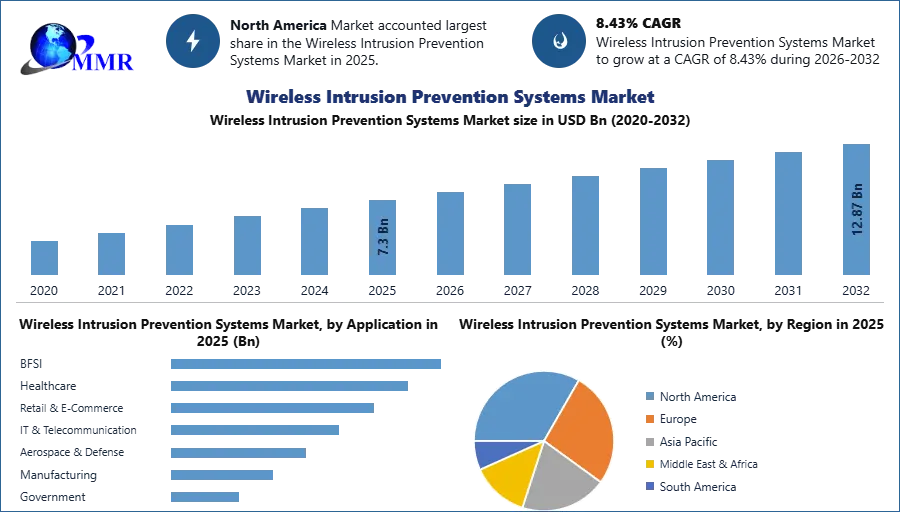
Wireless Intrusion Prevention Systems Market was valued at USD 7.3 Billion in 2025 and the total revenue is expected to grow at a CAGR of 8.43% from 2026 to 2032, reaching nearly USD 12.87 Billion.
Wireless Intrusion Prevention Systems Market Overview:
A wireless intrusion prevention system (WIPS) is a security network system that supervises, monitors, and controls radio frequencies in order to detect the existence of unknown access points and prevent illegal intrusion. The goal of the wireless intrusion prevention system development and design is to prevent unwanted network access to LAN connections and wireless peripherals.
 To know about the Research Methodology:- Request Free Sample Report
Wireless intrusion prevention system (WIPS) are applied in a commercial organization to protect the wireless network from unwanted cyber-attacks. Wireless intrusion prevention systems have traditionally been set up to identify just illegitimate access points. However, with advancements in wireless technology, these systems can protect wireless local area networks against a variety of cyber-attacks (WLAN).
Wireless Intrusion Prevention Systems Market Dynamics:
The market for Wireless intrusion prevention systems is being fueled by an increase in enterprise data breaches or data leaks. Massive cyber-attacks occur when hackers utilise the internet to launch planned and politically driven attacks against endpoints, networks, data, and other IT infrastructures, resulting in data loss for individuals, businesses, and governments around the world. The average cost of a malware assault in 2019 was US$2.81 million, according to Cyber Defense Magazine. This is a loss that no small or even medium-sized company could afford to incur. According to Cyber Defense Magazine, more than 40% of cyber-attacks are directed at small enterprises. In addition, the following cyber security statistics from Varonis, a data security and analytics firm, have us even more concerned about network security and integrity. There has been a rise in the frequency of cyber-crime as a result of the significant development in digital transactions globally across verticals. As a result wireless intrusion prevention systems market is expected to grow significantly throughout forecast period.
Organizations are mobilising their workforce as technology related to BYOD improves. Organizations are subscribing to security services to protect devices such as smartphones, tablets, desktops, and laptops from cyber threats as a result of the BYOD model's adoption. With the advent of bring-your-own-device (BYOD), businesses must safeguard not only devices on the premises, but also those with remote access to the corporate network. This feature has resulted in a large increase in the usage of WIPS solutions, which is expected to propel the WIPS market growth during the forecast period.
Several firms, particularly SMEs, are concerned about cyber security expenditure. Large corporations have the financial resources to establish an effective and efficient information security control environment. Small businesses face a difficult task in investing large sums in cyber security because they also invest heavily in other IT infrastructure. The costs of research and development (R&D) to build cutting-edge cyber security solutions are considerable, resulting in high security solution prices. In order to carry out their IT security activities efficiently, cyber security professionals continue to be concerned about a lack of necessary budget.
Growing public awareness and government laws for secure wireless communication are gaining traction and are expected to have a brighter future over the forecast period. However, it is expected that a lack of awareness of WIPS and the inability of existing systems to interact with sophisticated WIPS systems will hamper WIPS market growth during the forecast period.
Wireless Intrusion Prevention Systems Market Segment Analysis:
Based on the Solution, the Wireless Intrusion Prevention Systems Market is segmented into BFSI, Healthcare, Retail & E-Commerce, IT & Telecommunication, and Aerospace & Defense. The IT & Telecommunication segment held the largest market share, accounting for 34% in 2022 WIPS systems are increasingly being used in IT and telecommunications applications. Due to the development of smart devices with access to business networks, wireless intrusions are becoming increasingly significant, resulting in data breaches or illegal access to critical information. Security concerns have grown significantly across organizations dealing with core business areas such as finance, healthcare, retail, and so on, particularly when it comes to protecting critical assets from internal and external security threats using a comprehensive approach spanning technology and policies.
The Retail & E-Commerce segment is expected to witness a significant growth at a CAGR of 7.81% during the forecast period. The wireless intrusion prevention system (WIPS) is mainly used in retail and E-Commerce to protect the networks from innumerable hacking attempts. Wireless intrusion prevention systems (WIPSs) are used in manufacturing to protect network infrastructure and data. WIPS solutions provide real-time tracking of wireless threats such as rogue access points, advanced persistent threat attacks, and jamming devices at the edge of a secure enterprise zone. As a result, the market is expected to grow for this segment.
Wireless Intrusion Prevention Systems Market Regional Insights:
The North America region held the largest market share accounted for 38.7% in 2025. The presence of a major solution providers players such as IMB Corporation, CISCO system and others are primarily driving the wireless intrusion prevention systems market growth in the region. The growing mobile work force along with increase in demand for high speed data services are also driving the growth of the regional market growth. In addition, the growing adoption of cloud based solutions among SME and large enterprises and developments in IT sector are boosting the regional market growth.
Asia Pacific region is expected to witness rapid growth at a CAGR of 8.31% during the forecast period. An increase in the number of cyber-attacks and the rapid transformation of infrastructure with smart solutions in countries like India, Japan, and China are driving the wireless intrusion prevention systems market growth in Asia Pacific region.
The objective of the report is to present a comprehensive analysis of the global Wireless Intrusion Prevention Systems Market to the stakeholders in the industry. The past and current status of the industry with the forecasted market size and trends are presented in the report with the analysis of complicated data in simple language. The report covers all the aspects of the industry with a dedicated study of key players that include market leaders, followers, and new entrants.
PORTER, PESTEL analysis with the potential impact of micro-economic factors of the market have been presented in the report. External as well as internal factors that are supposed to affect the business positively or negatively have been analyzed, which will give a clear futuristic view of the industry to the decision-makers.
The reports also help in understanding the Wireless Intrusion Prevention Systems Market dynamic, structure by analyzing the market segments and projecting the market size. Clear representation of competitive analysis of key players by Technology, price, financial position, product portfolio, growth strategies, and regional presence in the market make the report investor’s guide.
Wireless Intrusion Prevention Systems Market Recent Industry Developments (2025–2026)
| Date | Company | Development | Impact |
|---|---|---|---|
| 13 February 2026 | Check Point Software Technologies | Acquired three cybersecurity firms—Cyata, Cyclops, and Rotate—to integrate advanced AI-driven asset discovery and continuous monitoring. | The $150 million expansion enhances the company’s ability to discover and secure autonomous AI agents and wireless OT/IoT assets. |
| 02 February 2026 | Cisco Systems, Inc. | Launched the CW9800L Wireless Controller and new Wi-Fi 7 Access Points featuring integrated wireless assurance and threat visibility. | This deployment provides real-time telemetry and automated troubleshooting to prevent wireless intrusions in low-to-medium density environments. |
| 06 January 2026 | HPE Aruba Networking | Released the Instant On Secure Gateways, unifying routing and wireless threat protection into a single AI-managed platform. | The solution simplifies guest Wi-Fi isolation and unauthorized access prevention for retail and professional services sectors. |
| 03 November 2025 | Palo Alto Networks | Unveiled a strategic collaboration with Nokia and Aeris to integrate Prisma SASE 5G security across global industrial device fleets. | The partnership enables unified visibility and Zero Trust enforcement across billions of connected devices at the wireless edge. |
| 06 August 2025 | Fortinet | Formed a strategic partnership with OneLayer to deliver context-based firewall enforcement for private LTE/5G networks. | This integration allows for SIM swap detection and automated network segmentation to protect stationary OT/IoT devices from physical tampering. |
| 29 April 2025 | AT&T Business | Announced a strategic agreement with Palo Alto Networks to launch AT&T Dynamic Defense™ with embedded real-time threat prevention. | The offering secures wireline and wireless connections within a singular framework, providing automated risk response for dispersed enterprise networks. |
Wireless Intrusion Prevention Systems Market Scope: Inquire before buying
| Wireless Intrusion Prevention Systems Market | |||
|---|---|---|---|
| Report Coverage | Details | ||
| Base Year: | 2025 | Forecast Period: | 2026-2032 |
| Historical Data: | 2020 to 2025 | Market Size in 2025: | 7.3 USD Bn |
| Forecast Period 2026-2032 CAGR: | 8.43% | Market Size in 2032: | 12.87 USD Bn |
| Segments Covered: | by Technology | Hardware Software Services Professional Services Managed Services |
|
| by Implementation | Network Hosted |
||
| by Deployment Mode | On-Premises Cloud-Based Hybrid Deployment |
||
| by Application | BFSI Healthcare Retail & E-Commerce IT & Telecommunication Aerospace & Defense Manufacturing Government Others |
||
| by End-User Type | Enterprises Managed Security Service Providers (MSSPs) Telecom Service Providers |
||
Wireless Intrusion Prevention Systems Market, by Region
North America (United States, Canada and Mexico)
Europe (UK, France, Germany, Italy, Spain, Sweden, Austria and Rest of Europe)
Asia Pacific (China, South Korea, Japan, India, Australia, Indonesia, Malaysia, Vietnam, Taiwan, Bangladesh, Pakistan and Rest of APAC)
Middle East and Africa (South Africa, GCC, Egypt, Nigeria and Rest of ME&A)
South America (Brazil, Argentina Rest of South America)
Wireless Intrusion Prevention Systems Market Key Players
1. Fluke Corporation
2. WatchGuard Technologies
3. Vanderbilt Industries
4. Cisco Systems Inc.
5. Mojo Network, Inc.
6. McAfee
7. Check Point
8. Corero
9. Dell Corporation
10.IBM Corporation
11.Extreme Networks
12.Symantec
13.Metaflows, Inc.
14.AT&T Incorporation
15.Hewlett-Packard
16.Aruba
17.NetScout
18.Fortinet
19.ForeScout
20.Topsec
21.Venustech