
Window Film Market Size – Industry Structure Evaluation, Demand Drivers Analysis, Regional Growth Analysis and Identification, Competitive Positioning Review & Global Market Size Forecast to 2032
Overview
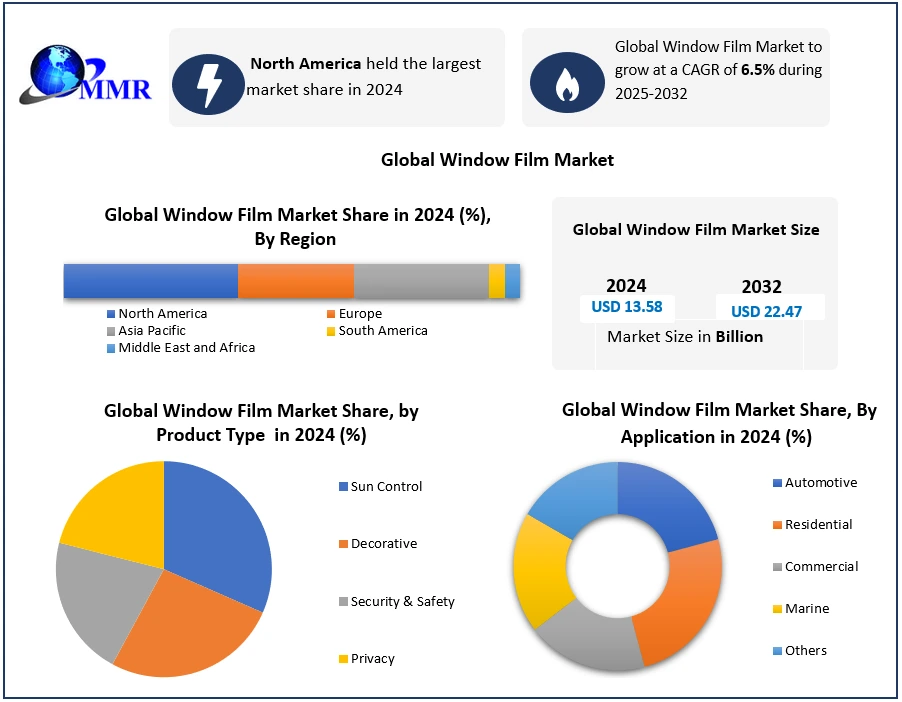
Global Window Film Market size was valued at USD 13.58 Bn. in 2024, and the total Global Window Film Market revenue is expected to grow by 6.5% from 2025 to 2032, reaching nearly USD 22.47 Bn.
Window Film Market Overview:
Window films are polyester films with adhesives on one side that are designed to be applied on glass surfaces in residential, commercial, automotive, and marine applications to achieve glare reduction, solar heat gain control, UV protection, added privacy and safety. The industry has advanced from tinted film to multilayer films, composed of engineering materials, spectrally-selective, and even some are smart-switchable. These advances have created the potential for energy savings, thermal insulation, shatter resistance, and aesthetics. For example, high-quality ceramic automotive films have penetrated the North American and European window film market, providing high-performance infrared heat rejection while allowing 5G cellular radio frequency to transmit through the opaque glass safety through mobile film and UV exposures from sunlight. The control and safety film is rapidly changing the atmosphere in the Asia-Pacific region. With consistently high ambient temperatures, rising vehicle ownership, and expanded metropolitan infrastructure in urban environments, it comes as no surprise that films are gaining popularity.
 To know about the Research Methodology :- Request Free Sample Report
The report an in-depth analysis of the major market drivers, including increasing construction activity, regulatory drivers concerning energy efficiency, tinting cars, and increased security of public infrastructure. Segmenting by product type, material, and application the unique demand characteristics of these segments across geographies. Key players in the global window film market include 3M Company, Eastman Chemical Company (LLumar, SunTek, V-Kool), Avery Dennison (Hanita Coatings), Garware Hi-Tech Films, Madico, Saint-Gobain (Solar Gard), and Nexfil, which are providing leadership in advanced manufacturing and proprietary technology. The report explores how recent developments, such as long-life exterior-grade films, anti-microbial coatings, and smart dimmable solutions, are changing the window film industry. The report also examines new trends such as the increased adoption of films that block UV and improve energy performance in green buildings, the growing interest of consumers in films for cars that are made with ceramic IR-rejection technology, and increasing demand for films to provide privacy and or decorative value in open-plan or retail interiors.
Window Film Market Dynamics
Increasing Awareness of Energy Efficiency to Influence the Window Film Market Growth
The awareness of environmental issues and energy efficiency continues to rise, and there is a growing demand for solutions that enhance the energy performance of buildings. The primary function of window films is to reflect heat to its source. This unique feature allows for drastic reductions in energy expenditure. By maintaining a steady, comfortable temperature within a space, hot and cold spots are minimized. In the summer months, these films reflect sunlight and heat outside, while in the winter, they function to retain heat indoors. Window films play a crucial role by reducing heat gain, improving insulation, and minimizing the need for excessive air conditioning or heating. This increased focus on sustainable practices is driving the adoption of window films in residential and commercial sectors. Such factors are expected to drive the Window Film Market growth.
3M Insulating Window Film, maintains temperature Control, Window Films decrease the Solar Heat Gain Coefficient (SHGC) and U-Value of your windows. In simpler terms, 3M’s window films increase the energy efficiency of windows all year long. It’s almost like turning a single pane window into a double pane, or a double-pane window into triple pane. These films block up to 99% of UV rays and up to 97% of infrared light (900-1,000nm), keeping occupants cool and protected. By blocking heat from entering through the windows during the summer and retaining manmade heat inside during the winter, 3M Window Films reduce dependence on the HVAC system and improve the building's or home’s energy efficiency.
Rising Concerns about UV Radiation and Health to Boost the Window Film Market Growth
The growing concerns about the harmful effects of ultraviolet (UV) radiation on human health, there is an increasing demand for window films that can block UV rays. Window films with UV-blocking properties are becoming popular in residential and commercial applications to protect against skin cancer, premature aging, and other UV-related health issues. This health-conscious trend is expected to drive the window film market growth. The U.S. Environmental Protection Agency underscores the advanced solutions, such as UV-blocking window films. UV radiation poses significant health risks, including skin cancer, premature aging, and eye damage. As awareness of these hazards grows, the demand for protective measures intensifies. This creates a unique opportunity for the window film industry to contribute to public health by offering products that enhance energy efficiency and mitigate the adverse effects of UV radiation.
Advancements in Technology and Product Innovation of Window Films to Create Opportunity for the Window Film Market Growth
Low-E window film presents a significant opportunity in the Window Film Market, addressing the substantial energy loss attributed to windows in commercial buildings. These films employ advanced technology by selectively absorbing and reflecting heat, reducing solar heat gain, and providing insulation. Lawrence Berkeley National Laboratory conducted a comprehensive assessment of Low-E film at sites in Utah and Texas, demonstrating improved thermal comfort and HVAC savings. The results, averaging 29% better thermal comfort and a 2-6 year payback period, showcase the efficacy of Low-E films, particularly with single-pane glass.
The technology proves beneficial in diverse climates, offering the most significant efficiency gains in buildings with single glazing or aging applied film. Deploying Low-E films in retrofitting scenarios, especially for lower-performing double glazing, emerges as a strategic recommendation for optimal energy savings and rapid returns on investment. Such technological advancements in window film manufacturing have led to the development of high-performance films with improved features. Innovations such as smart films that can dynamically adjust transparency based on external conditions or user preferences are gaining traction. These technological advancements enhance the functionality of window films and open up new opportunities for the Window Film Market growth, catering to diverse consumer needs.
Global Window Film Market Segment Analysis
Based on product type, the sun control segment held the largest Window Film Market share in 2024. Sun control window films play a pivotal role in safeguarding building interiors and enhancing their aesthetic appeal. The growing prevalence of skin diseases has fuelled the adoption of sun control films in both residential and commercial settings, fostering market expansion. Additionally, the escalating energy costs and the imperative to curtail power consumption are key drivers propelling the demand for sun control films in diverse applications.
Technological advancements in window films have revolutionized their capacity to mitigate solar heat gain and winter heat loss, thereby fostering a sustainable and comfortable indoor environment. These films find widespread applications in preserving the longevity of furniture, preventing fading of paints and coatings, and maintaining the condition of carpets in residential and commercial spaces. The burgeoning construction activities in emerging economies such as China, India, Japan, Thailand, and Vietnam are anticipated to propel the sun control window film market in the Asia Pacific region. In the automotive industry, window films not only reduce solar heat gain but also contribute to styling and protection. They play a crucial role in shielding interior components like audio equipment, seats, and electronic devices. These factors are poised to drive the window film industry growth.
Based on Application, the Residential segment held the Window Film Market with a 27% market share in 2024. In construction and building, it is used as decorative film, solar energy, security, and special film. The demand for these films for applications is increasing due to their properties such as anti-UV, anti-reflection, durability, lightness, and energy saving. Rapid urbanization in the emerging economies of Asia-Pacific, the Middle East, and Latin America is expected to drive product demand in commercial construction applications. There is increasing demand for shopping malls, stores, and supermarkets in these areas. These factors are expected to increase demand for products in commercial applications.
Window Film Market Regional Insights
North America accounted for the largest Window Film Market share in 2024. Ongoing investments in North America underscore a recovery in residential and non-residential construction in Canada, driven by capital expenditure cuts in the oil and gas sector and the fiscal stimulus plan of the Liberal government to spur new non-residential construction. Furthermore, considering the anticipated rate hikes by the Federal Reserve, the gradual increase in long-term interest rates is expected to persist, further influencing the market landscape. More and more green building construction projects in the US and the growth of net energy buildings are expected to drive the demand for the product. The growing consumer awareness about sustainability and carbon dioxide emissions, and improved energy efficiency is expected to boost product demand in the window film market.
Lower VLT ratings tend to have better glare control while higher ratings are preferred to maintain natural light. VLT widow membranes are an important factor in determining eligibility for thermal protection, UV protection, and safety concerns. High VLT in insulating film allows police attention to ensure public safety on vehicles. Some countries have exemptions if the driver or passenger has related conditions, such as lupus, sun allergy, photosensitivity, and melanoma.
The low-emissivity film helps buildings retain heat during winter. The low-E film uses special metal coatings, which block infrared and ultraviolet rays and allow maximum visible light to prevent fading of interiors in residential and commercial buildings. commercial. Low-E glass is replaced by the insulating film because of a better return on investment and it is 6.6 times more energy and cost-efficient than Low-E glass. These factors are driving the growth of the window film market in North America.
Window Film Market Competitive Landscape
The Window Film Market is competitive, with dominant players such as US-based 3M Company and Eastman Chemical Company driving global supply and innovation for automotive, architectural, and safety film. 3M Company (USA), is a leader in nanoceramic and UV-rejection technologies, and their new Performance Films division continues to innovate with their products, including their Crystalline Series. They have undergone operational restructuring to improve operational efficiencies and supply chain responsiveness. Eastman Chemical Company (USA), has four flagship brands in LLumar, SunTek, V-Kool, and Huper Optik that allow held market share worldwide to conduct operations in multiple high-capacity manufacturing plants across the U.S. and drive production of advanced spectrally selective and HEVL-filtering films. In 2024, Eastman's Advanced Materials segment products, including window films, generated more than USD 2.9 billion in revenue and contributions to gross profit, with no decelerating revenue from automotive aftermarket and energy-efficient building applications. The companies are also investing efforts in next-generation film technologies like smart films and sustainable coatings, in order to bolster their competitive positions in a market increasingly influenced by green building codes, energy-efficiency regulations, and customer preferences in high-performance glazing options.
Window Film Market Recent Development
• In February of 2025, Avery Dennison Corporation (USA) revealed the launch of its Encore™ automotive window film family that includes three tiers—Encore, Encore Supreme, and Encore Supreme IR. The Encore Supreme IR is the flagship product offering, which utilizes nanoceramic technology and blocks up to 93 % infrared heat, 65 % total solar energy, reduces glare by 94 %, and blocks more than 99 % of UVA/UVB rays.
• Lintec declared the launch of its new solar control window film, BR-50UH RECYCLE 100, made with 100% recycled PET resin, available from July 14, 2025. Part of its WINCOS brand, the film reduces solar heat penetration by lowering solar radiation permeability to about 57%, blocks over 99% of UV rays, and helps prevent glass shard scattering. Designed for offices, homes, and commercial buildings, it maintains high transparency while cutting interior heat. By using recycled PET bottles as raw material, the film achieves a 17.5% reduction in CO2 emissions compared to conventional films, supporting sustainability and environmental protection initiatives.
Window Film Market Recent Trends
| Category | Key Trend | Example Product | Market Impact |
| Smart Films | Rising demand for switchable privacy and dimmable films in offices & luxury homes | Polytronix Smart Glass Film | Drives adoption in high-end residential and commercial projects, expanding market beyond traditional films |
| Sustainability | Increasing preference for energy-saving and eco-friendly materials | Avery Dennison Encore™ Supreme IR Film | Strengthens position in green building certifications (LEED, BREEAM), supporting ESG commitments |
| Ceramic Nanotechnolog | Surge in high-performance, non-metallic films for IR heat rejection and 5G compatibility | Nexfil SDI-5G Nano Ceramic Film | Enhances automotive film appeal with tech-savvy, energy-conscious consumers |
Window Film Market Scope: Inquire before buying
| Global Window Film Market | |||
|---|---|---|---|
| Report Coverage | Details | ||
| Base Year: | 2024 | Forecast Period: | 2025-2032 |
| Historical Data: | 2019 to 2024 | Market Size in 2024: | USD 13.58 Bn. |
| Forecast Period 2025 to 2032 CAGR: | 6.5% | Market Size in 2032: | USD 22.47 Bn. |
| Segments Covered: | by Product Type | Sun Control Decorative Security & Safety Privacy |
|
| by Material | Vinyl Polyester Plastic Ceramic Others |
||
| by Thickness | Up to 2 mil 2–5 mil 6–14 mil Above 15 mil |
||
| by Installation Method | Dry Adhesive Films Pressure-Sensitive Adhesive Films Self-Adhesive / Peel-and-Stick Professional Installation vs. DIY Kits |
||
| by Application | Automotive Residential Commercial Marine Others |
||
Global Window Film Market, by Region
North America (United States, Canada and Mexico)
Europe (UK, France, Germany, Italy, Spain, Sweden, Austria and Rest of Europe)
Asia Pacific (China, South Korea, Japan, India, Australia, Indonesia, Malaysia, Vietnam, Taiwan, Bangladesh, Pakistan and Rest of APAC)
Middle East and Africa (South Africa, GCC, Egypt, Nigeria and Rest of ME&A)
South America (Brazil, Argentina Rest of South America)
Window Film Market, Key Players
North America Window Film Market Key Players
1. 3M Company (USA)
2. Eastman Chemical Company (USA)
3. Avery Dennison Corporation (USA)
4. Saint-Gobain Performance Plastics Corporation (USA)
5. Madico, Inc. (USA)
6. LLumar – Eastman Chemical Company Brand (USA)
7. Johnson Window Films (USA)
8. Polytronix, Inc. (USA)
9. Reflectiv (Reflectiv Solutions) (USA)
10. Geoshield Window Film (USA)
Europe Window Film Market Key Players
1. Armolan Window Film (Turkey)
2. Solar Screen International (Luxembourg)
3. Haverkamp GmbH (Germany)
4. Contra Vision Ltd. (United Kingdom)
5. Lintec Europe (Subsidiary of Lintec Corp., UK/Germany operations)
6. Saint-Gobain Solar Gard (France)
7. Reflectiv Films (France)
Asia Pacific Window Film Market Key Players
1. Garware SunControl (India)
2. Toray Plastics (China/Japan – Toray Industries subsidiary)
3. Nexfil Co., Ltd. (China/Korea)
4. Hüper Optik (Singapore)
5. Rayno Window Film (South Korea)
6. Wintech Window Films (China)
7. Nitto Denko Corporation (Japan)
8. Konica Minolta Films (Japan)
Frequently Asked Questions:
1] What is the growth rate of the Global Window Film Market?
Ans. The Global Window Film Market is growing at a significant rate of 6.5 % during the forecast period.
2] Which region is expected to dominate the Global Window Film Market?
Ans. North America is expected to dominate the Window Film Market during the forecast period.
3] What is the expected Global Window Film Market size by 2032?
Ans. The Window Film Market size is expected to reach USD 22.47 Bn by 2032.
4] Which are the top players in the Global Window Film Market?
Ans. The major top players in the Global Window Film Market are 3M Company, Toaray Plastics and others
5] What are the factors driving the Global Window Film Market growth?
Ans. Increasing construction activities and new advancements in film technologies are primary drivers for the market growth.
6] Which country held the largest Global Window Film Market share in 2024?
Ans. The United States held the largest Window Film Market share in 2024.