
Wearable Injectors Market - Industry Structure Evaluation, Demand Drivers Analysis, Regional Growth Analysis and Identification, Competitive Positioning / Landscape Review & Global Market Size Forecast to 2030
Overview
Wearable Injectors Market size was valued at USD 8.67 Billion in 2023 and the total Wearable Injectors Market revenue is expected to grow at a CAGR of 17.4% from 2024 to 2030, reaching nearly USD 26.65 Billion by 2030.
Wearable Injectors Market Overview
Pharmaceutical development has made significant studies in recent years, and every day, new creative medications are being released into the market. However, the demand to switch medicine delivery from customary settings to more cost-effective options has increased due to the expense and complexity of these novel treatments. Wearable injectors are delivery systems that are attahhed to the body and are used subcutaneously to provide bigger doses of medication (more than 2 mL) over a prolonged period of time.
Many pharmaceutical and medical device firms have been leading development efforts to sell Wearable injectors for more than ten years, such as BD LibertasTM large-volume wearable injector Wearable injectors offer a reservoir for the medication, a cannula for distribution to the tissue, adhesive to secure the device to the patient's skin, and a driving system to supply the right amount of drug despite product variations.
The difficulty of administering SC injections with increasing dosage volumes and viscosities in non-clinical situations can be successfully overcome with wearable injectors. Patients will be benifited with the convenience of injecting at home thanks to the introduction of strong, modern technologies. Furthermore, being able to adapt novel formulations with higher volume and/or viscosity will allow less frequent injections, to enhance the patient experience, and boost adherence to medicines. To know about the Research Methodology:-Request Free Sample Report
Scope of the Report:
The report provides a comprehensive analysis of the global Wearable Injectors Market. This report estimates the Wearable Injectors Market, in terms of USD value from 2024 to 2030. In order to identify potential investment pockets, this report gives an analytical representation of the Wearable Injectors industry together with current trends and future forecasts. The report includes a thorough analysis of the market share for Wearable Injectors as well as data on important drivers, restraints, and opportunities.
A quantitative analysis of the existing market is done from 2024 to 2030 to show the potential for market growth across the globe. In addition, Porter's five forces study demonstrates the market power of both buyers and providers. The research offers a thorough analysis of the worldwide Wearable Injectors market based on the level of competition and how it will develop over the forecast period.
MMR research offers crucial information on market size, industry structure, business trends, market share, and predictions that are crucial for creating company plans and strategies. The major strategic and competitive factors influencing the global market are also analysed, along with the major players in the sector and their market shares worldwide.
Wearable Injectors Market Dynamics:
Numerous chronic disease indicators, including diabetes, heart problems, neurological disorders, and oncological disorders, are becoming more common due to the growing world population.This has led to increase , increased demand for effective treatment choices. Additionally, businesses have created unique devices capable of efficiently and relatively simply delivering a number of formulations of various pharmaceuticals and therapies in order to enhance the quality of life for these individuals.
Self-injection is a new trend that has been labelled a win-win scenario for patients and medical staff. Self-injection systems are significantly more cost-effective since they provide a lower-cost form of medication administration, which also makes them user-friendly and comfortable for patients. Additionally, by significantly reducing the risk, it reduces the costs related to needlestick injuries. According to reports, these injuries cost the US healthcare system more than USD $1 billion annually. Large capacity wearable injectors have therefore showed a lot of promise to solve this issue.
A trend towards self-administration of medications and treatments has emerged in recent years. This is largely due to the availability of several self-injection devices, which have a number of benefits, including increased medication adherence, flexibility with dose, and fewer frequent clinic visits. Furthermore, some with a morbid phobia of needles even prefer these dosing choices. As a result, the demand for Werable Injection devices is increasing, and pharmaceutical companies are currently working to design and develop self-injection technologies for both medicines that are currently on the market and those that are in development.
According to the Centers for Disease Control and Prevention (CDC) and European Agency for Safety and Health at Work (EU-OSHA), there are roughly 3, 85,000 & 1,000,000 needle stick injuries among healthcare workers in the U.S. & Europe, respectively. The World Health Organization reports that NSIs cause 16,000, 66,000, and 1,000 cases of HCV, HBV, and HIV among HCWs each year. As there is no needle sick injuries during the application of Werable injectors the market of Wearable Injectors has shown tremendous growth.
The drug delivery industry has been predicting a considerable uptake in the use of Wearable innovative devices, with anticipated compound annual growth rates of over 25% for the next 10 years.Additionally high numbers of new wearable injectors are projected to reach the market in the coming years.The global Wearble Injectors devices market is also driven by a significant rise in demand for home health care, owing to low cost of treatment and improvements in overall patient experience.
The market is being driven by the ability of wearable injectors to treat chronic conditions such rheumatoid arthritis, pulmonary arterial hypertension, cardiovascular illness, cancer, Type 1 diabetes, and autoimmune diseases. Additionally, wearable injectors have several cutting-edge characteristics that are increasing their usage among patients globally, which is contributing towards the growth of wearable injectors market.
The use of new technologies in mAb-based biotherapy, wearable insulin pumps for at-home drug delivery, and infusion therapy includes the Dual Cartridge Injector, Sonceboz wearable Injector, Auto Reconstitution Injector, Reusable Auto-Injector, Amgen wearable Injector, and Subcutaneous Drug Delivery Devices.
The demand for wearable injectors is increasing as a result of the introduction of some cutting-edge injector devices like the QuickDose wearable injector from CCBio, the wearable drug delivery device platform from Sorrel Medical, the on-body injector from E3D, the Ypsodose by Ypsomed, and the SmartDose injector with Freedom60 syringe infusion are contributing towards the growth opportunity of the wearable injector market.
Wearable Injectors Market Segment Analysis:
By Type, Rising demand, and the convenience of the skin-contact patches, on-body wearable injectors had the highest revenue share in 2023. Compared to off-body worn injectors, body-wear patch injectors have a far bigger market share. Patients can easily administer necessary medicine subcutaneously using body-worn patch injector systems, which are user-friendly. Additionally, the need for body-worn patch injectors is being driven globally by technical improvements and rising acceptance rates. By Technology, in 2023, the category of wearable injectors based on springs had the highest share. The spring-based sector is expected to dominate the market since it is user-friendly and allows patients to accurately administer the medication subcutaneously by pressing one or more buttons on the device. According to research, the wearable spring-based Subcuject injector accurately administers a 3 mL, 1 cP viscous dosage in 4 minutes. Given that they are easier to use than other wearable injectors, rotary pump wearable injectors are anticipated to grow at the quickest CAGR of XX% throughout the course of the forecast period.
By End-user, With a market share of around 41.8%, the home care category dominated the wearable injectors market in 2023. The market is expanding as a result of increased demand for home healthcare services, the need for sophisticated medication delivery systems that require little technical knowledge, and a decline in the number of hospital stays for patients. The home care market is also anticipated to be driven by the low cost of wearable injectors and the growing desire to reduce healthcare costs.
Additionally, a study found that infusion therapy costs anywhere between USD 200 and USD 1,000 or more, whereas wearable injectors are priced between USD 20 and USD 30. A significant driver of the growth of the home care sector is the price of hospital therapy. The hospital sector is anticipated to grow.
Wearable Injectors Market Regional Insights:
The global wearable injectors market is segmented into Asia Pacific, North America, Europe, South America, and the Middle East & Africa. In 2023, North America is estimated to be the fastest-growing regional the market for wearable injectors market due to the region's advanced healthcare infrastructure, increased prevalence of chronic diseases, and lifestyle-related illnesses. Additionally, the market is anticipated to grow as a result of the local presence of key market participants in the U.S., including Becton, Dickinson and Company, Johnson & Johnson Services, Inc., Unilife Corporation, Steady Med Therapeutics, Inc., Amgen, Inc., and Enable Injections.
Rising geriatric population, increased prevalence of chronic diseases, supportive government initiatives, and research into wearable medical devices, Asia Pacific is expanding market for ultra-large volume wearable injectors.
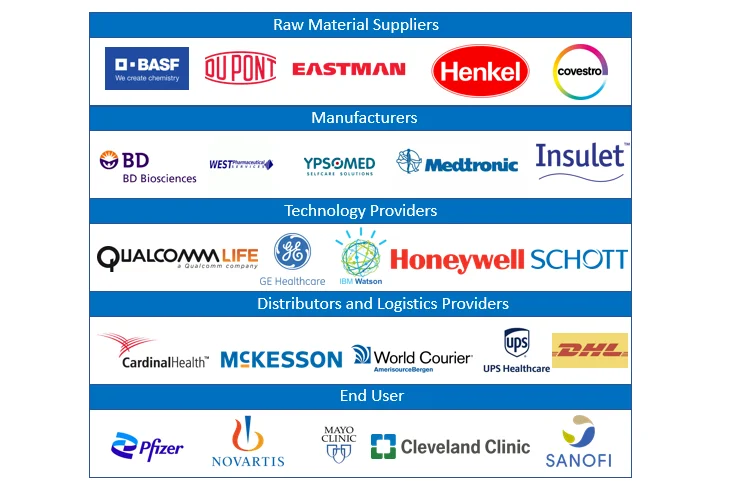
Wearable Injectors Industry Ecosystem
Wearable Injectors Market Scope: Inquire before buying
| Wearable Injectors Market | |||
|---|---|---|---|
| Report Coverage | Details | ||
| Base Year: | 2023 | Forecast Period: | 2024-2030 |
| Historical Data: | 2018 to 2023 | Market Size in 2023: | USD 8.67 Bn. |
| Forecast Period 2024 to 2030 CAGR: | 17.4% | Market Size in 2030: | USD 26.65 Bn. |
| Segments Covered: | by Type | On-body Off-body |
|
| by Technology Outlook | Spring-Based Motor-Driven Rotary Pum Expanding Battery Other |
||
| by Application Area | Oncology Infectious Disease Cardiovascular Disease Autoimmune Disease Other |
||
| by End-User | Hospital Clinic Home Care Other |
||
Wearable Injectors Market, by Region
North America (United States, Canada and Mexico)
Europe (UK, France, Germany, Italy, Spain, Sweden, Austria, Turkey, Russia and Rest of Europe)
Asia Pacific (China, India, Japan, South Korea, Australia, ASEAN and Rest of APAC)
Middle East and Africa (South Africa, GCC, Egypt, Nigeria and Rest of ME&A)
South America (Brazil, Argentina, Columbia and Rest of South America)
Wearable Injectors Market, Key Players are
1. Amgen (US)
2. Becton, Dickinson and Company(US)
3. Steadymed Therapeutics(US)
4. Therapeutics(US)
5. Tandem Diabetes Care, Inc..(US)
6. West Pharmaceutical Services, Inc.(US)
7. Dexcom, Inc.(US)
8. United Therapeutics Corporation(US)
9. Enable Injections(US)
10. Insulet Corporation(US)
11. Medtronic PLC(US)
12. Sensile Medical (A Part of Gerresheimer)(Germany)
13. Sensile Medicals( Israel)
14. E3D Elcam Drug Delivery Devices( Israel)
15. Bespak(UK)
16. Cequr SA(Switzerland)
17. Debiotech S.A(Switzerland)
18. Ypsomed(Switzerland)
19. Zealand Pharma A/S(Denmark)
FAQs:
1. What is the study period of the market?
Ans. The Global Wearable Injectors Market is studied from 2018-2030.
2. What is the growth rate of the Wearable Injectors Market?
Ans. The Wearable Injectors Market is growing at a CAGR of 17.4% over the forecast period.
3. What is the market size of the Wearable Injectors Market by 2030?
Ans. The market size of the Wearable Injectors Market by 2030 is expected to reach at USD 26.65 Bn.
4. What is the forecast period for the Wearable Injectors Market?
Ans. The forecast period for the Wearable Injectors Market is 2024-2030.
5. What was the market size of the Wearable Injectors Market in 2023?
Ans. The market size of the Wearable Injectors Market in 2023 was valued at USD 8.67 Bn.